Subscribe via:



Show Summary
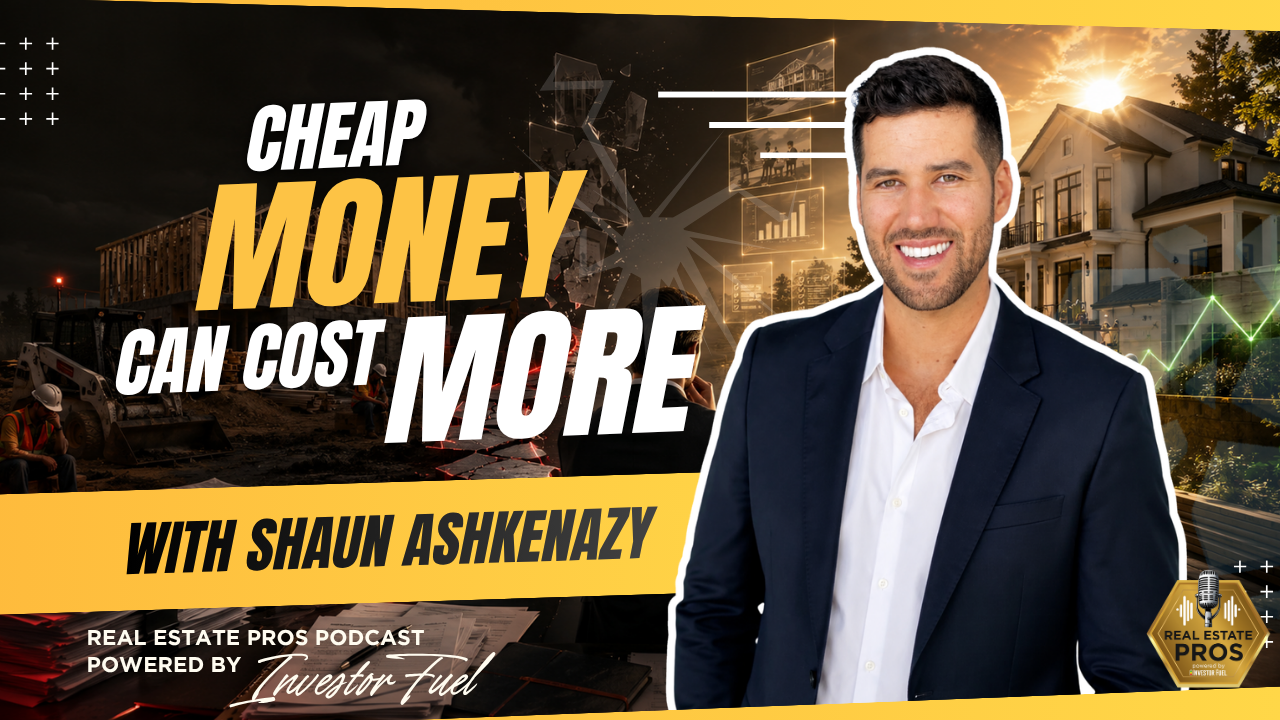
In this episode, Shaun Ashkenazy, founder of Lendyx and Onyx Funding, shares insights on private lending, deal structuring, and market opportunities. Discover how his boutique approach combines personalized service with institutional reach to navigate complex real estate finance.

Resources and Links from this show:
Listen to the Audio Version of this Episode
Investor Fuel Show Transcript:
Shaun Ashkenazy (00:00)
There’s certainly a few when we look at deals. One is we wanna be able to make a decision fast and protect both our time and our clients’ time, protect our reputation is something that is, always top of the list. We will never do anything or say that we will do something that we cannot do. And we pride ourselves in that, I think.
Building reputation takes a long time and it’s very easy to damage reputation. So that’s our guiding line in everything that we do.
Scott Bursey (02:06)
Welcome back to the Real Estate Pros podcast powered by Investor Fuel. I’m your host, Scott Bursey. Glad you’re with us. Today we’re joined by Shaun Ashkenazy, the founder and CEO of Onyx Funding and founder and managing partner of Lendyx. Shaun brings a wealth of experience in structuring complex capital stacks and commercial real estate debt advisory. Listeners, you can expect an insightful breakdown on how to safely navigate the bridge loan and construction capital markets
to fuel your next deal. Shaun, welcome to the show.
Shaun Ashkenazy (02:38)
Thank you, happy to be here.
Scott Bursey (02:39)
It’s awesome having you here, and to help our listeners get up to speed, please give us the ninety-second highlight reel of how your career ignited and where you’re pouring your fuel now.
Shaun Ashkenazy (02:51)
Sure. So right now I run Lendyx, which is a private lending company. We focus on construction, fix-and-flip, bridge, and DSCR financing, specifically for residential investment properties. So anything from one to four units, small-balance multifamilies, townhomes, stuff like that. So that’s Lendyx. We do around, I think this year we’ll probably be around the four hundred, five hundred million dollars in
origination volume. Prior to this, I ran Onyx Funding, which is a commercial mortgage brokerage. We still run it, although it’s not our main focus. And during that time closed about a billion dollars in loans across a multitude of different properties—investment residential properties that we’re focused on today with Lendyx, but also commercial properties like retail, hotel,
office buildings, et cetera. And during that time, obviously, being the middleman between borrowers and lenders and working with different borrowers from different places, working on different projects and working with tens of different lenders, it really allowed us to kind of see the process and the mechanics and the dynamics and what is
different between each lender, where their strengths are and where their obvious weaknesses are in some cases, and what makes a deal happen and also what—why deals will die. And really kind of being in the middle, advocating for our borrowers and really saving these deals from closing or not closing. And after doing that for about seven years, we’ve decided to basically take everything we learned and
put it into our own kind of firm and become the lender so we can basically continue to service our clients the best way that we can.
Scott Bursey (04:35)
That’s a fantastic and a fascinating journey, Shaun. Thanks for highlighting that insight for our listeners. And what really caught my attention about you was the way you’ve been able to bridge the gap between boutique advisory services and institutional-level capital reach, treating every single transaction with that personal touch. Expanding on that, interested to hear: What do you consider to be the core strength of
Lendyx funding when dealing with complex capital stacks and other firms that might be overlooking such things?
Shaun Ashkenazy (05:59)
Yeah, I think our strength is in—first of all, the data that we have and all the deals that we were able to work on and see over the years. Also being investors ourselves, being on the other side and experiencing what our clients also experience and knowing where the pain is, what they care about, because I’ve been in those shoes as well. So I would say
our focus or my focus as a whole and the company’s focus is to really provide the easiest, fastest, smoothest way to get a loan from submission to funding with the least amount of issues and problems and questions and stuff like that. And a lot of it is being able to underwrite these deals correctly and understanding the
macro and the micro and providing that kind of service. So anything from our ability to execute and service these loans after we close in terms of being able to provide draws as fast as possible as well.
Scott Bursey (06:58)
Speaking of the macro and the micro, how do you maintain that institutional reach while keeping the service boutique approach?
Shaun Ashkenazy (07:06)
So we focus on deals that are a little bigger than most other lenders in our space. The average in our space for other lenders is gonna be loan amounts that are around four hundred thousand, something like that. And then that becomes a volume game, right? So they have to do hundreds and tens of deals a month to—to get to the volume that they wanna be at.
Our ability to execute on larger deals—I would say our average loan size is about two and a half million. So we only deal with about 15 to 25, 30 deals a month. And that really allows us to give a lot of attention to each and every deal versus being spread thin across smaller deals.
Scott Bursey (07:48)
I appreciate you breaking that down, and want to dive into: What is a common weakness or gap you see in how real estate investors typically approach their financing, and how do you help them fix it?
Shaun Ashkenazy (08:01)
That’s a great question. I think today there is a lot of focus on pricing. And that’s a good thing to focus on, obviously, right? But the term sheet that has a quarter percent off or half a point lower from someone else doesn’t really matter if their draw process doesn’t show up, or if everything takes longer to close, or if those term sheets—
terms on the LOI are gonna change before closing. So, I wrote a piece about this a couple months ago called “Certainty Is the New Pricing.” And I would say that borrowers should put a lot more attention on whether that lender behind the term sheet is the partner that you want to have on the deal going forward
through closing and after it closes. Because any construction loan or fix-and-flip loan is essentially 15 smaller loans, right? You have to get draws in time and you have to work with that lender and your GC and your builder and your subcontractors as you’re fixing or building the home. And whether you got a quarter percent off on the rate from some lender that doesn’t really have their draw system or draw team built out correctly is going to turn out to be
way more expensive down the line. So I think the first question flippers and builders should ask your lender is, “Tell me about your draw process, and then let’s talk about whether we can negotiate terms on the—on the term sheet.” Does that make sense?
Scott Bursey (09:25)
Yes, draw process, absolutely. And building on that, what is the first thing an investor should audit in their own deal structure?
Shaun Ashkenazy (09:35)
Today, and it’s probably the same as most of the times, you want to know that your basis is good. I think today we are a little bit more in a buyer’s market versus a couple of years ago. There’s less transactions, there are less mortgage applications being filled out, there’s more houses on the market, houses sit longer.
So I think that creates a great opportunity for investors to enter the deal. However, I would put a lot more scrutiny on the exit because there is less liquidity, the mortgage rates are potentially gonna be higher for longer. So I would—I would put the focus on the entry and exit, as well as costs might change. In the next few weeks,
cost of mechanical equipment is gonna increase about ten to twelve percent. So, cost overruns and stuff like that are always something to focus on.
Scott Bursey (10:28)
Shaun, it’s always good to look ahead. Where do you see the biggest opportunity in the private lending space for investors in the next 12 months?
Shaun Ashkenazy (10:36)
Again, I think for investors to take advantage of a competitive lending landscape where they can maybe get better terms or work with lenders that can give them the right attention throughout their deal, and really find deals today that they can negotiate better pricing points on.
Scott Bursey (10:56)
Absolutely. And taking a look at the landscape, what is the biggest threat to capital markets right now in your view, Shaun, that every investor needs to be aware of?
Shaun Ashkenazy (11:06)
I think that there is a lot of new money coming into the space. There’s a lot of interest from institutional capital. And at the end of the day, all these companies are trying to grow. And some newer players come into the space, they might be more aggressive than others. They might approve deals that probably shouldn’t be approved.
Short term, that will allow borrowers to get financing or terms that they normally wouldn’t see. Long term, it creates—it could create a little bit of a—of a—of a bubble where you’ll get a term sheet today and that lender won’t exist to close that deal a few weeks after. We’re not there yet. It’s a speculation, obviously, of what I think might happen, but that is—that is certainly something to pay attention to.
Scott Bursey (11:53)
How does your debt advisory shield your clients from that specific volatility?
Shaun Ashkenazy (12:00)
I think we do a daily market review every morning here in the office. We all look at the news. We don’t just come in and bang the phones and try to get deals done. A big part of our culture is being well-rounded and understanding what’s happening not only in the real estate space, but the economy in general and
just the macro and the global—what happens on the global stage and how a rocket fired in the Middle East can affect gas prices here that will end up increasing rates. So we’re just trying to be aware of everything that’s happening that is affecting our space.
Scott Bursey (12:37)
I really value that candor right there. And Shaun, excited to hear, since you have a proven framework for blending bridge loans, senior debt, and construction capital, what is the one rule of thumb you never break?
Shaun Ashkenazy (12:52)
On construction or just in general?
Scott Bursey (12:54)
When you’re dealing—when you’re blending them all together—the bridge loans, senior debt, construction capital—what’s one golden rule, if you will, that you’ve learned to live by?
Shaun Ashkenazy (13:05)
There’s
a—there’s certainly a few when we look at deals. One is we wanna be able to make a decision fast and protect both our time and our clients’ time, protect our reputation is something that is always top of the list. We will never do anything or say that we will do something that we cannot do, and we pride ourselves in that. I think
building reputation takes a long time and it’s very easy to damage reputation. So that is what—that’s our guiding line in everything that we do.
Scott Bursey (13:40)
How does Lendyx’s direct balance sheet lending complement this to give investors a complete solution?
Shaun Ashkenazy (13:47)
So we are basically able to offer products across the cycle of a deal from acquisition, construction, or fix-and-flip for that matter, bridge financing, and then DSCR loans if they decide to keep those properties for rent. So we can really help people acquire, build, and hold their investment properties.
Scott Bursey (14:09)
That is such a critical distinction. And Shaun, interested to know: What has being in the right rooms with the right people—what has that done for your career, the impact on your business as it stands today?
Shaun Ashkenazy (14:22)
That’s a great—I think being in the right room with the right people has a ton of value, especially for founders early on and for people in general. That was not specifically my focus the first half a decade of building Onyx and building Lendyx. I just took a more hands-on, “I need to be focused and get
work done” versus trying to be in specific rooms. It could be the case that I missed out on a lot of opportunities, but that’s how I decided to divide my time. If someone has the opportunity to do that, I think there’s definitely value in it.
Scott Bursey (14:59)
That’s such a powerful way to look at it. Thanks for sharing. And Shaun, when it comes to locking in the best capital structure for a high-stakes construction project, what is the one hidden mistake investors make the most that costs them in the long term?
Shaun Ashkenazy (15:16)
I think a lot of investors look at cost of capital on paper versus, let’s say, cash-on-cash returns, and a lot of developers miss that specific number. So you’ll have a developer that goes get their construction loan from a bank and they get 70% loan-to-cost at seven percent or seven and a half percent these days, right? So definitely a better rate,
origination is obviously also a lot cheaper, but they have a lot more equity in the deal. So the sale price doesn’t change. The sale price, they’re gonna sell it for whatever they’re gonna sell it for. But how much money they have in the deal versus the cost of capital versus the cash-on-cash returns—if we can come in and give them 85% leverage and also finance interest reserves,
and our draw process will take two to four days versus a bank that can take three weeks so they can move faster and get the job done a lot faster, and our rates are not that much higher than a bank—we’re talking about maybe a hundred basis points or so, 150 basis points with the points another, let’s say one to one and a half percent—those costs kind of
are insignificant in the grand scheme of things where you only have ten, fifteen percent in the deal versus thirty percent plus carry plus all that stuff.
Scott Bursey (16:31)
I appreciate you highlighting that. And Shaun, you have given our listeners a lot of highlights and tips today. Any final words, thoughts that you could leave with our listeners?
Shaun Ashkenazy (17:26)
Any final thoughts? I think we’re in a very interesting time in the market. And I think for smart, sophisticated, patient, and aggressive developers, there’s a lot of opportunity, and I certainly hope to see people take advantage of it. And I think also it’s—it’s never too late to learn and we never learned everything that we need to know, and there’s a lot to know in today’s market.
So I would just say keep your eyes and ears open and an open mind, and let the deals come.
Scott Bursey (17:58)
That is some rocket fuel right there. And for those of our listeners that want to keep this conversation moving, stay in your lane, or collaborate with you on future deals, Shaun, what is the best way for them to plug into your pipeline and reach you directly?
Shaun Ashkenazy (18:11)
You can go on the website lendyx.com, fill out a form, or just pick up the phone and call us, and we’re always here.
Scott Bursey (18:18)
Shaun, thank you for joining us today on the Real Estate Pros podcast.
Shaun Ashkenazy (18:22)
Thank you very much for having me.
Scott Bursey (18:23)
And to our listeners, we appreciate you. If you received value from today’s episode, please subscribe. We’ll be fueling your tanks with a lineup of elite guests, like Shaun, who are accelerating and setting the pace for the rest of the industry. Until next time, keep your standards high and your vision clear. We’ll see you on the next episode, everyone.