Subscribe via:



Show Summary
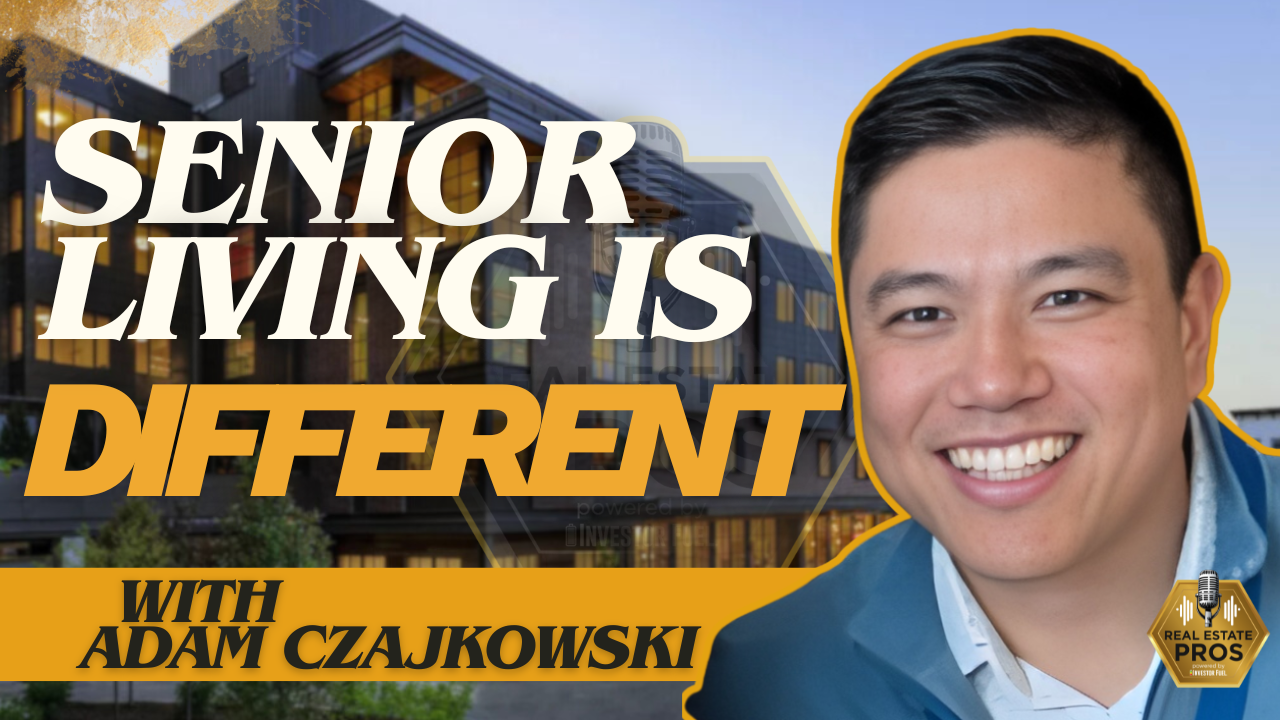
In this episode of the Real Estate Pros podcast, host Michelle Kesil interviews Adam Czajkowski, a commercial real estate investor specializing in senior living. Adam shares his journey from the W2 world to real estate investing, emphasizing the importance of networking, partnerships, and understanding the unique challenges of the senior living niche. He discusses the emotional connection to this field, the complexities of underwriting, and the significance of building relationships with passive investors. Adam also offers valuable advice for new investors, highlighting the importance of having a clear ‘why’ and focusing on the process of investing.

Resources and Links from this show:
-
Listen to the Audio Version of this Episode
Investor Fuel Show Transcript:
Adam Czajkowski (00:00)
Yeah, looking back, I’d say a couple things quick would be, definitely like you mentioned, start with your why, because that’s really what’s gonna keep you going. So that when things get tough, if you can go back to your why and the reason for doing this, it’s gonna help you push through whatever roadblock that is, as opposed to just throwing in the towel and giving up. ⁓ I think the other thing too is focus on the process.Don’t focus solely on the end result. If you can start falling in love with the process to get to the result, I promise you you’ll achieve what you wanna get to. Just fall in love with that process,
Michelle Kesil (02:10)
Hey everybody, welcome to the Real Estate Pros podcast. I’m your host, Michelle Kesil. Today I’m joined by someone that I’m looking forward to chatting with, Adam Czajkowski who is a commercial real estate investor. So excited to have you here today, Adam.Adam Czajkowski (02:28)
Yeah, no, thank you, Michelle. ⁓ It’s always an honor to be asked for any podcast or to come on and speak about experience and just be able to hopefully help someone else in their investing journey as well. So thank you for having me on.Michelle Kesil (02:43)
Awesome. Yeah, I think our listeners are really going to take something away from how you’re approaching the senior living space. So let’s dive in.Adam Czajkowski (02:53)
Yeah, absolutely. Yeah, I guess quick about me. was in the W2 world in sales. I still technically am. But as soon as like 2020 hit, being in sales, I saw a big dramatic drop in my income because the world kind of came to a halt. So that’s when I got into investing in real estate, started with single family and realized in order to really scale up and for you toMichelle Kesil (02:57)
Sure, go ahead.Adam Czajkowski (03:22)
create that financial freedom, the ability to leave your W-2, you needed to really find more of a business in it. And that’s kind of where I landed on the commercial side about maybe a little over a year ago. And it’s all about really getting around with the right people, the right rooms, because really that’s really what’s gonna help accelerate your growth, help you really achieve where you wanna go. So over the past year, I’ve been focusing really onyou know, the commercial space, as you mentioned specifically, senior living, assisted living, as well as residential treatment centers. So they kind of go a little hand in hand with a lot of the way you’re underwriting deals, the way you’re looking for deals, the demand, the need for it. So some similarities and just kind of aligned with some of the partners I’m working with.
Michelle Kesil (04:09)
Yeah, absolutely. So why did you choose this niche specifically?Adam Czajkowski (04:15)
Yeah, no, it’s very interesting, right? Because no one ever says, I’m gonna go into senior living, right? It’s a very kind of niche investment and kind of very off the beaten path, so to speak. So originally we were focusing on multifamily and some of the deals were just hard to pencil out. They weren’t really cash flowing great. The returns to the investors weren’t strong. The market had shifted and…I got around some people who is one of those things that kind of hit with my reticulated active system when you hear the word and it got brought up and I just kept hearing more and more of it. So I said, you know, this is kind of interesting. Let me look into it more. Spoke to a lot of people who in it, did some research and
really interested me for the first time outside of something for myself. I think a lot of investors will tell you to, know, you also want to find eventually a purpose that’s bigger than yourself.
And really the assisted living kind of struck that chord for me because it hit like a lot of emotional ties because I’ve remembered as a kid putting our grandparents in one and you just remember as a young kid how much it stunk to get older. You really hated the fact that, it does not seem fun. And understanding that and knowing like it’s hit me in a personal way, but also knowing that, hey, no one’s…
going to be able to escape that if you’re fortunate enough to live that long. And we’re all going to need that type of care at some point. understanding that there was a demand and a lack of supply, but also kind of giving me more of a purpose outside of my financial freedom, my family’s. ⁓
financial wealth and future, I saw that there was something else there to it. So that’s kind of what drove me into it for a higher purpose than myself and also being able to help a need in such a great opportunity over the next five, seven, 10 years.
Michelle Kesil (07:02)
Yeah, absolutely. And what markets are you operating in?Adam Czajkowski (07:08)
So right now the main focus is Florida. We also focus on certain parts up here in New England. ⁓ So it’s very niche in regards to the number of opportunities that are out there. ⁓ There’s a lot more different regulations and understanding when it comes to underwriting with these deals. So we’re very focused right now in those markets.Michelle Kesil (07:36)
Awesome. What do you feel are some of the main keys that have made the biggest difference in allowing your business to be able to grow and to run smoothly?Adam Czajkowski (07:48)
It really comes down to partners for me. Five years ago, looking at assisted living facilities or even commercial in general that were 10, 20, 30 million dollars to acquire, it just seemed early on as an investor that that was ⁓ a planet away from me. It was just so far off the mark that I’m not even close to that. But once I started getting aroundlike-minded people, the right people, it helps your mindset. It really helps you think bigger, faster. And getting around those right people and finding the right people to partner with really has kind of brought that feeling of, okay, this is on a different planet to like, okay, now it’s right in the neighborhood. This is totally doable. We can make this happen. We have the right pieces to the puzzle ⁓ to do that. And I think when you start limiting yourself on the mindset,
It really does open up a lot more doors, especially getting around, like I mentioned, the right people to do deals with.
Michelle Kesil (08:54)
Yeah, absolutely. How have you found who the right people were? there, do you find them through networking or any specific way?Adam Czajkowski (09:02)
Yeah, it’s definitely all about networking. It’s going in person, you know, because I think, you know, that’s key to really get to know somebody on a personal level. But also mentorships. ⁓ You know, again, I think it goes down to the right mentorship, joining the right group. There’s a lot of great ones out there, and it’s really about finding the one that really is going to be a good fit for you. And for me, that really comes down to like a feeling of community, a feeling of.people are here to help one another no matter who they are. You know, one of the groups I’m in on the commercial side, you know, it’s been fantastic because, you know, you’re around people who have.
significant networks above me, but they’re willing to bring people along, willing to help people along the way. And I think when you get in with the right groups, right networking, ⁓ and you’re out there taking action, bringing value, being a go-getter, but also someone who wants to give back,
I think it just ultimately attracts the right people, if that’s kind of the attitude and ⁓ action you’re taking yourself.
Michelle Kesil (10:45)
Yeah, absolutely. What are some challenges that you’ve experienced in this niche?Adam Czajkowski (10:55)
Yeah, and this niche, it’s challenging because you’rewith a lot of things that you’re not used to on underwriting. ⁓ If you’re talking like multifamily, in general, depending on the asset, ABC, where the market is, to do quick underwriting, you want to figure, it’s 50 % expense ratios. On the senior living side, you’re at least accounting for 70%. And that’s just due to the fact of
staffing being pretty much your number one expense. And that could be anywhere from 40 to 45 % of your expenses. So if you don’t have the right staff in place, if you don’t know how, if you don’t know to have the right team in place, the right people operating, that’s a big crucial part to your operations. I think the other challenging thing too is unlike an apartment complex that says, say it’s 50 units, 25 or one bed, 25 or two bed,
For the most part, you understand what the market rent is for each of those. With assisted living, those can be branched off in many different ways. And what I mean by that is with assisted living,
you could have a one bedroom, but it could also be shared. It could also be a memory care room. It could be a spouse room. ⁓ It could be a studio size. It could be a deluxe suite. Like there’s so many ways for those to be branched off. So you have to be really careful with your underwriting. You don’t want to get overly…
aggressive on that. You want to be very conservative and realistic and you want to make sure the expenses that you’re accounting for really do make sense. It’s sustainable and you underwrite these properly. So I think that’s a really big thing to understand when you’re dealing with assisted living and knowing that you really need to have the right operator in place similar to property management.
Michelle Kesil (12:46)
Yeah, absolutely. So are you like planning out the whole property, like finding the tenants and the managers or how does it work?Adam Czajkowski (12:57)
Yeah, so I think that’s another good thing that I’ve really loved about working with people. You know, when you’re in the commercial side, it’s not just one person. You know, you’re working with what’s called the general partner team, the GP team, and each member has their own strengths. And I think what is great about it is if you find the right group, everyone’s going to complement each other in the areas that maybe they aren’t so strong with. For me, my background in sales, I found the ability to really go out and talk to brokers.talk to sellers, ⁓ discuss capital opportunities with investors. So really on the acquisition side and acquiring investors has really been my strong suit where some of my partners, ⁓ one’s more on the underwriting side, they’re kind of joking a little bit more introverted. So they actually just like writing the numbers, doing more of the backend stuff. And then we have someone who’s been in the senior living space for about 17, 18 years and have operated. ⁓
about like 50, 55 different facilities. So, having all those skills and ⁓ different team members are really what bring it together. that’s going back to me, that’s where, again, I wouldn’t have a lot of experience with operating the facility. So that’s really why it’s crucial to have the right team in place because you each bring certain skills together that bring everything of the deal together.
Michelle Kesil (14:24)
Yeah, definitely. What are you most focused on solving or scaling to next in your business?Adam Czajkowski (14:34)
Yeah, mean, scaling, you’re always trying to look for the right deals, the right acquisitions for your team, but more importantly, your investors. So for me, ⁓ what I think I’m trying to scale and solve is going to be more solving problems for two people. ⁓ Aside from our team, it would be this problem for the sellers. You’re getting people who are looking to sell, who are looking to get out of that asset class.It could be for a variety of reasons. Maybe they’re retiring. Maybe they just don’t want to be involved anymore. Maybe they’re whatever it is. So we’re looking to solve the problems there for those sellers. And then on the other side, know, most of our passive investors, they’re looking to solve problems in their own way. They’re looking to find problems to solve in the financial freedom, buying back their time. So they’re investing with us maybe because they want their money to work harder for them.
They’ve lost ⁓ faith in the system, the 401k, working a job for the next 40 years. Whatever that problem internally is for them, we’re helping to solve that so that they can again make their money work harder and hopefully attain and achieve their own definition of their financial freedom and being able to buy back their time.
Michelle Kesil (16:37)
Yeah, definitely. So how do you partner up with these passive investors?Adam Czajkowski (16:42)
You know, it’s one of those things that everyone says capital raising, I think scares off a lot of people. But when you have the right understanding of what capital raising is, it really isn’t a scary thing. partnering with passive investors can be anyone almost. And, you know, most people think, oh, well, the reason I don’t like is because they picture someone panhandling, you know, asking for money. Hey, bring money to my deal, bring money to my deal. And when you really understand what it is, it’s not like that.It’s really, again, going back to what you said, you’re solving someone’s problem. You’re helping guide them to other avenues to invest. And I think it starts with, you just have to talk to people about what you do. Ask them what they do. Ask them about themselves, what their goals are. And it kind of leads into an organic conversation of maybe being able to solve their problem. ⁓
But I think also too, as a good capital raiser and an investor, have to also understand that not every person looking to deploy money or invest may be a good fit for you and your deals. If someone’s looking to make quicker money and turn it around in five, six, seven months, being one of our partners may not be the best fit. So I think you really have to find your, as a capital raiser, really be.
realistic about who your ideal customer is, about who your ideal partner is on the passive side, and then look to solve their problems ⁓ as well. So I think it’s just not something you say, I’m looking for money. Hey, you’re a partner. You really kind of have to do a date before you’re married type situation.
Michelle Kesil (18:23)
Yeah, definitely that’s important. So what goals do you have for where you want your business to head to?Adam Czajkowski (18:33)
Yeah, goals are always going to be partnering with the right people, doing deals, because that’s just so fulfilling knowing like, hey, as a group, we’ve brought this project to fruition. We’ve achieved ⁓ an acquisition with some great opportunity for not just us as the general partner team, but also for limited partners on the passive investing side. ⁓ So really the goals are to continue to do strong deals.bring back passive investors as I call it repeat customers, and to ultimately, for all of us, we’re just trying to look for something outside of having to work a job for the rest of our lives. Not being able to retire because that landscape is changing. It’s not the same as it was 30 or 40 years ago. So being able to achieve that, everyone’s own definition of their financial freedom.
doing it for their internal why, whether that be to go on more vacations, travel the world, spend time with your family, leave something for your grandkids and their kids to create that generational wealth. I think we all have our own why. And I think that’s really where it has to start when you’re an investor.
Michelle Kesil (19:49)
Yeah, I think that’s so important to come back to the root of your service.Adam Czajkowski (19:54)
It does because everything we do, this is not easy. There’s days where it’s extremely tough, where it really is that tip of the iceberg where only people on the outside see that tip of success of, hey, they don’t work anymore. They have financial freedom. They have this or that, but they don’t see that below the water surface of everything that goes through there, of the continued failures of the things that keep you up at night, all those challenges, every investor who’s been doing it.will tell you that, it’s part of the game, it’s part of growing. To get where you want to go, those are the things you have to do to achieve it.
Michelle Kesil (20:32)
Yeah, what’s some advice you could share to maybe people that are just getting started or are newer in the investing world?Adam Czajkowski (20:38)
Yeah, looking back, I’d say a couple things quick would be, definitely like you mentioned, start with your why, because that’s really what’s gonna keep you going. So that when things get tough, if you can go back to your why and the reason for doing this, it’s gonna help you push through whatever roadblock that is, as opposed to just throwing in the towel and giving up. ⁓ I think the other thing too is focus on the process.Don’t focus solely on the end result. If you can start falling in love with the process to get to the result, I promise you you’ll achieve what you wanna get to. Just fall in love with that process,
live in the moment, and everything else seems to always take care of itself if you’re doing the right things.
Michelle Kesil (21:25)
Yeah, absolutely. And maybe what’s obstacle that you faced? And now looking back in hindsight, you can see the lesson.Adam Czajkowski (21:37)
Yeah, I think for me looking back, one of the obstacles I faced was just understanding early on, as an investor, there’s two things to it. There’s the money you have to replace right now to achieve the ability to quit your job or maybe live life the way you want it to versus the future wealth, is building for tomorrow. So as an investor, really have to…draw out your blueprint and your diagram of as to what your goals are. Because if your goal is to achieve the ability to just leave your W-2, work on this full time, then you have to start focusing on activities and goals that are going to help give you that now money as I call it. Whereas if you’re looking to just maybe build wealth for 10, 20 years from now, that could be a different plan. So I think you really have to understand what’s gonna help you achieve.
both of those. ⁓ Ultimately, you want both, but there’s people who I know in investing that love their W-2 that really have no intention of leaving it. So they’re more in the mindset and the path of creating tomorrow’s wealth and holding on ⁓ assets, whereas other people I know want to quit their job as quickly as possible. So I think just understanding those two different sides to it and just drawing out your path to where you need to go.
Michelle Kesil (23:00)
Absolutely, thank you for sharing that. So before we wrap up here, if someone wants to reach out, connect, learn more, where can people find you?Adam Czajkowski (23:10)
Yeah, would say Instagram’s usually probably the easiest thing, know, in LinkedIn, ⁓ being on the commercial side, those are two really good platforms to, you know, be able to talk about what you do, you know, talk about ongoing deals, talk about things you’re learning, hopefully pass something along to somebody else, as well as LinkedIn has been a great way to meet some potential investors and ⁓ limited partners in deals. So.Yeah, try and be as actively as I can. ⁓ yeah, just it’s a great way to connect and find people like that.
Michelle Kesil (23:43)
Yeah, thank you for your perspective and for being here.Adam Czajkowski (23:48)
Yeah, of course, Michelle, I appreciate you having me on.Michelle Kesil (23:50)
Of course. And for those tuning into the show, if you got value, make sure you’ve subscribed. We’ve got more conversations coming with operators who are building real businesses, and we’ll see you on the next episode.