Subscribe via:



Show Summary
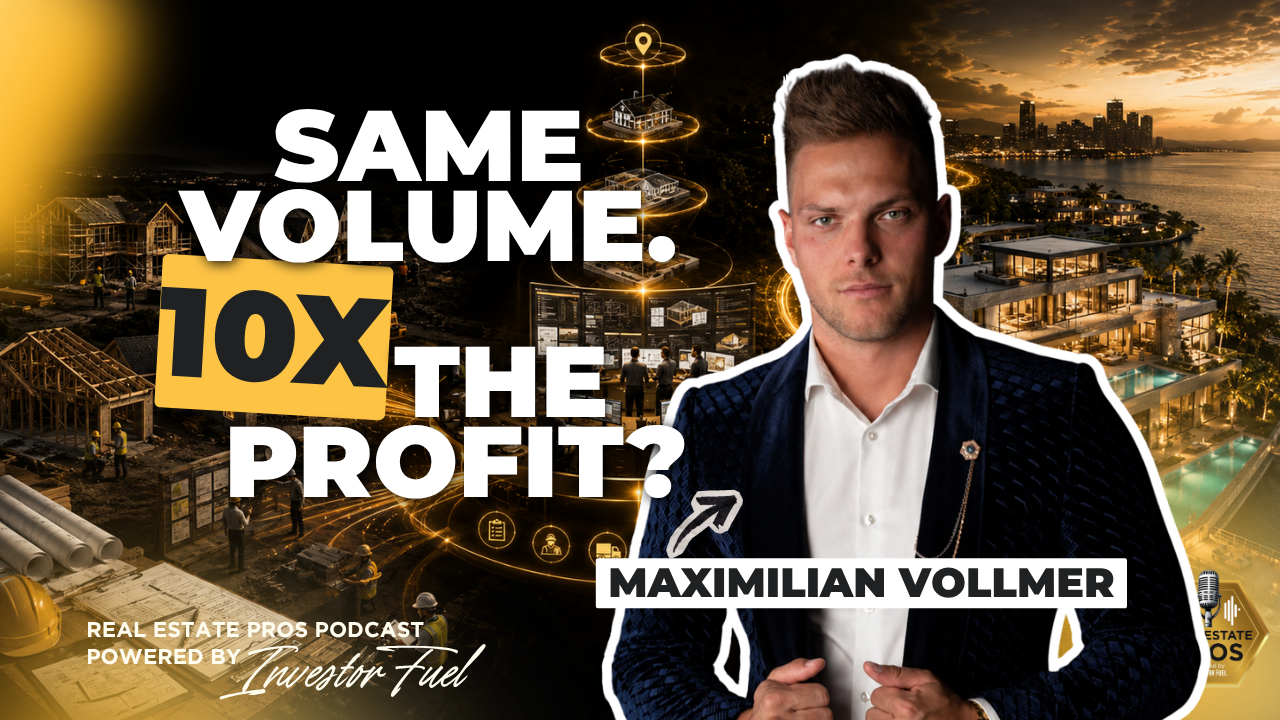
In this episode, Max shares his inspiring journey from starting with just seventy-six dollars to building a multi-million dollar real estate development business in Florida. He discusses market opportunities, challenges, team building, and the mindset needed for success.

Resources and Links from this show:
Listen to the Audio Version of this Episode
Investor Fuel Show Transcript:
Maximilian Vollmer (00:00)
So entrepreneurship is the only option. So we jumped into real estate after looking at all the other options because it just was the one that made the most sense. And we didn’t know anybody. We had no background in real estate, nothing. It was even before AI and like all that. It was like just reading books literally about it and watching whatever YouTube videos were accessible. So today it would be a lot easier. But started that way, started going into wholesaling.
I told myself if we can make $100,000 in one year wholesaling, I will not focus on getting a degree. It took us less than two months to make a hundred thousand.
Joseph Crooms (01:26)
Hey everyone, welcome to Investor Fuel Real Estate Pros Podcast. I’m here today with Maximilian Vollmer. And listen, I told him he likes to go by Max, but I said, man, with a name like Maximilian,
I know you’re gonna have a lot of good things to present to our audience. So my name is Joseph Crooms. I’m your podcast host. I’m here to introduce Max. Hey, Maximilian, say hello to everyone.
Maximilian Vollmer (01:52)
Hello, thank you for having me.
Joseph Crooms (01:53)
Hey, it’s my pleasure. So Max, let me dive right into this, man. So first of all, for people who may not be familiar with your world, give us the short version. What’s your main focus these days and what markets are you in?
Maximilian Vollmer (02:08)
Yeah, so we are focusing on real estate development, you know, spec for-sale, luxury, townhome developments, branded residences, and we do some very isolated, location-driven trophy asset short-term rentals that we build and then refinance, convert, and—and rent out. Usually beachfront, waterfront type of high-end homes. And our markets: Tampa Bay, St. Pete, Sarasota, so Florida.
Joseph Crooms (02:28)
Are you thinking about stepping outside of your market zone?
Maximilian Vollmer (02:31)
Not at the moment. You know, I’ve had this discussion with myself many times, but Florida is hot. And our market right now is very, very hot. There’s a lot of construction happening. A lot of hedge funds are moving into our market, and branded residences are starting left and right. So I don’t see a need for it because, obviously, it’s a different complexity. Just being local is a complexity by itself, but being away from it—we have a project in—and out of state, and that one is—is more challenging than one that you have here. You can drive by, check on things. So
I don’t think I have a need in the next five years. There’s plenty of work to be done here in Tampa Bay.
Joseph Crooms (03:01)
You, Maximilian, when you—you caught my attention when you said, “Hey man, we grew faster than we imagined.” Tell me about that story.
Maximilian Vollmer (03:07)
Yeah, man, it’s—it’s a journey. But my wife and I, we started real estate in 2020, January seventh, 2020, seventy-six dollars to our name. I was still—initially, when I met my wife before we started real estate, I was a professional track and field athlete competing for Nike and World Championships. I was in the top eight in the world, but there’s not a whole lot of money in track and field, unfortunately. And we lived back in Oregon back then because I was competing for Nike. Nike headquarters was in Oregon, so different than Florida. So when COVID hit,
everything was shut down. So my wife was working as a server. We were both still in college. We met in college, got married in college. So I didn’t make any money. Obviously, as a college athlete, she was working as a server. And you survived the bare minimum needs. And then when everything stopped, I couldn’t compete, she couldn’t go into restaurants, everything was closed, we were running out of money. And eventually we literally had seventy-six dollars. And—and when everything started, because I was like, “It doesn’t even matter. We can’t even get a job,
even if you wanted to, because everything is closed.”
So entrepreneurship is the only option. So we jumped into real estate after looking at all the other options because it just was the one that made the most sense. And we didn’t know anybody. We had no background in real estate, nothing. It was just based—and it was even before AI and like all that. It was like just reading books literally about it and—and watching whatever YouTube videos were accessible. So today it would be a lot easier. But started that way, started going into wholesaling,
told myself if—if I can make $100,000 in one year wholesaling, I will not focus on getting a degree. It took us less than two months to make a hundred thousand. We
doubled down and then within our first year, we did 165 wholesale transactions. We scaled our business to seven states. And then our last year in college, we then transitioned as well from wholesaling to fix and flips. So we did wholesaling in seven states, and two of those states, we did fix and flips as well. We hired local project managers and realtors to oversee it.
So we did a bunch of fix and flips, eventually focused everything into Florida because everyone was migrating to Florida. Florida was a hot market. So we doubled down on Florida and moved down here after college, built a team of 35 employees to basically do five to seven fix and flips a month. So we doubled down very heavily on fix and flip renovations, eventually tickled in some apartment syndications. So we—Class B apartments, renovated, syndicated, and resold again.
And then the market eventually shifted, right? Interest rates went through the roof. But with that, also our market locally shifted a lot into ground-up construction, cause when we first started fixing and f—fixing and flipping here, rarely any new construction was happening. And then rates went up and all of a sudden construction came in, zoning changed, hedge funds started to come in. And now we’re very much a new construction market. So that was like the pivot a few years back when we then came in and said, “Let’s move our operation 100% into construction, focus on acquiring
properties that are about to be rezoned from single family to multifamily or, you know, condominium rezonings.” And that’s what we did. We started just raising a bunch of money, acquired a huge portfolio, and now essentially, you know, building that $125 million construction portfolio that we have raised on over the last few years.
Joseph Crooms (06:46)
I want to ask you more about that, the construction industry. What would you say your book of business has been in the last year? What is the volume? What’s the revenue monthly?
Maximilian Vollmer (06:56)
Monthly or annually?
Joseph Crooms (06:57)
Let’s just—let’s say monthly.
Maximilian Vollmer (06:58)
I think monthly is tough, right? Because like construction is like a cycle. There’s like months where we have zero, depends on like what’s the offload cycle. I would say over a course of a year and like a net revenue, we sell probably like forty-five to sixty million dollars in real estate.
Joseph Crooms (07:10)
Okay.
Maximilian Vollmer (07:11)
That is like a twenty percent-ish profit, eighteen to twenty percent profit margin.
Joseph Crooms (07:15)
Okay, so now you were—you were flipping homes and you—now the construction company, what is the first thing that you were gonna attack when you started developing the instruction—the construction company? What’s the first thing you’re—
Maximilian Vollmer (07:29)
Yeah. Capital.
Joseph Crooms (07:30)
Okay.
Maximilian Vollmer (07:30)
And building relationships and raising capital, yeah.
Joseph Crooms (07:33)
So you got the capital now. What’s the next piece of equipment or personnel? Talk to me.
Maximilian Vollmer (07:38)
The next step is really what’s the most important thing about all that, and I think in real estate itself is like getting to be an expert of your local market, like really understanding what zip codes matter, what people buy in those zip codes, what’s the future upside going to look like, what is the city doing, rezoning, repurposing, really learning that. And then the way you look at the map is going to be a lot different. And that’s what’s making a good developer. You don’t just like buy, build, do something because you like the idea of it; you do it because there’s a strategy and it’s—it’s purposefully
designed to a certain outcome. So that is the most important thing. Is that—that’s why I’m saying it’s so complicated going into a different location, because you got to redo everything, build all the connections, relationships, understand your market, go to the city meetings, understand what the city is going to do in the next five years. So that—raising capital, really knowing your things is the most important thing. Everything else can be outsourced. You can find GCs, you can find subcontractors, permit people, all the good stuff. You don’t have to get good at that
if you don’t want to. But finding your good deals and finding the money, that’s the one thing nobody will do for you and—and gonna make or break it.
Joseph Crooms (08:38)
Max, let me ask you a question. I’m gonna call you Max, it’s just easy, it rolls off smooth. But I know your name is Maximilian. You’re making millions. Let me ask you this. Do you have a—a real construction company? Do you have equipment?
Or do you—and you have a property management team? Are you like a one-stop development, one-shop, you—
Maximilian Vollmer (08:57)
So now—our—we started as developers, you know, outsourcing everything, hiring general contractors, and we obviously realized that there’s not a whole lot of good GCs out there and everyone kind of struggles with the same thing. So we eventually integrated that arm into our division of just self-performing certain products where we have our own GC license, we have our own project managers, own permitting, own quality control, own designers, own procurement, the whole process. So we—we handle everything from a GC perspective.
We don’t necessarily have equipment because we obviously then still outsource subcontractors. So we hire a shell contractor to build the shells. We don’t have the equipment there, but pre-negotiated master agreements through volume to really lower the vol—the cost of construction as much as possible. And you know, handling everything from acquisition, permitting, to construction, design, sales. So we—we can fully perform everything from A to Z, or we can also outsource. And we—we outsource in certain areas, certain projects just because of
sometimes the location or just like availability of human capital, we sometimes outsource and have somebody else build it for us. We still do that, but conceptually we do most of it in-house, yeah.
Joseph Crooms (09:56)
What type of partnerships do you have? Do you—some—and before I even answer that question, you have to table, is it a bidding process that you—do you have to compete that way to get the actual—the development?
Maximilian Vollmer (10:08)
So you mean us like competing to—to pitch jobs?
Joseph Crooms (10:11)
Yeah, so it—a couple of developers got their eye on the same property. How do you—how do the city make a decision on which development company to use?
Maximilian Vollmer (10:21)
Well, I guess these are two different things, right? So we—we’re not doing like big projects that are awarded by the city. So you can do that. Like the city says, “Hey, here’s ten acres that we—it’s our land. We want somebody to build it,” and you can apply for that. We don’t do that, right? We acquire, z—rezone or have the zoning in place, design, and build. So we don’t do like the big commercial projects that—cause we wouldn’t even get them awarded. We don’t have the resume of what the city would like to see, right, when they award those things. And usually we’re talking like multiple hundred millions to billion-dollar type projects. So we’re doing
multi-million dollar houses. We’re doing up to right now fifty, sixty million dollars, like the biggest single project that we’re doing. So there’s no award process. It’s more so like you do the due diligence, you find the lot, just like any other real estate investor, flip or wholesale, whatever, and then you just take it through a different chain of completion. You don’t flip it, you just bring it all the way through the finish line.
Joseph Crooms (11:09)
How long do you normally keep the finished product?
Maximilian Vollmer (11:12)
Every project is different depending on municipality and depending on what you’re doing. So, you know, single families obviously go faster than townhomes, any sort of bigger type development. Single families can go from twelve months to eighteen months depending on municipality, and multifamily—so, like when you say multifamily fast, it’s more like, you know, townhome type developments—they go three to four years. Different permitting process, much bigger construction.
Joseph Crooms (11:34)
What’s considered a B? I heard this before, the A, B, and C. What’s Class B that you—that you say you look for?
Maximilian Vollmer (11:40)
So we don’t do B. We only do A. That’s one thing that in our business, we focus location first, cause the one thing I think is, you know, whatever happens to the market, if the location is good, there’s always going to be a value and there’s always going to be a buyer. So we—we pay a premium for the lots that are really in the location. When we—when we do townhomes, it’s about walkability to amenities, walkability to downtown, you know, downtown core.
And when we do single families, it’s either like, you know, high-end neighborhoods, direct waterfront, or Bayview top homes, right, that have itself a quality. So that—that’s what we focus on. Obviously, there is money to be made in like B/C locations or B/C homes. We’ve done it. At the end of the day, it’s—it’s like the way I look at it in single-family residential development, for most of us, it’s always the same, right? If you’re doing—if you’re doing it correctly, you’re making 15 to 20 percent on the back end
of your resale value. So if you sell a house for a million dollars, you make 150, 200k. That’s cool. If you’re selling a house for five million, now you’re getting closer to a seven-figure return on a single product, and it’s still taking you 14, 18 months, right? Plus-minus two months. So yes, there’s a little bit more risk, right? The construction numbers are higher, it’s a different execution. But when you talk about scalability, the—the net effort you’re putting in as a business operator is very much the same. So you can pick making half a million or making five million,
building the same amount of volume, just focusing on different locations. And that—that’s what we decided, right? We started with some of the cheaper houses, B locations, because we always thought about this: If it doesn’t work, we’re just gonna refi, rent it. That is a very like weak mindset, right? Because you do the right project in the right location, it’s gonna work. If you’re already like scared that it’s not gonna work and you have to rent it, you probably should think twice, right? That you gotta buy the land for a price that is just way below value, perfect location, perfect concept,
building a very strategic house that is value-engineered, that feels very expensive, at least in our scenarios. And it’s just the execution, the branding. We do brand with brands, I guess. We have a like multi-million company, Poliform, those type of companies we brand with. And we do branded residences. So another layer of creating a huge value upside here in your local market.
Joseph Crooms (13:40)
What’s been the advantage in starting your business of being married to your partner? Let us peek into a little bit of how you’ve managed each other, how you helped each other.
Maximilian Vollmer (13:51)
Yeah.
You know, I’ve seen it from one end. I—a lot of people have their opinion. There’s people that just do not want to work with their partners and want to keep things separated. I think for us, it was like there was no choice. We had both nothing, and like we both had to work. So we—we really started as a team, and we never not worked together. So, and there’s good things and bad things about it. You know, good things are, you know, we—we complain when the other guy is busy. Like there’s nights we are both working up until 1:00 AM, and like
it’s not like one is going to bed at nine. It’s like, “Caitlin, come to bed.” But then it’s also the bad thing, we never stop. Like we go on vacation, we’re both just like on the phone, and business doesn’t stop. But at least it’s like there’s this continuous support. I think what’s very important is in business specifically, at the end of the day, like business relationships here, there, you can never trust anybody really like your husband, wife, or family, right? So when it comes to really like—
sometimes bouncing these ideas back, but having somebody that really understands it and is kind of in the weeds and maybe sees this neutrally, is very, very valuable. And that’s like our core. Like we do everything together, we manage the business together. We all have our own roles and responsibilities, of course, so we don’t step on each other’s toes. But—and we had to learn that at the beginning, right? There was this like learning period of, “This is what you’re good at, this is what I’m good at. Let’s not step on each other’s toes, let’s help each other.” But once you get there and you view this as a passion,
it’s—it doesn’t feel like a job, right? For us, it just feels like a passion. That’s what we are. We are entrepreneurs, we’re running that business, that’s our baby that we’ve built from—from day one. And it’s rewarding just to see the things that we’ve accomplished and then sharing that success. You know, we just bought my wife’s parents a house to relocate them to Florida. And to be able to do that at a young age, just buying somebody a house to—to move and—and live for free, is huge. So that’s these like returns that you’re getting for working as a team and then seeing those fruits come to fruition.
Joseph Crooms (15:33)
Thanks for sharing with me, Max. So Max, well, what’s—what’s your wife’s name?
Maximilian Vollmer (15:37)
Caitlin.
Joseph Crooms (15:37)
All right, so what is Caitlin good at? What’s Max good at? And when did you say, “Okay, you gonna handle this, I’m gonna handle that, and when do you have to talk to me about that?”
Maximilian Vollmer (15:48)
She’s very creative. So she handles a lot of the design. We have a concept, like I do the initial analysis, numbers. She does a lot of the design. And that’s good, because I’m not, by all means, a designer. I’m also the number person, and she’s very bad with numbers. So we—we like the perfect medium. When it comes to like relationship building, she’s the one that really like builds the relationship, builds the emotions. I’m the one that talks numbers, negotiates, goes, you know, into serious discussions. So that’s—
depending on who we need to talk to or what’s our strategy, we send one or the other. It’s like, “Hey, you build this relationship now, make them feel fuzzy. I come back and we negotiate.” So we have like pretty much opposite ways of addressing things and thinking about it. But she’s also like, obviously, now we have a newborn, so she’s a mom mainly. So that’s really her main responsibility. She’s stepping out more and more from like day-to-day operations and just focusing on raising our daughter. But up until we had her,
she was, you know, much involved in it.
Joseph Crooms (16:41)
Great. First of all, congratulations to both of you guys. Let me ask you this. So what’s been the biggest difference on when you were—not getting the deals, but building your team? “We need this person first. We need this one second.”
Maximilian Vollmer (16:56)
Challenging, and it still is. You know, that’s the one thing. I’m 27, right? So then my—all my employees, most of my employees’ kids are older than me. So that—that itself is a very—
Joseph Crooms (17:04)
Mm.
Maximilian Vollmer (17:05)
complicated circumstance. But you don’t learn in school how to build a team, how to re—how to manage people, how to manage emotions, how to keep things organized. So it’s probably the single most challenging thing as an emp—entrepreneur. But it’s always easy to do—to do the work yourself.
But outsourcing and outsourcing it correctly, where you don’t just hire unvalid—you—you hire somebody just to waste money, doesn’t get any sort of done. So that—it was very complicated, you know, very, very complicated to—to do that correctly. And we failed multiple times. We hired wrong, completely had to rebuild our process, because you don’t know until you learn it the hard way, right? I think that’s the thing of like how to hire, who you need to hire, what are the qualifications you need, and like
how do you set a—a ground where they keep you serious, even though you’re much younger and they don’t feel like they should, you know, educate you? So it’s still a learning process. I don’t think like we—we’re actually like perfect at that, but we’ve gotten better by failing. Failing running a team, failing running operations, failing organizing, cause the biggest single challenge is when—when you transition from a solopreneur to a team, is you still do a lot of the stuff yourself.
Now you have people you’re onboarding. So now you’re doing two things: You do all of it, plus you train everybody and you help everybody. So you just feel overwhelmed. And that’s natural. Eventually, you have to transition where you sit above and you just dictate in a way where issues get accelerated over to you. You make coordinations, you bring people where they need to be to finish things, but you’re not actively working on a day-to-day and get sucked in, so you’re doing somebody else’s work. So you have to completely get yourself above that, where you focus on the roles and responsibilities that CEO or COO needs to do.
And that takes time, right? So that—that solopreneur to that portion where you actually have a business is very, very painful. It feels not rewarding because you feel like you’re just spending more, making less, you know, money and time. And eventually it turns, but eventually you get a good team and all of a sudden you start breathing, and it gets to a point where now you can actually build a company and focus on the things that the executive suite should be doing.
And things start, you know, growing. That’s where you get the exponential growth and really go from a million-dollar year to ten-million-dollar year, because you have people, you leverage money, you leverage technology, you leverage employees to scale. And there’s a huge value. You have 10 people working 40 hours a week, you have 400 hours of work that you don’t have to do, that still brings your business forward. And yeah, it’s challenging. I don’t think there’s like a sweet spot to do it, because every employee is different, every personality is different.
You are always different as an—as a leader, how you lead and how you—what’s your vision. And people change, circumstances change. A perfect employee for six months might not be great anymore all of a sudden, because things change, right? So it’s—it’s an ongoing process, and probably one of the single most challenging things for every business owner, to find the right labor that you can trust to help you succeed with the company and the vision that you have.
Joseph Crooms (19:42)
Thanks, Maximilian. Listen, we got like seven more minutes. So normally we have like a—a negative question, like, “Tell me one moment that you shared that your—things went bad.” But I want to ask you a different question, because you just went through the pain and went to the gain at the same time. When did your—both—when did the light bulb click and say, “We can do this”? What was that first deal that—tell—that spread the wealth a little bit and said, “We can…
we can take a breath, we can do this”? Tell me about that moment.
Maximilian Vollmer (20:09)
Yeah, that was the single most important moment of our business, right? When—when, cause when we started it, we knew nobody, we knew absolutely nothing. So of course, like everything pointed towards failure. Friends and family told us we’re silly for going this direction of you focusing on being this big entrepreneur. And so when nobody believes in you and you have really no handout or anything, it’s very complicated. So the only real thing that you have is your own thoughts and your own mindset. And luckily, both of us came from sports.
And it’s—that’s really much the same thing in sports. And I’ve learned a lesson in sports before I transitioned into business. But I, you know, was I think top four, top eight in Germany back then. And within one year, I went to top four in the world. And—and really what I did is like I committed. I said, “I want to go to the World Championships. I want to be a top-rated athlete there.” And I just made that decision. You know, one night I sat at my desk and I was like, I just want to do it because I was so inspired by these athletes. So I put it on my goal board,
and I made it a thing where every night before bed for 30 minutes, I was just standing in my damn room, visualizing me wearing the jersey for Germany, being at the national champ—World Championships and competing, just going through this momentum of competing, even though it was so far out. Even my parents were like, “Yeah, you keep dreaming. You didn’t even make it to the top three in your country. How are you gonna get to World Championships?” And I did it, right? Within that year, I completely blew up and everything changed. And that was when my brain ticked.
And when we started our business, it was the same thing. It felt like back then again, like we are—we’re nobody, we’re nothing, we have not—nothing, we’re just gonna fail. And then I reminded myself, I was like, “Listen, I’ve done this once and I’ve accomplished it, and this is the same thing I’m gonna do here.” And that’s what we did. We visualized the business that we have today years ago. I had the cars that I’m driving today on my screen years ago, not the—all my in-garage, right? We just made everything into reality. And that’s what it is. You can accomplish anything if you believe in yourself.
It truly feels like you can accomplish it. You visualize it and you put the right positive emotions to reinforce that. It is all energy. Eventually it’ll come your way. It might not be tomorrow, it might take a while, but things will start putting in place. And you consistently—the single most important thing you need to do is stay on track, believing in it. Even though it might not feel like this today or you—shit happens tomorrow, you stay true with this and eventually you make this like your personality. Like I was living that life already years ago and felt the way of wealth and
success, and now we are where we are. And looking back, it’s like everything kind of turned out the way it needed to be because we gave it the right emotions. We gave it the right water to grow. And so I wouldn’t say it’s a—a single deal. It was—it was an attitude. And that’s what everyone needs to do, is you gotta change your attitude and your mindset, and don’t wait for that external deal, the investor, whatever. When—when we started raising capital, we were in college.
We knew nobody. The only people I knew was my college kid friends. They didn’t even have ten bucks for a burrito at Chipotle. Where would I raise a million dollars from? So we manifested it, right? And then all of a sudden you just have this weird conversation at the gym, meet somebody there, and boom, it’s your first investor. And all of a sudden, things just commonplace because you believe that you’re gonna find the right people whenever the time comes, and everything works out. And sometimes it doesn’t. And if it doesn’t work out, it’s for reasons to protect you,
to give you a learning lesson about something, right? It’s not all like, “Be positive, everything is gonna go well.” There is learning lessons for that. But then whatever happens, happens for a reason. You accept it, you move on, eventually you realize it was perfect that this happened cause it opened this door and we just kept going. So that’s a story that has always been there.
Joseph Crooms (23:24)
Max, I—I want to thank you for sharing that, man. I—I felt the inspiration. It is something that was—is burning and still burning in you, and thank you for sharing it to our listening audience. That was great. What event did you run, Max?
Maximilian Vollmer (23:36)
I did the—the decathlon, so all of them.
Joseph Crooms (23:38)
Okay. All right. Well, it’s a pleasure, man. And tell what your wife’s name is, Katie?
Maximilian Vollmer (23:43)
Caitlin, yeah. Katie, Caitlin, yeah.
Joseph Crooms (23:44)
Tell her that we said hello. Max, we’re running out of time. You told the story, and I’m glad that I asked that—that question, especially that last one. It was—it was so real. How can people get in touch with you guys?
Connect with you, maybe collaborate and learn more about what you’re doing. What’s the best way to reach you?
Maximilian Vollmer (24:43)
I probably say Instagram. We’re pretty active there, showcasing all the stuff that we do in all the projects, such as max_vollmer. And you can DM me there and then we can start talking out on a call, meet in person, whatever is needed.
Joseph Crooms (24:58)
Thank you so much, Max. Max, perfect. Well, listen, I appreciate your time. I appreciate your—your total story. You gave a perspective to our listeners and that they’re gonna value, and it’s gonna take the beginners and those that are in the middle that’s running the races—you gave them something to—to—to motivate them. We need more people in the space who are doing it the right way. Thanks again for being here, Max.
Maximilian Vollmer (25:21)
Yeah, of course. I appreciate your time.
Joseph Crooms (25:22)
Yep. For those of you tuning in, I know you got value from this conversation with Max Vollmer.
So make sure you get in touch with him. Make sure you pick his brain. And—and those of you that are listening to this, make sure you subscribe to our channel. We got more conversations coming from operators
just like Maximilian Vollmer out there doing, building real businesses, helping people and helping people, and also motivating people. So I’ll see you at the next episode. Before I announce it, hey Max, tell everybody you’ll see them later.
Maximilian Vollmer (25:55)
See you guys later. Thank you.
Joseph Crooms (25:56)
All right. So thank you for being here at Investor Fuel Real Estate Pros Podcast. Maximilian and Joseph, we both out. Later, guys.