Subscribe via:



Show Summary
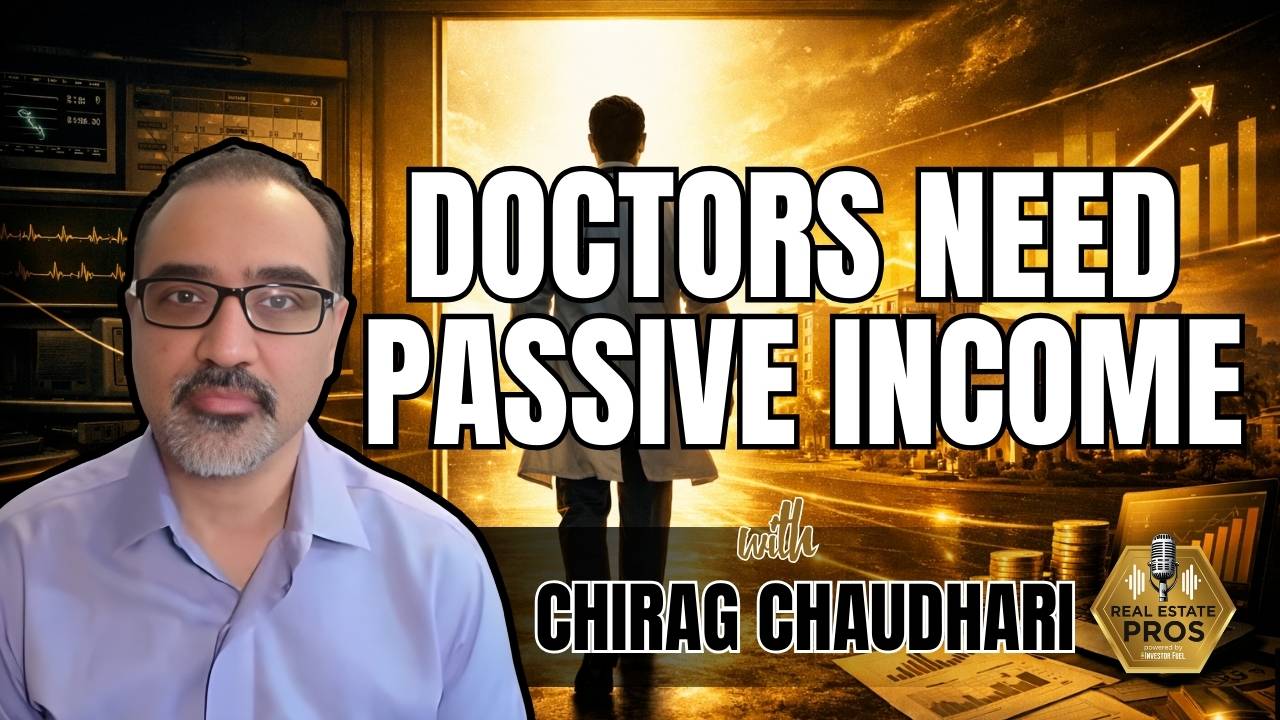
Chirag Chaudhari, an ER physician and founder of The Syndication Doctor, shares his journey from a high-income medical career to building a diverse real estate portfolio. He applies clinical diagnostic principles to real estate syndication, emphasizing thorough due diligence, risk mitigation, and systems for scaling investments. Chirag discusses lessons learned from both early successes and challenging deals, and highlights the importance of relationships, mentorship, and creating passive income streams for fellow physicians and investors.

Resources and Links from this show:
-
-
- Investor Fuel Real Estate Mastermind
- Investor Machine Real Estate Lead Generation
- Mike on Facebook
- Mike on Instagram
- Mike on LinkedIn
- The Syndication Doctor’s Email Address: [email protected]
- The Syndication Doctor’s Website
Listen to the Audio Version of this Episode
Investor Fuel Show Transcript:
Chirag Chaudhari (00:00)
Yeah, I think so that was in our early days when it just my wife and I and we were, you know, our due diligence was present, but it wasn’t what it is now. ⁓ And it was, again, it was just our funds. wasn’t where we were being entrusted with, you know, several millions of dollars from our friends and colleagues. And so that’s a very different responsibility.Scott Bursey (01:52)
Hi everyone and welcome to the Real Estate Pros Podcast. I’m your host Scott Bursey and today I’m joined by someone I’ve really been looking forward to speaking with, Chirag Chaudhari. Chirag brings a level of due diligence to the table that most people reserve for the operating room. He is a veteran emergency medicine physician who realized that while he loved saving lives, he wanted to help his colleagues save their time. He is the founder of the Syndication Doctor, a master ofthe Mid-Atlantic Market and the General Partner overseeing hundreds of doors across the country. He’s here to show us how to move from a high income grind to a high equity legacy. Please welcome to the studio Dr. Chirag Chaudhari.
Chirag Chaudhari (02:40)
Thanks so much, Scott. Super excited to be here. Really appreciate it.Scott Bursey (02:42)
I think our audience is really going to take something away from the way you have engineered your time as an ER physician doctor. You are a master of triaging what matters and what doesn’t. And you’ve applied that exact same logic to scaling your real estate portfolio. You’re showing us that being busy isn’t an excuse. It’s actually a reason to build better systems. Let’s dive in, shall we?Chirag Chaudhari (03:13)
Looking forward to it.Scott Bursey (03:14)
So first off, for people who may not be familiar with your world, give us the short version. What’s been your main focus these days?Chirag Chaudhari (03:24)
Yeah, so still practicing full-time physician. do emergency medicine. I do a shift a week in the ER. And then the remainder of my time is spent ⁓ sort of doing quality and informatics for my hospital on the administrative side.⁓ And then I’ve always enjoyed real estate, something my wife and I have always been involved with. within three, four years of becoming and attending, ⁓ we sort of buying properties and that was going to be the retirement plan is to sort of function off the cashflow from those properties over time.
Scott Bursey (03:59)
and what markets are you operating in?Chirag Chaudhari (04:02)
So we’re really market agnostic. It’s really about the deal and we’re now asset class agnostic. We try to spread sort of our eggs into every basket we can so that we’re not correlated to the market as much as possible. you know, typically if any one asset class is struggling for a period of time, the others are doing just fine. And so we’re in California, to Florida, to the Northeast, and we’re in storage, to oil and gas, to multifamily, to ground up construction.and sort of doing all sorts of different things.
Scott Bursey (04:36)
Awesome, awesome.Pleased to hear that. Keeping the broad focus. And that’s key to people’s success. Love it. What caught my attention about you was the way you’ve been able to apply a clinical diagnostic framework to the world of syndication. You know, that’s a heavy lift, especially with the way the wind is blowing in the 2026 market. What’s been the key to keeping your machine running smoothly?
Chirag Chaudhari (05:56)
Yeah, I think we have a team and when we look at these ⁓ potential projects, really, just like in the ER, we’re worried about the worst case first, right? What’s the worst possible thing that could be happening with a patient and let’s ensure that doesn’t happen and try to sort of mitigate that risk as much as we can, no different with real estate. sort of, the downside risk is so critically important. ⁓Ideally, the project does great. How great is less important than
how bad could it do, right? That’s really critically what we want to do is avoid any loss of capital for our colleagues, our friends, investors that are coming in. And so that due diligence is so key. We’ll spend typically three to four months on a project just doing due diligence and ⁓ looking at the numbers and running our own calculators and downside stress risk scenarios that could potentially happen based on the market. If occupancy were to drop, if capital expenditure items go much higher than expected and what that does
to the eventual outcome. And so I think most of our time is spent on risk reduction, really evaluating the sponsors, ⁓ and doing criminal background checks, and all of the things that one would expect when we’re bringing in large numbers of investors into opportunities.
Scott Bursey (07:15)
Couldn’t agree more. Orders of operation, you will, doctor. It’s impressive that you’ve reached that level of autonomy. Was there a specific moment or maybe a particular deal where you realized, okay, this is actually working?Chirag Chaudhari (07:33)
Yeah, I would say ⁓ one of the earliest opportunities that I got into ⁓ was expected to be a five-year hold. And this was in 2020, I believe, 2021 perhaps. But within two years, the deal was done. They had operated efficiently. They had ⁓ sort of ramped up ⁓ their initial…Value add strategy to be able to complete that within two years as opposed to the full five They had several offers that were off-market for much higher than what they had planned to sell for even at five years And so there was a return of capital and a very healthy profit within just a few years ⁓
Definitely not all deals work like that. It happened to be performed significantly. And I said, there’s something to this. Let’s continue to do this in a very thoughtful way. Be more strategic. Because if we continue to find opportunities like this, that’ll just expand sort of the reach and scope of what we’re able to offer to others.
Scott Bursey (08:41)
What a winning formula. That’s outstanding. Now, Shirog, every operator I know has a moment where things got real. Maybe a deal that went sideways or a time that you and your wife had to pivot fast. You mind sharing one of those moments with us?Chirag Chaudhari (09:00)
Yeah, absolutely. ⁓ This would be not a sideways, but a down south, down and out ⁓ direction, unfortunately. so one, again, one of the earlier deals that we got into, we we’d been doing active real estate for a number of years and had a healthy portfolio and didn’t want to spend more active time. And so we took a course in sort of how to learn about syndications and being more of a passive investor and then took massive action and jumped into probably six, seven deals that first year. And that was in twenty one.for the interest rate crisis that we all know now. so a lot of multifamily operators were tremendous operators in their own right, but had no idea that interest rates would skyrocket as quickly as they did. And the debt service just became too burdensome and they couldn’t recover. ⁓ And so we were in a syndication opportunity that went through the capital raise and tried to buy rate increases and things like that from the lender, but eventually had
to foreclose on the property. And so that was difficult. ⁓ It was a loss of capital moment for us. And I think one of the reasons that I say don’t put all your eggs in any one basket is it wasn’t a tremendous loss. We had multiple other deals that were doing great. ⁓ And that could scare some people away and say, look, I’m not interested in this.
But the way I think about it, that’s one isolated deal. People put their money into the market, and those swings can be tens, if not hundreds of thousands
of dollars a year, but nobody’s looking at it that closely. At least a lot of people don’t. ⁓ And they just let it ride. And so, you know, if you have enough of these indications, very similar. ⁓ It’s just a drop in the bucket for one, but the other ones will do tremendous. so dollar cost averaging, you’re still doing very well.
Scott Bursey (11:23)
about jumping in especially in the early going. Looking at your business today, Shrogg, what tripwire or system have you built specifically so that exact misfortune doesn’t reoccur?Chirag Chaudhari (11:38)
Yeah, I think so that was in our early days when it just my wife and I and we were, you know, our due diligence was present, but it wasn’t what it is now. ⁓ And it was, again, it was just our funds. wasn’t where we were being entrusted with, you know, several millions of dollars from our friends and colleagues. And so that’s a very different responsibility.And what would have been due diligence for a week, maybe for our deals are now four months, you know, when we’re bringing in the amount of capital that we bring in. And so we have a very regimented
due diligence playbook. We let the operators know and the folks, our sponsors that are running these deals, that we are methodical, that we are annoying, that we are going to peel back the layers of the onion ⁓ and to expect that it’ll be uncomfortable. And it’s funny, we’ve heard from some of them that our due diligence is on par with institutional level due diligence. People from PricewaterhouseCoopers and other large institutions, BlackRock, that are assessing these same opportunities.
we’re on par with that level of due diligence, which is very comforting for us.
Scott Bursey (12:43)
And quite frankly, Chirag that’s the kind of stuff people don’t talk about enough. And honestly, it’s what separates the folks who just dabble from the ones who stay in the game long term. Let me ask you this. What are you most focused on solving or scaling next?Chirag Chaudhari (13:04)
So I think you don’t ought…I tend to, as we begin to, and I think we’re all learners, we should always be learners. We should never be the smartest person in a room, right? You always want to be able to learn from someone and better your own skills and better your, you know, sort of how you, how you function, how you operate. So I think, you know, we’re always looking to figure out what is our unique zones of genius. And I work in a team and, you know, I have several partners and we’re always trying to focus on that, which we love. We do, you know, terrifically at.
And to us is not a job. fills our cup and we’re passionate about, and we know that’s going to be a beautiful work product. So everyone has their unique zones of genius. You function in that environment. And then, you know, whatever the rest of the 80 % is, you have to delegate it. You have to sort of find somebody that’s able to help. And these days it could be AI, it could be an executive assistant, a virtual assistant, but to have someone else to take that sort of load, which really allows you to hyper-focus on that, which is going to grow. ⁓
is I think something we’re always focusing on.
Scott Bursey (14:10)
and that is very admirable. I love it. What’s the next real go for you? The bullseye, if you will, doctor.Chirag Chaudhari (14:19)
Yeah, so ⁓ what we call that is our BHAG, right, our Big Hairy Audacious Goal. And so last year we were able to invest 50 million of capital ⁓ equity from our friends, our family, our colleagues into, you know, eight different opportunities. So we’re looking to offer ideally more, but we do not want to sort of, you know, at all decrease our due diligence or anything else. So we may not be able to because the due diligence is most critical. ⁓ And that’stime sensitive and we have to put in that amount of time but the goal is that we’re able to bring in 200 million of investor capital this year. ⁓ We’ll see how close we get. We wanted to set the bar high so that we were aspirational ⁓ and so that’s our hope for this year.
Scott Bursey (15:48)
Makes perfect sense. Setting that bar high is so critical, I think. So we see people chase doors or revenue all the time. For you, is that goal the destination? Or is it just the fuel that allows you to do something even bigger?Chirag Chaudhari (16:05)
Yeah, honestly, think ⁓ we want for nothing. ⁓ this is sort of, my wife always reminds me that a little bit that I’ve sort of.turning my back on medicine and I’m able to do things for others that not a lot of folks can and why would I ever want to stop or take attention away from medicine? And I think she has a lot of valid points there. And that’s not my goal. My goal is not to step away from medicine. I love medicine. I love what we’re able to do ⁓ in the emergency department and in the hospital. I think that’s critically important. And I think my physician colleagues who, know, are most of our investors are physicians just because that’s the language we speak.
⁓ And they tend to not trust others as much and they tend to be very risk-averse, but they’ll trust another physician. So I think if, you know, we’re able to speak this language, we know this universe and we’re able to sort of introduce it to them, allow them to keep doing what they love doing, which is taking care of people, ⁓ but be able to be comfortable and have additional passive streams of income and…
Other opportunities that perhaps they wouldn’t have gotten into would have been too nervous about Maybe felt like they didn’t know enough about to get into I think that’s my why is to be able to you know, to be able to help them. We’re not taught Finances through medical school through residency. Nobody teaches us sort of you know, how to take care of our funds how to be philanthropic with what we have in the end ⁓ And if i’m able to shed any light on that I think that’s a tremendous opportunity because we fall prey to you know
financial advisors, there’s a lot of good ones out there. ⁓ But, but a lot of them will, you know, we’ll say we’re young, we’re physicians who are going to have, you know, income potential and they find us young in residency and then put us into a variety of products and things that, you know, we may not need. And so ⁓ what’s really great, I’m 22 years out of residency, but there’s folks that I’m speaking to that are just two and three year old attendings. And that’s amazing because they will be in a much different position ⁓ than I
I am today. No regrets. Yeah, I wouldn’t change anything at all. But just kudos to them for learning about what other opportunities are out there.
Scott Bursey (18:21)
point well taken, Shrog. And it all boils down to that unique skill set that you have.Especially when you’ve already got the resources in place. Now, doctor, that next move can either compound things or create chaos depending on how you play it. Now, I know a lot of our audiences either earlier in their journey or looking to level up perhaps. And I think they’d benefit from hearing this. When it comes to building relationships and growing your network, what’s made the biggest difference for you?
Chirag Chaudhari (18:56)
Yeah, you know, it’s funny because I was always sort of… ⁓a DIY guy, right? And I know how to do it. I can do it myself. And ⁓ it’s not, you know, I’m a high functioning person. I’ve gone through graduate school. I’m, you know, I’m making a good income. So I’ve won the game, you know, what are you going to teach me? And I was so wrong. ⁓ And I started taking some of these courses and learning. obviously, education is paramount and learning and being able to have somebody else sort of hold your hand and mentor you and coach you. ⁓
Some of these programs were not inexpensive. You are dropping sometimes a lot of cash into masterminds and into coaching and into these courses, but the return on investment is…
Unreal and and it’s not and I don’t mean that in a financial sense, of course financially There’s there’s a healthy return on investment. I mean that from a filling your soul sense the folks you meet ⁓ Yes, the people that are leading you and teaching you are fantastic ⁓ and they will grow you but it’s the people in the community ⁓ That are there with you shoulder to shoulder all abundance Mindset and looking to lift one another up that I think it opens the universe to you and it’s it’s been truly
fantastic to experience.
Scott Bursey (20:15)
True words of wisdom. Everyone says provide value, but when you were starting out, you didn’t have a huge bank account or a massive portfolio. What was your currency? How did you actually get the attention of the heavy hitters?Chirag Chaudhari (20:33)
Yeah, was honestly just starting out. know, it’s very uncomfortable because my wife and I had been doing it for a long time and we were very comfortable with it. you know, the only time I ever asked anyone for money is my daughter, you know, selling Girl Scout cookies. And I would ask some people if they wanted to buy Girl Scout cookies. And then, you know, fast forward a few years, I’m asking people if they want to put in $50,000 or $100,000 into opportunities. And it’s very different because it felt dirty, right? And I came to realize slowly that I wasn’tasking for money, I was merely offering opportunity, right? And so that opportunity for folks when explained, I’ve said, here’s what I’ve done, here’s my portfolio, like, you know, I’m speaking from experience. It matters not to me what you think about this or if you think this is something you want to add to your own portfolio. ⁓ But I’m happy to answer any questions. And if you think it’s a right fit, great. If not, hopefully you got a little bit of education out of our conversation. But it’s, you know, it’s that no chase
It’s just you’re simply just trying to educate folks and then what they do with that education that’s that’s on them ⁓ You know, but it’s it’s been great
Scott Bursey (21:42)
Those are real words. And, Chirag, relationships are everything in this space. They really are. So thank you for sharing that. All right, before we wrap, if someone wanted to reach out, connect with you, maybe collaborate or learn more about what you’re doing. What’s the best way for them to contact you?Chirag Chaudhari (22:04)
Yeah, thanks, Scott. Always happy to chat, always happy to have a conversation with folks. think ⁓ we don’t have enough of them, honestly. ⁓ But people can get ahold of me via email at thesyndicationdoctor at gmail.com or my website, is thesyndicationdoctor.com.Scott Bursey (22:20)
Perfect, well listen, I appreciate your time, your story, and definitely your perspective. We need more people in this space who are out there doing it the right way, Thanks again for being here.Chirag Chaudhari (22:34)
Thanks, Scott, for having me. Really appreciate our time together.Scott Bursey (22:38)
And for those of you tuning in, if you receive value from this, make sure you’re subscribed. We’ve got more conversations coming up with operators just like the doctor. We’re out here building real businesses. We’ll see you in the next episode, everybody. -