Subscribe via:



Show Summary
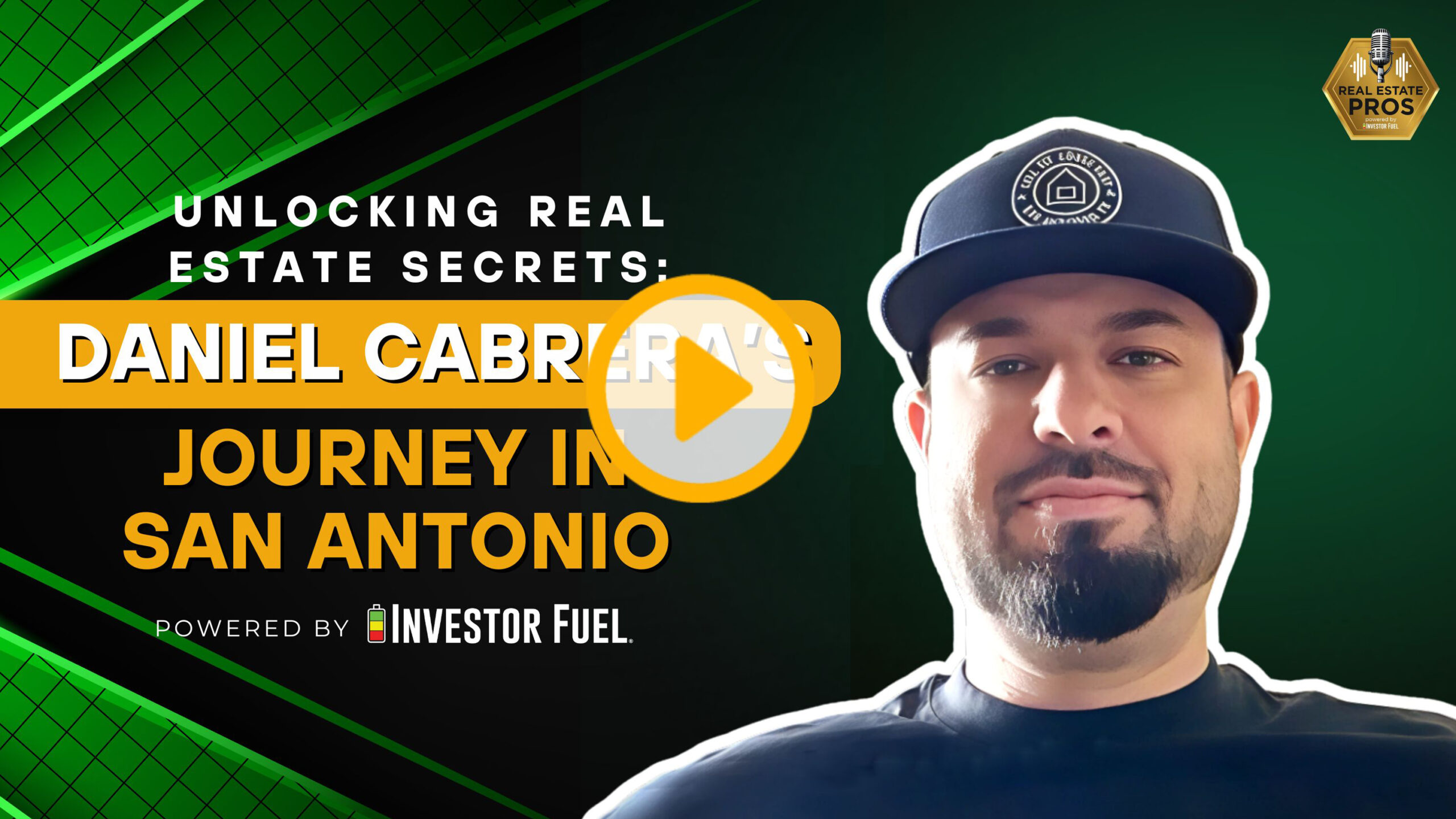
In this episode of the Real Estate Pros podcast, host Kristen Knapp interviews Daniel Cabrera, a seasoned real estate investor and founder of Sell My House Fast in San Antonio, Texas. Daniel shares insights into his journey in real estate, focusing on sourcing properties, navigating off-market sales, and the importance of building relationships in the industry. He discusses the challenges and misconceptions surrounding real estate investing, particularly in dealing with distressed properties. Daniel also outlines his plans for scaling his business and offers a glimpse into the San Antonio market.
Daniel Cabrera is the CEO & Founder of SellMyHouseFastSATX.com and FireDamageHouseBuyer.com, two trusted home-buying companies that specialize in distressed and fire-damaged properties across Texas and nationwide.

Resources and Links from this show:
-
-
- Investor Fuel Real Estate Mastermind
- Investor Machine Real Estate Lead Generation
- Mike on Facebook
- Mike on Instagram
- Mike on LinkedIn
- Daniel Cabrera’s Website
- Daniel Cabrera’s Website
- Daniel Cabrera’s Contact Number: 210 951 0143
-
Listen to the Audio Version of this Episode
Investor Fuel Show Transcript:
Kristen Knapp (01:31)
Welcome. I’m Kristen Knapp and this is the Real Estate Pros podcast. I have Daniel Cabrera with me, real estate investor and founder of Sell My House Fast San Antonio, Texas. Thank you so much for being here.
Daniel Cabrera (01:43)
Yeah, thanks for having me on, Kristen.
Kristen Knapp (01:46)
This should be an awesome podcast. can’t wait to learn more about your business. So just tell us a little bit more about it and you know where you’re at today.
Daniel Cabrera (01:54)
Yeah, so I started Sell My House Fast in San Antonio, man, like almost 16 years ago. Doing it part-time and really kind of went full-time, I guess, yeah, about six, seven years ago. We’re based out of San Antonio, essentially with kind of like an hour radius of San Antonio, so pretty big competitive market in Texas.
⁓ You know, primarily we focus on fix and flips, wholesaling, some sub 2 creative financing ⁓ things and we’re probably doing somewhere in the neighborhood of 40 deals a year at this point. ⁓ But yeah, it’s been an interesting journey to say the least.
Kristen Knapp (02:43)
Definitely, I bet. That sounds very impressive. So you sell homes fast, obviously, or buy homes fast. What does fast mean in your process? So how do you, it seems like you’re pretty good at sourcing houses. How do you go about that?
Daniel Cabrera (02:51)
I buy them faster than I sell them lately though, I tell ya.
Yeah, as far as most of our, ⁓ most of our deals, would say we source organically, you know, through our website, through word of mouth, just different search engine optimization. You know, we’ve worked hard building up kind of our credibility as far as the company is concerned. And, you know, we’re finally starting to see the benefits that kind of come along with it.
Kristen Knapp (03:27)
Yeah, awesome. You know, you’ve done a lot of different types of deals. You’ve closed fire damage homes, sub twos, wraps. What’s the most creative deal you’ve pulled off?
Daniel Cabrera (03:41)
Man, there’s just so many of them, but… ⁓
Some of the more interesting ones have been the fire damage properties, I will say. know, they’re just complete. We did a house not too long ago, it 4,300 square feet, and the entire second story was completely burnt down. The whole first floor was just down to the studs, and a lot of that was burnt down as well. But it was also one of the most rewarding properties we’ve done. ⁓ We had another property where…
I had a client call me on a Saturday. Monday was 4th of July and Tuesday she was getting foreclosed on. Somehow we were able to get the foreclosure stopped Tuesday morning, even though Monday was 4th of July, I must have called 500 lawyers over that weekend to try to get this deal done. Then I finally…
Got a hold of one and granted he charged me four times the normal rate. ⁓ That one is pretty nuts though, because we got the foreclosure stopped. Then we did the closing on the house, never heard from the client ever again, the seller. Went back because we had to evict her, unfortunately, because…
she didn’t hand over keys to the house. And then there was a goat running around the house on the inside running into the cops. And it was just an absolute nightmare. ⁓ And I had a hip replacement like a month prior to this. And I have this damn goat running around trying to kill everybody in the house. ⁓ So yeah, that was probably one of the more creative ones.
Kristen Knapp (05:26)
That sounds like it. Yeah, thinking
quick on your feet, having to do things last minute. Is that kind of the nature of it, having to do a of things at the last hour?
Daniel Cabrera (05:31)
Yeah.
Yeah, I mean a lot of times, a lot of times it’s just…
you know, ultimately I think a big part of it is just problem solving and usually the problem solving ones are usually the better opportunities that are out there for sure.
Kristen Knapp (06:41)
⁓ And if someone’s thinking about selling off market but feels hesitant, what should they know before reaching out to you?
Daniel Cabrera (06:50)
Someone’s thinking about selling off market. I think the biggest thing is just doing research on whoever you’re gonna be dealing with, trying to get an understanding how long they’ve been in business for. I think a big part too is just, we got a lot, I think a lot of times sellers,
fall under, how do I phrase this? What I’m trying to get at is not all offers are created equally. I think a lot of the time there’s a lot of companies out there who advertise the buy houses that really don’t buy houses and they’re more middlemen or wholesalers. At least here in the San Antonio market,
I think that, you know,
I think the biggest thing is just making sure you’re working with somebody who has that credibility there, who has something to lose, because we get sellers all the time that they’re getting calls from cold callers and they’re not in Texas. Then we review the contracts. They’re putting no money down, tying up the property for three, four months.
What I like to tell people is try to do business with somebody who’s got something to lose. Because the people who’ve got something to lose, they’re not gonna want to jeopardize, you know, what they’ve built up over the years just to do something not above board, per se.
Kristen Knapp (08:26)
Definitely. And when you’re talking with people, are there types of houses or properties that you wouldn’t be interested in buying up? What’s that criteria look like?
Daniel Cabrera (08:37)
Yeah, we’ve got a pretty strict criteria as far as what we’re
really, it really kind of depends on the exit strategy. ⁓ But a lot of the times, you know, I’ll talk to sellers and I’ll be the first person to let them know that, you know, obviously we’re in the business to make money and we want to help out. But, you know, we’re not the best fit. At the very least, we want to just help in any way that we can and try to point them into the right direction of what’s best for them.
even if that’s not working with us. So a lot of the times we’ll refer certain clients out to realtors ⁓ or maybe other, even other investors who kind of specialize more so in, you know, a specific selling scenario. But we’ve got a few good partnerships with some agents and a few other people as well that we’ll try to refer out to.
Kristen Knapp (09:27)
Yeah, I imagine probably networking is a big part of the business to find all of these homes. Do you have any tips for anybody from that perspective, like how to form these relationships, how to keep the relationships?
Daniel Cabrera (09:31)
Yeah.
So sure.
Um, you know, I think just kind of getting yourself out there is probably the biggest thing, but I have. I’ve formed a few relationships with a few realtors, a few wholesalers over the years and been working with them for probably 10, 15 years at this point. Um, you know, granted, there’s been a ton of people who reach out all the time that are
Absolutely terrible, but every once in a while there’s somebody really kind of worthwhile who comes along that and we just work with for four years, but
Kristen Knapp (10:21)
Yeah.
Yeah, I imagine that’s probably a hard part of the business. mean, any business really, people who promise you the world and then don’t follow through. Do you have, you know, situations where that’s happened?
Daniel Cabrera (11:08)
Yeah, I think one of the most frustrating things for me, so we have like a buy box criteria that we use and I probably get a hundred phone calls a month from newer wholesalers ⁓ who are trying to get into the business and I’m all for it, you know, but I’ll send them my buy box criteria, which is so laid out perfectly.
And then they send me everything under the sun that has nothing to do with our buy box in a different state. I’m like, guys, like, I don’t know. I don’t know how to explain it to you any clearer than I am.
But yeah, that’s probably one thing that we run into ⁓ pretty often, I would say.
Kristen Knapp (11:56)
Yeah, people don’t read. It’s kind of who it is. ⁓ And then just about your line of work, are there any misconceptions? Like, do people have some sort of thought about how this goes and maybe it goes a little differently? Or just tell me more about this business.
Daniel Cabrera (11:58)
Yeah!
I mean, misconceptions, yes. ⁓ You know, I think sometimes we can kind of, in this industry, we can get somewhat of a bad rap. ⁓ But I think what people kind of fail to realize a lot of the times, I’ll give you a prime example, just the…
There was a house in Shirts, Texas. A young guy, maybe 25, him and his wife bought the house two years ago, three years ago. The house has foundation issues. And they were pretty severe too.
⁓ He’s tried selling the house with a realtor before in the past, having a real difficult time selling it. And he’s like, Dan, he’s like, I don’t know what to do. I don’t want to get foreclosed on, but we can’t live here. We don’t have the money. You know, it’s not even about us profiting on the house. We just want out of this mortgage. And I think sometimes people look at that and…
think we’re taking advantage of somebody. But honestly, I don’t know anybody else other than me and I mean, granted, sure, some other investors too, but you know, it was a sense of accomplishment just to be able to help out this young guy who felt like he had a noose around his neck to finally being able to breathe again. And granted, I will say he didn’t make any money, but you know, ultimately he was able to kind of get out of.
this choke hold that he was in and move on. And I can’t tell you how grateful him and his wife were that we were able to get this done. And from start to finish, think we closed on the house in nine days. ⁓ It felt great.
Kristen Knapp (14:02)
Yeah, I imagine that a lot of this is a win-win for everybody because people are trying to offload properties and you’re trying to buy them. I totally see that.
Daniel Cabrera (14:09)
Yeah, and a
lot of the times too, like the houses that we’re buying, they’re not in perfect shape, right? And the market to be able to sell it to retail people and to try to get retail value is gonna be difficult, right? So where we kind of come in are the more so the problem properties that are kind of difficult to deal with.
Kristen Knapp (14:31)
Definitely, when you’re working with like a fire, you know, a fire situation, what’s even that process to nurse it back to health where you can even, you know, get it to the market quickly.
Daniel Cabrera (14:42)
Yeah, well, those are it just depends on the extent of the damage obviously, but usually step number one, you know, I’ll go out there, you know, kind of try to formulate a game plan on, you know, the rebuild and then shortly there on after I’m bringing my engineer out there first thing so he can kind of review everything to give me the green light on if he’s they’re willing to sign off on the rebuild itself.
And then it’s a whole long list of just materials and different crews. But it’s been really interesting. I’ve enjoyed it.
Kristen Knapp (16:04)
And you’re.
And you’re doing a
lot of this on your own, you said, correct?
Daniel Cabrera (16:10)
you know, I used to do a lot of the work myself years ago now. I’m more so kind of oversee the projects. ⁓ yeah, more so overseeing it and just making sure that we’re meeting certain timelines and things of that nature. ⁓
Kristen Knapp (16:27)
That
must have been a nice transition.
Daniel Cabrera (16:29)
It sure was because
I remember being on the job site and I’d pull out a chair on the job site while working and answering phone calls and trying to handle marketing and, also running a Home Depot back and forth and getting two by fours and you name it. But so it’s been a nice, a nice transition. And now I’m trying to scale a little bit more and bring on, you know, just kind of acquisition lead managers and, and that has been. ⁓
somewhat of a kind of a learning lesson to try to hand off the reins of what I know I’m really good at, but I just, it’s just too tough to juggle everything all at once.
Kristen Knapp (17:13)
And to scale, definitely
requires more people involved. What are, if you don’t mind me asking, what are your scaling plans from here?
Daniel Cabrera (17:22)
you know, I feel we’re at, we’re at a good place in the San Antonio market. ⁓ at this point we started a new website. It’s called fire damage house, fire.com. we’re trying to scale more so on the nationwide level of, ⁓ kind of helping sellers who unfortunately homes have caught on fire to kind of quickly, ⁓
to quickly purchase them in an efficient manner. It’s definitely harder than I thought it was going to be, but I’m hoping at some point in the future we’ll have more of a presence. ⁓ But that’s something I’m definitely looking forward to.
Kristen Knapp (18:08)
Yeah, that sounds awesome. I mean, it seems like you’ve really gotten in deep with the San Antonio market and that, you know, it makes sense to scale from there. And what about the San Antonio market, just for people listening, like what, what are, what’s like your favorite part about the market? What’s your favorite part about the city? Like, tell us more just about that area.
Daniel Cabrera (18:17)
Yeah, yeah, no absolutely.
Yeah, so I’m from New Jersey originally, although I’ve been in Texas now for probably going on 16, 17 years.
I do really like San Antonio. I think the biggest draw when I first moved down there though was just getting out of New Jersey and not having to deal with six months of freezing weather anymore. Although it can get pretty hot in San Antonio, but I’ll deal with the heat. you know, culture, the people. ⁓
It used to be a lot more affordable. It’s definitely getting more pricey now. ⁓ But yeah, I ⁓ built a business there. I’ve got my daughter here, obviously. ⁓ And for the foreseeable future, I don’t think I’m going anywhere, so yeah.
Kristen Knapp (19:32)
Yeah,
that’s awesome. So tell everybody if they’re interesting in working with you, how they can find you, and how they can learn more information.
Daniel Cabrera (19:40)
Yeah, saw my house fast San Antonio, Texas. Phone number is 210-951-0143. Open to working with anybody. And even just someone needs help with something, always happy to hop on a call as well. And definitely appreciate you having me on here, Kristen.
Kristen Knapp (20:04)
Yeah, awesome. Thank you so much. I feel like I learned a lot about the business. It sounds great and good luck to your scaling plans.
Daniel Cabrera (20:11)
Yeah, I know and only other place too I would just say is on our website. [email protected]
Kristen Knapp (20:19)
Perfect, yes. Everybody check that out. Well, thank you so much, Daniel, for meeting with me today. This has been awesome, and I wish you the best with your business.
Daniel Cabrera (20:28)
Thanks so much.