Subscribe via:



Show Summary
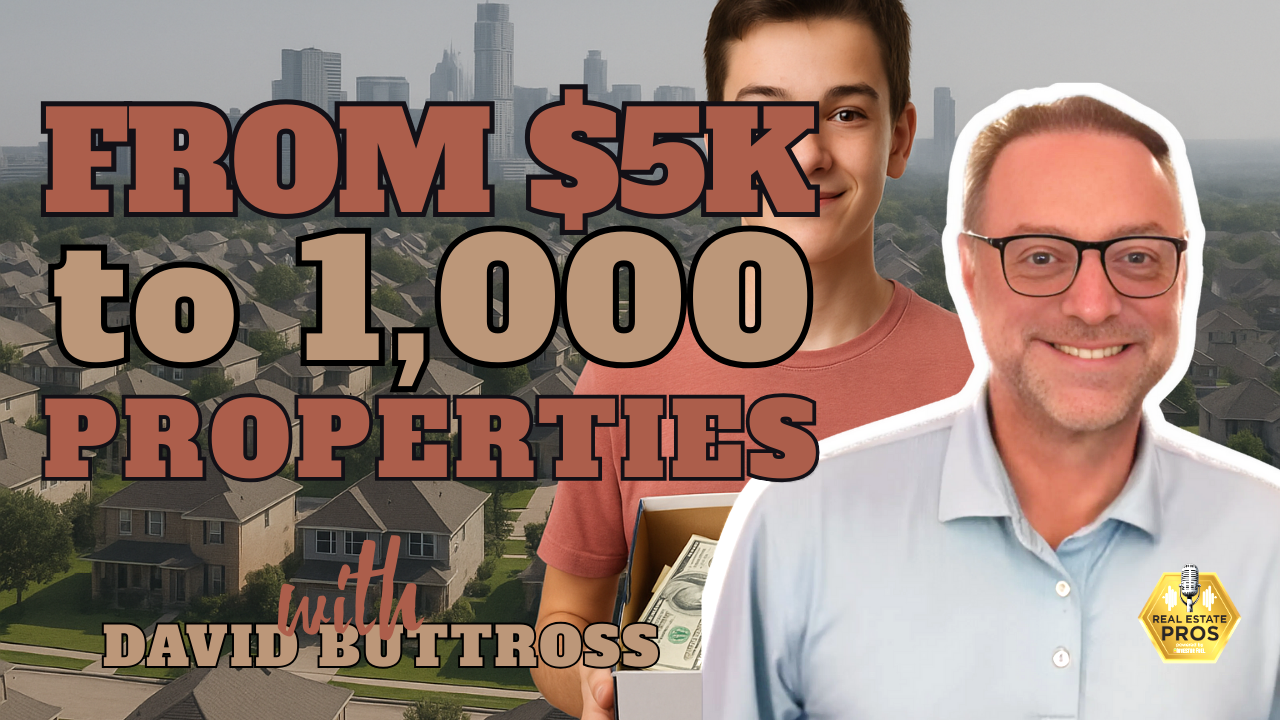
In this episode of the Real Estate Pros podcast, David Buttross shares his extensive journey in real estate investing, starting from his teenage years. He discusses his early experiences, the challenges he faced with cash flow, and how he adapted his strategies to market changes. David emphasizes the importance of understanding market cycles, making strategic investment decisions, and the value of solving problems for others. He also offers valuable advice for new investors, highlighting the significance of gaining experience and knowledge before diving into the market.

Resources and Links from this show:
-
-
- Investor Fuel Real Estate Mastermind
- Investor Machine Real Estate Lead Generation
- Mike on Facebook
- Mike on Instagram
- Mike on LinkedIn
- David Buttross on LinkedIn
- David Buttross on Facebook
- David Buttross’ Email Address
- David Buttross’ Phone Number: 512 3200 888
- David’s Book: Long-term Greedy: How Doing the Right Thing the Right Way Pays Off in the Long Run
-
Listen to the Audio Version of this Episode
Investor Fuel Show Transcript:
David Buttross (00:00)
I did that until Dodd-Frank changed the rules and made it against the rules to sell owner financed houses to people. And so we quit doing that about whenever Dodd-Frank kind of came along. And then we started doing raw land. Yes, ma’am.
Kristen Knapp (00:12)
And how did you pivot?
You pivoted to land, you said?
David Buttross (00:17)
And then we started doing land and selling, cutting land up and selling it to small businesses.
Kristen Knapp (00:22)
Wow. tell us about, cause I know you said, you you bought a thousand properties at one time. Tell us about that.
David Buttross (00:30)
So I started off buying single family houses that I want to do plexus and four plexus and then during one of the last bus like in early 2000s we started buying ⁓
big office buildings and apartment complexes and light industrial.
Kristen Knapp (02:18)
Welcome back to the Real Estate Pros podcast. I’m Kristen and I’m here with David Buttross. He is a real estate investing pro. He’s going to get into all of the deals he has going on. He’s done a really impressive lot of things, you know, leading up to this time. So thank you so much for being here, David.
David Buttross (02:34)
Nice to meet you.
Kristen Knapp (02:35)
Nice to meet you too. So tell us how you got into real estate in the beginning.
David Buttross (02:41)
I was 15 years old and my dad had a couple of rent houses and I asked him how do you buy a rent house and he told me and I said well I want to buy a rent house. He’s like well you’ve got to have you know at least ten thousand dollars down to buy a rent house and I said well I’ve got five thousand dollars. He’s like where did you get the five thousand dollars? I said well I saved it cutting yards. So I ran upstairs and grabbed my shoe box and I handed him five thousand dollars and I bought half of a house with him when I was 15 years old.
And then before my 16th birthday, I bought a Porsche. And then when I was 16, I bought a whole rent house. And then 17, I bought like a couple more. And 18, I bought some fourplexes. I’d say, yes, ma’am.
Kristen Knapp (03:21)
Wow, so you were just in it right away.
I mean, it’s impressive that you were saving your money even back then, not blowing it.
David Buttross (03:30)
Yeah,
there wasn’t a lot of things to spend money on in the 80s, so it was easier to save it back then.
Kristen Knapp (03:37)
That’s amazing. So did you work alongside your dad in the beginning or were you kind of on your own?
David Buttross (03:42)
I would, he would take me to show me the houses before he’d buy them and sometimes would fix them up together. I’d go with them to sign leases and meet tenants. He had one property where he actually, the tenant bought a baby lion and a baby tiger and that was like really cool to see it. And then like 18 months later they were like full grown and they had like destroyed the house. So I learned from him, he said, you know, don’t rent houses to people who have baby lions and tigers.
Kristen Knapp (04:04)
Whoa.
That’s a great piece of advice
David Buttross (04:12)
It’s kind of stuck with me over the years,
Kristen Knapp (04:12)
to share with everyone. Yeah. And then, you know, what about real estate really hooked you?
David Buttross (04:22)
You know, I wasn’t very smart.
And so I felt like, you know, this is an industry that I could get into where I don’t have to be really smart to make a living doing it. And so I got my real estate license when I was 18. Actually, the truth is I wanted to kind of be rich when I was younger. And so I Googled or I didn’t, guess back then they didn’t have Google, but I searched up, know, you know, how do you get rich? And back then it was real estate, car dealing, and inheritance. And my great grandfather lived to be like 97.
So I knew I wasn’t gonna be inheriting any money anytime soon. So when I turned 18, I got my real estate license and when I turned 19, I got my car dealing license. And so…
Kristen Knapp (05:04)
wow, so you hit it from both
sides.
David Buttross (05:54)
Yeah, and you spend 40 % of your income on your house and you spend 30 % of your income on the car. So I felt like if I could use my real estate license and have a free place to live and use my car doodling license to have a free car, that covered 70 % of my expenses. And so I kind of got those two bases covered at a young age.
Kristen Knapp (06:15)
Wow. What does it take to get your car-dealing license?
David Buttross (06:18)
In Texas it was pretty easy back then. You had to a $25,000 bond, which cost $200 a year, office, five parking spaces, a filing cabinet, and a little thing on your door that said what time your hours of operation are. And so you don’t have to pay sales tax on cars.
Kristen Knapp (06:37)
Wow, yeah, I mean, it sounds like from a really young age, you really knew how to work the system to your benefit. And then lead us up to kind of your journey throughout building up your equity.
David Buttross (06:44)
Yes, ma’am.
So my goal is to own a bunch of rent houses. So when I was like 26, I was like, let me get up to 100 rent houses. Or maybe I was 25. I was 25 and I had 100 rent houses.
And all of a sudden I realized I was losing $100 a month per rent house. And so that was like $10,000 a month I was losing in cash flow. like, well, shoot, these single family houses do not cash flow. This is not a good way to sell houses. And so I tried to list them for sale and none of them would sell because they were kind of in rough parts of town. I’m like, well, this is not going to end well. Because when you’re 25 years old, it’s hard to make an extra 10 grand a month to cover your negative cash flow. So I’m like, this is not going to end well. And so then I offered owner financing on one of the houses and it sold in like one
day and so I sold the hundred houses owner financed and I went from having negative ten thousand a month in cash flow to positive ten thousand dollars a month in cash flow.
and got about a million dollar net worth back then. And then that’s kind where I came up with the model of buying fixed ruppers and selling them owner financed. And
I did that until Dodd-Frank changed the rules and made it against the rules to sell owner financed houses to people. And so we quit doing that about whenever Dodd-Frank kind of came along. And then we started doing raw land. Yes, ma’am.
Kristen Knapp (08:07)
And how did you pivot?
you pivoted to land, you said?
David Buttross (08:12)
And then we started doing land and selling, cutting land up and selling it to small businesses.
Kristen Knapp (08:17)
Wow. tell us about, cause I know you said, you you bought a thousand properties at one time. Tell us about that.
David Buttross (08:25)
So I started off buying single family houses that I want to do plexus and four plexus and then during one of the last bus like in early 2000s we started buying ⁓
big office buildings and apartment complexes and light industrial.
And I like the apartment complexes because you can buy an apartment complex and have a bunch of people on salary like air conditioning guys and handymen. And so when you had the guys on salary, then it became more affordable to start fixing up houses around it. ⁓ So we did that. And then basically every couple of years, there’s a different segment in the market that becomes popular and not popular. So then once apartment complexes got to be too
We started buying light industrial then we started buying office buildings then they got to be too expensive and so there’s always a cycle ⁓ And so we also bought a lot of houses on the courthouse steps. We buy a lot of foreclosure houses at the auction Which was kind of nice and we bought a bunch of those in like seven eight nine ⁓ And did a lot of that stuff,
Kristen Knapp (09:13)
Bye.
Yeah,
so how do you, you know, create your strategy when something doesn’t seem to work as much anymore? How do you transfer to something else?
David Buttross (10:13)
So I try to figure out the segment of the market that nobody wants. basically like in 2015 or 14 I realized, you know, banks won’t lend on a house that’s less than $50,000. So once a house goes from $51,000 to $49,000, you have to pay cash for the house. And the pool of buyers that can buy a house for cash is a lot smaller than the pool of buyers that can pay $250 a month in payments on a $51,000 house.
So once a house became worth less than 50, they basically went value from 50 down to 25 because they had no financing. And so I’d buy the house for 25, I’d fix it up a little bit, and then I could sell it for 52 because it was worth 52 all day long. ⁓ So that was kind of our model was buying the houses that were really 50,000 our houses and buying them for 25.
Kristen Knapp (11:07)
Yeah, I mean, that’s interesting
that you say you like to buy the stuff that nobody wants. you tell us about kind of like the cyclical nature of the market and how that seems to be a good bet for you.
David Buttross (11:22)
Well, so everybody jumped into single-family houses. And so that’s what I did. And then I got out in 2019. I always seem to get out two years early. But I bought all those until there was no more equity in there. And then once interest rates went down to zero, the price of single-family houses got super stupid high.
And the math didn’t make sense. So I always like to do deals where there were win-win deals so I could sell the house owner finance and the person’s payments were $400 a month less than rent. And so why would they ever quit paying me and then have to pay $400 a month more to live across the street?
And so I always try to work a little bit harder to do a win-win deal where I make money and my customer even benefits even more than I did. And so once that delta between rent payments and mortgage payments changed to where there was no longer $400 a month, I got out of it because I thought there was a lot of downside risk in the single-family market. And then when interest rates went to zero, I’m like, it’s going to be hard for interest rates to go below zero.
And basically what happens was when interest rates go down, prices go up. When interest rates go up, prices go down.
And I got really lucky getting started in like 81, because in 1981 interest rates were 15 % and prices were really low. And so for 40 years, interest rates went from 15 % to zero and prices went straight up when interest rates went down. And so I hated to get out of the market when interest rates were zero because I could afford to buy whatever I wanted, but that meant that everyone else could afford to buy whatever they wanted. And I had to kind of sit on this out line when everyone made a lot of money for those 18 months, but when the market crashed and it still
Kristen Knapp (12:56)
Great.
David Buttross (13:02)
crashing, I wasn’t in the market and I wasn’t in that asset class.
Kristen Knapp (13:06)
Yeah.
So you have just like a long-term perspective about things, not necessarily like the short-term pop.
David Buttross (13:13)
Yeah, and so when interest rates went down to zero, I pivoted and I’m like, well, what segment of the market got hit the most when interest rates were zero and the only place that I could buy stuff was timberland. So I went out and bought 8,500 acres of timberland and I felt like the timber would be an inflation hedge and so I’m sitting on a bunch of timberland right now.
Kristen Knapp (13:32)
Wow. And as far as like geographical area, you’re very diverse, right?
David Buttross (13:39)
Yes, I was in every state except for Alaska and Hawaii in 2017. Though I have owned stuff in Alaska and Hawaii in the past. But in 2017, yeah, we’ve got houses in every state except for Alaska and Hawaii. ⁓ I realized that the East Coast and the West Coast are places you don’t want to own real estate. You don’t want to own… ⁓
Kristen Knapp (13:51)
That’s amazing.
David Buttross (14:01)
You don’t want to own real estate in the left leaning states, guess. So don’t want to own in Chicago or Detroit or any of those big cities because they they chase capital away. And so that was a lesson I kind of learned and I need to update my book. ⁓
and tell people not to buy real estate in those states. And you want to buy real estate in states that are growing, that are pro-business and pro-hardworking people, if that makes sense.
Kristen Knapp (14:30)
Yeah, tell us more about that. Tell us more about what geographical areas you actually you like.
David Buttross (14:36)
⁓ Well, so I like Texas, Alabama, Oklahoma, Florida, ⁓ Arizona, Nevada.
all those kind of states and I think kind of what I really realized is Texas is a pretty big state and you really should invest locally if you want to actually have an impact on your investments. When you buy out of state it’s hard for you to actually effect change on those deals. So as a general rule I’m trying to stay in Texas going forward except I did buy a property in Connecticut last week, 150,000 square foot office building.
And it’s like 30 minutes from downtown New York. But for the most part, I’m really trying to stay in Texas unless I get some random deal. I guess last week I bought a Dollar General store in Arkansas also.
Kristen Knapp (15:23)
When
you were purchasing in every state except for Alaska and Hawaii, what was the reasoning behind that? Did you just want to learn more about each area?
David Buttross (16:14)
No, I would get a list of about 1,000 properties a month, and I would just bid the whole list. I just, you know, I didn’t pick any particular state. I just had a little formula of buying the stuff that was appraised for 50,000 for half of appraised value. And I would end up with about 80 properties a month.
Kristen Knapp (16:33)
Wow, that’s so impressive. And how did you manage all that? What did your team look like?
David Buttross (16:38)
You know, it was just me and maybe one or two assistants.
Kristen Knapp (16:41)
Wow.
David Buttross (16:42)
And just tried to figure out how to buy stuff I’ve never seen and sell to people I’ve never met just to see if I could do it. And my whole goal is how do you reduce the amount of hours per transaction just to see if I could do it. And I felt like a thousand was enough. And so I did a thousand and I stopped. But you know, a lot of people, they end up buying one house and it takes them 18 months to get it renovated and sold. And they just get bogged down in the details. And so my thing is, you know, that’s why I didn’t want to become a heart surgeon. I’m like, you can only physically do so many
Kristen Knapp (16:56)
Yeah, feels like it.
Right.
David Buttross (17:11)
heart surgeries a month and if it takes you 18 months to get a real estate deal done you can only do you know 100 deals in your lifetime so my thing is how do you compress the amount of time it takes to do to get a property bought and sold and then just kind of how do you focus on the most important stuff and not all the fluff that doesn’t really matter
Kristen Knapp (17:19)
Right.
Wow.
And what would be like, I don’t know, like a time management tip that you have? You’re able to do so much by yourself.
David Buttross (17:42)
I try to spend 80 % of my time focused on solving the biggest problems of the day. But then you still have to spend 20 % of your time
on the other stuff, otherwise they never get dealt with. Does that make sense? But spend at least 80 % of your time on solving the big problems, but you still have to spend a little bit of time on all the stuff that just takes, you know, the problems that take forever to solve that are really low yield, otherwise they never get dealt with, and you can end up with a problem that’s never dealt with for 30 years. So that’s kind of my rule, 80 % on the most important problems, and then still spend 20 % on the brain damage stuff.
Kristen Knapp (18:22)
Makes sense, yeah. I mean, you’ve been able to do so much. ⁓ So right now you’re kind of focused on office buildings, correct? Tell us more about that, the opportunity there.
David Buttross (18:30)
Yes, ma’am.
You know.
Everything was overpriced, I think, in the real estate market. And when interest rates were zero, everything has a long way to fall down. And prices are really sticking because people don’t want to get rid of their properties because the interest rates are so low. And so they’re kind of carrying stuff and feeding a two or three thousand dollar a month of negative cash flow because they don’t want to take a two hundred thousand dollar hit when they sell the property. And so it’s kind of like a slow burn. ⁓ So all those prices are in single family houses and everything are still artificially high right now.
⁓ Office buildings got just totally hammered and obliterated. And I think they got obliterated because no one could afford to cover the carry. And when all their notes came due in five years. ⁓
You know, they bought these properties with 2 and 3 % interest rates and now the interest rates are at 7 or 8 % and the appraisals are low. You know, none of this stuff cash flows at the higher interest rates and they’re upside down. They owe more on the properties than they are worth. So it’s kind of like a big snowball effect. So I believe you can buy office buildings sometimes for 75 cents on the dollar. I mean 25 cents on the dollar of replacement cost. But the big issue is,
Kristen Knapp (19:43)
Is there ever a time… Oh, keep going.
David Buttross (19:47)
The people that have the experience to run office buildings owned office buildings and just got hammered. I would say 85 % of the people in the office space are just got obliterated. So there’s a lot of people out there that want to do it, but if you don’t have the experience to buy an office building, maybe you shouldn’t do it.
Kristen Knapp (20:05)
Right,
right. And is there ever a time in the market where you just don’t participate at all or is there always a sector that makes sense?
David Buttross (20:15)
Well, I would say when interest rates got to zero about 18 months into it, there was nothing that made sense. But what happened during the pandemic, there was nobody to work in the timber mills. So what happens plywood and two by fours got really expensive, but there was a glut of timber. So timber prices drop like a rock. ⁓ So that was the only part of the real estate market. I thought that there was some equity. ⁓
you know the prices are good but yeah I mean a lot of times you can we had an everything bubble when interest rates were zero so basically we’re gonna have an everything bust and that’s kind of what we’re having and I believe the only reason why the stock market’s high is the government
Kristen Knapp (20:53)
Mmm. Yeah.
David Buttross (21:00)
printed trojans and trojans of dollars during the pandemic and the money’s gotta flow somewhere. It either flows into real estate, into bonds, or into the stock market. And so I think we have a massive bubble in the stock market, but also think there are only certain sectors of the stock market that are booming. And like a lot of the stuff in the S &P is flat or actually lower now than it was three years ago.
Kristen Knapp (21:21)
Yeah. And what advice would you give to someone who’s maybe starting out investing right now?
David Buttross (21:27)
You know, the first place I would invest is in yourself and in knowledge. And I wouldn’t just be really excited about pulling the trigger. I’d go find someone that’s doing what you want to do and just go work for them.
and solve all their problems because if you have one house, it takes you a really long time to solve all the problems associated with one house. But if you go work for someone who has 100 houses, that means in one year, you’ve got the same experience as if you had had one red house for 100 years. Does that make sense? So you can learn a whole lot more and learn how to solve a whole lot more problems and then go out if you enjoy what you’re doing, then go out and buy your first house. But go work for someone first.
Kristen Knapp (22:04)
Yeah,
I think that’s really good advice. I think people get really excited about the possibility of working for themselves or the possibility of building their own equity ⁓ and maybe move into things a little quickly. And what would be maybe just something you learned along the way from a mistake that turned into a really great lesson?
David Buttross (22:29)
stuff on the East Coast. ⁓ Don’t be in markets where you don’t have a competitive advantage and really stay in markets where you have a competitive advantage and then basically learn your stuff. mean know more than your competition and only do things that you have a competitive advantage on. So don’t don’t compete with a hedge fund. Don’t compete with someone who only needs to get a six cap on their money. ⁓ Unfortunately that means you have to deal with all the brain damage property.
But learn how to solve problems, be a problem solver, and then find a problem and solve it. The bigger the problem is that you solve, the more money you’re gonna make. That’s kinda what I tell my kids. I said, you can feed somebody a hamburger, because they’re hungry, and you can only make a dollar on that hamburger. You can help someone find a car, and you can make a thousand bucks on a car. But if you can help someone find a home to live in, you can make 10 or 20 or 30 thousand bucks on the home. So find the biggest problem that somebody else has.
and solve that for them and you know work on being in service to others and then the bigger the problem you solve for others the bigger your compensation is. But don’t make making money your ultimate goal make solving other people’s problems your goal and the byproduct is you’ll earn a good living doing it.
Kristen Knapp (23:47)
I think that’s such great advice. mean, really invaluable and great, like, I mean, what you were telling your kids too. It’s all really good stuff. So tell us where we can find you.
David Buttross (23:59)
I’m in Austin, Texas. My name is David Buttross. I’ve got a little Facebook page I kind of don’t know if I even have a website anymore. I’ve been slowing down a little bit I’ve got four boys at home, but if you do need me my email address is davidabuttross.com you can email me or you can call my office 512 3200 888 or Find me on Facebook and send me a little message and messenger If you have a bunch of real estate questions, I wrote a book called long-term greedy. How doing the
Kristen Knapp (24:27)
Yeah.
David Buttross (24:29)
right thing the right way pays off in the long run. I think it’s like a dollar you can get as an e-book you read it I’ll answer any questions you have but it should answer most of your questions for beginning real estate investor.
Kristen Knapp (24:41)
Love that. Well, everyone, really encourage you to check out David and his book. That’s a lot of great information. Thank you so much for being here.
David Buttross (24:49)
Hey, you’re very welcome. Thanks for the interview.
Kristen Knapp (24:50)
And thank you everyone for listening and we will see you back next time. Bye.
David Buttross (24:54)
Take care.