Subscribe via:



Show Summary
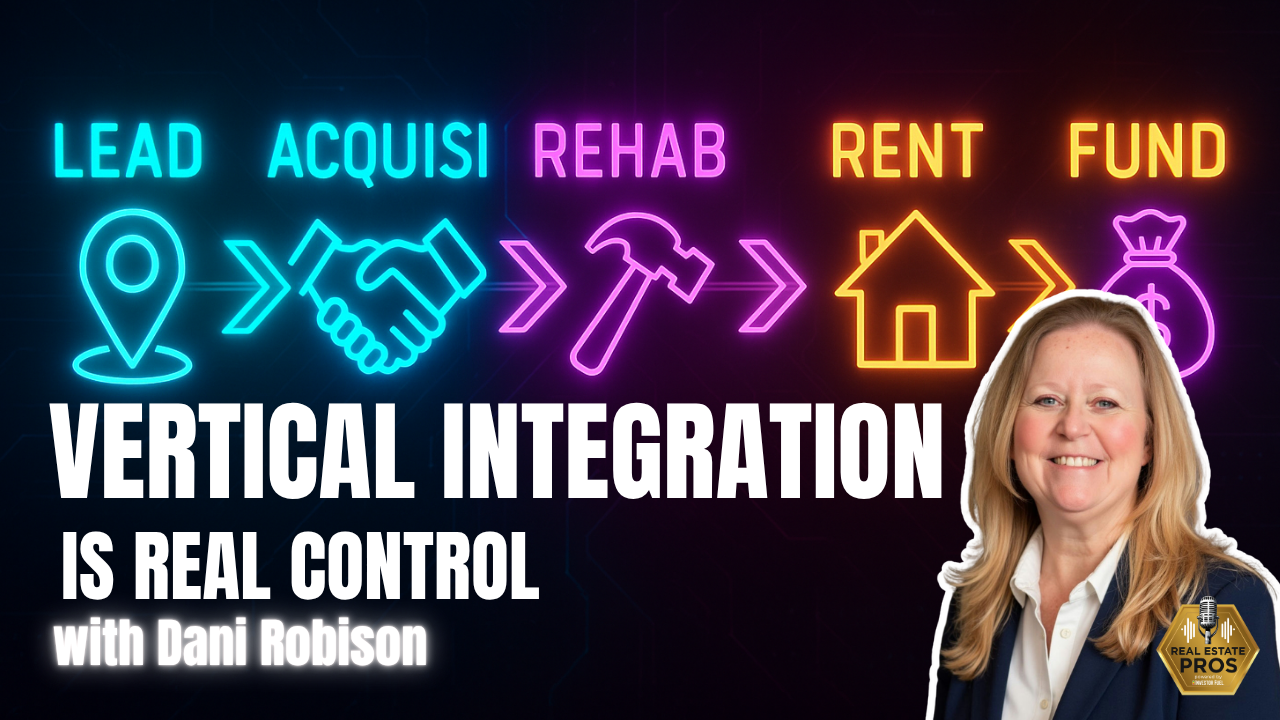
In this conversation, Dani Robison shares her journey into real estate, discussing her initial career explorations, the mindset that led her to success, and the strategies she employed in her early investing days. She emphasizes the importance of joy in work and the drive to build wealth, which led her to vertically integrate her businesses for better control and efficiency. Dani also highlights her transition from single-family homes to multifamily investments, showcasing her growth in the real estate industry.

Resources and Links from this show:
Listen to the Audio Version of this Episode
Investor Fuel Show Transcript:
Dylan Silver (00:01.454)
Hey folks, welcome back to the show. Today’s guest is the CEO of multiple businesses and brands with experience managing remote teams worldwide and building powerful lead generation systems. With over 50 million in assets under management, she focuses on making real estate investing simple and stress free through residential acquisitions and dispositions. Please welcome Dani Robison. Dani, welcome to the show.
Dani Lynn Robison (00:29.1)
Thank you so much, Dylan. Great to be here.
Dylan Silver (00:31.714)
I always like to start off at the top by asking folks how they got into the real estate space.
Dani Lynn Robison (00:38.83)
Absolutely, so it’s a funny story about how my husband and I met, but I’m going to fast forward all the way to the point where we got into real estate. After college in Florida and working at Disney and getting on cruise ships as musicians, we got into the art world and then maneuvered into traveling around and doing art auctions, fine art auctions like Picasso, Dali, Chagall across the United States. And during that time, we had been traveling on cruise ships for 10
years and so we really wanted to settle down and just find something new that we just really loved and so I said I would be the one to explore different ideas and different career paths. So as he continued into doing the fine art auctions across the US I went and explored three different industries that I thought might be interesting and I might like and the third one of course was real estate and that’s where I fell in love. That was in 2008, started off as a realtor. Eight months later and one deal, decided I didn’t want to be a realtor anymore.
with unreasonable sellers, dealing with buyers who want to want you to leave lunch to go show houses was not my cup of tea. So I found a mentor where we were living, which is in Austin, Texas at the time, and learned 12 different ways to buy and sell real estate. And that is when my real estate investing career began.
Dylan Silver (01:56.6)
So talk about being creative and prototyping a life out for yourself. You said, let me try a couple different paths. Third one, stuck. What were the first two?
Dani Lynn Robison (02:08.974)
The first two were financial services and then the second one was the mortgage industry and somewhere in there somehow I got tied into mergers and acquisitions too. I think in the mortgage industry I was just learning about businesses and buying and selling businesses and I thought, ooh, I like &A, let me just test it out. Didn’t like that either.
Dylan Silver (02:28.75)
So I want to tap into the of the headspace and the mindset that you’re at while you’re going through this. Because it wasn’t like you set out step one was real. I mean, if you knew it was going to be real estate would have been the first thing, right? So going through it and then you land on real estate, was your mindset like, hey, I know this is going to work because these other two weren’t. So this is for sure going to work. I was a little bit more like, let’s try this out.
Dani Lynn Robison (02:40.899)
Yes.
Dani Lynn Robison (02:53.111)
Yeah.
Well, I chose the three going into it. I said, me try three different things and one of them I hope to hit and I’ll give each one one year to give it a fair chance because when you start something, you’re not good at it. And so you got to get really good at it to start gaining traction. And so the reason the real estate stuck and I didn’t start figuring out a fourth idea was because it was fun. And I’m a big believer that whatever brings you joy is where you
you follow that path because anything that brings you joy means you get up excited all the time and you’re always wanting to learn and obsess about getting better. being happy in life is not always easy because you have the roller coaster of life itself. So it’s really great when you love what you do.
Dylan Silver (03:40.014)
Yep. Let’s talk about that because I am also super passionate about the investment side of real estate. I’m currently involved in the distress space. So people that have, you know, airship or dilapidated homes or just all different financial, emotional distress, something that could lead to a home being in disrepair where other people might see that as an eyesore. see that as an opportunity to not just problem solve, but also investment vehicle as well. And I love that.
I love that. love going into homes where it may be in falling apart and seeing, is there some value here? What was it about real estate and the investment side of things where you said, OK, this is really interesting?
Dani Lynn Robison (04:23.893)
Yeah, so for me it was about money. know money is a taboo for a lot of people and people don’t always want to admit that they’re in something for money, but I was. Real estate I thought was a way I was going to be able to learn how to build wealth and make money and I wanted to make a lot of money. Not just for me, but for my family to be able to give back. I just have always been a big thinker and there’s peace of mind that comes with money. There is the ability to do
more with more money. And I know a lot of people don’t think that that’s like maybe the servant way to do things, but I just believe if I’ve got $10 million instead of $100,000, I can do a whole lot more for the things that I care about. And so I’m going to focus on money and making money so I can do bigger and greater things.
Dylan Silver (05:14.382)
I couldn’t agree anymore.
Dani Lynn Robison (05:16.393)
Yeah, so that’s really what real estate was for me. It not only brought me joy, but I thought that was a path to wealth. And the way we got started, because I learned the 12 ways to buy and sell real estate, and it was in 2008, it was the subject to RAPS assignments that was the key strategy to success during that time frame. So it was really, really nice and fulfilling to actually be able to help people and make money at the same time. So I don’t know that
that if it was something that didn’t fulfill me on the heart level, I don’t know if I would have kept going for money and money alone, but that absolutely was a part of it. And I think the two combined is where I really fell in love.
Dylan Silver (05:58.24)
It’s such an amazing industry to be a part of when you see it from that perspective. really, really is. Because everyone needs a place to stay. And these are rather tricky. mean, you talk about subject to raps, like how many realtors go into that, right? And so as someone myself who has some level of familiarity with it, although I haven’t done a deal, a subject to rap, as soon as we start talking about this, I like the lingo, I can go down so many different rabbit holes talking about this, but
I want to pivot a bit and ask you about the growth during those first couple of years. Was it a lot of single family residential? I know now you operate nine businesses vertically integrated. What were the first couple of years like for you?
Dani Lynn Robison (06:44.587)
Yeah, so I’m glad you asked that question because the more successful you get, the harder it is to go backwards and remember what it was like when you first started. So I love it when podcast hosts will tap into the very beginning stages because where I am now, it speaks to a totally different crowd of people who are building their businesses and scaling and are taking the lessons that I’ve learned of growing the nine to adapt them to what they’re doing. But it doesn’t help the beginning investor at all. Like it’s a totally different.
It’s not even relevant. So back then it was tough as nails. The reason that we succeeded is we have a never give up attitude. We refuse to quit. We refuse to lose. And I think no matter what you’re doing in life, if you have that attitude, then you are bound to succeed at some point in time, especially if you align yourselves with other people that are smarter than you, that are better than you. You and I were talking before the podcast. I love to be the dumbest person in the room at all times.
for rooms in which I can learn from other people who are in a place that I want to go. So back then, our number one strategy was walking down streets. it’s not really a driving for dollars type idea, but it was just canvassing neighborhoods. And so we would go to Sam’s Club and buy that really bright neon colored paper. And then we would hand write with like black Sharpie and we would say, hey, I was in your neighborhood, interested in buying your house, something like that.
I actually have, I used to coach, I don’t anymore, but I have like everything that we did perfectly aligned. We’d write that message and then if you write that on a colored piece of or a white piece of paper with a black shopping marker and you copy it onto this colored paper, it looks like you hand wrote it. And so we just rolled those bright pieces of paper and then stuck it in the door jam between the door knob and the actual edge of the door so that when people, when they drove home, even if they went in their garage,
which most people do, how they enter their house, they could still see this bright green or bright orange, whatever, bright pink thing in their door, and so they would go get it. And so it would have this message. And that was our number one technique for buying houses back then. And there would be times where people would even stop us on the street and ask us what we were doing. And so I would tell them, it’s this raising values campaign. I said, you see these houses in your area that are abandoned or not selling and they’re distressed, it brings your values down. And so we want to come in, we want to repair them,
Dani Lynn Robison (09:14.127)
fix them up and then sell them or rent them, just depending on what strategy may be. Do you know of anybody? And then we’d have people literally saying, go call this guy, call this guy. this lady just went to the hospital. She’s been there for like two months. And so it was like the number one strategy. And it’s something that nobody wants to work that hard. So if you’re willing to work hard, you end up finding the things that work that nobody else is doing.
Dylan Silver (09:33.495)
No.
Dylan Silver (09:38.03)
I mean, that’s where I’m at. I was talking with my broker about, can I wholesale? And basically the answer is basically kind of no, you know, you can’t really, at least the broker that I have right now. And so I was thinking, well, what are my next steps? And then thinking about what I was doing before I was an agent, which was, you know, calling the foreclosures, knocking the foreclosures, calling and knocking the foreclosures, you know, getting their
opt in and then texting them. So now it’s like three different ways that I’m getting a hold of them and then I’m sending mailers out to them. And so it’s really like a contact sport. But I want to ask you, Dani, about from going from there to then nine businesses vertically integrated, what are the businesses and what was maybe the first couple that you vertically integrated?
Dani Lynn Robison (10:16.256)
Yeah.
Dani Lynn Robison (10:30.592)
Yeah, so the reason we vertically integrated is because we started doing turnkey real estate. So like I said at the very beginning, yes, I was in it for money. That was the number one goal. I want to take care of me. I want to take care of my family. I want to do more things in life and give back to others. And real estate was the vehicle in which I knew I could do it. But it was the part that I was helping other people that was the, you know, both had to come together. It’s like the two coming together was the
magic of it. so Turnkey Real Estate was that the more I understood how to build wealth through real estate, Turnkey Real Estate was me buying properties, rehabbing them, putting them under management, and then selling them to maybe a doctor or a lawyer or an entrepreneur or business owner. It’s just somebody who understood the power of wealth building through real estate but didn’t have the time to do it themselves. So I thought here it is again. I’m doing something for me that allows me to build my real estate portfolio, allows me to make money,
and I get to take other people on the ride with me that don’t have the time to do it themselves. so Turnkey Real Estate was what we got into, which is done for you rental real estate, essentially for anybody that doesn’t know what that is. So that’s what we started building. Well, we outsourced everything we bought from wholesalers. We had we hired construction crews. We outsourced source property management. We hired agents to list the properties if we were going to go ahead and flip them on the market. And you realize very
very quickly how much control you don’t have and how fast you can lose money on deals through the lack of control. And so construction was the first one that I started losing so much money by just bad crews. We could talk for two days on all of the horror stories I’ve had with contractors. So we brought in Bulldog Renovations was our renovation company. That was the very first one. Then Property Management, we outsourced to five other management companies.
So much fraud, so much mismanagement, so many money issues. It was bad, so we brought that in-house. There was a point in time when we brought property management in-house, we brought our retail brokerage in-house so that we could have both of them working together. We could list properties ourselves. Then the wholesalers dried up on all their deals, so we were like, crap, we don’t have any deals. And so we went and just built an acquisitions company, and that acquisitions company would go and find the properties and wholesale it to my other company. And then we’d put it through renovations, then management and stuff like that. So that’s how the vertical integration
Dani Lynn Robison (13:00.143)
came is out of pain and the desire to build. And once you have all of that vertically integrated and you can control all the pieces of the puzzle, then it’s just a matter of management of the people and making sure that you’re doing a good job in all of those pieces, which is another pain process that we could talk for hours and hours and days and days on. So after that, go ahead.
Dylan Silver (13:20.214)
Now, these businesses, with these businesses…
also separate in the fact that you talk about acquisitions and finding deals, was the wholesale arm also finding deals and then assigning them to third parties or was it just to your integration?
Dani Lynn Robison (13:41.995)
Great question. It was just to us. So the purpose was for us. And so we had different companies for legal asset protection reasons, for liability reasons. So the acquisition company actually found houses to sell to us eventually. And now we’ve turned it into a wholesaling company. So that is still our wholesaling arm. National Houses is that company now. And we are expanding nationally. I think we’re on,
12 states now, but that’s pure wholesaling because we stopped doing turnkey because company number six ended up being a fund and syndication company. I bought our first apartment complex. was a 56 unit apartment complex. Long story, really great story. Drugs, thugs and bugs is the name of that one. And we just, fell in love with apartment complexes. So we have dialed back doing residential and now we do bigger things. do, we have a fund and syndication company, which does multifamily seniors.
housing, built to rent, self storage and we’re really really growing that company now.
Dylan Silver (14:47.178)
I could probably talk to you at length, probably fill up three podcasts with some of the granular strategy about wholesaling, with some of the granular strategy about managing crews. I’m bilingual, Spanish and English, so I put increased attention into learning Spanish because I realized this is going to benefit me in real estate in so many capacities and working with contractors is one example of that. And then also the arm of
Dani Lynn Robison (14:53.229)
Yeah, for sure.
Dani Lynn Robison (15:02.156)
Nice.
Dylan Silver (15:14.37)
how to do this while also being a real estate agent, right? And so how do these intersect and the granular, and then some of the creative deals, like you talked about subject to wrapped, I could go down each one, but we are actually coming up on time here, Dani. Where can folks go if they’d like to learn more about your business and businesses or reach out to you?
Dani Lynn Robison (15:27.413)
Mm-hmm.
Dani Lynn Robison (15:36.917)
Yeah, so freedomfamilyinvestments.com is our main company right now. We have four that we’re really ramping up, but if you want to get to know me and what we’re doing right now, Freedom Family Investments, but you can also go to chatwithfreedom.com, takes you to the same website, but that’s how you can get to know us better.
Dylan Silver (15:57.304)
Dani, thank you so much for coming on the show here today.
Dani Lynn Robison (16:00.755)
Absolutely, thank you for having me Dylan.