Subscribe via:



Show Summary
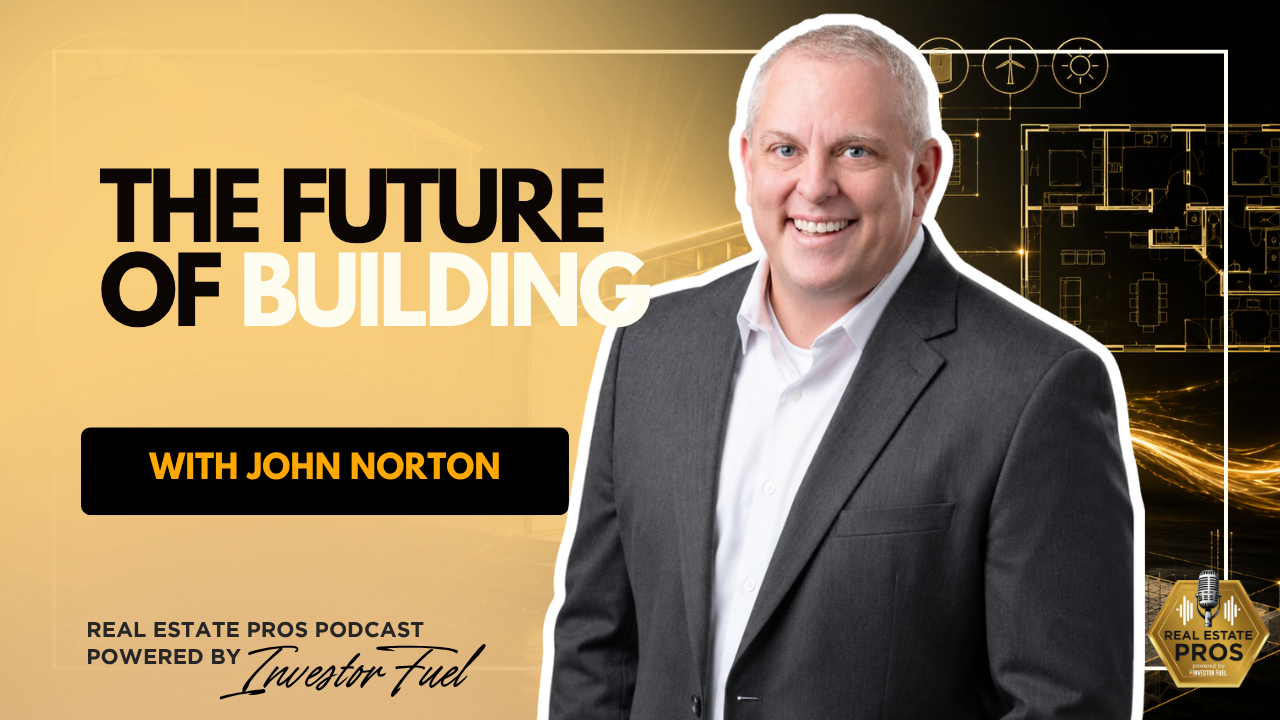
In this episode, Scott Bursey interviews John Norton of DreamStart Building to explore innovative construction techniques using structural insulated panels (SIPs). They discuss the benefits of solid core construction, speed of building, cost efficiency, and untapped opportunities in residential development.

Resources and Links from this show:
-
-
- Investor Fuel Real Estate Mastermind
- Investor Machine Real Estate Lead Generation
- Mike on Facebook
- Mike on Instagram
- Mike on LinkedIn
- DreamStart Building’s Website
- DreamStart Building on Facebook
- John Norton on LinkedIn
- DreamStart Building on Instagram
- DreamStart Building’s Email Address: [email protected]
- John Norton’s Phone Number: (816) 388-0462
-
Listen to the Audio Version of this Episode
Investor Fuel Show Transcript:
John Piazza Norton (00:00)
You know, it’s really the speed overall. There are other reasons, but the speed, especially if folks are needing to go faster. If they need to go faster because of holding costs, or they need to go faster because of, I need to get out of my other house. There’s all kinds of reasons, but if I can get somebody from a contract to a dried-in shell between six and seven weeks, that’s just nuts.
Scott Bursey (02:00)
Welcome back to the Real Estate Pros podcast powered by Investor Fuel. I’m your host, Scott Bursey and Pros, you know, we’re all about high octane performance in this industry. Today, we have a guest who isn’t just building homes. He’s constructing the future, bringing us serious injection of structural integrity fuel. He’s pioneering solid core construction using structural insulated panels. John Norton of DreamStart Building is here to show us how to build smarter, faster and stronger.
Get ready to fuel up. John’s in the house. John, welcome to the show.
John Piazza Norton (02:32)
Hey Scott, hey everybody. I appreciate you having me on.
Scott Bursey (02:35)
It’s just awesome having you on and for our pros listening in, tell us a little bit about yourself and DreamStart Building.
John Piazza Norton (02:42)
You know, I used to build pole barns back in the day and people like these rural buildings and the metal buildings. They always wanted to live in them though. So I started putting some stuff together and some people together because that’s the most important part. ⁓ And now, DreamStart Building, ⁓ able to put sip panel dried in shells up on…
Slabs we prefer slabs we can do basements and whatever ⁓ But slabs are easier and they’re cheaper if we’re looking to build multiple houses or house and garage Keeping those costs down is really our focus
Scott Bursey (03:20)
Thank you for that, John. That’s awesome. It really shows your commitment to innovation. Now, what really caught my attention about you, John, was the way you’ve been able to dominate the niche of solid core construction using structural insulated panels. Proving that sustainable, high efficiency building doesn’t have to be compromised. That’s not easy.
John Piazza Norton (03:41)
No, no it isn’t. Making sure that folks understand why that solid core is so important. ⁓ Thermal bridging is something that people don’t talk about very often. Her scores, which are how the blower test type of stuff works. 100 is the basic score of a new build. An older build is about 130 on leak.
When your dad said close the door, it didn’t matter. It didn’t matter if you close it or not. The air was going back and forth. There’s an air exchange. With a SITPanel build, you’re looking at between 40 and 50. So, so much tighter of an envelope, better for your energy, better for if you’ve got kids with asthma. I mean, there’s so many reasons why SITPanels make so much sense.
Scott Bursey (04:30)
Thank you for that expertise. And now let’s dive into some of the core components here that our listeners would like to know. What is the biggest strength of SIPs building over traditional stick-built construction?
John Piazza Norton (04:45)
You know, it’s really the speed overall. There are other reasons, but the speed, especially if folks are needing to go faster.
If they need to go faster because of holding costs, or they need to go faster because of, I need to get out of my other house. There’s all kinds of reasons, but if I can get somebody from a contract to a dried-in shell between six and seven weeks, that’s just nuts.
And if you’ve got ⁓ finishing crews that are able to finish that out and you want other houses to be done, you can get so many houses done per year if you allow that to be the case and just kind of frog jump each one off of the other.
Scott Bursey (06:15)
That’s game changing right there for our listeners. Thank you for that, John. And what is the hardest weakness or common misconception about SIPs you constantly have to educate your clients on?
John Piazza Norton (06:27)
You know, they’ve been around for a very long time. They’ve been around for about 90 years. EPS is my manufacturer and they’ve been around for about 45 and I’ve been around for about two or three ⁓ just because being able to change the mindset isn’t that fast. And I’m not looking to go super fast. I need to do about, I would say 20 of these a year and I’m not going to do any more than that.
I know that sounds kind of crazy, but I want to be able to focus on the ones that we’ve got. And at the end of the day, I don’t need so many so much dollars. I need the dollars for my family and to go enjoy ourselves and to make sure that other folks have great houses that they can live in. That’s all I need.
Scott Bursey (07:12)
And that’s a lot right there, and that’s rocket fuel. Let’s pull the lever, smash the gas, and watch the RPMs redline. Where do you see the biggest untapped opportunity for SIPs right now?
John Piazza Norton (07:23)
It’s definitely in the residential area just because I’m a realtor as well and looking at all these different pockets around Missouri, there’s just no houses. They just don’t have any place to live. So people are able to take the rents and just go crazy with them because people don’t have any other choice if that’s where they want to be. So being able to find some land from a farmer, great. Peace that off.
What do we need to do for septic? What do we need to do for solar? What do we need to do for how can I be off the grid enough? To be where I want to be and build we call them homestead shells and we call them homestead shells because Well, we invented the term for one, but it’s a slab construction. So there’s no stairs Because we don’t want to do a second story so we don’t go up or down. It’s all on one level Because when you go to resell it
Know you’re gonna tell me it’s a forever home. I get it and I hear it every day, but you’re gonna end up selling that house Just count on it Look at your investor pool when you do all one level Anybody can live there Anybody can it’s not Hey, I can’t go upstairs. can’t go downstairs. I I’m too old. I’m too old. I don’t want to do that. So
being able to do the homestead shell and develop it in such a way where it can be resold it can be it could be a forever home because you don’t have to take the stairs and we do it in such a way where the economy makes sense as well it’s just the concrete right now tends to be just a little bit bigger with that kind of footprint and concrete’s a little expensive i’m sorry i don’t do it
Scott Bursey (09:04)
That’s a winning formula. And honestly, that’s pure investor fuel, John. What external threat, be it competing green technology or a regulatory hurdle, keeps you focused on innovation the most?
John Piazza Norton (09:18)
You know, talking about being around for 90 years, innovation’s great, but if no one hears about it, and I’m on all of these science things and I see, ⁓ we’re gonna 3D print the house. Do know how much that costs?
No, we’re not. We’re not doing that anytime soon. So who has the machine? I can call, I can get some panels.
with the windows and the walls, the doors already cut out of the wall, we come, we stick them all together. They’re numbered. They’re like Legos. It’s not hard, but we put them all up. We put on the metal. When we leave, it’s a dried in shell. You drive up, looks like you drove up to an actual house. You go inside, looks like everything was stolen. We don’t do anything for drywall. We let you guys take care of the rest of that.
Scott Bursey (10:27)
you
It sounds like staying ahead of the curve means constantly improving installation standards and educating, you know, across all your trades.
John Piazza Norton (10:52)
For sure? No, are we?
Scott Bursey (10:53)
which quite frankly
makes perfect sense. really does. Let me ask you this, John, what is some short-term strategy you’re employing now?
John Piazza Norton (11:01)
⁓ The short-term strategy that I’m employing is really getting into the website, really making sure that people can see the pricing very upfront. It’s on the homepage. You say how much money you got, it tells you how big your house can be. It couldn’t get any more basic than that. And so taking those folks,
and making sure that they’re serious about building, making sure they’ve got a great lender if they need the money that way. If making sure that ⁓ the design is clean, we take care of all that as well. It’s part of our program. So bringing them into the fold, they just have to be ready here. If they’re not ready to build, you don’t have to talk to any builders at all. None.
Because if you’re not ready, if you’re ready in three months, the price is different. I promise you the price is going to be different in three months. So trying to get a bid doesn’t make any sense. If you want to know about how much it costs, you can go to the website, take a look, go back there in three months, take another look. If you’re ready to build it, say, hey, let’s get started. I’m glad to help.
Scott Bursey (12:08)
And let’s stay in the same lane, John. From an operations standpoint at DreamStart Building, what is the most important strength that allows you to execute projects faster than your competitors?
John Piazza Norton (12:19)
Just the network that I’ve put together. For me and myself, I’m not a builder. There’s no hammers here. I don’t have any. I’ve put together the manufacturer and the labor crews and help them find the concrete. We need to finish it out. I can help you find that too. I have that network. Most folks, especially if they’re moving, hey, I don’t know anybody in this town.
So they go to Facebook and start asking a bunch of questions. Don’t do that. Stop. I’ll help you find somebody in that area who knows what they’re talking about. Or I’ve got folks, even part of my design team, they have crews all across the United States that can help construct these. you’ve got, let’s say you have a warranty problem, for example.
that crew is still there in your area instead of me sending them the other direction across the country if we only had one crew. Localizing the help makes sense. Nationalizing how it’s put together makes sense as well.
Scott Bursey (13:20)
That was just an excellent blueprint for our pros. Now let’s pour some high octane fuel in our listeners tanks. If a pro is looking to move beyond traditional construction and scale, a highly specialized operation like Solid Core, what is the most critical investment in time, people, or technology that unlocks the greatest profit margin?
John Piazza Norton (13:41)
Yeah, it’s really aside from letting us help you. That’s number one. Two, do it all in one spot. Don’t try to run me all over the place while I’m doing… If you got a area, acreage, where you can do a cul-de-sac and a road out to the road,
that’s an excellent use of your money. It’s an excellent use of your time. And we’re able to help put all that together and localize it.
for you to, if you want to come visit, it’s one trip. And you can see all six of the houses going up. And then you’re able to bounce residents off of houses and it really starts to go crazy. So ⁓ I would say localizing as much as you can.
Scott Bursey (15:04)
John, this has been an absolute master class, but we can’t let you go yet. For our listeners that would like to get a little bit more in depth, some additional advice, what kind of golden nuggets can you leave with them?
John Piazza Norton (15:17)
If you’re thinking about stick build, think about what your time is worth. Because it’s been around for a long time for a reason. It’s a very inexpensive way to get the materials to do what you want.
our materials are going to cost more because they have six and a half inches of insulation already in the walls when you get them. So the components cost more, but your time and how long it’s going to take them to put that house up, I’m going to beat them every time.
Scott Bursey (15:48)
You just moved the needle for a lot of our pros. And for those of our listeners that want to keep this conversation moving, zoom into your lane or collaborate with you and learn more about your operation. What is the best way for them to plug into your pipeline and reach you directly?
John Piazza Norton (16:03)
You can go to the website dreamstartbuilding.com [email protected] is the email address. I get all kinds of wacky requests all day long. So definitely that’s a great place to do that. Or just give me a call 816-388-0462.
Scott Bursey (16:20)
Awesome, John. And John, thank you for joining us today.
John Piazza Norton (16:23)
Absolutely. Thanks, Scott. Appreciate it.
Scott Bursey (16:25)
And to our listeners, we appreciate you. If you got value from today’s episode, please subscribe. We’ll be fueling your tanks with a lineup of elite guests, just like John, who are accelerating and setting the pace for the rest of the industry. Until next time, keep your standards high and your vision clear. We’ll see you in the next episode, everyone.