Subscribe via:



Show Summary
Daniel Wagler shares his journey from luxury home building to innovative Core 10 steel container homes, highlighting the benefits, challenges, and future opportunities in modular steel construction.

Resources and Links from this show:
-
-
- Investor Fuel Real Estate Mastermind
- Investor Machine Real Estate Lead Generation
- Mike on Facebook
- Mike on Instagram
- Mike on LinkedIn
- Daniel Wagler on LinkedIn
- Daniel Wagler’s Phone Number: (815) 403-4008
-
Listen to the Audio Version of this Episode
Investor Fuel Show Transcript:
Daniel Wagler (00:00)
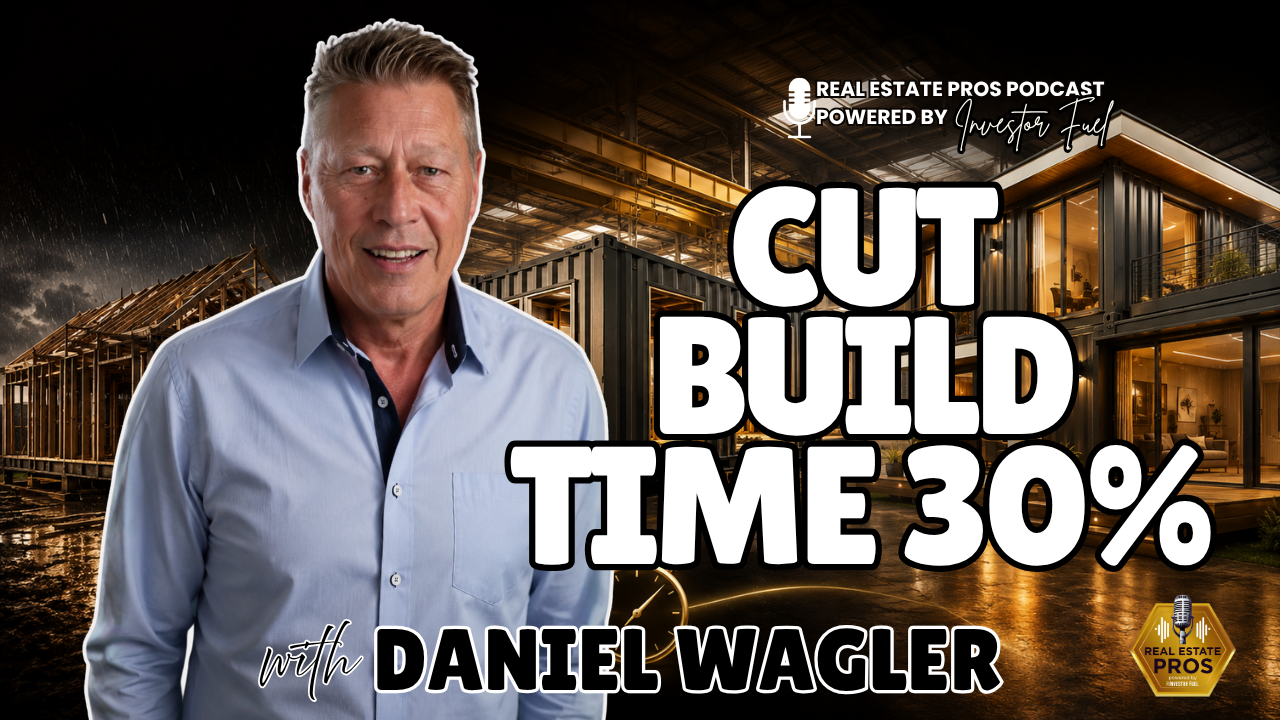
The durability, the sustainability are two main factors. And then the third one bring up as we talked earlier, Scott, is modular. modular construction is fast construction. I can usually cut thirty percent out of the time it takes to build a standard size home, let’s say twenty five hundred to three thousand square feet.
On any small build like an ADU, a tiny home, or even a two-container build, that I can do almost 100% in the factory and usually less than two months, where you still need site work done. So by the time your site work is done and your foundation is poured, I have a finished house ready to go for it.
Scott Bursey (02:17)
Welcome back to the *Real Estate Pros Podcast* powered by Investor Fuel. I’m your host, Scott Bursey. Glad you’re with us. And today we have a guest who has been building homes since 1990, starting as a mason contractor and evolving into a specialist in luxury and multi-unit construction. We’re sitting down with Daniel Wagler to talk about his transition into Corten steel container homes. Listeners, you can expect a masterclass on how to innovate
in the construction space while keeping your projects grounded in reality. Daniel welcome to the show.
Daniel Wagler (02:53)
Thank you, Scott.
Scott Bursey (02:53)
It is just awesome having you here, my friend, and I help our listeners get up to speed. Please give us the ninety second highlight reel of how your career ignited and where you’re pouring your fuel now.
Daniel Wagler (03:07)
quick ninety seconds is again, like you said, I’ve been a builder in the Chicagoland area mostly, although I’ve worked all over the Midwest, Michigan, Indiana, Arkansas, Missouri, all doing luxury homes or remodels or vacation homes. the last several years I’ve been doing luxury custom homes on the North Shore.
And transitioned into of all things, like you said, Corten steel cargo containers. it’s a newer industry, it’s catching on the United States. the number one thing is that cargo containers are actually only sent into the United States, they are never sent out. There is about 10 million of them filling up landfills around the country, mostly in the southwestern deserts, and they make perfect structure.
For your next home.
Scott Bursey (03:58)
Man, that is one heck of a journey. And I find this truly fascinating, Daniel. from the masonry grind to the container home frontier. Thanks for sharing that evolution. And what really caught my attention about you was the way you’ve been able to transition from traditional semi-custom builds to modular steel. And I want to pick your brain on that transition. When looking at your shift to Corten steel.
What do you think is the biggest strength of this material compared to traditional wood or brick framing, perhaps?
Daniel Wagler (04:32)
Because it’s already the box that you need to build with and the containers themselves are extremely rigid. quick background with the Corten steel. Corten steel is actually designed to not rust over time. It was absolutely designed to be in a salt environment on cargo ships. so the fact that you can alter it to put in windows, doors, and unlike again traditional stick frame construction.
your box is welded together and then it is welded down to a foundation, automatically creating a very robust and strong entity. And then on top of that, you would frame it out just like your traditional house on the inside. And you still have the ability to put a roof or cladding or anything on the exterior. So when you’re all done with your build, it can look like any other house on the block.
Scott Bursey (05:24)
Is that durability factor the primary selling point you lead with when talking to potential buyers?
Daniel Wagler (05:31)
The durability, the sustainability are two main factors. And then the third one bring up as we talked earlier, Scott, is modular. modular construction is fast construction. I can usually cut thirty percent out of the time it takes to build a standard size home, let’s say twenty five hundred to three thousand square feet.
On any small build like an ADU, a tiny home, or even a two-container build, that I can do almost 100% in the factory and usually less than two months, where you still need site work done. So by the time your site work is done and your foundation is poured, I have a finished house ready to go for it.
Scott Bursey (06:16)
Thank you for highlighting that. It really puts into perspective why modular is taking off. And Daniel, interested to know, every innovation has a hurdle. What’s the biggest weakness or pain point you found when working with containers that most builders overlooked?
Daniel Wagler (07:21)
I don’t know if the pain point is part of the sales or the pain point is part of the build. the pain point part of the building aspect itself is the fact that you are building out of steel. It is not traditional construction. You need fabricators, welders. I do all my reinforcement in the containers. So, like on a traditional build where you’re gonna use micro lambs and LVLs and I beams, all of that is
basically welded into the system in the shop before it goes out. now the biggest hurdle on the sales side is, and I’ve gotten this a couple times, what makes this better than a typical RV home or a trailer park home? We’ll go straight back to the Corten steel. All right. Most people don’t know this. A cargo container is designed to hold around 65,000 pounds.
They’re also designed to be stacked eight tall. So the pressure points on a cargo container can hold four hundred and seventy thousand pounds. That is insane compared to a stick-build building, right out the gate. so getting people over that hump is usually not a big deal. And like I said, the other drawback is typically a restraint by size.
because I am not creating the containers from scratch, like an RV park home you could build at 12 feet. I have to stick to my eight by twenty or eight by forty format and kind of go from there. Although I have done custom homes where one wall of the container is opened up and they put a stick build in front of it.
Scott Bursey (08:57)
I guess how do you communicate that level of honesty to your clients so there’s no surprises?
Daniel Wagler (09:04)
It always goes back to the design phase. What are you looking for and what is its purpose? with what I do, again, I want to be building for people that are living in these permanently 247. But a lot of people come to me and they’re like, I want a tiny home for my vacation spot or for my fishing lodge or whatever. Then I have to start asking those questions. Is it shut up?
For long periods of time? Is there access to power all the time? now we didn’t talk much about the interior builds, but for the most part, unless specified otherwise, I use all steel stud construction. I owe only rigid spray foam. I don’t use any materials that will rot. So I only use solid wood, cabinets, quartz countertops, PVC.
Acrylics, epoxy floors, vinyl, but nothing that can get damaged with moisture. Because like any other entity that’s that airtight, if you lock it up and you shut it up and you don’t keep it conditioned, you can have a problem. Okay, that’s something that’s set up front. So back to asking the questions. I use ERV systems in almost all of my builds.
But that means they have to have power. Okay, so is this in a place where you may lose power for a week at a time in a winter storm? Do you need a battery backup? I build with very cool solar systems. So I can give you three days of battery backup on a solar system mounted to the roof. I have a lot of options for every type of build.
Scott Bursey (10:45)
Being up front, that is very noble. And curious to learn, where do you see the biggest opportunity for growth in the container home niche over the next three years?
Daniel Wagler (10:58)
I’ve been approached by a lot of people, especially in the city of Chicago, back to low-income housing. I think it is what’s going to happen in the next 10 years. It’s on the forefront of every real estate person out there. I’m actually an active home inspector in Illinois. All right. There are not homes available for under 200 grand. All right. You’re lucky if you can find a condo in Chicagoland.
For under that price. But they’re still building all over the place in either neighborhoods that were completely torn down or on the fringes where there’s still cornfield. And that’s happening in Michigan and Ohio and Illinois and Wisconsin. It’s still happening. I got a project that might happen in Janesville, Wisconsin. They’re expanding the college, they’re adding a hospital, they’re putting a data center in.
There’s a demand for housing. It’s central Wisconsin. People aren’t looking for a four hundred thousand dollar house to go there with their wife and start a job.
Scott Bursey (11:58)
Daniel, are you seeing a shift towards commercial use or is it still primarily residential focused for your pipeline?
Daniel Wagler (12:06)
Most of my pipeline up till now has been commercial. The Navy Pier Marina is commercial. The shelter for girls is technically residential, but it’s commercial. It’s fifteen, sixteen bedrooms or something like that. I’ve done golf course halfway houses, I’ve done restaurant kiosks, so it’s a lot of commercial lately, especially and
Little coffee shops that want to pop up, vendors that want to pop up. Those are been what’s really popular with the cargo containers. there’s a cool restaurant in Las Vegas that’s all cargo containers. Commercials happening. Residential is slow to get going. Now in Europe, and I know of a project in New Jersey, they’re starting to do some high rises, like 300 unit apartment buildings, but that’s still not single family homes.
Scott Bursey (12:56)
Great insight. It’s definitely a space worth watching closely. And wondering if you could share what do you view, Daniel, as the biggest threat to this specif specific type of construction right now? Is it zoning, supply chain, or maybe something else entirely different?
Daniel Wagler (13:56)
I think more it’s the word of getting things out. The supply chain is very consistent because there’s still so much of it available. I think there’s a fear factor of starting to build. we talked about it a little bit earlier. finding a developer to team up with that actually take that leap and say, what, we should put 10 of these next to each other and see what happens. but
I had a two-story model home built for about eight months. Every time I did a tour, everybody was blown away. The quality and the interior finishes are exceptional. And coincidentally, with my name Contempo Containers, I try to build with smart systems, all LED, low voltage, very streamlined builds, very European style, doors, cabinetry, etc. Not typical
Americana as I like to call it.
Scott Bursey (14:48)
Staying ahead of those threats. I love it. And we’d love to understand, Daniel, if you were launching this business from scratch today, what is the one thing you’d do differently to scale it faster?
Daniel Wagler (15:00)
that’s good question. I hadn’t thought about that. I suppose probably getting into an investment group and having a decent amount of capital to get started rather than starting on my own. there’s always that fear factor there. again, back to I started a couple companies on my own. It is slow going at the beginning, but in every single instance the exact same thing happened.
Once you show what you can do, other people want that product. They like working with you. Back to honesty. It’s hard to find pure honest advice in people these days. And I got a different one for you, Scott, that I didn’t tell you about. My 20-year-old son has also worked with me for the last year and a half, and I am also trying to make something that is I can pass on to my own kid.
Scott Bursey (15:49)
I love that too. And your perspective on people do business with folks that they know they like and trust is spot on. And what’s the one lesson, I guess, Daniel, from your early masonry days that still saves you money on projects today?
Daniel Wagler (16:05)
Repetition and downtime, making the most of the available times. And I’ll I will tell you the night and day difference. I’ve been stick building for 30 years. Working inside a building is a game changer in Illinois. When you have zero weather factor in your build, your materials are never wet, you’re always on time.
People show up even when it’s nasty out because you’re working every day. That was a challenge working in the field, if you will. I like that phrase. that is a game changer in this industry. Working out of a warehouse is just unbelievable. And to be able to bring it out to sight and have it dried in within two days and have most of your inside finishes done, again, back to being a game changer.
Scott Bursey (16:53)
That’s a powerful takeaway right there. And excited to ask, what does your professional network look like right now?
Daniel Wagler (17:01)
I have a network of marketing people and tradespeople and a couple, if you will, sub-builders that are all helping me get started. They’re all people I’ve worked with in the past. They like working with me. They love this idea. It’s new, but they see how excited I am about it. So they’re willing to kind of get going. So the words out there, I’m just getting started. That’s why we’re talking today too, Scott.
so I’m very, hopeful at the very near future of things taking off quickly.
Scott Bursey (17:32)
Daniel, you have founded three businesses over your tenure. How valuable has it been for you being in the right room with the right people?
Daniel Wagler (17:41)
It’s always valuable. If people that can encourage you and B be behind your product, back to clients, want to work with you, want to build for themselves or whatever that’s my industry is building, but then there’s always the word of mouth, and again, this is real estate. Realtors take notice and they notice new things. So again.
Even if you’re marketing through one realtor and it’s getting sold by another, as soon as that’s on the market, their eyes open up. They’re like, hey, what’s this container thing with this open house? They start bringing clients to it. They get interested in it. So being in front of people that are good to promote is always a benefit.
Scott Bursey (18:25)
That’s a solid group to have in your corner. And if you could take us down this path. If a developer wanted to partner with you on a container project, what is the biggest make or break factor you look for in a deal before you say yes?
Daniel Wagler (18:42)
It I’m simply is it equitable for all parties? That’s it. Scott, I love doing what I’m doing and I’m still working at my age. so clearly my goal is not to become a multi-millionaire overnight and retire. as long as I’m sustaining myself and I’m happy doing what I’m doing, it just has to be equitable. I’m trying to give back. I love teaching.
younger guys, I have a lot of young guys on my crew. I am in that mode where again, I’m trying to do something good for the economy, good for the people that I work with, good for the youth of today, which is back to not only providing a place for them to live, but potentially a place to work, learn, grow, know a trade. so all of that kind of comes into its own circle.
Scott Bursey (19:29)
And your passion truly resonates. And I wanna ask you this in regards to the cor corrugated housing. Any additional words of wisdom, any thoughts that you could leave with our listeners?
Daniel Wagler (19:41)
It’s coming. There’s going to be a big boom in this industry. There’s either twelve, eighteen different companies around the country that are starting to do these types of builds. A couple of them are out of California, and I stay out of California. but this is a this is a sustainable product that is manufactured at a very reasonable cost and in
This environment it is sellable and it is needed.
Scott Bursey (20:10)
That’s the kind of high level advice right there that helps people level up. Thank you for highlighting that. And Daniel, for those of our listeners that want to keep this conversation moving, stay in your lane or collaborate with you, what’s the best way for them to reach you?
Daniel Wagler (20:25)
Reach out to me through LinkedIn. I’m very easy to find on that. I have no problem with anybody giving me a phone call. If you don’t mind me giving my number, I literally don’t mind phone calls. I like talking to people. In fact, I prefer them over text, just to be clear.
Scott Bursey (20:40)
Daniel, thank you so much for joining us today on the *Real Estate Pros Podcast*.
Daniel Wagler (20:45)
Thank you very much.
Scott Bursey (20:46)
And to our listeners, we appreciate you. If you receive value from today’s episode, please subscribe. We’ll be filling your tanks with the lineup of elite guests, just like Daniel Wagler, who are accelerating and setting the pace for the rest of the industry. Until next time, keep your standards high and your vision clear. We’ll see you on the next episode, everyone.