Subscribe via:



Show Summary
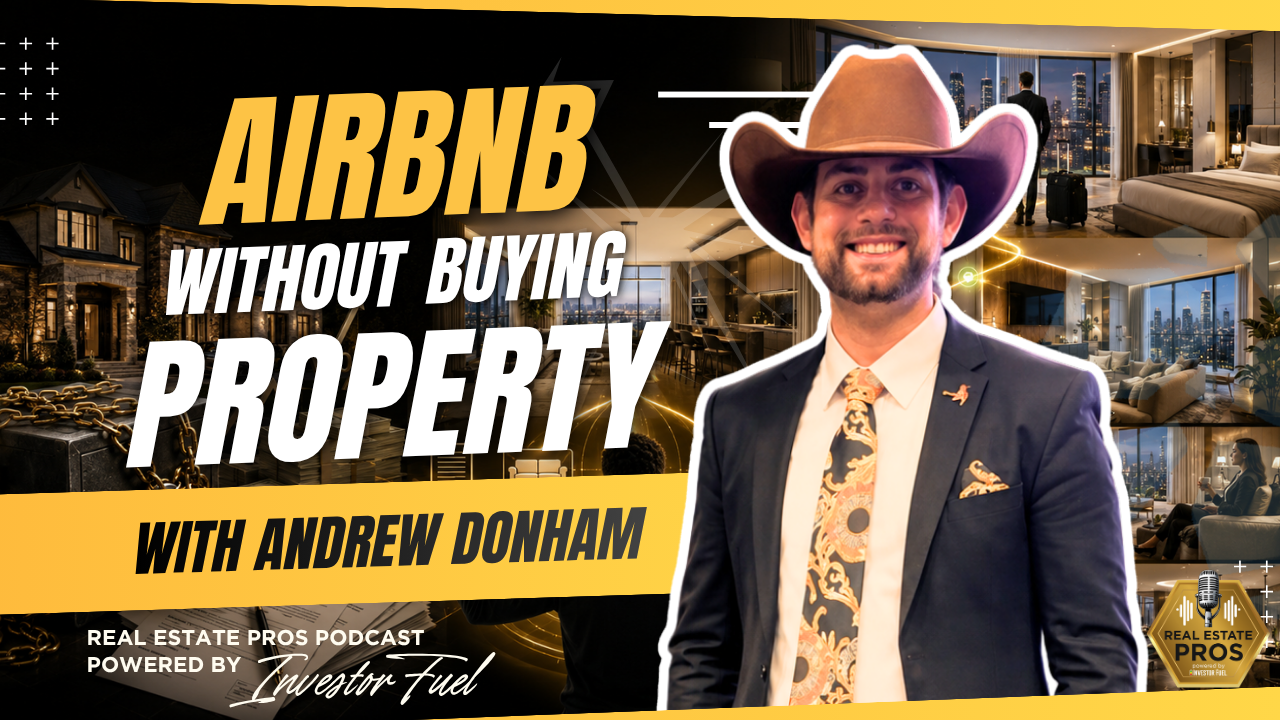
Andrew Donham shares his innovative approach to Airbnb arbitrage, scaling across multiple markets, and strategies for building a profitable short-term rental business in a challenging regulatory environment. In this episode, Andrew shares his journey in real estate, including his strategies, challenges, and future plans to scale his rental arbitrage business. Discover insights on financing, operations, marketing, and the importance of strategic growth in short-term rentals.

Resources and Links from this show:
Listen to the Audio Version of this Episode
Investor Fuel Show Transcript:
Andrew Donham (00:00)
If I hadn’t decided to take that leap and I did not pivot from California to another market, I had to step out of my comfort zone. Cause I was in Sacramento, I couldn’t do Sacramento—too regulatory. I had to pivot to San Diego. Couldn’t do that—too regulatory. Everywhere else, too regulated.
I had to pivot to Arizona or else we would not know each other. I would be living with my grandmother like I was before I started this business, and I would not be in the place that I’m at right now with over twenty to seventy thousand dollars in deposits going into my account per month. It’s crazy.
Freddie Steen (02:06)
Hey everyone. Welcome to the Investor Fuel Podcast brought to you by Real Estate Pros. I’m your host, Freddie, and today I’m excited to chat with someone I’ve been looking forward to meeting. This is none other than Andrew Donham of Sterling Stays Properties, who is turning the rental arbitrage asset class on its ear all the way from California to Arizona,
and even taking a peek at the East Coast, perhaps in the months to come. Andrew, I am glad to have you here, and I think our listeners are really going to take something away from how you’re approaching rental arbitrage, Airbnbs, and also how you’re scaling and flipping these rental arbitrage units for long-term tenants. But let’s dive in. So, first off, for people who may not be familiar with your world, give us the short version.
What’s your main focus these days, Andrew? And what markets are you operating in?
Andrew Donham (03:02)
I do Airbnb arbitrage. What I do is I take luxury apartment units from beautiful places like Phoenix, San Diego, Dallas, Miami, for example, and I turn them into a place where the business traveler wants to lay down their head. So for example, right now, currently we are operating
in Phoenix, Arizona. We have prospects in California and we have prospects in Dallas. And in Phoenix, Arizona, so far, we’ve had the chance to host people like NFL football players, Dani Dennis-Sutton, and other names as well. He’s gonna be Rookie of the Year. We’re keeping a big eye on him. And then we also host people like overnight trauma surgeons, security advisors to the United States government, maybe
ATF agents coming in from out of town or something like that. We host anybody and everybody that’s a business traveling professional. That’s the short story of it.
Freddie Steen (03:55)
Andrew, you’ve managed to scale through rental arbitrage—I mean leasing a property long-term to short-term rent it. Why do you prefer this velocity-of-money model over traditional buying in today’s high interest rate environment?
Andrew Donham (04:11)
Well, I’m really glad that you asked that question, because that’s the big crux of the issue right there is why would you want to do this model that’s not guaranteed all the time? So with Airbnb and the short-term rental market versus long-term rental market… So let me say you purchase a house, right? You put $100,000 down on a half-a-million-dollar home. That’s traditionally what people do, right? 20% down, 10% down. Now,
in today’s world, with interest rates the way they are and how much the mortgage is going to be and how much the market rents are, you’re not looking at a big profit spread. Purchasing real estate nowadays has turned into more of a long-term investment than anything. House flipping is great if you have a huge amount of capital to start with, but that’s not really what today’s world is geared for. Now,
with arbitrage… And let’s say you even did the same aspect with purchasing a home: you put 20% down, you do the long-term tenant, right? You’re only going to get $400, $500 a month.
Now, when you do the Airbnb method where you put 20% down, you furnish your home up to the nines by adding—put an extra $50,000 into the home,
make sure that the pool has state-of-the-art lawn chairs or sun chairs for people to lay down in, add amenities to your backyard, add amenities to the inside of your home… If it has a playroom downstairs, put a pool table and a projector screen into it. The more amenities that you have, the more bookings that you will have. If you build it, they will come. And if we’re talking about a half-a-million-dollar house,
same situation, four bedrooms, three and a half bathrooms with a backyard with a pool. Rent, you get maybe… It’s in California, too. Really butter up the numbers. Your mortgage is going to be about $5,000 a month. Your rent you’re going to be able to charge is going to be about $5,500. Not a lot. Now, let’s say that same unit was on Air—comes into town, or Chief Keef, or something like that,
you can charge $800, $900 a night, and people will book it. And that’s the thing about it, is it may not be guaranteed all the time, because right now I only have about seven thousand dollars in bookings for this month of September, but it’s only the first of the month. And those bookings are going to get filled out more and more and more by last-minute travelers, because that’s what the business is made for is either vacationers or travelers. So if you purchase a home…
Purchase the home. There’s nothing wrong with purchasing homes. I got into arbitrage because I was born on the other side of the tracks. I wasn’t born on the privileged side where people have millions and millions and millions of dollars to just throw at an issue, right? We had to build it from nothing. So that’s why I’m in arbitrage, and I’m taking that—the good parts of arbitrage, which is being able to
get a volume of units for a certain amount of money, which is only 1,900 bucks a month per two-bedroom apartment, right? So I could scale that. I could pay $10,000, $15,000 a month in rent out of my pot of money that I’ve created with 0% interest business credit. I can furnish it for $75,000. I can do all of that because I got the business credit to do so, and I took the time to make it perfect.
Now, if somebody went out and did that with a single-family home, you’re bringing in a lot of money. We’re talking $10,000, $15,000 per month. And sometimes during the high seasons, you could be looking at $18,000 a month in a home like that. I got a client right now over in Point Loma. Has a house that overlooks the Bay of San Diego. You can see the city, and the other part of the house overlooks the ocean.
It’s five bedrooms, four and a half bathrooms in Point Loma, which is only a five-minute drive from the airport. I can make that person $1,800 per night during the high season, and I can make him eleven hundred dollars a night during the low season. Very, very good profit spread. And he’s gonna be occupied seventy-nine percent of the time. Crazy.
Freddie Steen (08:54)
I love it, Andrew. I love it. I mean, what caught my attention about you was the way you’ve been able to manage multiple markets while still keeping your margins strong. That’s not easy, especially in this climate. Andrew, what’s been the key to keeping that machine running smoothly?
Andrew Donham (09:12)
It’s about paying your obligations to start off with. It’s about trust from the institutions, because your friends can trust you, your parents can trust you—it’s the institutions trusting you that really matters, and having those strong relationships with financial institutions. If the banks believe that you’re going to pay them back, they’ll give you the money. And having that money there to make sure that you’re able to pay those obligations allows you to expand, because they trust you.
They’re like, “He’s been paying me sixteen thousand dollars a month rent on time every month without skipping a beat. We’ll give him twenty more units.” And that’s how I’m able to expand. And also, 75-inch TVs 4K in every living room, 65-inch TVs in every bedroom 4K, 55-inch TVs in the guest bedrooms, and then on my studios, I got a 32-inch 4K
that hangs on the wall like a picture next to the bed that swings out over it and tilts out. And then in the living room for those, I got a 70-inch 4K TV with a sound system. And they have concrete walls, which means that I can really put in a subwoofer and it won’t be the worst thing on the planet, because all that concrete is structural concrete. Not a peep gets through.
Freddie Steen (10:20)
Andrew, I love it. And you’re known for walking your clients and guests elbow to elbow to secure those exclusive and elusive five-star reviews. What does that white-glove onboarding framework actually look like in practice?
Andrew Donham (10:36)
So in practice, what ends up happening is I go downstairs. I actually live on site, and we actually are training other people right now to do this for our other property in downtown Phoenix. But what I do is I get dressed—I have a buttoned-up dress shirt, pair of slacks or a pair of jeans—and I put on my cowboy hat or this Bass Pro Shops hat, and I walk down there looking like Forrest Gump, all nice and polite. And I…
“Hi, I’m Andrew,” and I knock on their window or text them, calling them, like call them, “Hey, roll down your window. I’m here.” And then what I do is I have them stay in their car, and I walk them with their car—they drive behind me. I walk them straight to their parking spot. And then from their parking spot, I help them with their bags, and I take them directly to their unit, having a conversation with them more like a friend
than a property owner or a landlord the entire way, asking what they do for work, why they’re in town. “You’re in town for college to help your son get started? What’s your son’s major? What do you like to do in school? Are you into sports? Are you into band? What are you into?” And go through those things. And by the end of the walk, I end up becoming more of a friend than somebody that they have to watch out for, be accountable to. And that friendly relationship
and warmth is what gets people coming back. And I also offer a tour of the facility. It helps them not get lost, it helps them get in easier, and makes the process smoother. Everything within Sterling Stays is geared towards ease of use and user experience. Does that help kind of clear things up?
Freddie Steen (12:07)
Andrew, that’s perfect. Now, every operator I know has a moment where things got real. I mean, maybe a deal that went sideways or a time they had to pivot fast. You mind sharing one of those moments for you?
Andrew Donham (12:22)
So I had originally really wanted to scale up in San Diego, because that’s where I went to school. I went to school at Vista High School. I’m a San Diego native. I even lived in Pinnacle on the Park for a year and a half—beautiful complex, they call it Ketchup and Mustard. And the thing is that I went there, I spent
$15,000 keeping up with the Joneses staying in this building right next to Petco Park. It’s called Park 12, if anybody wants to know. Beautiful building, beautiful apartments, wonderful place to live, floor-to-ceiling windows, and the rent is not terrible. The problem is though, while I was negotiating this deal, I had to pay daily rates on Airbnb—$300 a night, right? So I had to make somebody else money while I was there
trying to negotiate and close this deal. Lower management was super on board with it. Middle management was on board with it. Now, when it went up to the ownership at MG Properties, they had said no. And that, plus the regulatory stuff going on with San Diego, made it so that deal was dead in the water, and I had spent all that money. So I had to pivot, and I had to pivot fast.
So what I ended up doing was I ended up calling through Dallas, I ended up calling through Houston, I ended up calling through Tucson, I ended up calling through a little bit of Miami. And I was like, “My goodness, what am I gonna do?” And then I finally ended up calling Phoenix. It’s 120 degrees out here. Nobody wants to do business in Phoenix. But
Freddie Steen (13:48)
Huh.
Andrew Donham (13:49)
and they said yes. And I ended up
getting rewarded for that greatly by being able to be where I am at now with so many units under my belt. We’re getting a new unit every single month for co-hosting. And
if I hadn’t decided to take that leap and I did not pivot from California to another market, I had to step out of my comfort zone. Cause I was in Sacramento, I couldn’t do Sacramento—too regulatory. I had to pivot to San Diego. Couldn’t do that—too regulatory. Everywhere else, too regulated.
I had to pivot to Arizona or else we would not know each other. I would be living with my grandmother like I was before I started this business, and I would not be in the place that I’m at right now with over twenty to seventy thousand dollars in deposits going into my account per month. It’s crazy.
Freddie Steen (14:36)
Andrew, you established your roots in the 559 area code, but you’ve heavily expanded into the Arizona market. Our real estate pros are from all around the country, and I can hear them clamoring for attention to this question: What market data or regulatory differences triggered that shift for you?
Andrew Donham (14:54)
So the market data… San Diego market data is really good. On a two-bedroom, two-bathroom in that same building that I just mentioned, Park 12, we’re looking at two hundred and twenty-five thousand dollars a year in revenue. Everything about the state of California is perfect on its surface until you realize that there is licenses that are given out on a lottery, until you realize that you’re not able to get more than one of those licenses, and that license only covers one door—no more than that.
And then you have LA, where you have to be grandfathered in before the regulations even started, and we’re talking about 2018. If you haven’t existed since 2018, you’re not getting in. We’re eight years down the road now, so that opportunity is long gone. And unfortunately, the state of California—and this is not political—but they punish those who
make a lot of money. If I were to take away about seven hundred and fifty thousand dollars a year, they would take about three hundred and fifty of it, maybe even more. And the thing is, I’m not just doing this for myself. I’m doing this for my family. I’m doing this so that way my grandmother can have help twice a day—two hundred dollars an hour from these people that need to help out this eighty-three-year-old woman. The in-home help at
near end of life, it’s not cheap. So Arizona had only a two and a half percent tax rate, and they do not have any restrictions whatsoever on how many units I get. Neither does Texas, neither does Miami. But Arizona were the people that actually said yes and allowed me the chance—just one chance is all I needed to get started, to grow, to expand, to show that I could run with this.
Freddie Steen (16:32)
Andrew, pitching a landlord on arbitrage takes serious skill. What is the hook or value proposition that you or your team use to convince property owners that letting you sublease is better than a traditional tenant?
Andrew Donham (16:8)
So, well, first off, the hook here… This is just a little sales 101: If they hate it, don’t shove it in their faces. Nobody wants to hear the words “Airbnb,” “short-term rental.” It scares them away. It brings up bad memories of having to remove drunk and disorderly people, or having to deal with parties that damage their property.
If a customer doesn’t like the name or the topic, do not discuss it. Repackage it, turn it into something else. But as long as you repackage it into a more palatable thing that will allow them to even let you say what I’m about to say, which is: The value proposition in what we offer is rent every single month on time.
Now they’re also not going to have any of their maintenance requests get sat on, because guess what? I got to make sure that every maintenance request is done. And that means that, for example, a broken light above the stove—I’m not going to let that sit for six months, because I need the next person that comes through to have access to it. I’m also not going to let a garbage disposal sit forever either. I’m going to be, “Get it done, please. I need you guys to go in.” So with me, the units are getting turned,
as in cleaned, six to eight times per month each unit, which is something that a long-term tenant rarely does. Like my wife cleans our unit about four times per month—everything from the bathroom to the kitchen, the living room, everything, right? She cleans four times a month. Now, a maid though, they’re cleaning a lot more, and not every girl is my wife. My wife is a neat freak and a clean freak; she cleans almost every day. But that’s not every tenant.
Sometimes they’ll leave a place really bad. So their property’s gonna get taken care of, the rent’s gonna get paid on time, and there’s volume in that, too. So we control a lot of their portfolio. So as long as we’re doing good, we control a lot of their housing portfolio within any given area. We start to transition into the people who have power in the equation.
Freddie Steen (19:30)
Andrew, that’s the kind of stuff that people don’t talk about enough: the ability to be able to pivot fast, as well as being able to scale and increase margins in a climate that’s not necessarily ideal when you first look at it. Your elbow-to-elbow approach has really been some of the secret sauce for Sterling Stays Properties and Property Management, and honestly, it’s what separates the folks who just dabble
from the ones who stay in the game long-term. Andrew, let me ask you this: What are you most focused on solving or scaling next? What’s the next real goal for you?
Andrew Donham (20:11)
The next real goal for me is securing those units in downtown Dallas. Those units are able to make eighty to ninety-five thousand dollars per year. I’m hoping to get between five and fifteen of those. That’s my next focus above all, is going from kind of the beginning level of luxury
and scaling into that higher level of luxury, so that way I can prove myself to real estate owners in Manhattan, Hell’s Kitchen, Brooklyn, all these wonderful places that have units where people own entire floors and that’s their home—the entire 33rd floor. Or maybe they have an apartment that overlooks Central Park. Those are opportunities to co-host, where the income on those properties
are about five, six, seven hundred and fifty thousand dollars a year. And a fifteen percent co-hosting fee on seven hundred and fifty thousand dollars is a real decent chunk of money, I tell you that. So with all of that in mind, the next step is moving up a tier in luxury and intensity.
Freddie Steen (21:18)
Andrew, that’s big. I mean, especially when you’ve already got your foothold in markets across the country, especially when you already are marrying that to your elbow-to-elbow approach and your willingness to share with other people on how to make this happen for them. The next move can either compound things or create chaos depending on how you play it. Now look, Andrew, I know a lot of people listening are either earlier in their journey or
are looking to level up, and I think they’d benefit from hearing this: When it comes to building relationships and growing your network, what’s made the biggest difference for you?
Andrew Donham (21:54)
Real estate is about location, location, location, right? It’s about three things: location, location, and location. Well, networking and building relationships is as well. If you’re in a place right now where you might not be trying to go out, you’re just doing your job, you’re going from home, you’re going to work, or maybe you go from home to your business, but you’re not networking…
If your business is a shop, it’s stationary. You’re not gonna meet people unless you go out to things. You need to join these clubs, you need to put your name out there. My biggest thing in networking was when I was in San Diego, I was able to join a place called the University Club. Now, the University Club is a place where congressmen, presidential candidates, and governor candidates, along with bankers,
real estate tycoons, people worth eight, nine, and ten figures—that’s where they go to have lunch and have their meetings and stuff. So I became a member of that club, and it was only 250 bucks a month. I was a young executive member. I got their little 7 a.m. breakfasts for free. It was cool; I got free breakfast once a week. But it’s not like it wasn’t for everybody. It’s just like exclusive, like not a lot of people knew about it.
Like you had to kind of figure out. And I wasn’t the kind of guy that liked to explore, so I found it on a whim. I was just going around from building to building downtown looking to see, because I was an 18-year-old boy, right? I was like, “Let’s see how far up can I go. Can I go vape on the roof of this high-rise? Is that gonna be a thing? I see it happen all the time in movies and cop shows. They go up to the top of the building, they smoke a cigarette. Can I do that, too?”
Got in the elevator, it let me press the top floor, and I found this club. And they said the membership was only two hundred and forty-eight bucks a month for a young executive such as myself. Lunch, and overheard the type of people that are like, “Hey, I’m looking to run for president in the year 2030,” whatever, or, “Yeah, man, I just did this thing. I transferred over about eight hundred million,” or
“50 million this, 80 million that.” All these numbers getting thrown around. I put myself around those people—not because I necessarily agree with them. Sometimes the ultra-rich are a little—they’re a little off. But networking is the biggest part of any business if you don’t know people.
You’re not going to be able to get in touch with the people that you need to get in touch with to get the money you need when you need it. There are obviously ways to do it by yourself, and just like I did with the banks: credit stacking, setting up new business bank accounts, and just being smart, because I was in life insurance before, so I kind of knew what I was doing a little bit with contracts, banks, and all that stuff. But if I hadn’t had my mentor, Adam, an Airpreneur
with the Airpreneur School, I wouldn’t be where I am right now. So it’s important to not only go out in person, but go out on the internet, network with like-minded people, join groups, go on podcasts, get your name out there, and do your best to not stay in one place.
Freddie Steen (25:00)
Yeah. Andrew, you can’t fake that. Relationships are everything in this space. All right, before we wrap, if someone wanted to reach out, connect with you, maybe learn from you or collaborate with you about what you’re doing, what’s the best way for them to reach you?
Andrew Donham (25:59)
So I actually would advise people to reach out to me personally through social media—an app like Instagram. It’s popular, everybody uses it. My handle is _.thisdude_. And essentially what you’ll find is a man married to his loving wife, wearing a suit. Don’t hesitate to message me. Don’t hesitate to reach out to me.
I will teach you anything that you want to be taught about, be it finance, be it real estate. I will teach you what you need to know about Airbnb. Now, if you guys want me to close deals for you, I’m totally willing to do that. It’s a paid service. We can talk about pricing off podcasts, because it’s quite hefty. If you want me to close you a twenty-unit luxury apartment deal in the heart of a city, that’s an instant ticket to print out three hundred,
four hundred, five hundred thousand dollars a year depending on the market. Yes, I will charge for that, but I will get it to you, guaranteed. So if anybody needs their units designed, if anybody needs just tidbits on how to get started, registration, short-term rental regulations, reach out to me on _.thisdude_ on Instagram, and I’ll try to reply as fast as I can, okay?
Freddie Steen (27:18)
Perfect. Well, listen, Andrew, I appreciate your time, your story, and your perspective. We need more people in this space that are doing it the right way, elbow to elbow. So thanks again for being here, Andrew.
Andrew Donham (27:30)
Definitely. I’m more than happy to have been on here. It’s an honor and a privilege to have been able to do this. Thank you so much for taking the time out of your schedule to have me on, and I’m more than happy to come back if you ever want to hear my story and an update.
Freddie Steen (27:44)
Perfect. And for those of you tuning in, if you got value from this, from all the gems that Andrew dropped us today, make sure you’re subscribed. We’ve got more conversations coming with operators just like Andrew Donham, who are out there building real businesses just like you. We’ll see you on the next episode. Thank you, Andrew.