Subscribe via:



Show Summary
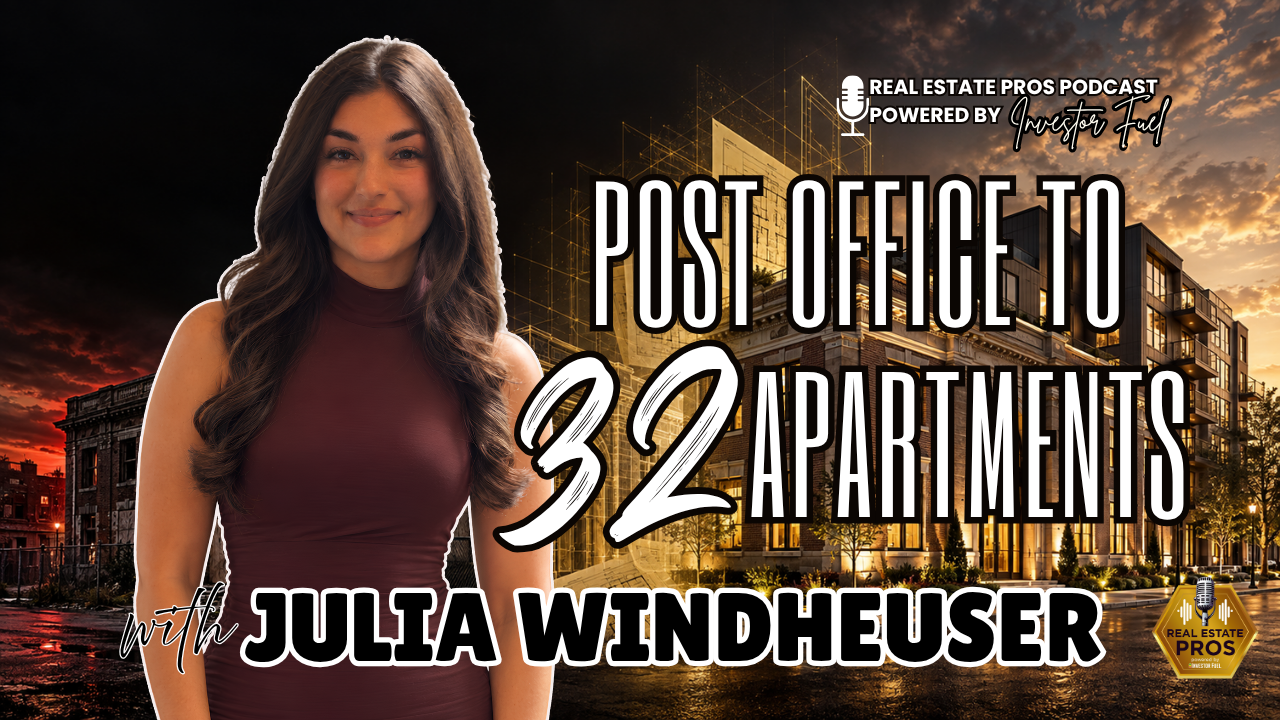
In this episode, real estate investor Julia Windheuser shares her journey from house hacking to managing complex redevelopment projects in Rhode Island. She discusses navigating historic property renovations, zoning challenges, and transitioning into residential assisted living, offering valuable insights for investors looking to diversify and scale their portfolios.

Resources and Links from this show:
Listen to the Audio Version of this Episode
Investor Fuel Show Transcript:
Julia Windheuser (00:00)
Absolutely. I mean, I think so I’ve been investing for almost six years now in various from four families, two families, single families. And I’ve experienced, managing multiple tenants over a long time while juggling a full time job. At this point now, because I’m a full time investor and operator, I have the time to dedicate all of my attention to this. I think if you’re gonna go into residential assisted living and take on a massive,
conversion from a restaurant to a living facility for seniors, it requires your time. And I think a lot of people think, well, could like everything on the internet, everything’s passive. You could do it with AI. It’s remote. It it’s a hands-on experience.
Dylan Silver (02:16)
Hey folks, welcome back to the show. Today we’re joined by returning guest Julia Windheuser an investor in Providence, Rhode Island. Julia, thanks for joining us here today.
Julia Windheuser (02:27)
Thank you so much for having me back.
Dylan Silver (02:30)
What types of deals are coming across your desk these days?
Julia Windheuser (02:35)
Yeah, really unique opportunity. I’ve been spending a lot of my time in South County, Rhode Island, which has a lot of historic homes that need a lot of redevelopment. So lots of old abandoned post offices, old historic homes that were previously restaurants that are looking to be added to the neighborhood with some new life and generate some new revenue for the town. So pretty unique situation. So
Dylan Silver (03:02)
We’re
talking about repurposing some old buildings in into new uses. When you’re looking at the state and the scope of rehab of these properties, it’s probably pretty substantial, no?
Julia Windheuser (03:15)
Yeah, it’s like nothing I really ever experienced before. I have worked with historic residential homes in the past, which actually was not as overwhelming as it may sound. I think a lot of investors see a historic home and they run away because they don’t want to deal with all the regulations that come with that. But in my instance, it was that the home on the exterior needed to remain historic and everything on the inside could be modern.
so it’s not as scary as I think people might make it sound.
Dylan Silver (03:49)
Now, when we talk about acquiring a post office, an older restaurant, what goes into the pro forma here? Because you’re looking at this and you’re saying, Well, the exterior, like you mentioned, can be maintained, but this is an older building, and then also the interior may need to be entirely redesigned. What goes into the pro forma there?
Julia Windheuser (04:10)
Yeah, I always like to tell investors you gotta have your plan A, B, and C. So for example, with one of them, I underwrote it as a residential assisted living facility. And that is going to be my plan one. And right now I’m going through due diligence with zoning because it’s currently a another challenge, a waterfront zoned business, and I want to convert it to general business. And there are laws in place that will help me do that, but that’s a deeper conversation that gets too
Two into the weeds. but the plan B is to underwrite it as long term rentals and C is potentially even condo conversions. So when you’re doing this kind of stuff, you need to make sure that you have many different options because if you pigeonhole yourself, and you don’t get the zoning approval, you can really kind of get yourself in a bit of trouble.
Dylan Silver (05:00)
Now, I I’m not an expert in zoning approval or a and titling a property a certain way, land I mean. But when we look specifically at, a post office, a restaurant, I can imagine that there’s some approvals that need to be had taking that to single family. What does that process look like? And i is it always the same or is it different if it’s, a post office or a restaurant?
Julia Windheuser (05:25)
It totally depends. I mean, you have to make sure that you’re aligned with what the town’s values are. So an issue that I’m coming into is they still want a waterfront restaurant there. And I, as the buyer, don’t. But there are laws in place that do help me meet the town’s needs. And my argument for it was is you have a rising senior population. And how are you going to accommodate all of these seniors that need housing to support them?
as you’re saying that they’re on the rise and there’s a huge demand for it. And that’s my argument as to why you don’t need another restaurant. And that’s where we can work with the town to meet their needs. In regards to the post office, I mean, it’s fully abandoned. It’s just sitting there and it’s going to ruin. And it’s such a shame for these historic properties. You don’t want to see them get demolished. And the towns typically want to see them restored and brought back to life.
And because there’s such a demand in that neighborhood for housing, they’re really willing to work with you to meet the needs of the town. And in that case, it would be for just regular rentals.
Dylan Silver (06:33)
Let’s talk the acquisition side of these deals here. You’ve got a waterfront restaurant, you’ve got an old hi historic post office. How did you find these deals? Were these, on the MLS? Was this through broker relationships? Is this direct to seller?
Julia Windheuser (06:47)
I would say direct to seller, what I did, and this is just me being a little relentless, is I would go on the GIS map and figure out who the owners were, and I would just cold call and say, Hey, like I really want to put in an offer. And it takes a lot of time when you’re dealing with off market deals and you’re cold calling sellers because typically they if it’s not on the market, they don’t have a motive to sell, but
as the person on the other end of the phone, you want to give them a reason to want to sell. and then as I went through that journey, particularly with the waterfront property, I had met lawyers and brokers that realized that I was really interested in redevelopment of these properties because a lot of people don’t want to take them on for so many reasons, the cost, the historic aspect, all of those reasons. So they that was desirable to them to build that relationship with me. And that’s how I was able to make further connections and opportunities with that.
particular post office.
Dylan Silver (07:43)
New England has a lot of these old h historic homes and buildings. And I’ve heard, it can be s challenging and confusing as well to see what type of permitting is sometimes needed, especially if something’s like a landmark for instance. When you’re looking at these two deals in particular, because they are older and historic, what challenges does that incur?
Julia Windheuser (08:54)
Yeah, and it’s interesting because I have the two opportunities in front of me and one of them has already gotten all of the zoning approvals, did all the environmental studies, they worked with an architect and they have all of the plans for the build approved by the city. So that one is really enticing for me because like you’re saying, it takes that huge lift from trying to get all those approvals and plans and
together and because I already have the blueprints, I can forecast the cost so much easier. Whereas with the waterfront historic home that was previously a home, then a restaurant, now we’re trying to make it a home again. none of that exists and I would have to take that on.
Dylan Silver (09:35)
Now, i if we look at the post office specifically, there’s a lot that i is running through my head as I’m hearing this. it it’s an old abandoned post office. How old are we talking here? What’s the year build of this post office?
Julia Windheuser (09:49)
goodness, I wish I remembered but hundreds of
Dylan Silver (09:51)
I mean very old, right,
Julia Windheuser (09:54)
It
was a bomb shelter. Like it was like it’s the real deal. I walked the property a few weeks ago and it’s yeah.
Dylan Silver (10:01)
W without giving away the gold and the specifics of this deal, who owns post offices and how does that happen? Does the post office no longer become active and then they sell to a private investor or an individual? Like how do people become owners of a post office?
Julia Windheuser (10:18)
In this case, that’s essentially what happened. But in New England in general, you’ll find a lot of converted spaces into like diners and cafes. that’s pretty common, particularly in the New England area. So when these go on the market, people just jump at them because with historic homes, they’re always going to hold value and be so unique that the value doesn’t disappear. But it does, in a sense, when
it’s so dilapidated and someone really needs to bring it back to life. But there’s an opportunity. You buy it a discount and then the ARV is gonna explode. So you have to be willing to take on that risk and do the value add.
Dylan Silver (10:58)
I wanna pivot here and talk about managing these rehabs. it sounds like in both cases here there is gonna be different scope of work, but nonetheless, a lot that has happening. You mentioned earlier that the bones of these properties are good, so it’s not necessarily like you’re having to do a roof to studs rehabs. But there’s still, a lot that needs to be done to convert, right, a post office into
a residential assisted living or a single family home. When you’re managing contractors and subcontractors and timelines and budgets, do you have an approach that, helps you from becoming that distressed investor or the investor that’s going over budget and overtime?
Julia Windheuser (11:42)
For sure. I think in this case it it’s commercial. So it’s going to be very different. Like my past experience was in residential homes. So being the project manager and having your Gantt chart and keeping those plans transparent with all the different contractors that you’re working with keeps everyone aligned and moving towards the goalposts at the end of the day. When it comes to bigger projects like this, you definitely need to be involved, but you need to have a trusted team and your builders and
the contractors that you’re working with need to have experience with these type of rehabilitations, which fortunately, like I mentioned before, the plans are approved. So we’re good to go in that regard. But yes, it’s really important to make sure that you’re working with trusted partners. You can’t just go with the cheapest guy on the block.
Dylan Silver (12:32)
I wanna ask you about the residential assisted living space. I I’ve heard a lot of folks are looking at different asset classes and I’ve had, numerous guests talk to me about residential assisted living and I’ve gotten kind of multiple definitions exactly of what a residential assisted living facility looks like. I in your words, what is a residential assisted living facility and who i is the ideal tenant there?
Julia Windheuser (13:37)
Absolutely. So for me, a residential assisted living is a boutique, senior living group home experience. these are people that are so mobile. they need the lowest level of care, but they’re really looking for that level of community, someone to help them cook meals, do laundry, just little medication reminders. but they’re at that point in life where they need a bit of support. You’ve maybe heard of like the golden girls.
type of living where they’re looking more so for community. Eventually, unfortunately, as we all age and maybe there’s memory and mobility issues, they might need to kind of graduate to a more senior level of care, like a nursing home. But this is that first step of transitioning into a type of facility where they would need a little bit of help.
Dylan Silver (14:25)
And now when we talk about both of these scenarios, the post office and then the waterfront property, how many leases or tenants could one of these properties support?
Julia Windheuser (14:37)
Absolutely. So the post office would be thirty-two one bed apartments. I believe there’s actually two beds that would be in that. And that has six within the actual post office itself. And then there’s going to be an extension on the back that they got approved for the historic requirements. They needed to keep the outside and the lobby looking as it originally did. So that was like an easy pass. in regards to the waterfront property.
It would be sixteen beds.
Dylan Silver (15:05)
When we look at a deal like this, right, I mean, one of the things that immediately comes to mind is this is a big jump. Is it not like going from the single family space to then being an owner operator of a residential assisted living facility? It it’s night and day difference, right? One is maybe a lot more passive. For folks who are making this jump and in your sphere out there, what have the folks who’ve successfully made this jump done right?
To make sure that they’re setting themselves up for success.
Julia Windheuser (15:36)
Absolutely. I mean, I think so I’ve been investing for almost six years now in various from four families, two families, single families. And I’ve experienced, managing multiple tenants over a long time while juggling a full time job. At this point now, because I’m a full time investor and operator, I have the time to dedicate all of my attention to this. I think if you’re gonna go into residential assisted living and take on a massive,
conversion from a restaurant to a living facility for seniors, it requires your time. And I think a lot of people think, well, could like everything on the internet, everything’s passive. You could do it with AI. It’s remote. It it’s a hands-on experience. And no, I personally won’t be the operator because I need someone with at least, I believe, two years of experience in the space managing the day, to day.
But that’s where like I really need to make sure that I’m doing my job interviewing and putting the right people in place. and I think too, when I first started, I was in long term rentals because I didn’t have the time and attention that maybe like an Airbnb or a short term or a midterm rental would require. but now that I have time, I can take on projects that are gonna allow me to have more cash flow. And of course.
comes with more risk and more time and attention into the investment, it won’t be as passive, but that’s something that I’m willing to take on at this point.
Dylan Silver (17:01)
You mentioned partnering with someone with two years of experience in this space. So this is a regulated arena, right? That the residential assisted living space. in Rhode Island, does the two year operator is this someone with some type of medical licensure, or is this can this be anyone who has successfully operated assisted living facility for two years?
Julia Windheuser (17:23)
No, it’s someone that is like licensed in the in the space that needs to be there. but like anyone can own it. That’s not the issue. It’s just like the day to day operations that’s managing it day to day.
Dylan Silver (17:35)
I wanna pivot here. we of course talk with a lot of investors from all across the single family space. And acquisitions is always something that people are talking about. Where can they find their next deal? how to buy a deal right? You clearly have a very unique strategy going after properties and re envisioning them in maybe ways that others might not. How did you arrive at that a strategy?
Julia Windheuser (18:02)
I think for me when I was f like my first property, for example, it was a like they always say, it was the ugliest house on the street and it needed a lot of work. And what really drew me to that property was there was an entire third floor that could at the time I thought could have been converted to a two family home to a three family home. And then of course with zoning and other issues, we weren’t allowed to. but
we were able to combine it with that second floor unit. So it was no longer a two-bed, one bath. It was a four-bed, two bath. And the point I guess I’m trying to make is looking for that unique opportunity to add square footage to the home that ultimately added to the overall value of the home. So I kept that in mind as I continued to grow my portfolio. It was like if I’m looking on Zillow, let’s say if or LoopNet and
There’s just a lot of square footage, but it’s listed as minimal beds and baths. I’m like, they’re not optimizing this space well. I was like, there has to be more that can be done here. So I always look to see if I can add bedrooms or bathrooms, even extending the home if there’s if the lot in particular is huge, you can always do extensions. So just finding those little things that they might not be advertising.
Dylan Silver (19:15)
Now, would you take that beyond, four units i into what would then be considered right like commercial or multifamily property in that regard, or would you keep it under four so that it could still be single family?
Julia Windheuser (19:25)
Think it depends. yeah, I think it depends on the opportunity. Like when I first started out, I understood that I can’t bite more than I can chew if I want to stay in the scheme. And you continue to build confidence deal after deal after deal. Now that I had done five and it was a total of ten doors and I did my biggest renovation, I had the confidence and the experience to t now take on residential assisted living or that huge, post office renovation.
It really just comes with time and I would just encourage any investor to do it in baby steps. It’s not a sprint, it’s a marathon for sure.
Dylan Silver (20:03)
That’s for sure. You don’t want to become the distressed operator yourself and tire yourself out. You’re in Rhode Island. there’s a lot of folks who are saying, it’s sometimes tough to be an investor in various parts of the East Coast in New England. You had mentioned in the green room you had previously lived in Boston and that’s certainly a challenging market. Do you see a lot of out of state investors, even mom and pop investors, investing in, Providence, for example, or is it mostly local folks who are investing in their own backyards?
Julia Windheuser (20:33)
think it’s more local. I think Providence is like the best kept secret in New England when it comes to investing. I think people immediately draw their eye to Boston and they see the price and they’re like, my God, forget it. but Rhode Island was a great opportunity, like a little over an hour away from the city. So you do get and I’ve also had with my tenant some Boston commuters. you get a lot of postgrad. There’s a lot of college grads here that like to stick around and stay in the area.
I will say that the market is changing. but I think to answer your question that it’s a lot of boots on the ground local investors.
Dylan Silver (21:10)
We are coming up on time here, Julia. Any new projects or activities that you’re working on, and also anything you’d like to mention directly to our audience?
Julia Windheuser (21:20)
Sure. I think a couple things that I’m working on right now is I’m in the middle of writing a book called Your Lease Won’t Save You. it’s meant to be a little triggering that title, but I really do believe that if you are a operator of your own portfolio and self managing, it really does start with the re the relationship. I think so many people like to say hands off, it’s transactional, don’t get involved with your tenants, blah, But it really just challenges that thought that’s been
told over and over again is being a transactional business and actually building a relationship and going from there. So that’s coming out soon. and I think just my advice for anybody is make sure that you’re being careful out there. I mean, interest rates went up again. make sure that you’re having a good healthy margin with your cash flow. I mean
I started investing in 2021, interest rates were in the three percent. My cash flow was ridiculous. Now, I’ve had interest rates as high as eight percent. You really have to make sure that you’re giving yourself enough room to sustain your portfolio. And I know, and the last thing I’ll say is I know that it gets really hard with the internet and everyone’s like, I scaled to 50 doors in six months and all of this stuff, but truly take your time because
real estate, the longer that you’re in it, your equity will grow and you’ll get where you wanna be. Just take your time.
Dylan Silver (22:45)
Julia, thank you so much for joining us today. Thanks for your time.
Julia Windheuser (22:49)
First. Thanks, Dylan