Subscribe via:



Show Summary
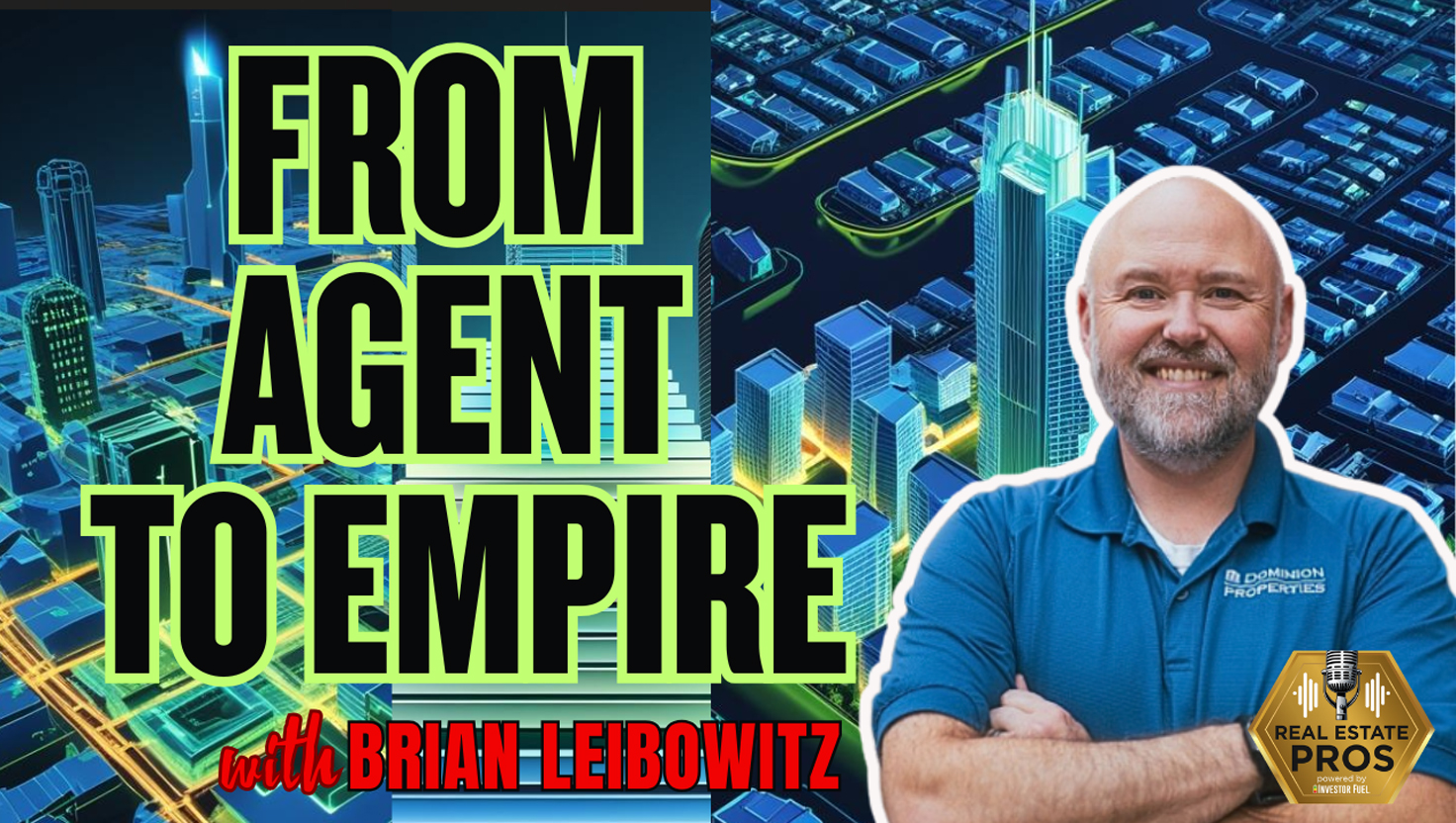
In this episode of the Real Estate Pros Podcast, Kristen Knapp interviews Brian Leibowitz of Dominion Properties, who shares his journey from college graduate to a successful real estate investor managing over 900 doors in Baltimore. Brian discusses the challenges he faced in the REO market, the importance of understanding local neighborhoods, and the transition from being a real estate agent to focusing on investment properties. He emphasizes the value of vertical integration in operations and the current opportunities in the multifamily market. Brian concludes with key advice for aspiring investors, highlighting the importance of market knowledge and the ability to say no.

Resources and Links from this show:
Listen to the Audio Version of this Episode
Investor Fuel Show Transcript:
Brian Leibowitz – Dominion (00:00)
I challenge investors to really dig, you know, to double down on that. The people that I talk with, you know, it doesn’t matter the city.
St. Louis, Baltimore, D.C., I don’t care, Philadelphia. It doesn’t necessarily matter on that. I think that you should be the local expert. I think that’s the real goal, right? Like if you want to be really successful and you really want to know where ⁓ you’re going to have a leg up on your competitors is knowing the blocks in which they don’t understand. They don’t know, they haven’t dug into the data the same way. They haven’t looked at the public record data or the permit
or heck, even the crime data, just understanding where things are concentrated and where they’re not is gonna make you more successful than you’re the people who are not doing that stuff.
Kristen Knapp (01:55)
Welcome back to the Real Estate Pros Podcast. I’m Kristen and I’m here with Brian Leibowitz of Dominion Properties. We’re going to talk about all of the major investing he’s doing. They have over 900 doors just in Baltimore. So this is going to be a really insightful conversation. Thank you for being here, Brian. Yeah, so let’s get back to the beginning. What brought you into real estate in the beginning?
Brian Leibowitz – Dominion (02:11)
Hey, no problem. Thank you, Kristen Thanks for the invite.
Well, I graduated from Virginia Tech and graduated in a very unique time in the
with the great recession and really couldn’t find anything in my career that I went through college with and got into real estate because my parents had been doing it for years. And a buddy of mine said, hey, look, man, go get your license. We’re doing all these REOs. I need help. And I went and did it. And frankly, Kristen, I never look back. And it’s one of those things where not only does the ⁓ money follow the effort that you put into it, but I just find it so gratifying.
meaningful to be a part of someone’s first time home purchase or heck, even the end of it, their retirement home purchase, the whole thing in between. And then that expanded into the volume real estate that we do today, 15 years later, here I am, right? it’s, I don’t know, I find real estate just so interesting. All the different avenues and all the different information and all the different data that you can dig into is very meaningful.
Kristen Knapp (03:22)
That’s amazing you found your passion right away, right at a college. ⁓
Brian Leibowitz – Dominion (03:26)
Yeah, I
lucked out, bottom line. That’s definitely something that I’m very grateful that I did, because I went to Virginia Tech for environmental science, chem minor, biology minor, geology minor, and just couldn’t find much that was going on in 2010, 2011. It just didn’t exist. The market was a different time, and job interviews were few and far between, and I’m still grateful to my buddy who
Push me, push me and say, look man, you’re good at this, your parents have been doing it for a while, you’re better than most, go get your license. It’s $250, right? Like go get it. And the rest is history because now it’s 2,500 transactions and just hundreds of millions of dollars of real estate that has gone through my transaction pipeline. And I’m forever grateful, to be honest.
Kristen Knapp (04:04)
Yeah.
amazing. Your parents are probably like, we’ve been telling you this is an industry.
Brian Leibowitz – Dominion (04:23)
Yes, yes, that’s
exactly what they were. At first they were like, wait a minute, what are you doing? You just went through college? What are you doing here? But it is, and I do say that while I’m not using my degree, I did meet all of these contacts, the people who put me into real estate, who got me interested in it. I did meet them at college. So I don’t know if that would have happened whether or not I went, but that’s my story, and I’m sticking to it on that front.
Kristen Knapp (04:44)
I’m amazed.
And what was the turning point? Like, can you take me back to one of your first deals where you really realized like, this is actually something I can make into a career.
Brian Leibowitz – Dominion (04:57)
So it
actually, it progressed very quickly because of REO. The way REO was back in 2010, 2011, was, you know, the people who are listening today who remember that time, like REO was bonkers and it was literally dozens and dozens and dozens of foreclosures daily. And I remember it vividly. My friend that got me, that pushed me to be licensed, he said, hey, I’m gonna give you your first couple of listings. Just take your time, go ahead and get through them.
So he gave me, think, three listings that first day. And I was like, all right, cool. I’ll sink my teeth into them, no problem. Well, three days later, he gave me another three. And if anybody who’s listening has been a first-time real estate agent, you don’t know what you’re doing.
Like the courses only give you so much. I got thrown into the wolves because a month in, I’ll cut to the chase here, a month in I had 60, 70 listings. And my buddy’s like, all right, you’re probably good for right now. I’m like, dude, I’m drowning. What are you talking about? But because of that, I am who I am today. Like now having 100 in the pipeline is the minimum.
Kristen Knapp (06:34)
You
Yeah.
Mm-hmm.
Brian Leibowitz – Dominion (06:57)
I’m
built differently now and I expect the team and the construction team and acquisitions to be humming. We’ve got to keep the pipeline full because we’ve got multiple departments that are dependent on it.
Kristen Knapp (07:12)
How did you even go about managing that many listings right in the beginning of your career? Did you outsource some help or did you do that all yourself?
Brian Leibowitz – Dominion (07:20)
No, that was 80 hour week work.
It’s just what it was. And today, you look, I’ve learned my lesson, right? Like, you know, it’s 15 years later. know people can’t function doing that for very long. And frankly, it took about two, three years of understanding. Like, look, this is not sustainable. You can’t do that. You know, my longtime girlfriend who’s now my wife, you know, she, she was very understanding. And the, the, the change that, you know, that we made was one, we moved closer to where I was doing business. were living in Northern Virginia at the time.
So I was commuting to Baltimore, know, literally hours on the road every day and it was crazy So we just said look like we got to make a change here We’ve got to get my schedule back to a more normal
status. So we moved. We moved to Baltimore and we love it here. We live in Baltimore County and it’s great. It’s a great place to be. It’s more affordable than Northern Virginia and it allowed me to really, really pursue my career and we’ve done a lot since.
Kristen Knapp (08:24)
Yeah, I mean, it sounds like you guys have such a presence in Baltimore. Talk about more about what makes that market so special.
Brian Leibowitz – Dominion (08:30)
Yeah, so.
Baltimore on paper looks very affordable. And I think it tends to, I’m gonna quote the owner of Dominion, it tends to chew people up and spit them out. You really, really gotta dig into the neighborhoods and you really have to know the blocks. with the amount of transactions that I’ve done, it’s the reason why I got put into the chair that I’m in today is running the department, being a director. The owners of Dominion know Baltimore better than anyone. And I’m right behind them.
you know with with the amount of transactions that we do it makes it a very unique type of place to understand to see all these to see all these properties going back and forth and having 900 doors and having you know doing you know 30 40 50 flips a year you know you see a lot you see a lot that’s you know that
that is not usually seen in the typical MLS data or the Zillow data. If you’re not a real estate agent, I know you don’t have MLS access. So you gotta know that stuff because Baltimore is so unique and everybody’s able to say, like, every city’s block by block, Brian.
I challenge you to find a city that has more than, you know, a $200,000 swing in value block by block. Like that’s very unique.
And that’s where I feel that we really have a leg up on a lot of our competition, understanding that there is a real difference between one block to the other in knowing what product that you’re going to end up with, you know?
that we or anybody for that matter is specifically undercutting on their renovations or something. But you have to know like, you’re not going to have a $300,000 house on this block. You’re going to have a $200,000 house. And that means that you’re limited on what you can do there. And it may mean that you may not buy on that block, really. That’s really the key. And I feel that we’re really good at that.
Kristen Knapp (11:07)
Yeah, I always love hearing people talk about going deep rather than just spraying wide, at least in the beginning. I think there’s so much value in knowing the market very intimately and as you said, knowing block by block what’s, you know, what the market is all about.
Brian Leibowitz – Dominion (11:22)
Yeah, I agree with you. think ⁓ the general knowledge, right? The general idea that, I know this city or I know that city.
I challenge investors to really dig, you know, to double down on that. The people that I talk with, you know, it doesn’t matter the city.
St. Louis, Baltimore, D.C., I don’t care, Philadelphia. It doesn’t necessarily matter on that. I think that you should be the local expert. I think that’s the real goal, right? Like if you want to be really successful and you really want to know where ⁓ you’re going to have a leg up on your competitors is knowing the blocks in which they don’t understand. They don’t know, they haven’t dug into the data the same way. They haven’t looked at the public record data or the permit
or heck, even the crime data, just understanding where things are concentrated and where they’re not is gonna make you more successful than you’re the people who are not doing that stuff.
Kristen Knapp (12:22)
Absolutely, absolutely. And there’s just more trust that’s built through the whole process.
Brian Leibowitz – Dominion (12:26)
Agreed.
Yeah, the trust is a thing, right? Like that’s a tangible thing. It’s not, you know, there’s not, you know, money associated with it per se, but if you are more trustworthy and you understand the trustworthiness of a specific block versus a different block, you’ll make more money.
Kristen Knapp (12:44)
Absolutely. When did you make this transition from being an agent to investing?
Brian Leibowitz – Dominion (12:49)
So I’m still licensed because I list everything that we flip, that we’re selling ourselves. But I got out of really what I would call general real estate agency. ⁓
really about 10 years ago. So I was what I would call a regular real estate agent for about four or five years of my career. Did a lot of transactions and then moved into more volume real estate, it was representing investors or doing volume REO or doing what I’m doing at Dominion now and just buying in mass for an investment purpose.
You know, I’ve done a lot of things. ⁓ There was even a startup in there that got mixed into that for a little while. But I haven’t been a real, what I would call a ⁓ regular real estate agent for about a decade.
Kristen Knapp (13:42)
Thanks.
You guys seem like you have, I mean, it’s a very in-house operation. got you as a realtor, you guys have your sister company that helps with lending. It seems like a very just tight operation.
Brian Leibowitz – Dominion (14:00)
Yeah, no, this is, we are very, very vertically integrated, know, full in-house construction, full in-house property management. You mentioned Dominion Financial. Most of your listeners know them very well because they’re nationwide lending. ⁓
I mean, all of these sister companies work in harmony together. And the directors that sit in these chairs, we are constantly communicating as to what is working and what isn’t. Because I don’t want to put a whole lot of effort, company dollars, Like company money, behind something that’s not working. So we’re constantly changing where we’re putting marketing money, where we’re putting effort in leasing, where we’re putting, hey, that block doesn’t rent as well anymore. Hey, sell that ass.
asset, that type of thing. And it’s, you have to communicate. We just have to. So the vertical integration is usually scary for a lot of people, but we have found a real niche to be able to do that very well ⁓ with the way we have structured, you know, the owners of the company have structured Dominion in general.
Kristen Knapp (15:03)
Yeah, wow, that’s so much to keep track of. You guys are so organized.
Brian Leibowitz – Dominion (15:07)
Well, so, yes, right? it’s why there’s, you know, very specific people in the specific chairs. You have to be, you know, we all call, you know, all of us call each other rock stars. Like, it’s just, you know, everybody who’s contributing here is a rock star in my book because frankly, this company doesn’t run. We’re a very lean company. There’s only, you know, we’re a team of 10, okay? Property management is another team of 12, you know.
construction is bigger just because of the amount of contractors and stuff that they employ and use. But even then, they have five project managers running 120 jobs.
You have to know everything that you’re doing on your day to day. You’ve got to be an expert at it here. There is no time. There is no time to dilly dally. There is no time to… ⁓
to delay on waiting for a permit. Like, no, no, no, you gotta call the city. You gotta call them. You have to babysit them. We don’t have the luxury of some of these very, very large ⁓ REITs or something where they’re, I’m not gonna say that they’re wasting money, but they have more money than us and they have the ability to wait a little bit longer. I don’t have that luxury. So we’re constantly pushing, pushing, pushing to make things happen.
Kristen Knapp (17:05)
Yeah. Right.
Wow, sink or swim. And you guys are sort of transitioning into multifamily now.
Brian Leibowitz – Dominion (17:11)
Yeah, agreed. Totally agreed.
Yeah, I mentioned before we started that cap rates have really put a damper on our ability to get into multifamily for a long time, especially during COVID. mean, cap rates got real low. they just didn’t cover. ⁓ The boom of COVID threw a monkey wrench into that mentality of us being able to really expand into that world. Today, with commercial real estate being
being more depressed than it has been has allowed us to pick up a few deals here and there where it’s very niche for us. We picked up a 28 unit, a 20 unit. We’re currently about to go online with our first ⁓ self-built. ⁓ That one’s 46 units. We’re about to break ground on a 60 unit. Like we’ve got, you know, we’ve got a lot going on now where we’re way more comfortable with the cashflow, the, you know, the projections, the actual renovations.
portion, know, all of this stuff has really come to fruition over the last about 24 months. And in the last probably 12 months is where we’ve really started ramping up and looking at more and more ⁓ multifamily deals across the board, again focused in the Baltimore region, but you know looking at more and more of those deals to see if they fit our, you know, what we’re trying to do.
Kristen Knapp (18:42)
Yeah, that’s really exciting. I mean, it’s a good way to add a bunch of units too.
Brian Leibowitz – Dominion (18:47)
Totally agreed and you know some of these you know I we kind of giggle about it behind the scenes and some of them You can’t build them for what they’re selling them for like the replacement cost is more than what they’re you know what they’re selling for now
You can’t say that about every one of them, right? And further, some of them don’t even cover the mortgage. Like there’s, you know, they’re mismanaged, there’s issues, you know, there’s capex problems, blah, blah, blah, right? We’re not really looking at those, right? Like I’m looking for the middle of the road ones that, you know, maybe someone’s just trying to get out of the market, they’re trying to retire or…
you know, hey, they’re just tired of being a landlord. You know, they’re tired of what I refer to as tenants and toilets. Like it’s just not working for them anymore and they want out. Well, those are really good candidates for us because it doesn’t mean that they’ve been neglected. They’ve just, you know, the landlord is just, ⁓ I can’t deal with it anymore. And that’s a good fit for us. So we find, you know, a bunch of those deals. ⁓
that are far closer to our numbers than some of the others. So we go way further down the rabbit hole with those than we do some of the other deals that are out there.
Kristen Knapp (19:56)
Do you guys have a property management company vertically integrated? I assumed so. ⁓
Brian Leibowitz – Dominion (20:00)
Yeah, so Dominion Man, yeah, Dominion Management,
that’s, you know, can, you know, anybody can look them up online, baltimore’sbestrentals.com. they’re, I made a comment earlier, they’re rock stars, right? Like they, operate somewhere in the four to 5 % vacancy rate. We had an uptick over the last couple months, I think we’re at 7%, but that’s slowly coming down again. ⁓
And we don’t really know why. We dug in, don’t quite understand where the uptick came from, but neither here nor there. There’s still demand for rentals. It is on its way down. I think we’re hovering right around five and a half, 6 % at the moment, which for 900 doors is very low.
There was a long time there where we were operating at around 2-3%. We didn’t think that that was going to stay forever though. So having it be around that 4-5 % is kind of where we want to be. And we’re slowly working our way back to that.
Kristen Knapp (20:56)
Yeah, and what are your guys’ goals for the next few years?
Brian Leibowitz – Dominion (21:00)
⁓ I mean, it’s never been about the unit count. It’s never been, we want to get to a thousand doors or we want to get here. I think in general, there’s never been a specific goal, right? It’s more along the lines of make the portfolio as profitable as we can, ⁓ fill it full of good real estate.
And that also means getting rid of some of the stuff that we’ve owned for 20 years that doesn’t work anymore, right? Like if you’ve owned a property, you know, if you’ve owned an asset for, you know, 15, 20 years, a lot of things can happen, especially in Baltimore, right? Like that block may be completely different than what it was when you first bought the place and it no longer works, right? Like you’re getting turnover, you know.
every two years, that’s not how we operate. Like across our entire portfolio, we’re averaging about seven and a half years on our tenancy. And it’s because we do good renovations, we’re well managed, you know, there’s people who actually care on the other end of the phone, you know, like that type of stuff. So the goal is to really just fill it full of that, fill it full of people who want to stay, keep doing flips, know, keep doing, you know, keep doing the ⁓ advantageous stuff for, you know, the acquisition side.
and keep the construction team, you know, I ⁓ don’t want them to, I don’t want them to get lazy, okay? You know, I want them to keep them busy. And that’s really the goal. It’s never been about a specific number or, hey, we want the portfolio to be worth this much money. It’s just not what it is.
Kristen Knapp (22:32)
That’s amazing. You guys do such great work in that area. What would be, kind of to wrap this up, what would be some advice that you wish you knew earlier about real estate investing?
Brian Leibowitz – Dominion (22:43)
First one I always tell people is how to say no. Learn it. Learn it. And in real estate, your time is your entire salary. So…
Kristen Knapp (22:46)
Mm, yeah.
Brian Leibowitz – Dominion (22:55)
you need to learn how to say no. And it’s easy to say yes. It’s so easy to say yes. And even the owner of Dominion gives me hell from time to time because I hate the idea of disappointment. So I say yes a lot. ⁓ But learning to really know when to say the word no is a very, very important thing.
The next one that I really harp on is knowing your market. We talked about that already. Really digging into some of the free, right? Like I’m not talking about signing up for stuff, but digging into the free data that most cities, towns, you know, are already providing via GIS maps, via public record data, via, you know, whatever, right? Find it, learn it, learn to love it because you want to be your industry expert. And the only way you’re going to get there is
is really digging in hard. most, piece of advice, most of your competitors aren’t. So the better you know your market, the better you’re gonna be.
Kristen Knapp (23:58)
Totally. I mean, it sounds like you know the market really well. Yeah.
Brian Leibowitz – Dominion (24:01)
Thanks. I mean, we try. Like
it’s thing. We spend a lot of time doing it. So thanks for that because I definitely appreciate it.
Kristen Knapp (24:08)
Well, amazing. How can
people find you?
Brian Leibowitz – Dominion (24:12)
So you can go to our website which is dominionbuyshouses.com ⁓ I’m on LinkedIn so you can just look me up, Brian Leibowitz. ⁓ email is brian at the dominion group dot com. Feel free to reach out. I’m always available if anybody wants advice, to know how to dig into the Baltimore market. I’ll happily share some tips and tricks. ⁓ But in general just reach out whenever somebody feels like it.
Kristen Knapp (24:41)
This has been such a great conversation. Thank you so much for being here, Brian.
Brian Leibowitz – Dominion (24:44)
No, I appreciate the time. Thanks, Kristen.
Kristen Knapp (24:46)
And thank you everybody for listening and please check out Brian and Dominion and we will see you back next time. Bye.
Brian Leibowitz – Dominion (24:53)
Thanks everybody.