Subscribe via:



Show Summary
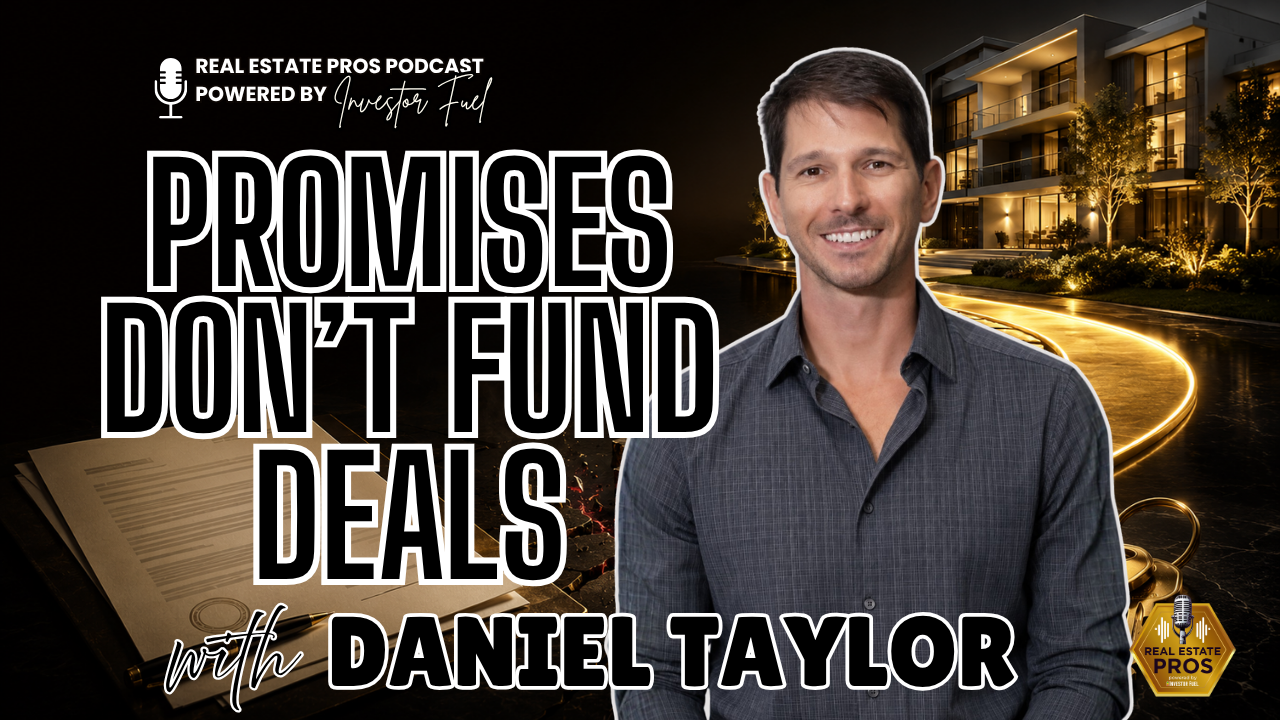
In this episode, Dan Taylor, managing director at Lendyx, shares insights on real estate investing, lending strategies, market challenges, and leadership lessons from closing over $800 million in transactions. Discover how his experience bridges brokerage, lending, and active investing to navigate today’s volatile market.

Resources and Links from this show:
Listen to the Audio Version of this Episode
Investor Fuel Show Transcript:
Daniel Taylor (00:00)
Maybe even more. But if the deal works at that, I think you’re relatively okay. Now, I’m sure a lot of old school guys would jump on and answer that question, say take a 20% haircut, which fine, great. Then you’re never gonna do a deal. what I mean? Like it’s just like that’s not that doesn’t exist. I mean, I don’t want to say it doesn’t exist, but I think you’re gonna be pressed to find one which might take you
a lot more a lot more time, right? and so I think you can find good deals by being conservative, underwriting to today’s exits, to today’s rates,
Scott Bursey (02:03)
Welcome back to the *Real Estate Pros* podcast powered by Investor Fuel. I’m your host, Scott Bursey. Glad you’re with us. Today we’re sitting down with Dan Taylor, the managing director at Lendyx a powerhouse direct private lender based out of Miami. Dan is an absolute force in the industry. He leads origination and capital market execution and has an incredible track record with over $800 million in transactions closed.
He brings a unique perspective as someone who has been a broker, a lender, and an active investor developing his own South Florida projects. So listeners, you can expect some top tier insights on capital strategy and market navigation today. Dan, welcome to the show.
Daniel Taylor (02:50)
Thanks for having me, Scott. I’m looking forward to it.
Scott Bursey (02:52)
is awesome having you here, my friend. And I help our listeners get up to speed. Please give us the ninety second highlight reel of how your career ignited and where you’re pouring your fuel now.
Daniel Taylor (03:03)
So I got into real estate actually at after graduating University of Florida in our master’s program, went straight to work for Rialto Capital, working in commercial mortgage backed securities, underwrite, special servicing, et cetera, et cetera. real, white collar environment, learned a lot. Really great place to kind of launch one’s career. I can’t think of a better kind of place and a place to learn. And from there, kind of skipping over a couple of years.
we went into Sean and I, my partner went into founding Onyx Funding, which is a mortgage brokerage here in South Florida, where we helped clients nationwide, investor developers nationwide, and on receiving competitive financing. We did that for about five years or so. We’re still running it today, but since then we’ve done over a billion dollars in closed transactions via Onyx. And since then we’ve opened Lendyx which is our direct lending platform.
today we’re almost twenty people in house on the team. we’re doing hundreds of millions of dollars in closed transactions. We work with top tier borrowers, great clients nationwide. We do a lot of business here in South Florida and continue to keep learning and growing.
Scott Bursey (04:08)
Wow, Dan, what a journey. what really caught my attention about you was the way you’ve been able to bridge the gap between being a high level broker and a hands-on developer, giving you a 360 degree view of every deal you touch. Building on that, curious to know, with your massive track record, what do you consider the biggest strength in the Lendyx lending model currently?
Daniel Taylor (04:33)
I think our biggest strength is our execution. I mean, that’s a lot of people say that, but I think it’s I think it’s important to reiterate, saying and showing people a client’s a term sheet or saying something and actually getting it done, I think are two different things. And so I think we pride ourselves here. I know we pride ourselves here about executing and showing our clients, proving our clients day in and day out that we care, that we work for them and we want to get the deal done.
Scott Bursey (05:00)
How does that actually translate to the deals investors are closing today?
Daniel Taylor (05:05)
I mean, today’s tough. This is a tricky market. A lot of volatility. I mean, between everything on the politics, economics, it’s in it’s incredible. I feel like every other quarter it’s it just gets even hairier and hairier and more confusing and tougher to make decisions. And so being there as a soundboard for your clients, brainstorming, listening, thinking through deals, I think is a major value add. As developers, we know the pain points, the struggles of getting a draw on time.
having subcontractors walk out on a deal and filing notice of commencements and lien waivers and we know the timing constraints of getting under contract and closing in five days and seven days and having to have certainty of execution because you’ve got two hundred thousand dollars hard on a contract. But we understand those things. We’ve gone through them ourselves and it allows for us to behave accordingly and get the job done.
Scott Bursey (05:55)
Thank you for highlighting that. And Dan, digging into the friction points, what is the one area you see clients struggle with most in today’s market?
Daniel Taylor (06:04)
I would say what I think I think buying, I think buying is very difficult because prices are wild. They’ve been wild. But lately we’re seeing, let’s say, after repair value, meaning after someone has purchased a property, renovated it, and now has a completed finished product. That’s the after-repair value. We’ve seen those coming back lower on a recent appraisals and kind of nationwide, right? And so and we and we’re very
detailed oriented when it comes to these trends and metrics, and we’re following the data constantly. And so I think it makes it difficult to have sellers and buyers come together on agreed value. Right. Real estate is always so ambiguous, the value. Well what is the value? Whatever the comparable sales are. well whatever somebody’s willing to pay for it, et cetera, et cetera. And so I think I think in today’s market, pegging that value
Where there’s still meat on the bone for a refinance or for an exit sale, I think is very tricky. I think that’s the hardest thing that our clients are running into today.
Scott Bursey (07:03)
Fascinated to hear your thoughts on this. What is the biggest untapped opportunity for investors in the South Florida market?
Daniel Taylor (07:58)
Wow, that’s a good one. biggest opportunity in the South Florida market. I mean, look, construction is the first thing that comes to mind, but that’s so generic. Of course it’s construction. We have more cranes in Miami than I think the entire state of California. I’m leaning on one of my team members on that stat. So hopefully he didn’t throw me under the bus and make that up, but I did hear that. So
Yeah, I think construction still seems to be like the way to go. There are still so many new jobs, new tech companies, new money abro coming from abroad. They want shiny, they want new, they want unlived in. and Miami is filled with 30s, 40s, 50s product. houses that are 60, 70, 80 years old. I live in one. I bought a nineteen forty-one house.
now I love it. I love the character and the charm, but I’m maybe I’m just older than I look, but most people most people want the modern style. They want the Kitchen Aid this and the Sony La Plat screen that. So they want all the they want the whole the whole kick out caboodle, what I mean? So they want a nice finished product that looks good, that entertains well, all these types of things. And so
if you’re an investor in Miami, I think getting involved in new construction is probably the best way, the probably the best return on investment that you can make.
Scott Bursey (09:17)
Dan, wondering if you could weigh in on the risks. What do you consider the most current threat in the current lending landscape?
Daniel Taylor (09:27)
you broke out a little bit there, Scott, but it sounded like what’s the greatest threat to the lending space? Yes. So yeah, I would say I would say these large market movers like like what’s going on either like with midterms, midterm elections or with the Strait of Hormuz in Iran, or like these types of just absolutely uncontrollable events.
That without a doubt have an effect on bond rates, investor sentiment, and just the overall health of the economy, inflation, et cetera, et cetera, that I think it’s a threat to making decisions, which affects the industry. Lenders maybe not wanting to fund 90% of construction because they’re looking at a couple months in the future, and boy, we’re at tariff wars with Canada and Mexico.
Who knows if the budget I’m about to close at is gonna have any implications with cost overruns, et cetera, et cetera. Or the investor, I don’t know if I should get under contract because of, the gasoline prices are so much higher. And that I mean, obviously that affects everything. And so, I think these uncertainties is what is the biggest challenge that our industry faces.
Scott Bursey (10:36)
How do you advise your partners to protect their downside in this environment?
Daniel Taylor (10:41)
man.
I’m learning I’m learning one myself here. I would say underwrite to what is in the market today, then take a five percent haircut.
Maybe even more. But if the deal works at that, I think you’re relatively okay. Now, I I’m sure a lot of old school guys would jump on and answer that question, say take a 20% haircut, which fine, great. Then you’re never gonna do a deal. what I mean? Like it’s just like that’s not that doesn’t exist. I mean, I don’t want to say it doesn’t exist, but I think you’re gonna be pressed to find one which might take you
a lot more a lot more time, right? and so I think you can find good deals by being conservative, underwriting to today’s exits, to today’s rates, maybe even increasing the rate if you were to keep if you were to refinance in today’s rates six point seven five as a debt service coverage ratio loan, maybe you push it to a seven percent and underwrite that way. that I mean that’s one of the biggest risks is those loans. Those things are
so volatile. but yeah, I think I think I think the big thing is just underwriting to today’s values and do doing a small haircut.
Scott Bursey (11:43)
Man, that is a solid point. Thanks for keeping it real for the listeners. And Dan, thinking about your dual role, how do you balance being a lender while still having your boots on the ground as an active investor?
Daniel Taylor (12:38)
Well it’s easy. They both kind of they c both kind of bounce each other out, right? I mean, lending is about lending is about risk, right? Or j I just need to get my money back. I need to make some money doing it. I need to get my money back. That’s it. That’s lending. as an investor, I’ve made money, I need to put that money to work. How do I get that money back? I mean, in a way, it’s like the same thing. you look at these deals and you underrate, and you look at the market and you underrate.
What I think a better question, Scott, is how do you how do you do how do you make decisions on deals that you don’t know the market, where you’re not boots on the ground? Right? I do loans in California all the time. I don’t know, I don’t know, one street from the next. Right? Now that’s not South Florida. South Florida, I can tell you every neighborhood, every pocket, all the demographic I know everything. This is my this is this is my town. I’ve been here 34 years and I’m not going anywhere. So that’s straightforward.
But a lot of different markets that we’re aggressive in, the Carolinas, Georgia, all these different states, that can be a lot trickier to balance decision as an investor and as a lender.
Scott Bursey (13:41)
Does that investor experience change how you structure your loans for others?
Daniel Taylor (13:46)
honestly, no. It doesn’t it doesn’t change. It is pr it is it is pretty uniform, right? But I would be lying if I said I could look at the appraisal and said, this is a this is a great appraisal because, it’s in this market or whatever it is, right? Like I just don’t know. I could go on the Zillow, the MLS and pull comps and do this, do this and that. There’s I mean, there’s all the resources in the world out there, right? Which we do.
And we have analysts here in-house that are performing, data search like that constantly. but ultimately, when we decide to fund the loan, there’s two criteria. There’s the project and there’s the borrower. They both need to align, they both need to be above board, the project needs to make sense, they need to make money. So we want to know that they’re making a good return. We don’t we don’t want to do a deal where they’re not gonna make any money. What’s the point?
and then the borrower. We need to make sure the borrower’s above board and experienced and has track record and that we can build some sort of relationship with. I think that’s very important.
Scott Bursey (14:42)
That’s such a helpful perspective. Thank you for clarifying that. And on another note, Dan, what does your professional network look like right now?
Daniel Taylor (14:51)
What is my professional network? I investors, developers. yeah, I don’t know. I don’t know. I’m not I’m not even sure I’d I’m not sure how to answer that one to be honest with you. yeah, my professional network is my clients, my clients, but also my capital partners and the people I work with. I actually I guess I can I can’t answer that. So I would say like the day-to-day, what’s interesting is the people on our committee or with credit.
I think that those are, that they deserve a nod, so to speak, because they are in my professional network and I deal with them daily. And sometimes they you don’t you don’t think of them as like part of your network from time to time. But to be honest, it’s so important. It’s so important to maintain relationships, kind of with anybody. You never know.
when, kind of where the next deal, the next opportunity, where the next favor, where the opportunity for you to help somebody else where any of that may come into play. And so, I would say from the people that I work for with, for the people that I serve, that’s my professional network.
Scott Bursey (15:46)
And that’s some powerful perspective right there. Digging deeper, Dan, what is the most important lesson you’ve learned closing over eight hundred million dollars in transactions that you wish someone told you on day one?
Daniel Taylor (16:01)
I think I learned this just over time, just over experience, but but the emotions involved, the emotional experience of closing a deal, and how to control that. I think that goes I think it goes unsaid. and I don’t think people
I don’t think others and my counterparts in my industry or in other industries, say, whatever tech sales or even just real estate agents, whatever it may be. I think the emotion that goes into closing or sourcing or securing and underwriting, I think the emotion involved is so profound, but is so like such a double edged sword, that can lead to irrational behavior or decision or et cetera.
And I think for me, that is one of my greatest strengths today is having gone through so many different experiences and all the different ups and downs of those emotions, learning now to control, have perspective, see the other side, put myself in their shoes and understand where they’re coming from.
I think learning how to control the emotion, something I would have told myself, six years ago when I was getting started.
Scott Bursey (17:06)
Thank you for dropping that wisdom. And Dan, you have dropped a lot of wisdom here today. It’s been wisdom bomb after wisdom bomb. But what additional golden nugget or two could you leave with our listeners here today?
Daniel Taylor (17:21)
I would say, just something’s been top of mind lately. just because I, do my own podcasts here in this room. And so conversation we were having lately was about growing a team. And so that I will say has also been another, challenging point. of all the deals and all the success and the money and the relationships, et cetera. I would say that of all the challenges that come up in this industry, the hardest piece is.
The partest piece has been growing a team and keeping a team and creating culture where everyone wants to be there, everyone wants to learn, everyone wants to have fun and obviously make money because at the end of the day it’s a job. But if you only look at it as breaking rocks, then you’re not gonna last. this is in real estate in general, whether you’re in my shoes or in most other real estate professionals’ shoes, you cannot look at it for the dollars and you cannot look at it as breaking rocks.
You have to find a deeper meaning. You have to find a purpose. And that will lead to longevity. And so that’s something we preach a lot here is the constant push to learn. We read books together. We review articles every day. We have a 30-minute daily market report where we review perspectives that are going on and articles around the world and the country and our local municipality to kind of provide that like that perspective, right? And
I would say invest in investing in yourself and investing in your team is probably the best thing you can you can do.
Scott Bursey (18:41)
Dan, thank you for those additional words. Powerful. And for those of our listeners that want to keep this conversation moving, stay in your lane or collaborate with you. What’s the best way for them to reach you?
Daniel Taylor (18:52)
Let’s start with an email and we’ll go from there. [email protected]
Scott Bursey (18:57)
Dan, thank you so much for joining us today on the Real Estate Pros podcast.
Daniel Taylor (19:01)
Absolutely. Happy to be here. Thank you, Scott.
Scott Bursey (19:03)
And
to our listeners, we appreciate you. If you receive value from today’s episode, please subscribe. We’ll be filling your tanks with the lineup of elite guest, just like Dan Taylor, who are accelerating and setting the pace for the rest of the industry. Until next time, keep your standards high and your vision clear. We’ll see you on the next episode, everyone.