Subscribe via:



Show Summary
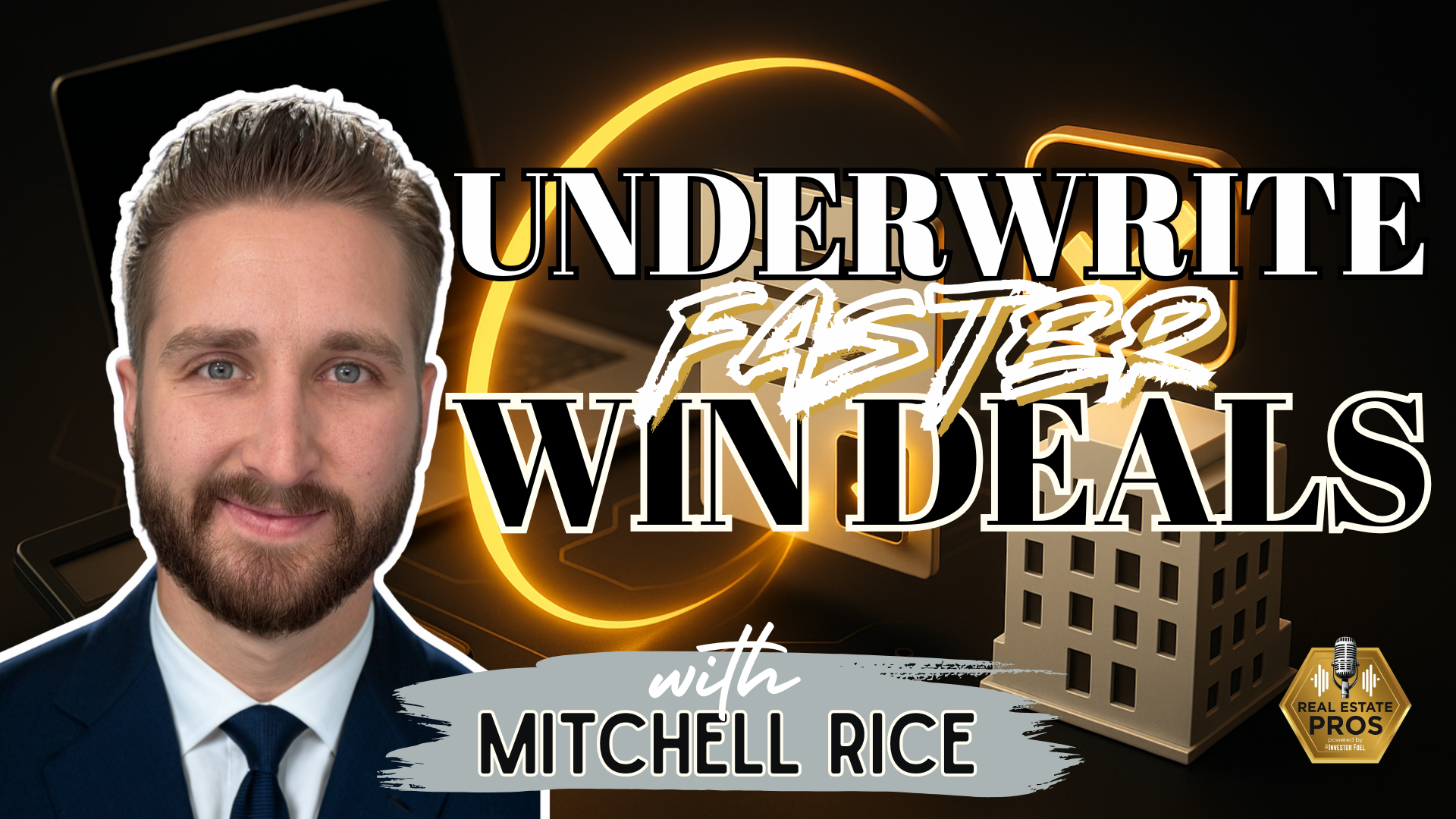
In this conversation, Mitchell Rice discusses the significant challenges faced in acquiring real estate deals, emphasizing the lengthy process of locating and securing properties in a tough market. He highlights the importance of focusing on quality deals rather than solely on capital raising, suggesting that good opportunities will attract the necessary funding.

Resources and Links from this show:
-
Listen to the Audio Version of this Episode
Investor Fuel Show Transcript:
Mitchell Rice (00:00)
It’s totally worth it and a case study on that, one we bought in Houston for just under five million. Before we even closed, we had a aftermarket appraisal in hand. So based on, after this is leased up as a multifamily building and you’re done with your conversion, what’s it worth? And our appraisal came back at nine million. ⁓ And that’s what we’re on track for based on the income that the property’s generating.Michelle Kesil (01:55)
Hey everybody, welcome to the Investor Fuel Podcast. I’m your host, Michelle Kesil, today I’m joined by someone that I’ve been looking forward to chatting with, Mitchell Rice, who’s been making serious moves running a real estate private equity company. So, to have you here on the show today, Mitchell.Mitchell Rice (02:17)
Thanks Michelle for having me. I’m glad we could make it happen.Michelle Kesil (02:20)
Absolutely. I think our listeners are really going to take something away from how you’re working on investing in multifamilies and converting hotels to multifamilies and all of the deals that you’ve been working on. So let’s dive in first off for those not familiar with you and your world yet. Can you give us a short version of what your main focus is?Mitchell Rice (02:47)
Yeah, so just like you said, we’re a private equity fund focused on buying great multifamily assets and converting extended stay hotels. So these are hotels that already have kitchenettes and changing the use of hotels to multifamily assets, which significantly increases the value. And then on the multifamily side, we’ve done both value add and core. So right now we’re buying a property that was only built four years ago. So it’s not even a value add, but we’re buying it and assuming that 3.5 % interest rate that’s in place for seven more years.So we’ve done about five deals and we’re just looking to do more.
Michelle Kesil (03:24)
Amazing, what an exciting time for you guys and what markets are you operating your business in?Mitchell Rice (03:33)
We’ve bought in Tennessee. We’re buying right now in Indiana. We bought in Texas. We’ve developed in Idaho. Utah is our backyard. That’s where we’re located. And we have not even done a deal in Utah. We were trying so hard. Utah is pretty expensive. And we probably underwrote 30 deals just in the last month. And even the best deals were kind of only shaken out to 14%, 15 % IRR. And that’s if we can get the seller to agree to our terms.Michelle Kesil (03:46)
ThankMitchell Rice (04:03)
It’s a really competitive market here. This is where we definitely want our next acquisition to be, but ironically, we’re located here and still don’t own anything here.Michelle Kesil (04:12)
Yeah, awesome. Sounds like you guys are hitting the nation and I’m sure you guys will land on Utah soon.Mitchell Rice (04:22)
Thank you.Michelle Kesil (04:23)
Yes. So how did you get started with this business?Mitchell Rice (04:29)
Yeah, I got started. My dad was a investor. was a, you know, after the great financial crisis, I watched him go pick up a couple of houses in Arizona, Phoenix and Las Vegas and did an Airbnb in Idaho. And I watched him become a LP, so a limited partner investor in some hospitality syndications, both in Idaho and Utah. And just seeing him do all these real estate transactions over the years got me excited. so I studied entrepreneurial management in school and I…kind of knew I wanted to do real estate finance.
So I taught myself how to financial model and underwrite just from getting models online and watching YouTube videos and building models from scratch. And I ended up working for the Mormon Church’s for-profit real estate investment arm as their senior analyst. So I would underwrite all their grounded development projects, anything from warehouses to build for rent communities to mixed use, multifamily developments. And that was just amazing experience for me, my team.
We did about half a billion over two years in transactions. And that kind of just gave me the confidence to start Elkstone Capital. And so that’s what we did. And to date, we’ve raised about 20 million over the past two years. ⁓ We’re approaching 700 doors is where we should land by the end of this year. And yeah, we’re just excited to continue the growth.
Michelle Kesil (06:35)
Amazing. That is exciting. What are some of those keys that have allowed your business to run smoothly over the years?Mitchell Rice (06:48)
I mean, so anybody who’s looking to get into multifamily, you have to know how to raise capital. And I didn’t when I started. you know, and I recommend this to anybody starting out, go work with another GP first before you start. Typically you’ll have to have some experience to bring to the table, whether it’s underwriting or it’s asset management or it’s property management or it’s construction management or something else. But go raise capital, go try to raise money.for somebody else’s deal and become a sponsor in their deal. And that’s how I did it on my first one. And I remember those first few calls were brutal. Go for the people that you know and that aren’t gonna be too hard on you when you butcher your first pitch, because it’ll be horrible. ⁓ But you just gotta start. So work through ⁓ SOI, a sphere of influence first, so friends and family. And ⁓ eventually you’ll just get really good at raising capital.
But it doesn’t matter how good you are at raising capital, you also have to have a great deal. So the deals speak for themselves.
Michelle Kesil (07:54)
Absolutely. So what are some of your maybe advice or tricks that you are doing now to raise capital now that you’ve gotten more experience under your belt?Mitchell Rice (08:11)
So honestly, one of my biggest tricks is probably one that people don’t really talk about, and it’s to ask for referrals. It’s go add value to somebody, and once you’ve added value, a lot of times they’ll ask you the question, what can I do for you? And sometimes we’re too nice, and we just say, you’re good. Don’t worry about it. And that comes from our own pride. But if you add value to somebody, you have every right to ask them to add value back to you. So whether you’re in my business or something totally different,Ask for referrals. Assure that person that you did a good job for them and you’ll take good care of their friends and family and who can they introduce you to that you can help. So that’s honestly one of my biggest tips is working through my personal network of people I’ve already worked with.
Michelle Kesil (08:57)
Yeah, think that is really smart advice to ask for what it is that you need, definitely.Mitchell Rice (09:06)
Yeah, and then you’ve got to know how to present a deal. If you ever get in a room, I’m part of a investor group here in Utah. It’s called Tribe Angels. So there’s a couple hundred accredited investors we meet on the last Thursday of every month. And typically, they invite somebody to do an investment pitch. And every month, it’s different. Sometimes it’s consumer products. One month, it might be real estate. One month, it might be crypto. This month, it was something in the health care industry.Michelle Kesil (09:06)
So, yeah, go ahead.Mitchell Rice (09:36)
You know, being there at each of those meetings month after month, some of them are very straightforward and easy to understand. And when an ⁓ operator can get up and in 10 minutes, very clearly lay out a business plan and nobody’s left confused, that just increases the probability of all of us wanting to invest by so much. But if you can’t effectively synthesize what your business plan is and do it in a way that’s not confusing and… ⁓you know, investors have a clear roadmap of how they’re getting their money back and how it’s going to benefit them. I think that is also so important. You have to explain it simply.
Michelle Kesil (10:49)
Yeah, definitely. That’s some good advice for sure. What are some things that you’re focusing on solving or scaling to right now in your business?Mitchell Rice (11:04)
I mean, capital is always a hurdle, even though we’ve had success with it, you know, and again, starting off in a time when capital markets have pretty much been frozen. Like most family offices aren’t allocating at all right now. If they are there, they’re investing in just private credit deals, no private equity. ⁓ so, so we’ve even had good success, but capital is always a big hurdle. if you can never have enough.If you have more capital, you can always go get more deals. Believe it or not, the deals have actually been our biggest hurdle this year. At the beginning of the call, I told you that it took us five months from January just to May to successfully locate the property that we’re under contract for right now. So five months of working with brokers, underwriting, and then it took us from the end of May to July 27th to actually get it under PSA, to get it under contract. So it’s just a tough market, finding great deals.
I think that’s actually more important than being able to raise the money. Because if you have an amazing deal, the capital will find you. There’s capital out there. So that’s what we’re trying to solve is just how can we vet deals quicker? How can we underwrite faster? So at the beginning of the year, we were kind of still using our full blown sophisticated underwriting model. It would take one to two hours just to underwrite one deal. And now we’ve, we kind of swapped that for a very simple back-end app that takes 20 minutes.
And that way we can underwrite three times as many deals in the same amount of time. And then, you know, if it looks like the numbers are checking out, then we’ll take it and plug it into our more sophisticated model. So I think that’s one thing that ⁓ everybody in real estate needs to learn is right now it’s not about how much time you can spend on a deal, it’s how many deals you can see to find the right ones.
Michelle Kesil (12:57)
Absolutely. Yeah, that makes a lot of sense. So what are some of like these hotel conversion ⁓ processes look like for you?Mitchell Rice (13:13)
Yeah, so step one is we gotta go to the city and see if they will let us, give us a change of use and change of zoning. Because hotels and apartment zoning are very different. ⁓ And usually there’s designated tracks in certain jurisdictions where they want the hotels and where they want the apartments. So nine times out of 10 cities say no when we call them and say, we’re looking at this deal. Would you give us a change of use permit to change the use of this to multifamily?Michelle Kesil (13:20)
ThisMitchell Rice (13:43)
If they do say yes, then we still need to go to the seller and negotiate a very long due diligence period. Usually it’s at least four months because once we put under contract, ⁓ the seller is going to write us a letter of authority saying we can go ⁓ kind of negotiate on his behalf. He’s still the owner. So he’s giving us authority to go and change the use, but we’ve got to go to typically a pre-op meeting and then a planning commission, then a zoning commission, and then.depending on what kind of jurisdiction is usually the final meeting is like a city council meeting. Assuming we get through all of those and they say yes, we get the rezone. Until all that is done, we do not close. So we try to eliminate all that entitlement risk. Because if you buy one of these hotels thinking you’re gonna be able to convert it but you don’t have the entitlements and the city has not said yes, you’re gonna be stuck with the hotel. And a lot of the conversions we’re looking at, they do not pencil as hotels, they only pencil as conversions.
So that’s step one. Step two is do they already have kitchenettes? So are they ready for long-term leases? Sometimes they do, sometimes they don’t. Again, we like to target extended stay brands, so they already have the kitchenettes in them. So they have a sink, they have an oven, they have a microwave, and people can live out of them long-term.
Another common thing we have to do is we have to sub-meter. A lot of these hotels are on a master meter, so sometimes the city requires us to sub-meter out the electric, so to install a separate meter for every unit.
so they can read their electrical bills. Another common thing is fire sprinklers. So a lot of these are older buildings and they do not have fire suppression systems in them. That wasn’t a code requirement at the time. And for the city to give us ⁓ the change of zoning, they’re gonna require us to install fire sprinklers in every unit. So that’s another thing that we commonly have to do.
And then again, every city is different. know, they’ll send people out to the property and sometimes there’s random code items like, hey, these balcony railing spindles are spaced too far apart. Some kid could fall through that and fall off the balcony. Like you’ve got to, you’ve got to close that somehow. We, you know, we’ve had properties like that. And so it’s always a curve ball what the city is going to ask for. But the most important thing on conversions is just that you’re constantly communicating and that you have a long due diligence period to vet everything.
Michelle Kesil (16:45)
Yeah, absolutely. Well, that’s such a lengthy process, but of course it makes sense to go throughout full conversion. I’m sure it’s worthwhile once you get that end result of what you’re looking for.Mitchell Rice (16:59)
It’s totally worth it and a case study on that, one we bought in Houston for just under five million. Before we even closed, we had a aftermarket appraisal in hand. So based on, after this is leased up as a multifamily building and you’re done with your conversion, what’s it worth? And our appraisal came back at nine million. ⁓ And that’s what we’re on track for based on the income that the property’s generating.So we’ve already converted it. We’re installing the fire sprinkles right now. just got, we officially got the change of use. It’s been about 12 months. And we’re, we’ve got 75 leases as of last week out of the 108. So we’re really close to getting stabilized on it. ⁓ And again, the total equity we had to raise on that one was about 3.2 million. So say we go to refinance in a couple months and we do hit that kind of 9 million target valuation.
the difference between our purchase price being 4.75 and the new loan on a nine million dollar value is cash out proceeds. So we should be able to get back as much equity as we put in on that deal to return to our investors just from the refinance and then we’ll keep them in the deal and they get to keep reaping the benefits for the next five years.
Michelle Kesil (18:12)
Awesome, what an exciting opportunity. Yeah, how are you collaborating with investors? Are you working with them on these projects? What does that relationship look like?Mitchell Rice (18:22)
Yeah, so our model is syndication right now. So we have an SPV, a single purpose vehicle, for every ⁓ opportunity that we’re doing. And we bring in LP, so limited partner investors. So they get to invest passively, and they get to come along for the ride, and we do all the work. And as a limited partner, that implies that they have limited personal liability. So if anything goes wrong at the property, like they can’t be sued, the most that they could lose is their contribution.We’re the ones that are signing on the loan ⁓ and putting ourselves up to that liability, not them. So that’s, mean, we work with dentists, doctors, lawyers. We just had a group ⁓ come in who is in the auto dealership industry. ⁓ Anybody who’s run or sold out of a business, typically they like to diversify into real estate. And so anybody can invest with us, whether you’re a family office or you’re
somebody in sales and you just want to stash away on a grant.
Michelle Kesil (19:27)
Yeah, amazing. Sounds like a great partnership opportunity for people.Mitchell Rice (19:33)
Yeah, on our Indiana deal we’re buying right now, we’re giving our investors an 8 % preferred return, which means before we as the operator take any of the profits, they have to make 8%. And then once they’re hitting that, then we start to participate a little bit. It’s a 20-80, so we make 20%. They make 80 % of all the profits above and beyond an 8 % preferred return, up to a 15 % hurdle. And then if we crush it and we do better than 15 %Any dollars above and beyond that 15%, now it’s a 50-50 split. So that’s what’s called a real estate waterfall. Usually there’s a first hurdle being the preferred return, then sometimes there’s multiple hurdles after, and it outlines how those distributions change.
Michelle Kesil (20:20)
Awesome, yeah, what a cool way to distribute things. So when it comes to networking, growing that network, creating new relationships, building your business, what are some of those things that have made the biggest difference for you?Mitchell Rice (20:41)
So in-person meetings are so important. You have to do them. But we’ve had investors who have invested in our deals and we’ve never even met in person. We live in a digital age. I will say what you and I are doing right now, Michelle, is much better than just a phone call where you can’t see the person. I’d say get on as many Zoom calls, as many video calls as you can. ⁓ I honestly almost feel like that’sor it’s at least trending to be better than in-person meetings because it’s just less pressure. If you’re setting up lunch with somebody, sometimes it can take weeks to find the right time and place and actually make it happen. But these video calls are just so low pressure. Somebody in Florida can hop on a call with me in two hours that I just met. And that’s the beautiful part of raising capital in the digital age.
So I would say do as many video calls as you can. And you can get video calls with new investors through creating lead magnets. And I’m not just talking like, don’t just put stuff out in the ether to do it. You need to come up with an e-book that actually has diamonds of information in there that’s going to move the needle in somebody’s life and actually help them. You can’t just be using AI to write this stuff. You’ve got to come up with things that people don’t know, whether that’s
an underwriting training that you’ve recorded or a financial model that you’ve built that you’re giving out for free. So use lead magnets, post those to social media, make sure you have some type of way to capture the leads. Don’t just give away that value for free, but if people want that, ask for an email, ask for a meeting, follow up with them, see if they got value out of it. And the more video calls you can do, the better opportunity you’re gonna have to do business with folks.
Michelle Kesil (22:37)
I love that that lead magnet idea is so clever. I haven’t heard people on the podcast share that yet, so I think that is really good advice for people.Mitchell Rice (22:45)
Good.Great.
Michelle Kesil (22:49)
Yeah, absolutely. Yeah, relationships are everything in this space. So the more that you can build them and connect, the further you will go.Awesome. So, yeah, I was just saying that relationships are everything in this space. So the more ways that we can come up with ways to connect and build them, the further we can go.
Mitchell Rice (23:02)
See you again, Michelle.Mhm.
Yeah, for sure.
Michelle Kesil (23:17)
Yeah.Awesome. So before we wrap up here, if someone wants to reach out to you, connect, collaborate, where can people find you and connect with you?
Mitchell Rice (23:31)
Yeah, find me on LinkedIn. That’s the best way because then we can actually keep in touch over the years. Send me a message, show you, listen to this, tell me what you liked or if you didn’t like me, you can tell me that too. just LinkedIn’s awesome because I’ll send somebody a message and then three years later, they’ll come up, it’ll come full circle and you’ll have something to reference.Michelle Kesil (23:41)
Yeah.Mitchell Rice (23:55)
So connect with me on LinkedIn and yeah, let’s keep in touch. I would love to figure out how we can do deals together or partner on something.Michelle Kesil (24:05)
Perfect. Well, listen, I appreciate your time, your story, your perspective. Thank you for being here.Mitchell Rice (24:12)
Thanks for having me.Michelle Kesil (24:14)
Of course. And for those listeners tuning in, if you got value from this, make sure you’ve subscribed. We’ve got more conversations with operators just like Mitchell who are building real businesses. We’ll see you on our next episode.