Subscribe via:



Show Summary
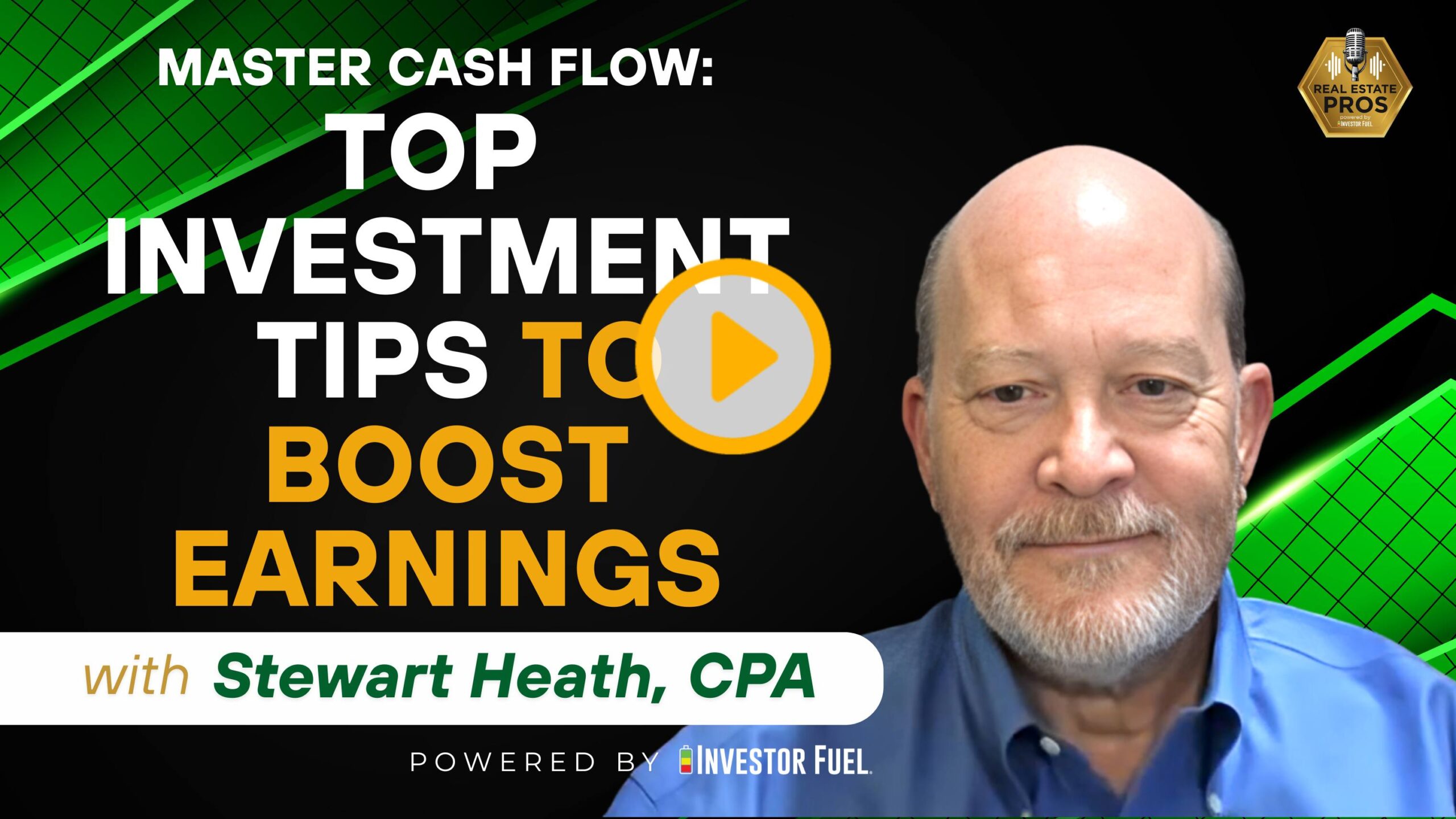
In this conversation, John Harcar interviews Stewart Heath, a CPA and real estate entrepreneur, discussing the importance of passive investing in real estate for entrepreneurs. Stewart shares his journey in the real estate industry, the lessons learned from his experiences, and outlines five compelling reasons why entrepreneurs should consider investing in real estate. The discussion emphasizes the benefits of diversification, passive income, tax advantages, inflation hedging, and the importance of professional management in real estate investments.

Resources and Links from this show:
Listen to the Audio Version of this Episode
Investor Fuel Show Transcript:
John Harcar (00:02.031)
All right, hey guys, welcome back to our show. I’m your host, John Harcar, and I’m here today with Stewart Heath, CPA . And what we’re gonna talk about, besides his journey in business and real estate, we’re gonna discuss the five reasons why all entrepreneurs should be passively investing in real estate. Remember guys, at Investor Fuel, we help real estate investors, service providers, really all real estate entrepreneurs, two to five X their business.
by providing the tools and resources to help grow the business they want to grow and in turn live the life that they want to live. Stuart, man, welcome to our show.
Stewart Heath, CPA (00:38.092)
Hey, thanks a lot for having me here. really an honor to be asked to be on your show. Really appreciate it.
John Harcar (00:43.379)
And I appreciate you coming on and you know, I’m very looking forward to the five reasons. You know, I had saw that on your website. I thought that’d be a great topic. Uh, but you know, before we get into that, right. And get into the weeds, why don’t you give our audience a little background on you, right? You know, your, experience in business and real estate and, kind of what got you up to today.
Stewart Heath, CPA (01:03.32)
Sure, well, I’m old now, so that can take a while. so yeah, as it says down there, I’m a CPA. My dad was a CPA. I really had no clue what he did, but I thought it sounded good when I was in college. And it came out and got my CPA and I started doing public accounting. I’m like, my God, I hate this because I’m far more entrepreneurial than my dad ever was.
John Harcar (01:18.236)
Okay.
John Harcar (01:28.635)
Okay.
Stewart Heath, CPA (01:29.742)
So I ended up taking after my mother and who was quite the entrepreneur. But anyway, so what that really means is along my CPA journey, I’ve actually started many businesses along the way, a couple of which are still in existence, but you know, always trying, always taking risks, always doing the stuff. But really at one point found real estate.
John Harcar (01:52.061)
Hmm.
Stewart Heath, CPA (01:59.662)
and fell in love with it just because of the numbers, because of the predictability, because of the creativity you can apply to it. And it’s kind of almost accidental that I found it in that. So I got out of college in 1985 and less than a year after that they passed the 1986 Tax Act.
which many people may recall, many people my age, that that destroyed investor real estate, you know, for for a few years, really. You know, it was retroactive. They were doing the right thing. I think the retroactive was a bit too far because there was some abusive tax provisions, you know, where you could write off, you know, four times what your at risk basis was. I mean, it just didn’t make any sense. It was abusive.
John Harcar (02:54.269)
great. Yeah.
Stewart Heath, CPA (02:56.654)
But the way they fixed it was almost equally abusive. And I’m a baby in business at this point, and I’m soaking it all in, and I’m going to meetings and listening to bankers tell us that real estate is bad and they don’t lend on real estate anymore. I’m like, okay, I’m writing all this down like it’s gospel. And it all made sense to me. I mean, it makes no sense to me now.
I guess they prefer collateral that has wheels and can leave the state and stuff like that. So I was with a big accounting firm, Frankswater House at the time, figured at the age of 25, I knew everything, so I started my own firm. And immediately started picking up several clients in the real estate business. I had contractors and
John Harcar (03:29.668)
Who knows?
Stewart Heath, CPA (03:52.65)
and realtors who were doing fix and flips and guys who doing all the kinds of stuff and were cooking along pretty well and it dawns on me in the middle of tax season one evening that all of these people are in real estate, which is bad, bad, and they’re making all kinds of money and they’re not paying any taxes. And I know they’re not paying any taxes because I’m doing their taxes. And I was like,
John Harcar (04:17.437)
Cause you’re doing their taxes.
Stewart Heath, CPA (04:21.044)
something doesn’t jive here. And so I began to dabble and I found a guy who was selling a duplex in my hometown. It was in the hood and I thought, well, this will be fun. So I gave him like a couple of thousand dollars and he carried the rest of the note and I was hooked. I absolutely loved the process. And so I became a landlord. And then within a year,
I took those two units and then I had 30 units and next thing you know I’m building houses, got a contractor’s license. All the while I’m practicing as a CPA too. And then we started doing development and got to, actually bought and ran a property management company as well. And I’d gotten our personal portfolio up to about 200 units.
at the beginning of 2007 and I’m doing all of this just on a few thousand dollars and the good graces from every bank that I can find. So you can probably see where we’re headed here. And then I also realized at that time, all these residential units was the nearest definition of hell on earth I could imagine.
John Harcar (05:28.659)
Mm-hmm.
John Harcar (05:32.295)
Right.
Stewart Heath, CPA (05:44.984)
didn’t like multifamily, but anyway, was a sizable portfolio. then in the second half of 2008, long story short, banks stopped lending, people were calling lines of credit. so anyway, went through a pretty massive reversal, giving all that stuff back to banks and stuff.
John Harcar (06:09.363)
Mmm.
Stewart Heath, CPA (06:14.798)
And I wasn’t doing it right. I’m not blaming anybody. was doing it all with no reserves and hardly any equity. And that’s not the way you should do any business. But I was convinced that, well, everything’s always going to keep going up and to the right, isn’t it? the merry-go-round stopped. So anyway, I go back and I take on some C-level positions.
John Harcar (06:25.074)
Right.
Stewart Heath, CPA (06:42.294)
All the while, I’m still loving real estate. Really just want to get back into it. And it did that in 2020.
John Harcar (06:49.693)
So at this, real quick, I apologize for interrupting. So at this point, did you sell all your doors? Are all your doors gone now?
Stewart Heath, CPA (06:56.11)
Yeah, I don’t have any of those anymore. Basically, I took a big, I took a bankruptcy and I lost it all. anyway, made major life changes and, you know, C level jobs, get back into it and here comes COVID and I was just starting to get back to it.
John Harcar (07:03.955)
Okay, okay.
John Harcar (07:21.715)
Mm.
Stewart Heath, CPA (07:23.982)
But anyway, COVID delayed everything a little bit. But in 2022, I had formed Harvard Grace Capital and started talking to some partners and said, all right, we’re gonna do this right this time. We’re gonna have reserves, we’re gonna have equity. And so in 2022, we bought our first couple of deals, did about 15 million in assets that year. Fast forward, our focus is all on stabilized assets.
fixed rate instruments, fixed rate debt. We’re not doing any development. And so that’s been our focus. And so from 2022 to now, we’ve now got $40 million of assets under management. We’ve raised about 15 million in equity. those ratios look a lot better. Everything is operating its full.
We’ve not had to reduce or stop any distributions to our investors, which so many of my colleagues has. And I’m not poking fun at them at all because I think the Fed kind of did a number on us with, mean, we would have gone into a deal expecting interest rates to raise five and a half points in a year and a half. Nobody does.
John Harcar (08:33.149)
The end.
John Harcar (08:42.663)
yeah.
John Harcar (08:48.25)
Exactly.
Stewart Heath, CPA (08:51.566)
So, but anyway, I feel fortunate that we’re in good space. So that’s my journey. So yeah, still love real estate. Just, thank you.
John Harcar (08:57.96)
I love it.
John Harcar (09:02.813)
Such a great story. And I love the perseverance. I where did you get your work ethic from? I mean, you kept going and plugging through ups, downs, drops.
Stewart Heath, CPA (09:14.878)
my parents, it was just, you know, call it tough love, call it whatever you want, just call it being raised by two depression survivors, you know, but well, you know, the best expression of it, well, you can’t fall off the floor. So you may as well stand up and go somewhere. you know.
John Harcar (09:26.163)
Mmm.
John Harcar (09:34.035)
I love that. I love that saying. Did you make that up or did you find that somewhere?
Stewart Heath, CPA (09:41.996)
No, actually one of my college roommates told me that years ago and I’ve only applied it here 30 years hence.
John Harcar (09:49.565)
That’s awesome. type of, like are there any specific kind of mindset tools or just routines or something for you that just kind of keep you in that go forward mode?
Stewart Heath, CPA (10:01.733)
No, I would say that my faith has a great deal to do with it all. I have not had mindset coaches or any kind of tools like that. I’m not opposed to those. They just didn’t feel right to me. I do spend a great deal of time talking with people in my church, my faith, my wife, and in prayer. And just sort of…
discerning what’s the next right thing to do and and Given the given the entrepreneurial nature I have I’m always biased to action And unfortunately the action usually is risk-taking But but you can take risk and be smart about it so yeah, that’s what we’ve done this this next go
John Harcar (10:39.89)
Hmm
John Harcar (10:53.658)
cool. Before we start talking about the five reasons, tell us a little bit about Harvard Grace.
Stewart Heath, CPA (10:58.702)
Yeah, Harvard, Harvard Grace actually started Harvard Grace Corp in 2010 after my bankruptcy to go back and do fractional CFO work, which, which I used it for that. I ended up taking a job, so it just lay dormant until about 2017. And so really, it just became a consulting enterprise. We made a ton of money during COVID doing PPP loans and stuff like that for people.
It grew my client base during that, all the way up to, and in 2020 and 2021, like, I don’t want any more clients. I want to do real estate. But you got to make hay while the sun’s shining, as they say. So then we formed Harvard Race Capital, which is now the main operating entity that we operate out of.
John Harcar (11:36.563)
Hahaha
John Harcar (11:56.179)
Okay, and then with that you’re doing, you said fractional CFO, what else are you doing?
Stewart Heath, CPA (12:01.518)
We were doing some cost segregation studies along the way, we haven’t done that for several years. But we have very little consulting income.
John Harcar (12:07.423)
okay.
John Harcar (12:11.507)
Awesome. now? Where are you? You’re located in Tennessee. Is that where all your properties are? Are you a virtual business as well?
Stewart Heath, CPA (12:18.434)
Yeah, we like to call our, we are virtual business and all of my employees are remote as well. Right now our holdings are from Spring Hill, Tennessee, which is about 20 miles south of Nashville, down through Birmingham. we’ve got nine properties across that spectrum. And one of the ways we’re different in that we have focused on a geography. I’ve lived my life up and down I-65.
really from childhood to now and feel like I should just be in an RV and drive up and down that interstate. Yeah, and so we focus on this geography that we know very well. We’re asset class opportunistic. And so the first deal we ever did was office and in 2022 people are coming, are you crazy?
John Harcar (12:55.591)
Do you know it? Like the back of your hand.
Stewart Heath, CPA (13:16.418)
Well, I’ve managed this building for a client for four years and it’s full. It was full throughout the pandemic. It’s full now. It’s still full today. I mean, it’s a classic location, location, location story. It’s a suburban office in Spring Hill and it’s filled up with doctors and dentists and other service retail type customers.
John Harcar (13:23.698)
No.
John Harcar (13:29.107)
Yeah. Yep.
John Harcar (13:38.853)
Right, right. so what do you, so just so, and once again, we’ll get to our topic here in a second, but just for people listening that might be in there, what are you buying? Like what’s your buy box right now? What does it look like so people can bring you some deals?
Stewart Heath, CPA (13:50.562)
Yeah, right now our focus is on.
Stewart Heath, CPA (13:57.676)
medical office. We just love that class. And we like some retail too. know, retail came out of COVID really underbuilt in a lot of, and so the rent rates on retail have gone sky high and there’s still not a lot being built. And so the demand for retail space. So we’re looking for anything that we can cash flow from day one. And so, you
John Harcar (14:16.445)
Mm-hmm.
Stewart Heath, CPA (14:25.858)
We like those type of assets, really anything that has a good cap rate going in, good for us. It’s really about the numbers when you really get down
John Harcar (14:41.277)
Very cool. All right. Five reasons. Let’s go.
Stewart Heath, CPA (14:45.55)
Five reasons. So this is from a piece that we put together a few years ago because our target investor is, which you know, quite busy professionals, but we really think entrepreneurs. And entrepreneur, I mean, being one, I think I understand most of them.
We all tend to be too heavily invested in our own business, in our latest creation. Unless you’re one of the guys who have started the business and had an exit or two and is sitting on a pile of cash while you’re doing your new business, you’re probably 100 % invested in whatever company you’re running right now. And we think that that’s a mistake. One of the things we try to coach people on is
is building your portfolio, your investment, intentionally. So the five reasons are this, diversification, passive income, income tax benefits, and inflation hedge and professional management. So those are the five reasons. we just encourage people to build their portfolio correctly. And we think step one is you have a foundation in your portfolio of cash flowing assets.
Cash flowing assets tend to be more stable. They’re not as subject to volatility, like in the stock market. If you look at dividend paying stocks, they tend to be more state price stable than the Googles and the Apples and the ones that don’t pay dividends. They will still move the dividend paying stocks. Obviously, we think the best cash flowing asset out there is real estate.
although we’re open to other forms that you may find along the way. But cash flow tends to be stable. And that is the business that Herberger’s Capital is in. We are providing those type of investments. We’re not against development. We’re not against other types of higher return, more risk assets. We just think you need to have that foundation first.
Stewart Heath, CPA (17:10.472)
And that’s certainly what’s behind all of these five reasons. Diversification, you need to diversify from that one thing where all of your eggs are in one basket. You’ve heard this before. And not just go buy one piece of property, you should probably be in several different pieces of property. If not five, maybe 10 or 20, depending on what your investable cash flow is. Put 50,000 in a lot of different private deals.
John Harcar (17:17.469)
Yeah.
Stewart Heath, CPA (17:39.898)
And the passive income, well, you can be a whole lot even more entrepreneurial if you’re not needing to make a living out of your latest creation, your latest deal. So you should begin to generate other streams of income that are not dependent really upon your efforts or upon the business that you’re creating. So generate new streams of income.
The income tax benefits from real estate are unparalleled. Even with our boring stabilized properties, we’re going to do a cost segregation study. We’re going to shelter that income for at least the first three years where you won’t pay tax on the six or seven or 8 % cash on cash return you get. And so when you’re not paying tax, that turns those returns into
John Harcar (18:28.573)
Yeah.
Stewart Heath, CPA (18:38.37)
10s, 11s, and 12 equivalent returns without tax. And that’s just the beginning. You’ve got the ability to do 1031 exchanges. You’ve got the ability to defer or shelter tax in many different ways using real estate, which you don’t get with some forms. You don’t get that through a public rate. Those tax benefits do not flow to you.
John Harcar (18:41.863)
Sure, yeah.
John Harcar (19:03.389)
Right.
Stewart Heath, CPA (19:08.414)
Inflation hedge. Real estate, to me, is, I’m not sure if it’s the only, but it’s certainly the best inflation hedge. I like to joke about being old. I came out of school in the 80s when we were just at the end of Jimmy Carter’s misery index, where we had double-digit inflation and double-digit interest rates. And so I sort of grew up with inflation. We all do it.
John Harcar (19:29.427)
Mm-hmm.
Stewart Heath, CPA (19:38.114)
But we’ve had a couple of generations of people younger than us that really had no inkling of what inflation was until it hit us again in 2022. And then where we found a lot of opportunities in buying some of our assets is people who were not raising rates on their real estate. We bought some stuff from people who hadn’t raised their interest rate and their rental rates.
John Harcar (19:50.386)
Yeah.
Stewart Heath, CPA (20:08.014)
for 14 years. But they think it’s still worth what it’s worth today. But no, you got to live through those leases. But when you structure your leases right and you provide for appropriate pass-through of costs, you’ve got an inflation hedge. And you’re passing it all onto your tenants. And really, they don’t have any other options because most of the…
John Harcar (20:18.365)
Right.
John Harcar (20:28.36)
Yeah.
Stewart Heath, CPA (20:36.972)
most people are managing their real estate correctly. And the fifth reason, professional management, and that’s what we bring, you’re a professional manager of your business, you know what you’re doing, and trust other managers. Just if you put a million bucks in the market, you’re gonna hire a money manager or a financial advisor. They’re professionals at what they do. There are many professionals that know how to run real estate.
John Harcar (21:02.259)
Mm-hmm.
Stewart Heath, CPA (21:06.062)
and do exactly what I just talking about. The real estate’s only worth the amount of money it’s gonna make for you, and what you want is to make it, have it be the most you can possibly get, and that’s through a properly structured lease and the appropriate management of costs and expenses. So, to maximize that income. And that is a full-time job.
John Harcar (21:24.467)
Got it.
John Harcar (21:30.004)
Yeah
Stewart Heath, CPA (21:35.874)
And you want it to be passive, going back to our point number two. You don’t want to have to worry about that, but you do want to find a good manager who will optimize that income for you. So those are the five reasons we think entrepreneurs should be investing passively in real estate. It obviously doesn’t just apply to entrepreneurs, but those are the key reasons we think people should consider real estate.
John Harcar (22:02.127)
Awesome man such great information. Thank you so much to her for coming on and sharing with all this. If there’s folks out there listening that maybe you don’t want talk to you more about it, maybe have a deal in your area. How can they reach out to you?
Stewart Heath, CPA (22:06.894)
Yeah.
Stewart Heath, CPA (22:14.958)
Yeah, thank you for that. The best way to get me is our website, harvardgrace.com. You can find these resources that we were just talking about there. You can find my channel there. And I do invite anybody and everybody to book some time with me because I can talk your ear off of real estate forever. And we’ll become friends and maybe do a deal someday. So that’s the best way.
John Harcar (22:36.764)
I love it.
Hey, there we go. I love it. Well, Stuart, man, thank you again for sharing with us today. Guys, I hope you enjoyed the show. Hope you took some good notes. And I really enjoyed it. And I’ll look forward to seeing you all on the next one. Cheers.
Stewart Heath, CPA (22:51.982)
Thanks, gentlemen.