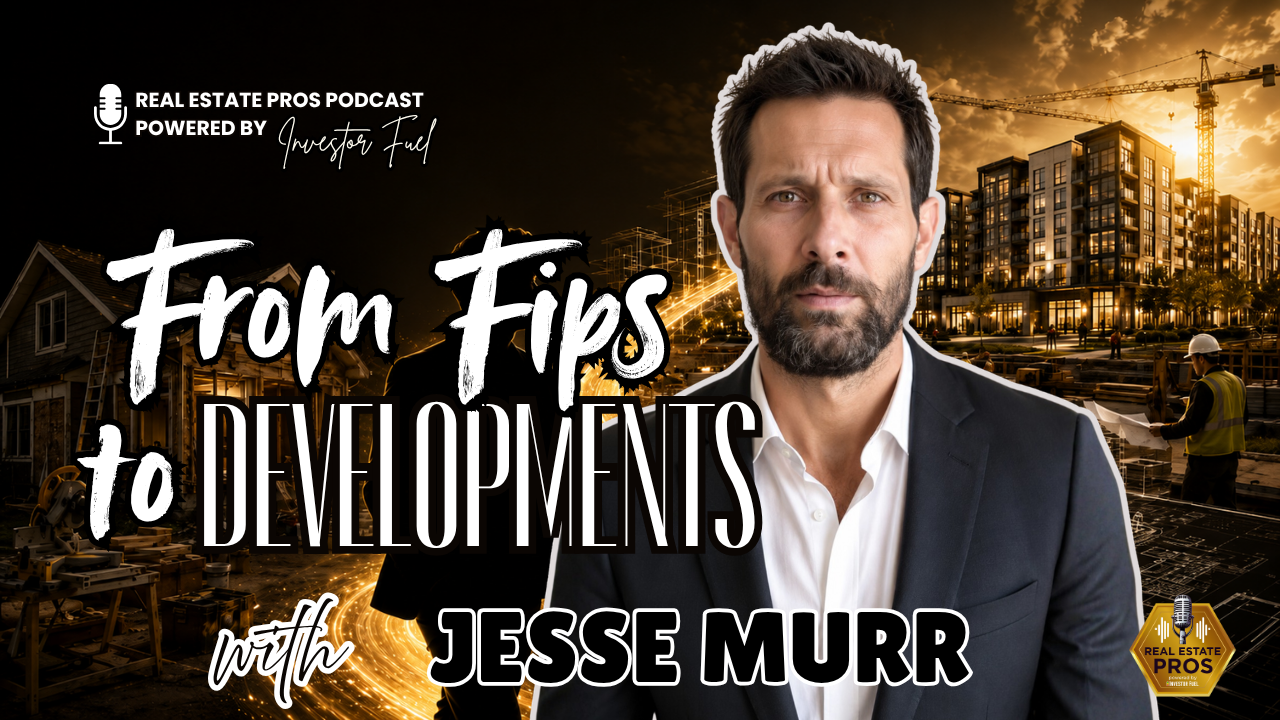
How to Scale a Real Estate Portfolio by Finding Better Deals | Jesse Walters
Show summary
In this episode, Jesse Walters shares his journey from zero to over six million dollars in assets in just five years, highlighting strategies for scaling a real estate portfolio, managing contractors, and leveraging market opportunities in Missouri.
Key takeaways
- Jesse went from 1 to 20 doors in his first four years, then doubled to 50 doors ($6M+ in assets) in year five by focusing on finding deals first and letting financing follow.
- He builds equity early by putting 20% down on initial purchases, then uses that equity for cross-collateralization and down payments on future deals.
- On a 29-unit portfolio purchase, he used a hard money loan requiring only 10% down (interest-only, 3-month minimum) to lock up the deal, then refinanced with a local bank 90 days later and recovered all his cash.
- He budgets flip renovation costs conservatively and can turn around a full renovation estimate and offer in under 30 minutes, which has increased his close rate.
- Contractor reliability is his biggest current operational gap; he now maintains a backup list of contractors to avoid project delays.
- He keeps flips in the $300,000-or-less range because homes at $400,000+ sit longer in his market and are out of reach for first- and second-time buyers.
- Most deals now come through referrals from real estate agents and property managers rather than mailers or paid marketing, though he still uses social media and mailers.
- His portfolio currently sits at roughly 65-70% loan-to-value; his 12-24 month plan is to do one more larger multifamily acquisition, then shift toward paying down debt to bring leverage closer to 50%.
In this episode
- 02:05Intro: Jesse Walters and JAM Investments
- 02:49From zero knowledge to 50 doors since 2021
- 03:51The mindset shift that drove rapid scaling
- 04:53Building equity first before leveraging
- 06:55Fast renovation budgeting and making offers on the spot
- 07:49The contractor bottleneck
- 09:20Moving into larger multifamily: a 10-unit and a 29-unit
- 10:53Financing larger deals with equity and hard money
- 12:19Risk: new construction slowdown and pumping the brakes
- 13:38Referral network: agents and property managers
- 17:22Current bottleneck: fewer, more profitable flips and multifamily scale
About the guest
Jesse Walters runs JAM Investments in the Columbia, Missouri market. He and his wife started unofficially in 2017 when she got licensed as a real estate agent, and he bought his first rental property in 2021 with no prior real estate knowledge. Since then he has scaled to 50 doors valued at over six million dollars and has completed over 25 flips, recently expanding into larger multifamily deals including a 10-unit and a 29-unit portfolio.
Listen to the audio
“If you find the deal, the other pieces will fall into place. It'll motivate you to do it. Like, if you can find a duplex that's fifty cents on the dollar, you know you're gonna be motivated to find the money to buy it.”
Jesse Walters
“These people are doing it, and they actually don't know what they're doing either. So why am I waiting around?”
Jesse Walters
“I can go in and come up with a renovation budget in less than thirty minutes. And then I can make offers on the spot.”
Jesse Walters
Questions answered in this episode
How did Jesse Walters scale from zero to 50 doors in five years?
He started in 2021 with no real estate knowledge, bought his first rental, and gained confidence by talking to other investors who were also figuring it out as they went. He began making offers rapidly and calculated risks, building equity in early deals with 20% down, then using that equity to leverage into more properties with no money down. Years one through four he went from 1 to 20 doors, then doubled to 50 doors in the fifth year.
How did Jesse finance a 29-unit multifamily deal with little cash?
Banks wanted 20-30% down, which he didn't have in cash. He used a hard money lender that only required 10% down on an interest-only loan with a three-month minimum, used that to lock up the deal, then refinanced with a local bank 90 days later and got all his money back out, ending up with no money down in the deal.
What is Jesse Walters' biggest current operational challenge?
Finding and keeping reliable contractors. He says it's been a constant battle because good contractors lose their edge or get pulled onto other things, so he now keeps a running list of contractors on speed dial as backups. He noted more projects have run longer than anticipated in the last 12 months because of this.
What is Jesse's criteria for flips now versus a few years ago?
He's gotten pickier, looking for more profit per flip and turning down deals he would have said yes to a couple years ago unless the offer makes sense for him. He focuses flips in the $300,000-or-less price range since homes in his Columbia, Missouri market priced at $400,000 and up sit longer because they're out of reach for first- and second-time homebuyers.
Where does Jesse Walters get most of his deals from?
Most deals now come from referrals rather than cold marketing. Real estate agents send him properties that need too much work to sell on market or where sellers need a fast sale, and property managers refer owners who want to sell off rental packages, often as part of a 1031 exchange.
What advice does Jesse give to investors stuck at a small number of doors?
He says nine times out of ten the bottleneck is simply not finding the deal. If you find a deal priced well below market, like a duplex at fifty cents on the dollar, the motivation to find financing follows naturally, and you'll call banks, private money lenders, and hard money lenders to make it happen.
Resources and links
Full transcript
Jesse Walters (00:00)
I talked to lot of investors, either new or they might have ten doors in their portfolio. Nine times out of ten, what it comes down to is they’re bottlenecked in some way. It’s just like find the deal. Like, they’re just not finding the deal. Like, if you find the deal, the other pieces will fall into place. It’ll motivate you to do it. Like, if— if you can find a duplex that’s fifty cents on the dollar, you know you’re gonna be motivated to find the money to buy it. You know, it just all starts falling into place. You’re gonna call banks, you’re gonna call private money lenders, hard money lenders… like, you’re gonna make it happen because you know it’s a deal.
Scott Bursey (02:05)
Welcome back to the Real Estate Pros podcast powered by Investor Fuel. I’m your host, Scott Bursey. And today we’re joined by Jesse Walters from JAM Investments. Jesse is a pro in the Columbia, Missouri market, scaling a portfolio from zero to over six million dollars in assets in under five years while completing over 25 successful flips. Pros, we’re going to break down how to scale aggressively while maintaining stability in a competitive market. Jesse, welcome to the show.
Jesse Walters (02:37)
Yeah, thanks, Scott, for having me. I appreciate it.
Scott Bursey (02:38)
It’s just awesome having you here, and to help our listeners get up to speed, please give us the 90-second highlight reel of how your career ignited and where you’re pouring your fuel now.
Jesse Walters (02:49)
Yeah, so we kind of started unofficially in 2017. My wife got licensed as an agent. She grew in that business. We’re helping other investors. We decided we should probably be buying rental properties, too, if other people are. And so we kind of got into it backwards. We bought our first one with no knowledge in 2021, and I got the bug after that. And so from 2021 to now, yeah, we’re at 50 doors, yeah, just a touch over six million valued. And we’ve gone from single families to small multi, now to this year we’re buying larger multifamily.
Scott Bursey (03:22)
Man, that’s incredible. What a trajectory! Thanks for breaking that down for us. And Jesse, it’s awesome to see that growth. What really caught my attention about you was the way you’ve been able to scale from zero to six million in just five years while mastering both flips and buy-and-hold strategies. Looking at that, what was the biggest mindset shift you had to make to handle that kind of growth so quickly?
Jesse Walters (03:51)
That’s a great question. I— I— I think if— if I had to nail down to one thing… I mean, there’s a lot of things that came into it, but I, you know… like, obviously, repetition, you start learning more, you get more confident that way. But like, talking to other like-minded people doing it and like, hearing their mistakes, and yeah, and like, all that… it’s— that really gave me the confidence. It was like, “Okay, like, these people are doing it, and they actually don’t know what they’re doing either. So why am I waiting around?” You know? So I, you know, once I… that kind of… that light bulb went off, I just went for it. I was like, you know, I just started making offers rapidly at that point. And I was like, you know, we’re— I’m making offers in a not a foolish way, you know, like, it’s a calculated risk. However, I just started making more and more of them, and that’s what really started to scale it with that— that confidence, knowing I don’t need to know everything— like, I’ll figure it out along the way.
Scott Bursey (04:40)
Thank you for highlighting that. And if somebody’s listening and they’re thinking to themselves, “This is somebody I really like and would like to do business with,” what would you like them to know first about your operation?
Jesse Walters (04:53)
Yeah. So I would say, you know, when we first started, it was like we put money down and like, put equity in. And you know, we want to play this so we’re like, “We’re not giving these properties back to the bank.” And then, you know, once we got a good ground base underneath it, we started leveraging more at that point. So like, the— the first couple properties we bought, that was the foundation that was paying the bills, you know, for the rental portfolio— not necessarily paying us, but it was paying, you know, maintenance, you know, repairs, things like that, and we don’t have to worry about it. You know, we’re not taking money out of pocket.
And— and then from there, yeah, we started leveraging more and more from that. And like, we were very focused on like, “We don’t want to bring in partners.” We were like, “We can do this ourselves, like, we just grow it a little slower.” And even though, grand scheme, it really wasn’t slow, but, you know, we— we could have gotten it to 10, 20 million by now if we wanted to, but we didn’t want to, you know, bring in all these other people. So I would say, yeah, like, get the equity in it first, and then let that foundation carry you the rest of the way, ’cause then you can leverage that equity to buy more with no money down, and it just starts snowballing from there.
Scott Bursey (06:49)
Curious to know: what do you consider your biggest internal strength when analyzing a new deal?
Jesse Walters (06:55)
I would say now when it comes to flips, I’m— I’m pretty quick to come up with a renovation cost. I’m not perfect at it, but, you know, I’m relatively conservative on it. So like, I’m, you know, I’ll kind of budget a little higher than maybe what I think it might be. But I can go in and— and come up with a renovation budget in less than thirty minutes. And then I can make offers on the spot. And I think that once I got to that point, it… more deals started closing for me. You know, pe— people can see the confidence I had in it and they’re like, “Okay, this guy knows what he’s doing,” and he can… he— it gave the seller confidence to know, like, I can close and like, I’m not gonna just leave them dry, you know, afterwards, things like that.
Scott Bursey (07:39)
Jesse, the pros would be interested to hear: what’s one operational gap you’ve identified in your business that you’re working to close right now?
Jesse Walters (07:49)
Yeah, it— it seems to be a constant battle with contractors. I’ve always been… like, I— I’ve ow— I’ve had a few good ones for the last couple of years, and then more recently, they’ve— they’ve lost their edge for whatever reason. You know, they all have their own personal things going and like, it’s nothing against them— it’s, you know, they have their own lives, stuff like that. But like, I— I’m getting more adamant and just keeping like a list of contractors just like on speed dial. So like, if one drops, I’ve got a backup or, you know, things like that. And I try to work with the ones I just like and then also that have a knowledge base. So yeah, that’s definitely been a big hurdle trying to get over. So like, I’ve— I’ve had more projects go longer than anticipated in the last 12 months than I did prior. It’s— they’re just taking longer because I can’t get people there to work quicker.
Scott Bursey (08:36)
And on that note, what does success look like for JAM Investments once that gap is fully closed?
Jesse Walters (08:44)
You know, I would say I don’t have like a high volume. So like, you know, you always see these flippers, like, you know, they’re flipping ten houses a month, all this stuff. Like, I don’t really have any… I d— I really don’t have any plans to do that. So I really like, if I can do one successful flip a month and just keep that ro— you know, just one, and that’s paying the bills, you know, income coming in… like, that’s all I want. And then we’re just building our rental portfolio in the background, you know, on top of that. So that’s really my goal.
Scott Bursey (09:10)
Thank you for sharing that. And Jesse, we’d love to understand: where do you see the biggest untapped opportunity for investors in your specific area this year?
Jesse Walters (09:20)
Yeah, like, we’ve grown our portfolio and our experience enough to where we started getting into larger multifamily. So we got a 10-unit and then we bought a 29-unit portfolio this year already. I’m seeing more of those opportunities now. And if I— I have learned a lot about this sector in the last six months, you know, d— I’ve been really thrown to the wolves and everything. But like, I’ve— I feel like financing is the biggest hurdle in all of it. ‘Cause like, you know, the renovations, all that stuff, it’s all the same, it’s just more of it. You know, I— I’m confident in that stuff, but it’s just getting the financing to do it. So like, if you can figure out the financing, I think there’s a big opportunity there with these larger multifamily. And like, I’m not saying like you need to buy a 300-unit apartment building. It’s just like the 10-units, the 15-units. I think I— I think there’s gonna be a really good opportunity there that most people can’t purchase, and if you can get in that sector, there’s less competition and there’s more deals to find.
Scott Bursey (10:47)
On the topic of financing, how are you positioning JAM Investments to capitalize on that right now?
Jesse Walters (10:53)
Yeah, so one is equity. So like what I said before, like, we— we have equity in our properties now, especially the ones we bought in the very beginning. You know, we put a decent chunk of money down, like twenty percent down on those, and then, you know, five years later, they’re just worth more money than we bought them for. So that’s a big one. We use that equity for cross-collateralization, and that’s our down payments with local banks. And other one… I wasn’t a fan of this for the first few years, I just didn’t want to do it, but we started using hard money to buy, especially on these larger deals, because they require less money down usually. So I can… it’s very temporary financing, but it’s just to get me to lock up the deal.
So for example, that 29-unit, banks, they wanted anywhere from twenty to thirty percent down. I’m like, “Well, I don’t have hundreds of thousands of dollars cash sitting in the bank just to give you as a down payment on this thing.” So I went to a hard money lender, they just required 10% down and it’s an interest-only loan, minimum of three months. And then after that three months, we literally just refinanced it back with a local bank, you know, 90 days later, and we got it all taken care of that way. So, I mean, I got all my money back out of it, too, on the refinance. So— so we’re in a 29-unit portfolio, no money down now. It just— it was just a couple extra steps to get there.
Scott Bursey (12:11)
Thinking about the external environment, what is the biggest risk you’re currently monitoring for— for your portfolio?
Jesse Walters (12:19)
Yeah, so on the flips, we— we started doing some specs. You know, not much, but like, we’ll— we’ll build a couple houses a year with a local builder, we partner with them on it. New construction is really slowed down in our area. I think that might be a lot for the country, but in our area especially, it’s just the cost to build is just so high, and it’s not affordable for first-time homebuyers. And that’s really my bread and butter for flips. Like, I’ve learned like in our area, it’s like 400 grand and up, those homes just sit longer. It’s not the first-time homebuyer, so, or even the second-time homebuyer a lot of times. So we really focus our flips in that three hundred grand or less range. And the new construction is… I’m just keeping a close eye on it. We haven’t stopped— like, we’re building two right now— but I’m not building any more till those are done and sold. Like, I want to make sure those are taken care of before we just start dumping more into it. So yeah, like, I think that’s a— a… it’s not a threat right now in our area, but it— it might be. And I’m just keeping a very close eye on it and I’m really pumping the brakes in that sector.
Scott Bursey (13:28)
You mentioned the market has slowed down in your area. Wondering: what’s the one strategic pillar that keeps JAM Investments ahead of the— the competition?
Jesse Walters (13:38)
I think it’s our presence. Like, we’ve just been in it long enough now. As real estate agents and an investor, we— we just built a lot of connections. Most of our deals now come from referrals. So like, other agents will send us stuff or we get a message online about a property for sale that’s off-market. I— I think that is the biggest thing keeping us going right now. Like, you know, we— we do mailers, we do other types of marketing, things like that, but like, really social media and like, just keeping those referrals in place… like, that has been huge and kept us busy through even though the market slowed down.
Scott Bursey (14:13)
And on that note, Jesse, where do you see the vision for JAM Investments over the next, let’s say, 12 to 24 months?
Jesse Walters (14:21)
That’s a question. So I— I definitely think now, like, after putting a lot of thought into this, I’d like to get one more like, larger multifamily portfolio in, just under our belt, just so we have that. And then I’m debating if we sell off a few that we bought a few years ago that aren’t really performing like we thought they were, or that equity could just be used, you know, better elsewhere, you know, something like that. So I’ve… yeah, 12 to 24 months, like, we’ll grow a little bit more in our portfolio, and like, I’ll keep flipping. Like, I— I would love to keep a flip going a month. Like, I… that just— that pays the bills, you know, we want to keep that going. And the rental portfolio is just growing in the background.
So I think after that one more bigger purchase, I think we might flip gears and start like, paying down some of the debt and getting it more stabilized. ‘Cause we— we’re pretty high leverage right now, like, in the things we bought in the last two years. And it’s getting a little bit out of my comfort zone of like, “All right, now we need to…” well, I want to get that safety net back down. So, and we’re not horrible— I think we’re sitting at like, seventy… sixty-five to seventy percent loan-to-value right now with our whole portfolio, but I would like to get that down to like, fifty, and just so it’s just stable.
Scott Bursey (16:13)
Please help the pros understand: what does your professional network look like right now?
Jesse Walters (16:18)
Real estate agents are a big one. We have realtors sending us deals that they don’t have them listed or anything, but like, they might go to a listing appointment and like, this house needs like $50,000 worth of renovations. Like, they know it’s not gonna perform well on the market, or the seller is like, “I need to sell this thing in three weeks.” And it’s like, “Well, I can’t do that on the market,” you know? And so I— I— I’m top of mind for a lot of people in that area.
And then also one of my biggest referrals as a— are property managers. You know, they— they have their hands on all the rentals around the area. And then when a owner wants to sell, they’re calling me. And you know, like, and typically it’s like package deals, like they have like, you know, a few properties that they just wanna offload ’cause they’re going to their 1031 into something else, and then we can make a deal happen. It’s a win-win for everybody.
Scott Bursey (17:05)
It’s all about who you surround yourself with. And it’s fascinating to look at your growth, and we’re real curious on this: what is the one specific bottleneck you’re choosing to tackle right now to push JAM Investments to the next level of profitability?
Jesse Walters (17:22)
I’m getting picky on the flips we take now. So like, I’m looking for more profit per flip. The ones I would have said yes to a couple years ago, I just— I’m just not anymore. Or I’m making an offer where it makes sense for me. If they say no, they say no. So the ones I do take on, it just… it’s more efficient for me, not— less chance of losing money on a flip. So, knock on wood, I haven’t lost money, but I’ve come pretty damn close on some stuff. So that, and then yeah, that larger multifamily stuff… I— I think that’s what’s really gonna help us scale.
So like, just to give you an example: so like, that years one through four, we went from one to twenty doors. And now the fifth year here, we went from twenty to fifty doors. Like, we over-doubled it in the last, you know, twelve months. So I— and I think that’s— that’s the big opportunity for scale here, and it— it’s— it’s figuring out that financing piece and just the larger multifamily world, just learning more about it and how the expenses, repairs, maintenance, all that stuff works, and management is a big one.
Scott Bursey (18:25)
Thank you for highlighting that, Jesse. And Jesse, you have given our listeners just a tremendous amount of really good words of wisdom here today. But is there any other advice that you could leave with our listeners?
Jesse Walters (18:38)
I talked to lot of investors, either new or they might have ten doors in their portfolio. Nine times out of ten, what it comes down to is they’re bottlenecked in some way. It’s just like find the deal. Like, they’re just not finding the deal. Like, if you find the deal, the other pieces will fall into place. It’ll motivate you to do it. Like, if— if you can find a duplex that’s fifty cents on the dollar, you know you’re gonna be motivated to find the money to buy it. You know, it just all starts falling into place. You’re gonna call banks, you’re gonna call private money lenders, hard money lenders… like, you’re gonna make it happen because you know it’s a deal. So it’s like, just find the deal. And then from there, it will scale, I promise ya.
Scott Bursey (19:15)
Great advice. And for those of our listeners that want to keep this conversation moving, stay in your lane, collaborate with you, Jesse, what’s the best way for them to plug into your pipeline and reach you directly?
Jesse Walters (19:27)
Yeah, so we’re— I would say we’re most active on Instagram. We post all of our projects and stuff through there. So, but yeah, it’s my handle is @jesse.v.walters, J-E-S-S-E dot V as in Victor dot W-A-L-T-E-R-S, @jesse.v.walters. But yeah, you can message me through there. I answer pretty quick usually. So yeah, but happy to chat, and if I can help, I definitely will.
Scott Bursey (19:50)
Jesse, thank you for joining us today on the Real Estate Pros podcast. This has been an outstanding conversation.
Jesse Walters (19:57)
Yeah, thank you for having me. Yeah, I appreciate it.
Scott Bursey (19:59)
And to our listeners, we appreciate you. If you receive value from today’s episode, please subscribe. We’ll be filling your tanks with the lineup of elite guests just like Jesse Walters, who are accelerating and setting the pace for the rest of the industry. Until next time, keep your standards high and your vision clear. We’ll see you in the next episode, everyone.