Subscribe via:



Show Summary
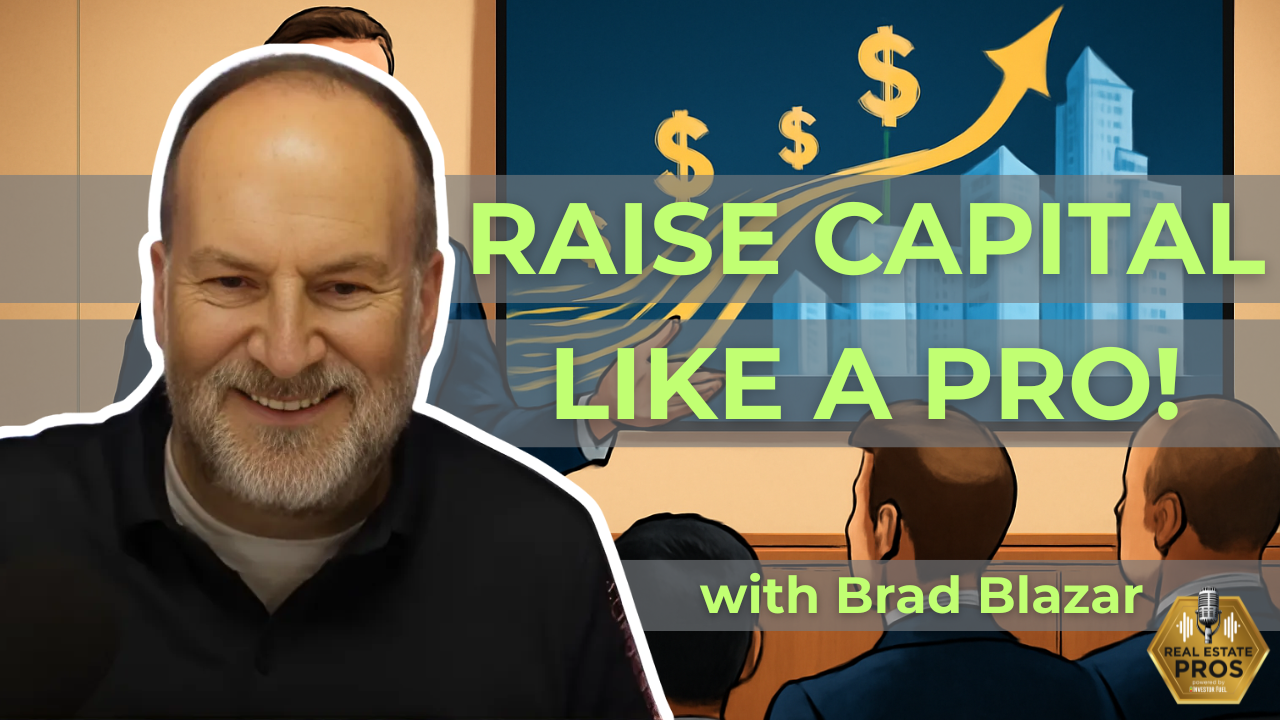
In this episode of the Real Estate Pros podcast, Brad Blazar shares his journey from aspiring architect to successful entrepreneur in the real estate and capital raising sectors. He discusses the importance of building relationships, understanding the regulatory environment, and developing the right mindset for success in fundraising. Brad emphasizes that anyone can start raising capital, regardless of their financial background, and provides practical strategies for finding investors and overcoming challenges in the fundraising process.
Resources and Links from this show:
Listen to the Audio Version of this Episode
Investor Fuel Show Transcript:
Brad Blazar (00:00)
money will always exchange hands when problems are solved.
And the bigger the problem, the more money people are willing to invest to solve that
Kristen Knapp (01:40)
Welcome back to the Real Estate Pros podcast. I’m Kristen Knapp and I’m here with Brad Blazar, who’s a serial entrepreneur. He has Capital School, which is education on raising capital. And then we have the Richendo Capital Group, which is investing in all types of projects, specifically multifamily. And I’m so excited to talk more about it. Thank you for being here, Brad.
Brad Blazar (01:58)
It’s great to be here, Kristen. It’s a pleasure.
Kristen Knapp (02:00)
So you have such an interesting background. You’ve lived many lives. I would love to kind of go into your journey of how you found yourself into real estate.
Brad Blazar (02:09)
Yeah, well, you know, it’s really interesting. I certainly didn’t find this journey. It kind of found me. I actually went to school to be an architect. And so that was kind of my original goal. I think it was really kind of following a path that largely my parents had kind of inspired me to follow. I think most parents say, hey, go to school, get a good job, get a career. And so that’s what I really started doing back in my late 20s. And while I was in school,
I responded to an ad in the local newspaper and went to work for a very small oil and gas company in Austin, Texas. And I was just going in, you know, between classes and after school calling to investors, building relationships. They were investing alongside us in our drilling programs. And I got really good at that. And so after working for one company, I then went to work for a second company, essentially doing the same thing.
only to find out that they were doing things improperly and I really didn’t want to associate or lend my name to them. So I resigned and basically the investor base that I had cultivated turned to me. Most of them had never met me because I was doing most of this work over the telephone. And they said, well, you what are you going to do now, Brad? And what I saw was really just a door opening up saying, you know, we got a bunch of investors, they’ll back me. And so at the age of 23,
pretty much just launched an oil company and didn’t know anything about the business, which is really the amazing thing. I just kind of said, you know, it’s either now or never. I’m young enough where if this doesn’t work out, I can always go back to school. And so I basically just, you know, withdrew from my education, printed up some business cards, put a, you know, sign out on the door, started raising money and kind of surrounded myself with the resources and the people I needed to become successful. You know, an attorney, a CPA, you know, a geologist and
Over the course of about 10 years, we built a pretty nice sized small oil company with drilling programs in Texas, Oklahoma, Louisiana. ⁓ Fast forward, in the late 80s, early 90s, a couple of things affected the energy space. One was collapsing oil prices. The tax law changed in 1987. That took a lot of the incentives away for investor capital. And so,
I kind of decided to just kind of collapse the business. We never filed bankruptcy because we didn’t have any debt on the books, but you know, we just kind of slowly consolidated until one day we no longer existed. And that’s when I went back to school and ultimately came out now with a BBA in finance because I had changed majors. And so I’m out there with this little sheepskin diploma and people are wanting to hire me, but they were offering me salaries comparable to what I would make in a good month back when I was in business for myself.
And I just said, is not the direction I want to go. And so it was really interesting. I was watching a TV show many years
and Steve Harvey was actually on there and he was talking to his audience and he said, I believe everybody here in the room has a special talent. It’s what I call your something special. It’s kind of like if you’ve ever been to that little build-a-bear factory where they make those little bears and they put that little red heart inside the build-a-bear.
It’s inside you, but you’ll never find it. But he said, for those people that do and could package that up and deliver it to the world, it’s transformational. And so I thought about that concept and it literally hit me like a ton of bricks. A couple of weeks later, I’m like, my God, like my talent is raising capital. I’ve raised millions of dollars to build my company and that is probably a skill that a lot of business owners and entrepreneurs would like to know.
Kristen Knapp (06:12)
again.
Mm-hmm.
Brad Blazar (06:30)
And
so that’s what allowed me to really enter the career of becoming a capital raiser, working for some of the world’s leading financial services firms, you know, raising hundreds of millions of dollars now in excess of two billion, which is more than any other educator that we know of out there. And then also, of course, today start our other platform, which is Crescendo Capital Group, working with investors to bring them in alongside us. But it was really that journey.
Kristen Knapp (06:46)
and
Brad Blazar (06:57)
of just kind of finding myself that inspired me to say, hey, I can impact other people’s lives in a very positive way because here’s what I learned when I retired. ⁓ I became a consultant to business owners and I was always asking them, Kristen, if you weren’t doing what you’re doing now, what would you really want to be doing? And everybody shared that dream like, my God, I’ve always wanted to start a restaurant or I’ve wanted to buy a business or I’ve wanted to get in real estate. And I was like, well, why are you not doing that?
Kristen Knapp (07:16)
Yeah.
Brad Blazar (07:26)
And it always came down to money. was never the fear. It was never the limiting belief that they would or not be successful. I’m sitting there going, my God, I raised two billion dollars. Like if I can show Kristen how to raise money, her dream can become a reality. And so we’ve been able to do that now repetitively over and over and over again for so many business owners that it’s really amazing to see these people’s lives change where they become better parents and better husbands and wives and, you know, start getting on that trajectory to really building a much more financial future for themselves.
And so that’s what gets us out of bed every day, me and my team, we just love the impact we’re having on so many other people.
Kristen Knapp (08:02)
That’s incredible. mean, your background, although you’ve done a lot, it does feel very seamless where you really are tapping into what makes you special and what you’re really good at. Because I’m sure in the oil industry, you learned a lot about management and risk and obviously raising capital. That’s incredible. And it really is a skill that people want to know. That’s a huge thing that people just have no idea where to even start.
Brad Blazar (08:25)
Yeah.
Absolutely. And you know, it’s not just where to start. It’s also the regulatory environment. When we take other people’s money and they’re investing with us in a passive nature where they expect to get a return on that investment, we’re stepping over into the security space. And so, you know, that’s obviously a heavily regulated industry with the SEC and various state regulators. And so you need to understand how to be compliant and how to do things properly, because if you don’t, you know, the repercussions can be very severe.
And so we always build from the ground up. We educate first on the compliance and the regulatory environment, because once you’re aware of that, you can then scale your business and sleep well at night knowing that you’re doing things the right way. And so it starts with that. And then the other is really just showing people how to build interest with potential investors, how to articulate and communicate your story and your opportunity. Because we’ve seen so many mistakes.
And I think the biggest problem people have, Kristen, is they got a business opportunity or they have a project and they meet people and so they start talking about it very early in the relationship. And, you know, out of respect for you, the other person’s going to say, you know, something like, hey, Kristen, it sounds, you know, like a pretty interesting opportunity. Can you send me some information so I can take a better look at it? Well, everybody says that. I mean, like, you know, if you’re pitched an idea, you’re going to say, oh, you know, you’re being polite.
So now you send them everything, but then they go dark and they never invest. And really what’s happening at a very subconscious level is the other person
is really ghosting you or not moving forward because it’s way too early in the relationship. They’re like, you know, we just met, like we’ve only talked once and now you’re asking me to invest with you? Like, you know, let’s slow down the process, kind of like dating and get to know each other. So I understand your values and I understand a little bit more about the business and I can ask proper questions. And so…
Kristen Knapp (10:44)
Right.
Brad Blazar (10:54)
A lot of people get caught up in kind of what I call this randomness in motion. They’re doing things thinking that they’re going to get the results they’re looking for, but they get very frustrated because they’re going about it in a very improper manner.
Kristen Knapp (11:08)
Yeah, and I mean, I think a lot of people can see capital raising as very transactional, and it really is relationship building.
Brad Blazar (11:13)
⁓
absolutely. 100%. People invest with people they know, like and trust. Absolutely.
Kristen Knapp (11:19)
Yeah.
And that’s really been kind of the foundation of you and both of your businesses and how you’ve been able to succeed is really through relationship building, correct?
Brad Blazar (11:26)
Yeah,
yeah, absolutely 100%.
Kristen Knapp (11:29)
Yeah,
and I would love to talk about just, you know, some of the things you, like some of the advice that you give to people. What caught my eyes, you know, a lot of people think they have to be rich to get into real estate or, you know, to start a business or whatever, but you’re saying you don’t.
Brad Blazar (11:45)
Not at all. No, I mean, you know, we have many entrepreneurs that we’ve helped literally that have started with very limited resources. And, know, even in real estate, there are ways to get started with very little if no capital. You can become a wholesaler. And, you know, I know many wholesalers that are making seven and eight figures. You know, these guys are making multiple millions. They’ll find a property that they can buy below market. They’ll find an investor.
and they’ll wholesale that property to the investor, you know, in the process make 10, 20, 30,000, in many cases more dollars. And then they do another before you know it, they’ve gotten enough money to now go over here and do this and then do this and, you know, grow their real estate building business. The other key of course is if you’ve ever read the book, Rich Dad Poor Dad by Robert Kiyosaki, you know, he talks about buying assets and creating passive income.
But also in the book he says the key to really building like significant legacy wealth is understanding the principle using OPM, other people’s money. Because that unlocks the door to you being able to do bigger projects, getting seats at a bigger table, know, doing bigger deals. And the challenge I think is so many people don’t have the track record. Maybe they have marginal or bad credit. ⁓ You know, maybe they’re just getting started. So they go to a bank.
and they try to borrow money and they get turned down. So they just give up, you know, where they don’t realize, know, hey, if I go to the SBA and borrow money for a small business, really what they’re doing is they’re now partnering with Uncle Sam, because that’s a government loan. And now if the business doesn’t work out, you know, now you’re personally liable. They can not only take the business assets, they can come after you personally. And so I don’t believe that’s a viable option either, you know.
And so I tell people the best option for you is to learn how to raise investor capital. Because once they buy into you and they see the vision, a lot of times they will vote with their checkbook and now you can move forward and capitalize what it is you’re wanting to do. And then of course from there, you know, the sky’s the limit.
Kristen Knapp (13:47)
Yeah, and what about the mindset it takes? Because you kind of mentioned how I think a lot of people get in their own way and they say no before someone else says no. What’s kind of the mindset you need to start raising some funds?
Brad Blazar (13:53)
Yeah.
I think the mindset that you need is number one, you need to be confident. think number two, you need to be kind of what I call somewhat nonchalant. When you approach a potential investor, you certainly don’t want to come across as somebody that’s talking to them from a position of desperation or come across overly persistent. And so I kind of explain to my students, those people that we mentor, create the attitude that some will, some won’t, so what?
There’s always another investor to be talking to. And if you kind of take that, you know, standoffish attitude, what I’ve learned, and of course, psychology has actually proven this, people want what they perceive they can’t get. And so that’s human nature. One of the most powerful closing techniques known to any salesperson is what we call the takeaway offer. You offer something to somebody.
Kristen Knapp (14:30)
Right.
Right.
Brad Blazar (14:51)
And then you slowly take it away from them. And then what they do is they justify why what you offered is suitable for them. So, you know, if I
built up the excitement in you and get you excited about what we were doing. And then I said, you know, but now that I get to know you better, Chris, and I really don’t know if what we’re doing is suitable for you. You’re to be like, what do you mean it’s not suitable for me? I want to do this, you know, before I know it, you know, we’re moving forward and you’re investing. So.
Kristen Knapp (15:53)
Yeah.
Brad Blazar (15:58)
There is definitely some psychology in the mindset. And I think the mindset you have to have is that it’s not going to be for everybody. And that’s okay. You you might have to talk to 10 people to find those two or three investors, but what about the other seven? You know, maybe it’s timing. Maybe they just weren’t qualified. Maybe if you stay in touch, they’ll do something with you at some point in the future, which is why a drip campaign is so very important. So if you kind of create that mindset of, know, hey,
⁓ We definitely are interested in getting to know you better and we’d love to have you partner with us But you know right now I don’t have anything that I can openly share discuss it creates basically the impression That you’re interested in other people and when the timing is right, you’ll bring them in But I think the biggest thing is really just confidence you have to get outside your shell You have to be talking to people and realize that this really you know, capital racing is a people business
Kristen Knapp (16:54)
Yeah, absolutely. And do you think the best way to deal with rejection is to be rejected and to kind of feel that?
Brad Blazar (17:01)
Yeah,
I I really do. I mean, think that so many people are in sales and they have the call reluctance. And everything starts with a conversation. And unfortunately, I think one of the things that’s really affected us is technology. mean, we get on airplanes and we’re no longer talking to the passenger that’s seated beside us. We’re either tuned into a movie or we’re getting our laptops out. And I see that all the time because I travel.
You know, even with, you know, families, you know, you’re at a restaurant, you see a dad on his phone, you see a kid being entertained with a laptop. So what we have to realize is that every sale, whether it’s raising capital or just selling goods and services, really starts with productive conversations with people and just, you know, inquiring. And so I become very attuned when I’m out there to, number one, look for people that look for, you know, that look successful. I mean, you can tell the way they dress, you know, do they wear Rolex or are they, you know, dress nicely?
And you know, just walking up casually and just saying, hey, you know, I just wanted to compliment you on your beautiful outfit or your purse or whatever. You know, what do you do for a living? And before you know it, you’re striking up a conversation and then they ask you what you do for a living. And before you know it, you’re telling them and there’s interest and you know, you’re exchanging information. But so many people kind of get caught up in this mindset of nobody’s going to be interested.
Kristen Knapp (18:22)
right?
Brad Blazar (18:22)
Or,
you know, I’m an introvert and I really am uncomfortable talking to people. Well, there’s plenty of ways that you can still raise capital on the internet. You know, we can create a funnel, we can create webinars, we can create a lead magnet like an ebook. And so now you’re only interacting with people that have opted in. So it’s a little bit warmer lead and you don’t really have to get outside your comfort zone nearly as much because now you know that that person has already indicated interest and now you’re just following up. So.
It’s really finding out with a person that we work with, what can you do consistently that’s within your comfort zone that will get you from point A to point B. Because if I tell you to do something and it’s outside your comfort zone, it’s not going to work for you. And I think that’s one of the challenges some of these other educators teach people how to raise capital the same way that they raised it, but what worked for them might not work for you.
Kristen Knapp (19:01)
Right?
Mm-hmm.
Absolutely.
Brad Blazar (19:18)
And
so, you know, we lay a blueprint where we give people about 12 different strategies of personally what I’ve done to raise, you know, hundreds of millions. And I say, you know, let’s pick two or three that you’re somewhat comfortable with. Let’s see what works for you. And then let’s double down once you start seeing success.
Kristen Knapp (19:35)
Amazing, and these are ways to actually find the people.
Brad Blazar (19:38)
Yep, exactly. Absolutely.
Kristen Knapp (19:40)
Because I think that’s what
people get really hung up about, where it’s like, I know people exist with money, but how do I access them?
Brad Blazar (19:47)
there’s tons of ways, you you can organize a meetup, you can host events, you can literally buy lists of accredited investors. And then of course you can invite them to an opportunity or you can call them. You can create a webinar and basically advertise on social media and, now become a person of interest. You can create an ebook. You know, you can go to locations that we just know cater to affluent, wealthy people, know, country clubs. And so there’s many ways.
to get in the environment. throughout the year, there are also many events that are curated and hosted where we bring what we call allocators, i.e. family offices or small registered investment advisors together. And then people looking for capital come into the room and present their opportunity. And so we ⁓ invite our students to do that as well. Hey, come alongside Brad. He’s going to be at this event. He’ll introduce you to a bunch of people.
And so just by facilitating those relationships, we’ve been able to make introductions. So there’s lots of ways to get in the environment of meeting affluent, wealthy people.
Kristen Knapp (20:55)
And what would you say to someone, because I know that people talk about bad times to raise money, like the summer is a bad time or the holidays are a bad time, what would you say to that?
Brad Blazar (21:00)
Hmm?
I say there’s no such thing as there’s a bad time. Every time is a good time. I’ve raised money for over 35 years through recessions and through peaks and valleys in the market. When interest rates were high, when interest rates were low. The thing that I think really people need to understand, Christian, is
Kristen Knapp (21:07)
Mm.
Brad Blazar (21:24)
money will always exchange hands when problems are solved.
And the bigger the problem, the more money people are willing to invest to solve that
And so when I’m getting to know people, I’m asking a lot of questions and I’m listening really, really well. And so what I’m trying to uncover, and I cover this in something I talk about called the trust sequence, which is a six step process to build trust with other people, is the second step is what we call the temptation phase.
I want to find out what will tempt you to invest with me. So as I’m talking to you, I might pick up on certain things. I might hear you say something like, Brad, I’ve got two kids, and we’re saving to put them through school in the next four to six years. Or me and my wife have a goal we’re trying to save so that we can buy a second home and use it as a vacation property in the next five to seven years. And so when I’m now presenting my offer to you, which is the investment,
I’m going to talk about how this will solve that problem. Like if we’re investing in real estate, I might say, Kristen, can you see how the appreciation in this piece of real estate is going to help you put your kids to school in the next couple of years, like you mentioned earlier? See, now you’re shaking your head, right? Or can you see how this is going to help you and your family move into that vacation home in a couple of years? And so when they go, yeah, it becomes much easier for them now to move forward and invest because they see this as a solution to what they want their money to do.
Kristen Knapp (22:34)
Sorry.
Brad Blazar (22:50)
And so that’s really the key. And so to answer your question, people are always looking to solve their problems, whether it’s the summer or whether it’s the winter, whether the economy is doing well, whether the economy is not doing so well. And I think even when the economy is not doing well and people come out of the stock market and they’re sitting on this big bucket of cash, they realize that that money should be working for them. It’s not doing them any good just sitting in a bank account. And so if you can show them a path to a comfortable
Kristen Knapp (22:58)
and
Wait.
Brad Blazar (23:19)
fairly safe return, they’re going to be more likely to move forward. So raising capital really is just becoming a really, really great sales professional in listening well to what that other person is saying so that you can match the benefits to the investment to their need to solve that bigger problem.
Kristen Knapp (23:32)
Mm-hmm.
I think it’s such great advice. mean, this has already gone by way too quickly. We’re already at 20 minutes, but you’ve been so generous with giving all of this advice. How can people work with you?
Brad Blazar (23:50)
So the best way to find me is just Google me. It’s just, know, bradblazar.com. Just remember they’re no E’s in the spelling of my last name. A lot of people think it’s spelled like the Chevrolet Blazer or like a Brooks Brothers sport coat, but it’s just always bradblazar. And I’ll just come up all over Google for you. mean, Instagram, Facebook, my website, LinkedIn, and you know, just reach out, shoot us a DM.
Let us know that you’d like to learn more about what we do many of the bootcamps many of the tools and resources We have we’re very transparent. We do a lot of webinars that are absolutely free We do a lot of bootcamps where we bring groups of people together so that you can network with me and other professionals And really the key is to network It’s to be in the environment that we create with other people that are successfully raising money because then your mentality becomes Well, this person over here is no different than me
You know, they weren’t born in a gifted, they’ve just been at it a little bit longer. And so if I do what they do and I do what the others that are in Brad’s group do, I too will also have success. And so I really think that’s what fosters the confidence. I think the biggest problem a lot of people have is they go out there as a solopreneur trying to do it all themselves. And that is a big mistake because raising capital is really more of a team sport. You know, you need a team of people to support you.
Kristen Knapp (25:04)
Right.
Brad Blazar (25:12)
But also when you see other people do it, it really instills the confidence because then you know, okay, these other people are doing it. I know I can do it too. But the real biggest problem that people have is they get started with something with good intentions and then they fall off the bus. And, you know, one of the biggest lessons I’ve learned in life is incremental effort compounds over time to give you dramatic results. It’s just like losing weight or, you know, creating a six pack. You don’t see the results.
instantaneously, but when you chip away at it, you know, week after week, it does have that compounding effect to then ultimately give you the results you’re looking for. And that’s where we really start to see big, huge change.
Kristen Knapp (25:55)
Right, I love that. Well everyone please check Brad out, he has so much to offer and if you’re raising capital, he’s your guy for sure.
Brad Blazar (26:01)
I appreciate that.
Kristen Knapp (26:04)
Well, thank you so much for being here, Brad.
Brad Blazar (26:06)
Thank you very much for having me. You’ve been a great host.
Kristen Knapp (26:08)
Awesome, thank you. And everybody, thank you for listening and we’ll see you back next time. Bye.