Subscribe via:



Show Summary
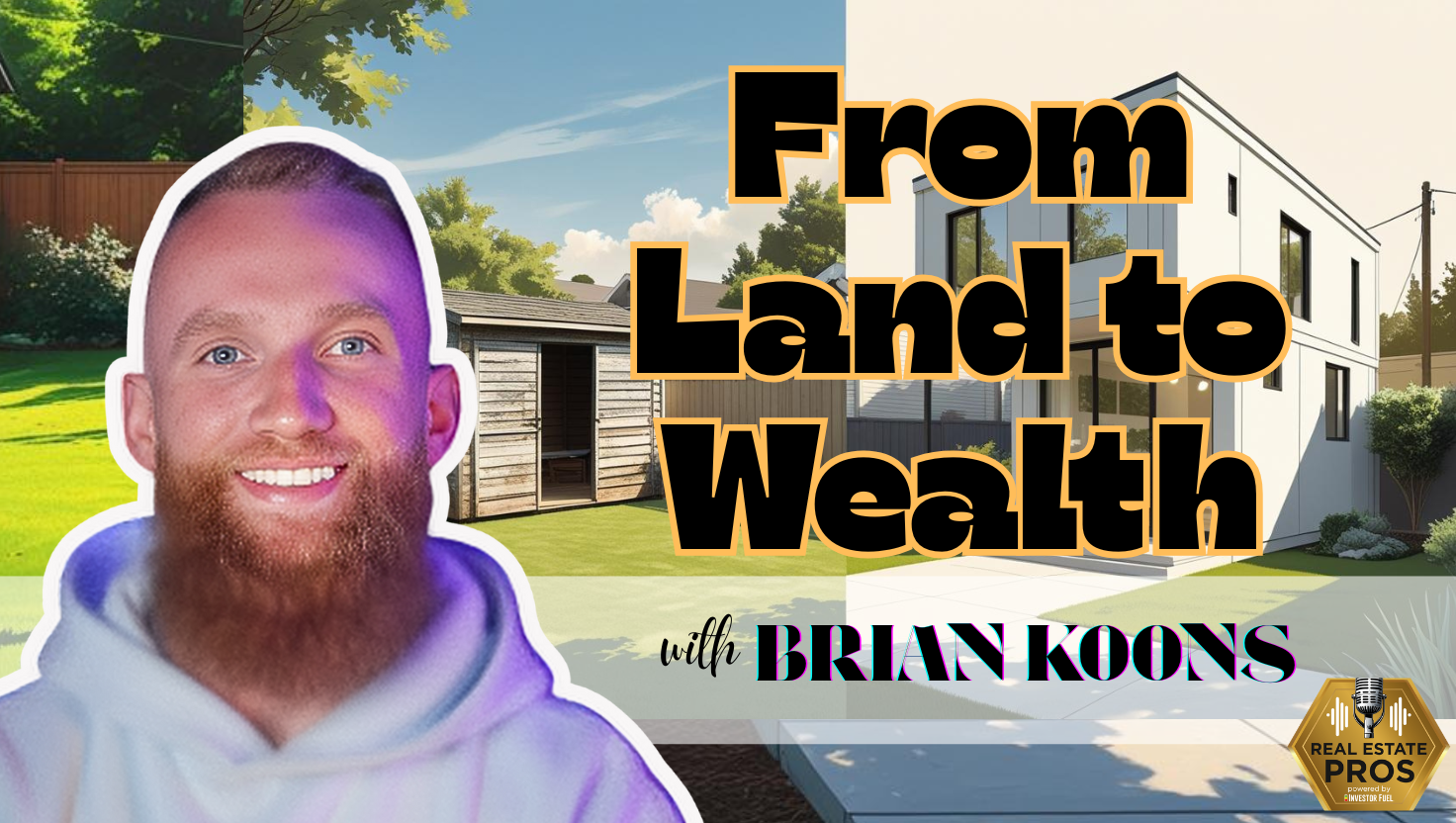
In this episode of the Investor Fuel Podcast, host Michelle Kesil interviews Brian Koons, a real estate developer specializing in small urban infill development and accessory dwelling units (ADUs). Brian shares insights into the development process, the importance of feasibility studies, and the challenges he faced in his early career. He emphasizes the growing trend of ADUs across the U.S. and how they can enhance cash flow for property owners. Brian also discusses the significance of networking in real estate and his mission to educate homeowners about the development process.

Resources and Links from this show:
Listen to the Audio Version of this Episode
Investor Fuel Show Transcript:
Brian Koons (00:00)
people are having a lot of issues right now with cashflow, with interest rates and things like that. So what ADUs and these secondary tertiary units are is strictly a modality to get additional density that can increase cashflow and increase property value in order to make something work that may not have otherwise. So depending on the market you’re in, obviously some are a little more friendly than others, but there’s normally some sort of option for you there and being able to…
look at that and figure out how you finance it. And if it’s something that makes sense for you, can make you significantly more likely to get into a deal that you may have otherwise not been able to.
Michelle Kesil (02:08)
Hey everyone, welcome to the Investor Fuel Podcast. I’m your host, Michelle Kesil, and today I’m joined by someone I’ve been looking forward to chatting with, Brian Koons, who’s been making serious moves in the real estate development space. So really excited to have you here with us, Brian. I think our listeners are really going to take something away from how you’re approaching the development business.
So let’s dive in.
Brian Koons (02:38)
Yeah, thanks for having me on the show.
Michelle Kesil (02:40)
Absolutely. So first off for people who may not be familiar with you and your world, just give us the short version of what your main focus is these days.
Brian Koons (02:52)
Yeah. So I focus on small urban infill development and ADUs as a modality. So ADUs are accessory dwelling units, which is essentially a tiny home or some sort of second structure on a house. However, it’s not just one. can, you know, I’m doing one actively that’s 11 units. There’s people doing ones that are much larger than that. So it’s really essentially a function to add more density to existing properties and take advantage of the need for housing.
to add more density to existing properties and leveraging that as an entire real estate strategy.
Michelle Kesil (03:26)
Nice. And what markets are you operating in?
Brian Koons (03:29)
Yeah, so I’m in San Diego is my market where I invest in. However, Southern California is the area that I’ve been able to service from just the perspective of teaching people and all the way up to Northern California now. So pretty much all of California I’m pretty extensively well versed in.
Michelle Kesil (03:46)
Amazing. So yeah, can you share a little bit more about how you develop these properties and like what your process looks like?
Brian Koons (03:56)
Yeah, no, it’s a great question. So the way that the process works for developing a property is pretty much the same, whether you’re doing one unit or you’re doing 30 units. It’s a process called feasibility design permit build is what I look at. So feasibility is a process where you’re taking a look at the actual property itself and saying, can I build something here? from the perspective of, I allowed based on the rules that the city’s put forward? And then secondarily.
Does it actually, it physically feasible? Is there enough room for me to do it? Is there any obstructions in the way? Things like that. And then from there, you have to make sure it’s financially feasible. So even though you can build something, you need to make sure that it makes sense to actually build it and you can actually get it financed. Cause if you can’t get it financed, it doesn’t get built. From there, you would determine the physical and financial feasibility. And then you move to the next stage where you’re actually drawing what you want to build. So you get a designer or an architect, all the people involved.
You draw exactly what you want to build. And then from there, you get it sent to the city and ask, can I build this? You ask to get it permitted to build. They will permit it for you after a pretty extensive back and forth. And then from there, you’re able to build it out, lease it up, live in it, whatever the end use is for it.
Michelle Kesil (05:57)
So, are you primarily helping people who already own these homes and are just looking to add more value to them?
Brian Koons (06:06)
Yeah, so it’s actually a mix. So a lot of people that I talk to are, they have an existing house and they’re saying, Hey, what can I put on this? And then there’s other people that are saying, Hey, I know that the ADU or smaller benefit space makes sense financially. I would like to get into it.
So can you help me look for a property for it? And I had a very unique opportunity to work with a lot of people and pretty much all aspects of it because I was a developer myself while also working at a company that had over 500 projects that I’d say about half of them were homeowner, half of them were investor style people. And I was working with both of them from every perspective of day one, you know, deciding they want to look at it once they actually had a deal that they were looking at buying, or it was something that they’ve owned for 20 years and they’re looking to maximize the space now.
in the mix.
Michelle Kesil (06:54)
Okay, amazing. Yeah, a lot of the listeners here are investors that are maybe just starting or looking to level up. So maybe how can this be something supportive for them if they haven’t looked into this side?
Brian Koons (07:10)
Yeah, it’s a really good question. And it’s something where it doesn’t really matter where they are at location wise in the country, because ADUs are expanding to pretty much every market. So places, it started in Seattle, California was super forward thinking. They’re now in Florida, Texas, Colorado, all of these places have generally some opportunity to add some sort of secondary or tertiary unit to a property.
So what I’ve learned is people are having a lot of issues right now with cashflow, with interest rates and things like that. So what ADUs and these secondary tertiary units are is strictly a modality to get additional density that can increase cashflow and increase property value in order to make something work that may not have otherwise. So depending on the market you’re in, obviously some are a little more friendly than others, but there’s normally some sort of option for you there and being able to…
look at that and figure out how you finance it. And if it’s something that makes sense for you, can make you significantly more likely to get into a deal that you may have otherwise not been able to.
Michelle Kesil (08:14)
Yeah, absolutely. So what has been like the key to keeping this business running smoothly?
Brian Koons (08:23)
Yeah, this is great question. keeping an ADU business running smoothly is a feat for sure. For several different reasons, you I worked at a company that was a design and permitting company, and now I focus more so on just strictly being the developer. So I actually hire out each role. So the designer, the contractor, everyone involved, because I’ve learned that by being the developer, not one specific piece of the development life cycle.
You are able to, similarly to like an escrow company where you’re kind of in the middle and just coordinating everyone. If somebody is not the right person or the right fit for yours, you’re not tied to them for the project. You can fire them, you can hire somebody else, et cetera. And so that’s an incredibly powerful way to look at a project, right? So it’s like being the developer and just managing the people is really the best way that I’ve seen to kind of grow and be efficient with getting these projects to the finish line.
Michelle Kesil (09:18)
Yeah, absolutely. How did you get into this development space?
Brian Koons (09:24)
That’s a good question. So I did eight years in the military and near the end of those eight years at about year six, I bought a four unit property in San Diego with my VA loan. And that VA loan was one that I used essentially maxed out my debt to income ratio. And luckily, because it was a VA loan, I didn’t put any money down, but I couldn’t qualify for anything else. So I had some money saved up that I didn’t put down, but I couldn’t qualify. So the only logical explanation was to buy vacant land for me.
found two partners just through real estate networking events and things like that. We bought some land in San Diego and the month that we went into escrow, we expected to put four units on the property, but because of the zoning changes and these rules that changed in the city with ADUs, we were able to put eight units on that property.
And this was right at the start of COVID as well. So being able to double the unit count and COVID just raising the all ships that were floating, the property value went up significantly.
so I got really excited about ADUs because I saw how much value could add. And then we were able to sell that just the land and get it, get into a couple more deals and started to get my feet wet with renovations and things like that. And got into some other house hacks and started working at this company. And it really is something I just fell in love with from, from day one. I felt like a Jehovah’s witness trying to preach the gospel to people talking about ADUs at the time. and it’s funny now cause any meetup I go to.
It’s hard not to just hear people on the side talking about ADUs because it’s so trendy now. So it was something I saw the wave, it made sense to me. And I was like, this is, this is the niche of San Diego and this is, you know, and I believed in it. And since then I’ve been in it, you know, all day long doing the thing.
Michelle Kesil (11:36)
Amazing. Love that story. Now, every operator I know had a moment where things got more real in their business. Maybe a deal went sideways or you just had to make a fast pivot. Do you mind sharing an experience like that for you?
Brian Koons (11:54)
Oh man,
there’s so many times where I got all the learning lessons through the school of hard knocks. so in terms, so I’ll give you two. Uh, first one was when I got into my house hack. So this isn’t even real estate development. So it’s more just the broad investor. I inherited tenants and one of the tenants was, uh, I inherited them. They were fine for several months. So I actually renewed the lease with them. And then right afterward, their roommate said that they were using drugs and it
Michelle Kesil (11:58)
Yeah.
Brian Koons (12:22)
kind of forced me to be in a position where a lot of things happened and essentially ended up evicting them. Went through about $25,000 of lost rents and renovations on the property that was brand new when they moved in like six months prior. So went through a lot of that. They were housing homeless people as I was living in one unit, cause it was a house hack and got to experience that. And biggest learning lesson from it was just to make sure that you
⁓ you screen your tenants properly. If you inherit tenants, you bake in the risk associated with that. And it’s something that, you know, make sure that they meet your standards as, as much as you can. ⁓ so that was, that was one right in the beginning. That was the first like six months that I owned a property. and then another one was a development project we were doing that was actually, it was from the land. We went from just permitting vacant land to renovating three properties across 13 different units at the same time.
And I found out very quickly how important ensuring you have the proper cash flows and cash reserves is to a project. So we started too many renovations at the same time. We were having issues with the lender at the same time. And it forced us to be in this very hard position where we were constantly trying to argue with the lender to get a draw. So more money for the project. We were trying to pay all of the contractors. They were doing shoddy work because they weren’t getting paid well. So all the projects were just,
we were managing money, not managing projects, and that the projects were actually not getting done as well as they could have because inherently the contractors weren’t doing as quality of work because they weren’t getting paid as well. So doing less projects to ensure you have the proper cash reserves rather than just seeing how many you can get into is another like really big learning lesson that ⁓ cost us a little bit of money but got a lot of school hard knocks from it.
Michelle Kesil (14:04)
Yeah, absolutely. That’s the kind of stuff people don’t talk about enough.
Brian Koons (14:09)
Yeah, yeah, it was rough. it’s fun. Fun nonetheless. I like to share it and let other people kind of know the issues that can come up. as long as you assess it and you factor it in, any deal can work.
Michelle Kesil (14:23)
Yeah, absolutely. So let me ask you this. What are you most focused on solving or scaling next?
Brian Koons (14:32)
It’s a, yeah, a really good question. So my main purpose, with everything, my main purpose is helping people understand and execute the real estate development process and skip the learning curve of it, because there’s so many things that can happen either because you didn’t ask the right question at the right time, or something is just, you didn’t even know to ask it. so my entire, you know, my entire company and job are now is focused around teaching people.
the process and then helping people execute the process at whatever level of assistance they need with it. Because it’s a very, there’s so many homeowners now that can be a real estate developer that don’t inherently have the knowledge of real estate development, but because they own the home and because of these new laws, they can access it. So it’s helping them avoid the same mistakes that have cost me hundreds of thousands of dollars and so many other people that I’ve seen do the, you know, cost them the exact same thing.
Michelle Kesil (16:10)
Yeah, that is so important. So you mentioned that people need to ask the right questions. What are some of those things that people should make sure that they’re asking?
Brian Koons (16:21)
Yeah.
Uh, so great question. So some of the questions, if you’re looking at doing an ADU project that you should absolutely ask day one is can I build it? So that’s that physical feasibility stage where if you, if you start a project and you go through and you, a designer says, yeah, I’ll draw this for you. And then you, say, oh yeah, I need structural engineering. And you get all of these people to draw things. You’re paying five, 10, $15,000. You submit to the city and then the city says,
You’re not zoned for that or you’re in an overlay that doesn’t allow ADUs to be built or something like that. All of a sudden you’ve just spent six months and 25 to $35,000 and it’s not feasible. So that’s one of the first questions and there’s, you know, pervasive questions to that. But the second one is just because I can build it, does it actually financially make sense for me? So if you have a super steep hillside and you’re like, I want to put the ADU all the way in the back, but all of a sudden you’re going to need soils, you know, soils, civil engineer.
You’re going to, it’s going to be twice as expensive because the foundation you’re going to have to build is significantly bigger. There’s grading issues with the dirt that you have to move. And all of a sudden it makes what could be a $200,000 project, 400,000. It’s not going to make financial sense for you. So, and people don’t understand that where they, you know, they get it drawn and the architect or whoever’s drawing it isn’t inherently looking at the cost implications of it. So by being able to ask those questions and get both of those answered, it doesn’t make sense to build.
or can it be built and then also doesn’t make sense to be built, it’s going to be significantly less headache throughout the rest of the project.
Michelle Kesil (17:56)
Yeah, absolutely. And what would be the best scenario for someone to add this ADU into their investment portfolio? What would make that be something that would be attractive to them?
Brian Koons (18:12)
Yeah.
So ADUs, like I said, they’re getting more and more well known across multiple states and pretty much nationwide. They’re starting to become generally adopted. So it really is something where it can make an investment cashflow better if you already own it. So if somebody owns a portfolio and they’re saying, Hey, like interest rates are really high acquisition prices aren’t inherently going to be or acquisition, you know, interest rates aren’t inherently where we need them to be to make pricing work to buy something.
Let’s take a look at our existing portfolio. Can we increase cashflow on it? And the way to do that is by adding additional units to it in a lot of scenarios. So you can look in, if you own five, 10 properties, you can look at and say two or three of them are zoned for, you know, or two or three of them makes sense to add additional units to, and we can add additional units. So let’s go through that process and add them now. Another, another way, another thing that makes sense for ADU development is if you have a lot of equity.
There’s two different methodologies. the issue with people who own a property at the issue with people who’ve owned a property for 20 years or 10 years, whatever is the AD regulations weren’t allowed at that time when they bought it. So they bought this property and they have a lot of equity. And I noticed a lot of people now trying to shovel around peg in a square hole and saying, what can I build on this property?
where the real play in a lot of scenarios is if you know that you’re going to have the bandwidth and the wherewithal to actually build ADUs and the mental bandwidth to do it, it may make sense to take that existing equity and put it into another deal. So sell a 1031 exchange or something like that into a better deal where you can all of a sudden buy something that’s conducive specifically to ADU development. And you’re inherently going to make significantly more money in the long run because of that. So those are kind of some of the best ways is
existing equity or existing portfolios.
Michelle Kesil (20:06)
Amazing. So what is like that next real big goal for you?
Brian Koons (20:12)
yeah. So right now I am in a new phase of my career where several months ago now I started an education, in community and mastermind community around real estate development. So I have a course and a entire community to teach people how to do real estate development. And then the second piece of that is the people that maybe aren’t the SDIY type people and don’t necessarily want to do it, but they want, you know, a partner that can actually take it through full cycle and they have a good amount of capital where they know they want to do real estate development.
but don’t want the headaches of the same amount that I’ve had in the past, I’m able to help all three of those. And so it’s just growing that and being able to help as many people as I can understand the process and get assistance and help at whatever level of DIY or handholding they want.
Michelle Kesil (20:59)
Yeah, that’s big. I love that. So needed. Awesome. So I know a lot of the listeners are either earlier in their journey or they’re just looking to level up. And I think they’d benefit from hearing this when it comes to growing your network and creating new relationships. What has made the biggest difference for you?
Brian Koons (21:02)
Appreciate it.
Yeah. So if you want to grow your network and your relationships in the real estate space, the best thing that you can do is just show up on a regular basis. So I went to so many networking events. I talked to so many people and I never went with the intention to try and sell somebody something. I’ve never once handed somebody a business card. I’ve never owned business cards. And it has made it to where every single thing that I’ve had has been from networking events, the job that I had leaving the military, the partners I’ve had.
Every single opportunity that I feel I’ve had has started from some sort of connection to a networking event. And that is probably the best way is just going with the best intention of just talking to other people, learning from them, and just trying to add value to others. You will meet good people. And now I feel like I just go to them to say hi to my buddies and talk to them. And like I said, 99 % of the business has been built just from going, being a good dude, and just trying to talk to other people and help out.
Michelle Kesil (22:21)
Amazing, yeah, relationships are everything in this space. That’s so important.
Brian Koons (22:28)
I agree.
Michelle Kesil (22:30)
Alright, so before we wrap up, if someone wants to reach out, connect with you, maybe collaborate or learn more about what you’re doing, what’s the best way for them to reach you?
Brian Koons (22:44)
Yeah, best way to reach me is at the builder Brian on any of the platforms. ⁓ pretty much all of them pretty active on Instagram is, the, where I’m the most active, but yeah, just reach out and there’s definitely a way that I can help you if you’re looking to get into the real estate development or ADU game.
Michelle Kesil (23:00)
Perfect. Well, listen, I really appreciate your time, story and perspective. We need more people in this space who are doing things in this right way. So thank you so much for being here.
Brian Koons (23:11)
Yeah, thanks for having me.
Michelle Kesil (23:13)
Yes, of course. And for those of you tuning in, if you got value from this, make sure you’re subscribed. We’ve got more conversations coming with operators just like Brian who are out here building real businesses. And we’ll see you all on the next episode.