Subscribe via:



Show Summary
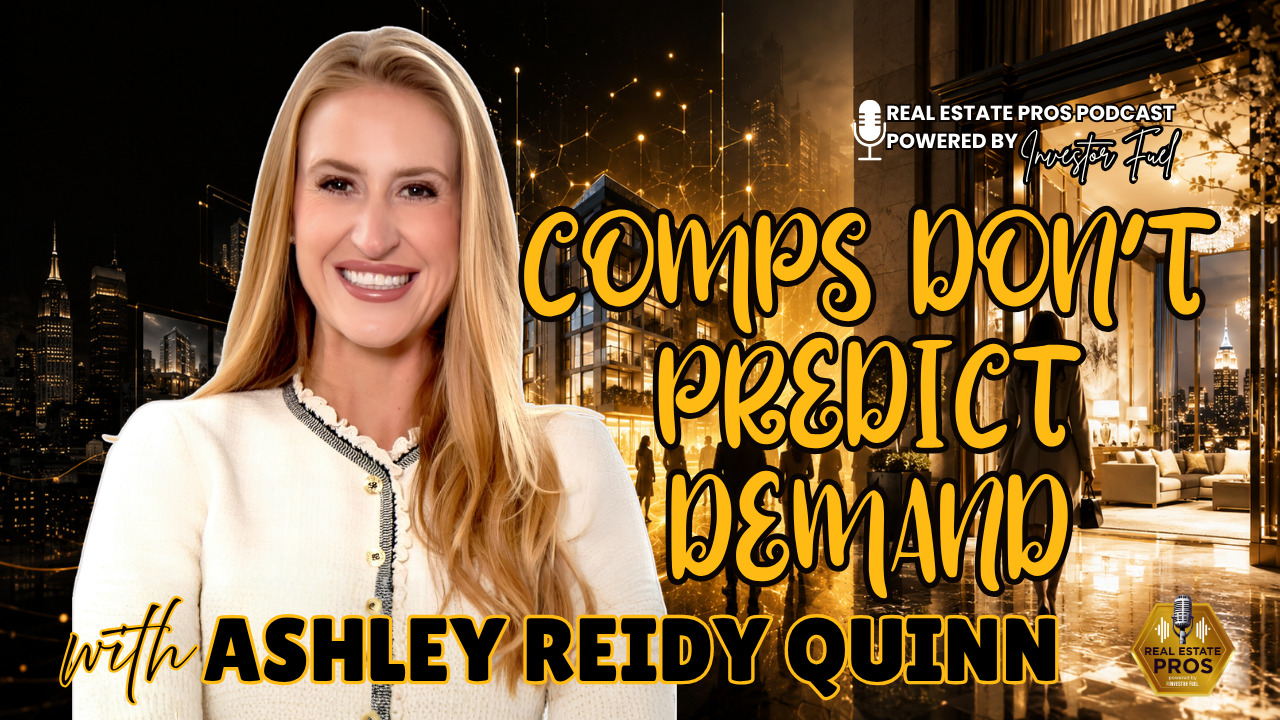
Ashley Reidy Quinn shares her journey from NYU pre-med to a leading expert in luxury residential valuation and operational excellence in real estate. Discover how she applies sophisticated models, manages emotional dynamics in high-end markets, and leverages AI for operational growth.

Resources and Links from this show:
-
-
- Investor Fuel Real Estate Mastermind
- Investor Machine Real Estate Lead Generation
- Mike on Facebook
- Mike on Instagram
- Mike on LinkedIn
- Coldwell Banker Real Estate LLC’s Website
- Ashley Reidy Quinn on Instagram
- The Asset Advisory Team on Instagram
- Ashley Reidy Quinn on LinkedIn
- Ashley Reidy Quinn’s Email: [email protected]
-
Listen to the Audio Version of this Episode
Investor Fuel Show Transcript:
Ashley Reidy Quinn (00:00)
I mean, the the data, the numbers, the comps, that explains the past, that explains the market value. But the conversations that we’re having now about the market, that tells us what’s happening tomorrow. And the pricing can be so black and white, it can so explain it. But at the end of the day,
It’s people’s decision for wanting the product, for wanting the apartment for the the townhouse, et cetera. That’s ultimately what will take the transaction across the finish line or not. We we part ways with the transaction altogether. So it’s it’s the comps tell you where the market’s been. It’s the demand in the people tells you where we’re going.
Scott Bursey (02:11)
Welcome back to the Real Estate Pros Podcast, powered by Investor Fuel. I’m your host, Scott Bursey And today we are joined by Ashley Reidy Quinn. Ashley is known for her deep expertise in luxury residential valuation, market modeling, and operational excellence. Her background in the high stakes, New York City, and Hamptons markets has sharpened her ability to turn complex data into real business intelligence.
Pros today, you can expect to learn how to bridge the gap between volatile market demand and the kind of operational precision that drives high end results. Ashley, welcome to the show.
Ashley Reidy Quinn (02:47)
Hi everyone, how are you?
Scott Bursey (02:49)
It is just awesome having you here today. And please for our listeners that may not be familiar with your journey, if you could give give us the front row seat and how your career ignited and where you’re pouring your fuel now.
Ashley Reidy Quinn (03:02)
Absolutely. So it was a it was an untraditional path. It all started when I was studying undergraduate at NYU here in New York City. I went to college pre-med, was determined to be a dermatologist. And while I still love skincare, I decided halfway through that process, you know, I really like real estate. So being at NYU and being in New York City, I was like, you know what? Why don’t I take advantage of this opportunity?
And NYU didn’t have an undergrad program at the time for real estate. So I went to the New York Real Estate Institute at night after my classes. And I ended up passing the licensing exam, finding a firm response for my license, called my parents, and I said, you know what? We’re gonna do a little switcheroo here. I think I’m gonna take real estate on. And my parents were like, This is this is fun. I was also working in fashion at the time. So they’re like, let’s just stay focused, pick a path, like any.
twenty one year old. I was like, I can do it all. So I said, give me one year. Let me just do this for one year, see if I can really hit the ground running. And they said, Okay. So many years later we’re still here.
I am now co-founder of a team. We are thriving in New York City, the Outer Boroughs, out on Long Island, South Fork, the Hamptons. And it’s fantastic. It’s a new day every day. I my psychology background from NYU pays dividends every day. And I’m loving it. I’m absolutely loving it.
Scott Bursey (04:31)
And I love that. What a journey. You know, Ashley, what really caught my attention about you was the way that you’ve been able to apply sophisticated valuation models and operational strategy to high end assets, effectively bridging the gap between raw market data and high performing business results. That takes dedication.
Ashley Reidy Quinn (04:45)
Yeah.
It does, you know, I’m a numbers person. I love it. I love the analytics. I when I first started in this industry and we were really focusing a majority of our business on our investor clients, it was so data driven. And it’s still so data driven, but it’s been amazing to me how there’s been a huge market shift and the psychology component has played in
tremendously, tremendously. I mean the data helps to set the pricing. Comps are incredibly important here in New York City, as they are most places. But it’s it’s the people who make the decision. It’s it’s the people who close the business. so it’s been fascinating to learn and grow, but having this analytical background is it’s the foundation to every our entire business.
Scott Bursey (05:40)
And Ashley, I’m fascinated by the psychology behind the numbers. How do you see buyers emotionally respond to price in the current high end landscape?
Ashley Reidy Quinn (06:38)
It how do they respond? Very emotionally sometimes. there’s a lot of emotion behind it. I mean, the the data, the numbers, the comps, that explains the past, that explains the market value. But the conversations that we’re having now about the market, that tells us what’s happening tomorrow. And the pricing can be so black and white, it can so explain it. But at the end of the day,
It’s people’s decision for wanting the product, for wanting the apartment for the the townhouse, et cetera. That’s ultimately what will take the transaction across the finish line or not. We we part ways with the transaction altogether. So it’s it’s the comps tell you where the market’s been. It’s the demand in the people tells you where we’re going.
Scott Bursey (07:21)
Does that emotional volatility make your evaluation process more complex?
Ashley Reidy Quinn (07:25)
Always, always. And that’s why I I think back to when I first started twelve years ago and I was like, you know, it felt so black and white. Like it felt it was Excel sheets all day. And don’t get me wrong, I’m still deep in the Excel sheet, but that’s such a small portion of this day to day, especially in this investor landscape. The emotions are getting they’re heightened. I’m not sure if that’s just a reflection of where we are in our
day to day as a as a whole economy, but it’s a huge component. And navigating those emotions, I sometimes sum it up as holding the client’s hand. And sometimes that’s just a big client hug is a huge part of the it’s it’s a huge part of the transaction. It is.
Scott Bursey (08:08)
And Ashley, that is such a great distinction to make. Thank you for that. Shifting gears just a bit here to the data side of things. What is your framework for modeling demand when the market feels so unpredictable?
Ashley Reidy Quinn (08:17)
Yes.
It’s yeah, well, I feel like the market’s been a little unpredictable for a while now. that being said, in New York City, what’s unlike most places in the country and most places in the world, we have linear living. So we have big buildings. We have a lot of comps that we can refer to. For some of the larger buildings in New York City, so multiple hundreds of apartments within the building.
Putting a model together, a comp report, is actually pretty straightforward. Of course, there are always outliers, and the best real estate agents know and understand those outliers, some of which can be breaks in the floor or and I don’t mean a literal break in the floor. I mean the view could all of a sudden if you clear the building next to you, that changes the valuation, or the ceiling height is taller.
These may seem like little nuances, but they’re incredibly important when you’re putting evaluation together. So understanding that and knowing that is it’s a huge basis of gathering these data points, but it’s also knowing the competition. So once buildings close, when you when a building is new development, every apartment looks the same. It’s actually rather boring, to be quite honest. It’s a few years after those apartments trade and buyers add details or take things away.
completely changes the valuation. And knowing that and understanding that is how you can add value to your client’s investment moving forward and how you position that on a resale.
Scott Bursey (09:45)
I appreciate that insight. And Ashley, thinking about the art of the deal, when structuring offers and terms in a competitive environment, where do you find the most leverage?
Ashley Reidy Quinn (09:50)
Mm-hmm.
It you know, there are a few there are a few parts. The data is incredibly important. That’s the foundation for setting the precedent of what an offer may look like, but emotion is a huge component. And the emotion is twofold. Actually, it’s threefold. It’s the emotion of the seller, it’s the emotion of the buyer, and it’s the emotion of the listing agent. And this is from my perspective as a buyer’s agent. If I’m representing the listing, then it’s the the buyer’s agent.
Navigating those emotions incredibly important. And sometimes I’m I’m preferencing it as if there’s one individual in each position. No. Oftentimes it’s a couple selling, a couple buying, sometimes it’s a trust with multiple trustees. The other factors are timing and confidence. I I would say all of that combined together creates a successful transaction.
Scott Bursey (11:16)
How do you keep that balanced leverage against keeping the client experience seamless?
Ashley Reidy Quinn (11:23)
You know, it is a it’s it’s like a seesaw. The balance is not always balanced. but it’s truthfully, it’s really putting the client first, managing my client’s expectations, managing their emotion, managing the transaction, making sure I’m setting them up for success, which changes throughout a transaction. That’s what’s most important. the rest is the rest just comes with the territory, managing the other the other agent.
Sometimes managing the attorneys, sometimes if it’s a finance transaction, managing the bank. That all comes with the territory. But the balance is it’s a lowercase B balance. It’s not always there. It’s an ebb and flow.
Scott Bursey (12:03)
Absolutely. And that makes a lot of sense. You know, Ashley, you built a reputation as a true operator. Where do you think most real estate teams are still missing the mark on their operational back end?
Ashley Reidy Quinn (12:15)
On the back end, the basis for everything is communication. So that’s on the back end, that’s on the front end. I find that in an industry like real estate that is so fast-paced, it’s moving, and it’s 24-7, it’s hard to stay on all the time. And that’s where communication can get lost. That’s where sanity can get lost and everything ties together. But I would say
Operations are you’re only as successful as the health and wellness of the people on the team and the communication of the team.
Scott Bursey (12:48)
Spot on, that’s critical. Looking at the long game, as teams look to scale their operations without losing that premium touch, let’s say, what is the biggest trap they fall into?
Ashley Reidy Quinn (12:59)
Someone told me recently they said one of one of the most important parts of operating a team is hire slow, fire fast, and make sure you have the right people in the right seats. And I didn’t fully understand that until recently, honestly. Like a part of being on a team and scaling your operations or growing pains. Everyone has to go through growing pains. If someone tells you that it’s a success from day one, I don’t know.
write a book because I’d love to read it. it’s it’s hard. It’s really, really hard. And we’re people. Like we’re we’re talking about the psychology in a transaction, but it’s also the psychology of the team. And everyone is going through their own stuff. It’s really hard to check the door in real estate because this door is like it’s one of those swinging doors that goes back and forth. It’s always open.
Scott Bursey (13:25)
Mm-hmm.
Ashley Reidy Quinn (13:43)
So it’s hard to manage that and it’s hard to it’s hard to keep the team morale always high. And knowing when sometimes a team member shouldn’t be a part of the team anymore or doesn’t want to be a part of the team or needs to move within the team is really important from an operation standpoint because once that starts to one little aspect turns negative, it can really grow fast.
Scott Bursey (14:07)
Thank you for that excellent breakdown. And let’s dig a a bit deeper for our listeners here. If you could point to one untapped opportunity in the market that operators are completely overlooking right now, what would it be, Ashley?
Ashley Reidy Quinn (15:02)
So this might be a personal issue, but I think the more people I talk to, especially in real estate, it’s a growing miss, is the inclusion of AI and understanding what AI can do for your team. It’s such a hot topic. It’s such a buzzword. It is so there’s so much that can be expanded upon. AI, it I almost want to find a different term for it because it can help with marketing. It can help with team organization, it can help with
Operations. It can help with market reports. And to a certain extent, I don’t prefer. That’s again, that could be a different podcast topic, but there’s so much that AI could do to help in the day to day and to help with your operations. Understanding that, knowing where it can go for the team and how it can best suit your team is I think a huge untapped part of the day to day.
Scott Bursey (15:52)
I love that framing. And Ashley, you have brought just so much valuable insight for our pros here today. But is there anything that you like to leave with them?
Ashley Reidy Quinn (16:02)
What to leave with? I would just say we were talking a little bit before, like what is what does it look like? How’s the the motivation and the self-talk? And it’s really hard. Scaling a business, growing a team, focusing on yourself sometimes is the biggest miss. I miss that all the time. I’m like, shoot, what did I forget to do today? Eat, drink, take a walk, take a lap around the block.
It’s so important to focus on yourself and not lose sight of what your goals are. And it’s okay that those goals change. My investment, personal investment, my team’s investment, my investment in my team. It’s constantly changing. and being okay with that and knowing what you need to do in order to make those pivots. It’s crucial.
Scott Bursey (16:47)
That is crucial and that is powerful. Ashley, thank you for that. And for those of our listeners that want to keep this conversation moving, stay in your lane, collaborate with you. What is the best way for them to to reach you?
Ashley Reidy Quinn (16:53)
Thanks.
You can call me, you can email me, my email is is there a way we can include this anywhere? It’s a little long. It’s [email protected] or find me on Instagram @ashreidy A S H R E I D Y. That may be the fastest way to get in touch with me.
Scott Bursey (17:15)
Ashley, this has been Pure Gold. Thank you for joining us today.
Ashley Reidy Quinn (17:19)
Thank you. This has been such a pleasure.
Scott Bursey (17:21)
And to our listeners, we appreciate you. If you receive value from today’s episode, please subscribe. We’ll be filling your tanks with the lineup of elite guests, just like Ashley, who are accelerating and setting the pace for the rest of the industry. Until next time, keep your standards high and your vision clear. We’ll see you in the next episode, everyone.