Subscribe via:



Show Summary
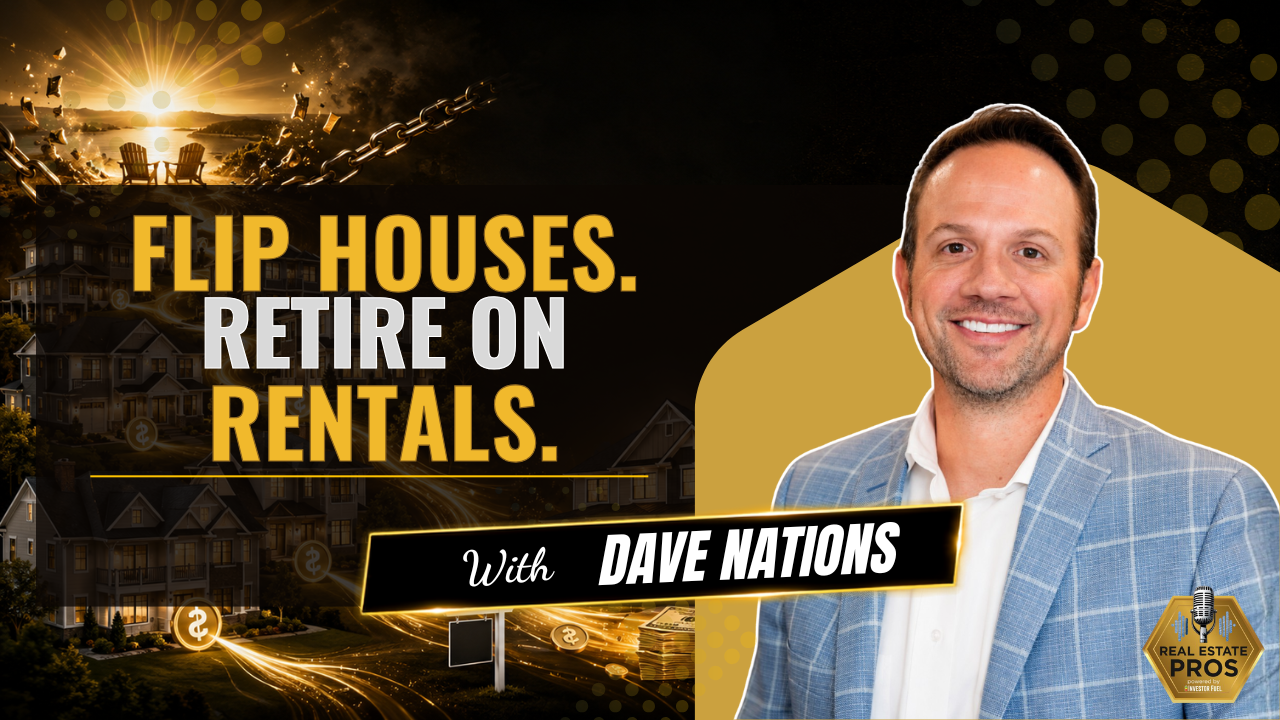
In this episode, Dave Nations shares his journey in real estate, from flipping houses to building a rental portfolio, and how his dual role as a realtor and investor creates unique advantages. Discover practical strategies for scaling, maintaining quality, and leveraging local market knowledge.

Resources and Links from this show:
-
-
- Investor Fuel Real Estate Mastermind
- Investor Machine Real Estate Lead Generation
- Mike on Facebook
- Mike on Instagram
- Mike on LinkedIn
- Nations Network’s Website
- Dave Nations on Instagram
- Dave Nations on Facebook
- Dave Nations’s Phone Number: (314) 956-1047
- Dave Nations’s Email: [email protected]
-
Listen to the Audio Version of this Episode
Investor Fuel Show Transcript:
Dave Nations (00:00)
You’ll do a flip and you’re like, my God, I made all this money. This is amazing. Now I’m gonna go and do a new construction. And then you’re like
Well, just because you sold one house and made a bunch of money doesn’t mean you should go do that. But you’ll go do it because you’ve just created all this confidence in yourself. And then you go and then you’re spending all this money and it doesn’t work and you lose it, you know, or you go and buy in an area don’t really know because you think it’s gonna be an amazing deal, but it blows up.
Cody Crabb (01:56)
Welcome back to the Real Estate Pros podcast by Investor Fuel. I’m your host, Cody Crabb, and today I’ve got Dave Nations with me. Dave is based in St. Louis, where he runs Nations Brothers Renovations with his brother. They flip around twenty houses a year, own a hundred and seven rental doors, and have built a real estate business around staying consistent, doing what they know, and strong agent relationships. Dave, thanks so much for hopping on today.
Dave Nations (02:18)
Hey Cody, thanks for having me. Appreciate it.
Cody Crabb (02:20)
Of course. Yeah. Well I’d love to hear just a little bit about yourself. You can introduce yourself a little bit to the audience to a little more than I just did. I mean I gave you a little intro but so they can get to know you a little bit. Yeah.
Dave Nations (02:31)
Sure, appreciate it. Yeah, I I bought my first flip back in two thousand and four and with a buddy of mine from high school, kind of stumbled into this and he he suggested we should go buy a house and neither of us have ever done anything in real estate and so we both thought, Hey, this would be a good idea and bought it, sold it, made a few bucks and kind of opened up my eyes to something totally different than I was doing. And next thing you know, I got my real estate license in two thousand seven and
at that point the market shifted so we weren’t doing any more rehabs for quite a bit and then jumped back into the rehab side full on back in two thousand and ten and we’ve been doing it consistently ever since and my brother and I are business partners and went in you know doing just a couple you know a year and have slowly scaled this and brought on full time employees and like you said doing twenty a year now and we’re able to take the proceeds. Our whole goal was to buy houses, fix up,
and then make the money and take the money and go and buy rentals with it. And so the more we flipped, the more income we make, then the more reha rentals that we could buy. And so we’ve then built out our rental portfolio, as you said, to currently a hundred and seven doors and and that’s where we’re at today.
Cody Crabb (03:41)
So yeah, I find it interesting. When I was when you were telling me about your strategy, I was like, it’s not often that you hear a business with kind of like an end goal, like literal end, like it’s an arc that goes down, like that finishes. Like usually when you hear a business, it’s just like it goes up forever and the number just goes up and that’s it. That’s the plan. But I like that you’ve got this not just defined goal, but like this is and then that’s it. Then we’re good. Like, yeah, it’s pretty cool.
Dave Nations (04:09)
The whole goal was to then develop the rental portfolio. And now that we’ve gotten it to the size that we believe is the right amount that’ll generate the right amount of income. Now the income from the flips will then go to paying them all off. So then we have our retirement fund, right? And then we can actually benefit from all the hard work. And then that’s where we get to stop doing the flips and and you know, we still have to maintain the properties and and keep them rented and all of that, but we just don’t have to do all of the legwork to get there anymore.
Cody Crabb (04:35)
Yeah. Yeah, I just it I like that just ’cause I hear my what I always hear is just like more doors, more doors. I need more doors, more doors. But like I love that you’re kind of you’re like, nah, this is around the right size. So what what made you decide that this number was kind of the right size? Was it just was it based on a like a cash flow number? Was it like a debt pay the debt payoff plan? I’m guessing it had more to do with that.
Dave Nations (05:43)
Well, I my brother and I are business partners, so it was looking at okay, if everything’s paid off or whenever we get to we we both agreed on a number that we would both say like, Okay All right, when it gets to that number, are you good with that? Are you good with that? Yes. And so we we got there and then we, you know, we looked at like okay, if the debt was completely gone, we still have to pay taxes, insurance, still gotta factor in maintenance, right? So what’s left after that, if we’re splitting it, we’re both like, Okay, yeah.
Cody Crabb (05:52)
Divided by two.
Dave Nations (06:10)
that works, you know, and and we both have agreed, you know, while we hit this number, if we come across a deal that we really like, probably still buying it, right? I think everybody in this business it’s kind of addicting and you’re like, well let’s what what’s one more? What’s another, you know. But but now the plan is to start paying them off. We just paid off our first one actually just a couple of months ago and we’ll start kind of creating a snowball effect and start paying these down. So
Cody Crabb (06:34)
Well, so let’s talk about kind of the machine behind this. So you’re doing flips and rentals and you’ve got, you know, but on top of that, you’re you also got your real estate license. And you said that has actually fed quite a bit into your strategy to the point where you told me before the podcast your marketing spend is like literally non existent. And so I’d love to hear more about how that has benefited you and and vice versa. Has it also benefited you as a realtor the other way around?
Dave Nations (07:01)
Absolutely. So got my license, as I said, two thousand seven.
Had an independent, rolled into a large franchise in 2011, learned how to build a team, made my first hire in 2012, and started building the real estate team. Currently there’s 18 people on our team. We sell two to 230 homes around St. Louis a year. And I’ve been doing that pretty consistently and you know, building a team since 2012, and and 80 to 85 percent of our business is referral-based. So we’ve done really well on that front and being in it for a while, I’ve developed a lot of really good relationships.
With other realtors. And so I was building the real estate team and the renovations business simultaneously. And as we were doing that, letting people agents know, hey, we’re looking for houses. If you come across anything, let me know. And and we’ve had a I’ve had a good reputation, I have a good reputation on the sales side. The rehab side, because I was a realtor, the first thing I told my brother is, we have to make sure that the houses that we’re selling.
Our quality, people aren’t coming back, we’re not getting a bad name. The last thing I want is for people to look at our sign and go, it’s a Nations Brothers. We don’t want it. Those guys are dirtbags or whatever, right? So we’ve always made sure that when we do something, we do it to the top, best ability we can do.
and that has really worked out in our favor to the point where people will call us and say, Hey, I know you just sold that one. What else do you have? I’ve got buyers that want more of what you have. I’ve had we’ve had people that have lived in a house, wanted to sell it, and then move up into another one of our houses because they like them that much. So I think that reputation has really helped us in generating more business. And majority of the leads that we get are agents that will call us and say, Hey Dave, I’ve got this house, you know, over on Glenlea.
You know, would you come take a look at it? We make a cash offer. We don’t do inspections. We don’t do anything. We agree on the price, we agree on closing and that’s it. And the agents love it, right? ‘Cause they don’t have to do anything. I’m an agent. If I can get deals like that and have to
Cody Crabb (08:51)
Yeah,
who doesn’t? Why wouldn’t you take that? Yeah, exactly. So what what are the qual when you say good reputation, I mean you you make it sound like some of it is quality, like they just really like what you’ve done. But I also would like to know, you know, what other factors are involved there. You are just particularly easy to work with and just I I I I just would be curious what people s what feedback you get. Yeah.
Dave Nations (09:11)
I
think it’s it’s we’re easy to work with. I think, you know, when we rehab a house, I mean as I was telling you, I mean I feel like these days our average spend on a house probably about a hundred and thirty grand. I we’re putting in new plumbing, new electric, new windows, new
Cody Crabb (09:22)
And that’s in St. Louis, which that’s no that’s nothing to sneeze at down there. That’s like yeah.
Dave Nations (09:27)
Our our
market, we’re we’re buying probably in the two to four hundred range and then we’re selling these from like three fifty to eight hundred, depending on where they’re at and the size, right? So we’re kind of in a middle range there, which also sets us apart from a lot of other rehabbers. A lot of guys don’t want to take on projects that size. Having our own crew in-house allows us to be able to go in and knock these out fairly quickly. And we’ve done enough of them that we’ve got a really good system behind it. But again, like our houses are almost new construction by the time you’re done, right?
So I think the quality of them goes a long way. When something comes up, once we’re negotiating inspections with agents, if it’s something that we did, we’re fixing it. Absolutely. Like if there’s something that’s wrong that we put in, a hundred percent. You know, they’re rehabs, so it’s not new construction. If something comes back and we had nothing to do with it, we’re reasonable. Like, okay, well, let’s talk about that. What do we need to work on? So I think from that standpoint, we’re easy to work with. The quality of the homes are are are great. You know, I think twice
in the entire time we’ve been doing this, have we had a callback that was like, hey, something happened and we fixed it. You know, and otherwise we don’t we don’t get them. And I think that that says a lot about the product. And then we’ll see our houses sell down the road. They’re identical to what they look like when we sold them to them. And then they’re selling them for, you know, a hundred grand more than they bought them from for. So they’re making money on it too.
Cody Crabb (11:18)
So when you’re spending 130K on a rehab, like you mentioned, these are larger projects than a lot of people. A lot of people go for the lowest possible, you know, cheapest possible d dump that they can find and and just and rehab that. Your strategy is different. You said you want to upgrade the kind of level of the house. I’d be curious. So so what what things do you do that
other flippers or other investors might skip. I mean, you mentioned the big stuff. You said like even new plumbing and stuff like that. I are is there anything else?
Dave Nations (11:50)
So a lot of times we’ll look at a house and say we’ve got a ranch and it’s a three bed, two bath. We’ll look at it and see how do we open up the kitchen, make it bigger.
And then can we add in bedrooms and bathrooms? And so in some pa parts of town in St. Louis, I can add in a bedroom, bathroom down in the basement, a true bedroom, a full bath. So now I’ve made it a four bed, three bath instead of a three bed, two bath. And now instead of selling it for Annapolis, I mean five fifty, I can get seven hundred, right? But it didn’t cost me another hundred and fifty to do that. So I can increase my margin. I can push the value of the home.
And so we’ll look at opportunities like that. And then with the newer open floor plan on the main level with the open kitchen, brand new updated bathrooms, finished lower level, another bedroom, another bathroom, we can really max out what we can get for it and that helps increase what we can make.
Cody Crabb (12:36)
Hm. Yeah, I like so I I f I find that interesting because, you know, you’re not just actually making it prettier, which a lot of when people think of flipping, they think of like throw a coat of paint on it, you know, and just hope that someone will buy it a little a little more a little for a little higher price. But you’re like actually changing the utility of the house. Like you’re you’re adding stuff that actually makes it a different house a little bit.
Do you kind of make the do do you do these these kind of decisions beforehand before you’re even looking at let me think of how do I wanna how do I wanna phrase this?
Dave Nations (13:10)
So when we see the house, we look at it and determine, okay, based on the scope of the house, based on the neighborhood, if we were to add bed to baths, does it make sense? Right.
Cody Crabb (13:19)
That was one of the
questions I had was like the comps. Like do is that what you is that what you do?
Dave Nations (13:23)
And it was a three bed, two bath, we left the basement unfinished. We just went in and redid the entire first floor. And then in that case, we moved laundry upstairs to, you know, make it main floor laundry instead of down in the basement. So we’ll do little things like that. But if the comps, you know, don’t support adding in bed baths and it’s really the same if it was a three two versus a four two or you know, then we won’t do it. So that you know, it really depends on the neighborhoods.
before we just jump in and do that. And then for us, like if we can I we would rather it be a total dump and bigger. So then we can just go in and do it all. For us, it is really hard to have a house where like the kitchen is nice and the floors aren’t bad, but I still gotta do the bathroom and then this, like where you’re sort of doing stuff. We would rather just do it all. It’s just easier to go in, demo it all and start over.
Cody Crabb (14:09)
Yeah. That makes sense. Yeah, ’cause it’s it’s kind of like the you’re counting on the volume almost. It’s n it’s not the same exact thing, but like it’s all it’s it’s just you’re taking a different you’re making a different calculation than someone would add on a
Dave Nations (14:21)
The other thing we realized
is the cost for to rewire electric or a new panel, the cost for a new HVAC or the cost for new waste stack is the same in the a hundred and fifty thousand dollar house as it is for the four hundred thousand dollar house. So our cost is the exact same, right? But the the margin on the four hundred thousand dollar house can be larger because it’s a bigger house, you know, and there may be other work that has to do to it. So it was hard for us to do smaller ones that we were still having to do that kind of work, but you can only sell it for so much, right? So
it made it a little bit tighter and it was like, Well, if we’re gonna do all this work, then let’s just go big.
Cody Crabb (15:36)
Yeah, bigger margins and that that’ll cover that. So I wanna kinda zoom out a little bit. You mentioned before we started talking or before we started the podcast, that you had some big lessons on specifically on staying in your lane. And I’d love to know what you meant by that. Obviously, you know, you said you l you lived through the housing crisis
so what lessons did you learn and what can we what can we share with our listeners about that?
Dave Nations (16:01)
Sure. So I mean yeah, I got licensed two thousand seven. So that was when right as the Great Recession really started kicking in, right? And I I guess the blessing in that was I didn’t know what I didn’t know. I never sold a house. So for me, this was the real estate market.
Cody Crabb (16:15)
It can only go up from here. Yeah, that’s true.
Dave Nations (16:18)
And at that same time, I also jumped in and got a graduate degree from St. Louis University for urban planning and real estate development. The plan was when I got out in two years to go work with developers and, you know, go convert old warehouses into lofts and condos and, you know, that kind of thing. Well, I got out in 2009 and the market was even worse. So that wasn’t gonna happen. And so I just, you know, jumped into being a realtor full time. Investing wasn’t really an option because the money wasn’t available and the market was just
dying. So the risk was way too great. And so then I just went in and became a full-time real estate agent for a while. The stay in your lane piece there, I believe, when you get into this and you start doing real there’s so many options in real estate investing. And I think that’s what I mean by stay in your lane that you
you’ll do a flip and you’re like, my God, I made all this money. This is amazing. Now I’m gonna go and do a new construction. And then you’re like
Well, just because you sold one house and made a bunch of money doesn’t mean you should go do that. But you’ll go do it because you’ve just created all this confidence in yourself. And then you go and then you’re spending all this money and it doesn’t work and you lose it, you know, or you go and buy in an area don’t really know because you think it’s gonna be an amazing deal, but it blows up.
you know, things like that. Or we did one and we put on a thousand square foot addition. We’ve never done an addition. In this area, we don’t really do a lot in, totally kind of out of our space, but we thought we could do it.
And we didn’t make a dime, you know, and every time we we look back on deals where we didn’t make any money, it was because it wasn’t what we normally do. Right. We went off of off the ravine off you know the the path that we were on and and went over here and then it was like, well, no wonder. Like stay in your lane. This is what we do, this is the price points we buy, and these are the areas that we like, this is the style that we like. Every time we’ve ever tried to like force a deal to work and figure it out, it doesn’t work, right? So just stay in your lane, stay consistent.
And that that is what’s paid off for us and we just do the same type of thing over and over and over again and that’s what’s been really beneficial and successful for us.
Cody Crabb (18:17)
So counterpoint to that, let’s say I am you know watching the market, I I am cautious, I’m I I want to make sure that I’m you know staying well you know nimble so that I’m not just I just don’t just get toppled by one thing. I wanna make sure that I’m well you you get what I’m saying. I’m trying if you’re trying to be cautious and you’re trying to stay with what you know, I’d be curious, like what how would you recommend expanding if you’ve been looking to expand?
Dave Nations (18:41)
So expanding by being able to do more projects perhaps?
Cody Crabb (18:44)
In in it in d more projects or different projects or things like that. Just I’m curious how you would view that.
Dave Nations (18:51)
Yeah, I mean I I we’re not opposed to growing and doing more. I think for us is just finding more deals that are within the wheelhouse that we’re looking in, you know. And for us, like we we have three full-time guys. So in order for us to do more, we’re probably gonna have to bring in a fourth guy. You know, again, like as another example, because we have our own in-house crew, we have done
bathroom and kitchen and basement remodels for people thinking like, well, we could make that money. We don’t have to just buy a house in order to do it. Well the problem is our crew is over there doing that person’s basement. Well our houses are sitting here and no one’s working on them. Right. So now you’re sp you’re still costing you money because no one’s over there doing that job. Where at first it was like, well it doesn’t cost us anything. You know, this is free. You know, it’s like, well no it’s not. These houses are still so that’s like a lesson that was like, we shouldn’t do both. So
you know, kind of stick to what you know. And I think we can still scale it and and go from twenty to thirty. We in for us it was it was more of capital that we needed in order to fund more of the deals and the renovations because of how much we’re spending and and our limits on what we could handle there. So cash flow and labor, I think were the two two pieces for us.
Cody Crabb (19:59)
Yeah, I think I guess my main point is yeah and you’re you’re making the distinction of doing the same thing over and over is not necessarily the same thing as being stagnant. Sometimes it just means you have found something that works and you want to stick with it. And I think especially, you know, you’ve built a reputation in your area, you know the market that you’re in, it makes a lot of sense to why would you deviate from that? You know, if if it’s working, then why if it ain’t broke, you know, don’t fix it.
Dave Nations (20:25)
Well, yeah, and the houses are still selling. I would say, like, let’s say two thousand and eight happens again, right? And then all these houses are sitting. Yeah, I wouldn’t just keep buying and and just keep doing this and waiting for them to sell. I couldn’t afford to, right? Then I would absolutely have to pivot because of the market dynamics. But given where they’ve been, we’ve been able to do this consistently for years and these price points are still moving, people are still buying. Inventory overall in St. Louis is still low in the grand scheme of what we know as far as inventory. And honestly, being a realtor, I think, also benefits me in that, in that as much house
houses as our team sells, my fingers on the pulse of the market every day. So we have a really good idea of what’s working, what’s not working. Is it gonna start to slow down? Are we shifting? You know, that kind of stuff. So it helps me make better decisions as a real estate investor. And I’ve told a lot of people that that like going out and being a realtor first isn’t a bad thing. You get paid to go learn the areas, you get paid to go see what good rehabs, bad rehabs are, you get paid to go do all of that. And then
Cody Crabb (21:20)
Have
massive network boost at the same time. Yeah.
Dave Nations (21:23)
Yeah,
well then you go on listing appointments and somebody’s like, I just need to sell this right now and you’re like, Okay, I’ll make you a cash offer. Here you go.
Cody Crabb (21:30)
Exactly. Yeah,
you’re first on the scene. Yeah, that’s true. That’s true. Yeah, there’s I could certainly see some some benefits. Have you also seen any other benefits to being in in a a realtor first?
Dave Nations (21:42)
Yeah. Well, I mean, you know, we’ll get people that’ll call and say, hey, I want to sell my house cash as is. Great, come out and take a look. And then you look at the house, you’re like, you should list it. Like the house is perfectly fine. There’s nothing wrong. Like, I don’t know what I’m going to do to this house. You know, and then you you can educate them and say, Well, I can buy it. Here’s this, or we can list it and here’s this. And I think it really helps the consumer to make a better decision than, you know, some
big monster company that comes in and just buys up their houses and doesn’t care and says, sure, here you go and buys it. Whereas I can as a local realtor say, Well I can get you this. What’s more important to you? You know, and I can turn that in from maybe helping them get a better situation for them.
So I think that’s where it can be beneficial on both sides, you know, as a realtor and an investor. It’s like, what would you prefer? What makes the most sense for you? Again, I may go on a listing appointment and I we’ve done this. And then the seller’s like, I actually, you know what? I don’t want to go through all this. I’d rather just sell it and be done. Like, great. And then we agree on a price, we close, you know, pay me a commission, we buy the house. And then they’re like, great, I don’t care. You know, so the ability to be flexible and work with what it is that they need and be important, that’s important to them.
Cody Crabb (22:43)
Give me the
Yeah, and it sounds like that’s probably really helped with your reputation as well, because you can kind of pe pe people aren’t feeling like you just did what you wanted to do, like you helped them with what they needed instead.
Dave Nations (23:01)
I think the other like, you know, we’ll look at agents that’ll call and they’re like, well, they need to s they need to sell this and it needs a lot of work, but they need to buy something. So we’ve done we’ll we’ll lease it back, but we’ll buy it from close on it. Now they have the cash. They don’t have to be contingent. Now they can go buy a house with their realtor, not contingent with cash, and we’ll lease it back to them for a couple of months while they go do that. So then it benefits this the agent, benefits the seller, and it benefits all of us, right? So being able to be flexible
with them and understand that and work with the agents I think also helps us from that standpoint.
Cody Crabb (23:33)
Yeah, I think that’s all that is just a really great point. I think it’s it’s silly to think that you should only focus on one thing if if you are like the ri the realty side it sounds like is feeding the investment side and and vice versa. So that’s a good example of how depending on your situation, it can it can seriously benefit you. So for people that are kind of listening in St. Louis, or or kind of thereabouts,
tell us a little bit more about what you’re doing right now and if you know, if people want to work with you, you know, what kinds of stuff are you looking for?
Dave Nations (24:05)
Yeah, so
actively buying single family houses, fixing them up and reselling them. And so in St. Louis, mainly St. Louis County, Central Corridor is kind of the general area that we buy in. And as I think I mentioned, we’re typically buying, I’d say 250, 300 to like up to 400 on like the front end. And then you know selling anywhere from 350. I know we’ll have one that’s gonna go on around 800. We’re usually at capped at about 750, but we do have one going a little bit higher than that.
and so we’re rehabbing and selling those, you know, that price point, single family ones. And then we’re just wrapping up. We actually bought three four-families that are all right next door to each other, gutted them all, and renovated every single unit in there and they’re all two bed, one baths, and now we’re putting them back out there and holding those and renting them out and added that adding that to our our rental portfolio. So those are kind of our you know, right now we’ve got
three under construction, one closing, one we just closed and one under contract. So actively looking to go out and buy some more.
Cody Crabb (25:07)
Gotcha. So who should reach out to you? Who’s the best person to reach out to you and how can they get in touch with you? Yeah.
Dave Nations (25:13)
I
mean, anybody that comes across leads that are looking to sell houses in St. Louis, in general, right, because we can either help them from a listing, you know, real estate standpoint, realtor standpoint, or an investor standpoint. So any of that kind of any referral, I guess, for that matter, and whether it works for me or a team member of mine, we can refer it and tee it up for somebody on the team. Just depends on on what their needs are and what it is. As far as
getting a hold of me. My phone number is (314) 956-1047 and my email is [email protected]. So
Cody Crabb (25:45)
That is a that’s a re I was just gonna I’ve been meaning to say this the whole time. That is a really cool name for like for what what you’re doing. You know what I mean? It’s like it just fits, right? I don’t know why. It just it sounds like it works for sure.
Dave Nations (25:55)
Funny that we
were I was talking about this with somebody earlier today that that it doesn’t sound like a person’s name. Like and a lot of people with our team don’t know that it’s an actual Nations is an actual person. It just sounds generic enough, right? Sounds like this company, but we’re real, an actual person. So anyway.
Cody Crabb (26:07)
Yeah.
Awesome. Well, I th I think this is really practical, and our audience is really gonna like it. Thank you so much. And for for everybody listening, you know, make sure you reach out to Dave and and his team. It sounds like they’ve they’ve got some awesome stuff cooking. I mean if you’re in the area, it sounds like you’re pretty you’re pretty local, it sounds like St. Louis.
Dave Nations (26:31)
People know
somebody moving into St. Louis or moving out of St. Louis. We do a lot of referral business with other investors. Actually a lot of our we have a lot of people coming in on buying in the St. Louis because it’s more affordable than the coasts. And I’ve got a full-time agent on my team that that is all he does is work with our out-of-state investors. Wow. Helps them buy investment properties, multifamily, single family, Section 8, all kinds of stuff.
Cody Crabb (26:55)
Awesome. Well yeah, it’s definit it’s Dave Dave’s the guy to know, it sounds like. Once again, thanks again for for hopping on and thank you for listening. If you got something out of this, make sure you’re subscribed and we’ll see you next time. Take care, Dave.
Dave Nations (27:07)
Thanks, Cody. See ya.