Subscribe via:



Show Summary
In this conversation, Dylan Silver interviews Stephen Perez, an investor and realtor, about his journey in real estate, focusing on the Westchester County market. Stephen shares insights on navigating the complexities of property management, the importance of being solutions-oriented, and the strategies he employs to scale his business. The discussion also covers the differences between cash offers and traditional listings, emphasizing the need for transparency in real estate transactions.

Resources and Links from this show:
Listen to the Audio Version of this Episode
Investor Fuel Show Transcript:
Stephen Perez (00:03)
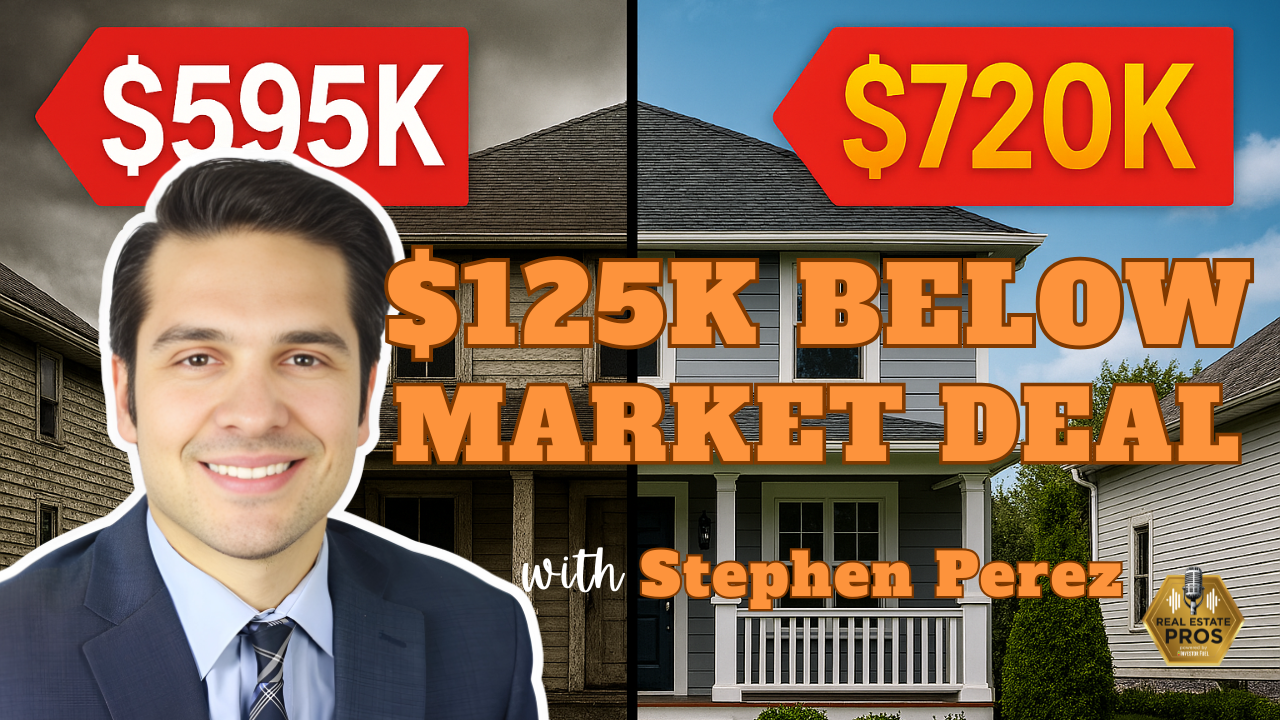
And so we were able to get something for $595 that was worth $720 at the closing table. That would never happen on the MLS.
Dylan Silver (00:09)
It’s a no-brainer, you know,
Hey folks, welcome back to the show. Today’s guest is an investor and realtor. His company Zarep does a lot of deals in the West Chester County area. Please welcome Stephen Perez. Stephen, welcome to the show.
Stephen Perez (02:00)
Thank you Dylan, pleasure to be here, happy to be here and speak to your audience.
Dylan Silver (02:04)
It’s great to have you and I’m from not necessarily right in that area, but I tell people, you know, when you’re from the tri-state area and then you move out to Texas, everyone that’s kind of from Pennsylvania, from Northern New Jersey, from the area that you’re in is kind of a long lost brother in a way when we’re out here. But it’s great to speak with someone from my neck of the woods. But I always like to start off at the top of the show by asking folks, you know, how they got into the real estate space.
Stephen Perez (02:35)
Yeah, so how I got the itch was through my father. He’s been living in Florida the past 20 years. He’s been buying single families, developing properties. He put up a strip mall in an area called St. Cloud, Florida. And so observing him from ⁓ childhood, teenagehood, I was like, I need to get into real estate. And the itch was born with a single family home in Winter Haven, Florida. And I was living in New York.
buying single families in Florida, trying the out of state investing thing. Went pretty well, cash flows weren’t great, but did a few deals there and realized after those few that out of state investing was not for me. And so I started.
slowly but surely selling those properties off and bringing my business to the tri-state area where I’ve lived my whole life. And now I try to do real estate investing within one to three hours of where I live.
Dylan Silver (03:33)
I think ⁓ there’s a lot of regionality in real estate and I’m a fan of kind of doing this remotely and I’m trying to do it myself but I will say it’s not easy and you’ve experienced some of that and I also think that whatever vertical people are involved in, whether it’s single family, multi-family, commercial residential, land, wholesaling, being a realtor, other verticals that I didn’t name, right? ⁓ It helps a lot to approach it.
with a regional outlook. I’m curious to get your feedback on that because even within New York you’ve carved out a niche in the West Chester County area and I’m familiar with that area but not super familiar with it. What’s the market like out there and what types of deals have you been looking at?
Stephen Perez (05:10)
Yeah, no, good question. So it’s, it’s an area that has very high price points and sophisticated owners. So it is a difficult area to do off market deals, to do wholesaling, especially in New York being an attorney state. Westchester and the surrounding area became my focus is just because that’s where I’m from. And I, and I know Westchester kind of like the back of my hand. So the volume is not high.
But when you find a very good deal, it can be a juicy one. You could be able to get a deal maybe 100,000, 120,000 below its value, depending on the circumstance. So it’s a low volume business in Westchester. I would say if you’re looking for more volume, you want to sneak up north of Westchester to the Hudson Valley area. So that’s Dutchess County, Columbia County.
price points aren’t nearly as high and there are more owners, I would say, that are in tougher situations. Westchester, it’s very hard to find that.
Dylan Silver (06:10)
Now in Westchester, I’m imagining the deals that you’ve been involved in are long term buy and holds. And generally speaking, are you looking at a cash flow heavy strategy? Are you looking at, we’re going to hold on to this for X amount of years and then exit? Or is it more along the lines of, hey, the appreciation is so heavy over here that cash, even cash flow aside, we know that we’re going to have this huge exit in X number of years.
Stephen Perez (06:36)
Yeah, so the focus is primarily on small multifamily, anywhere from two to five units, where there is an equity play, where we can get it 15 to 20 % below what it’s worth, as well as have the cash flow. But we’re buying.
First focus being the equity component and second being cash flow. It is harder to cash flow in places like Westchester because the property taxes are so high and your insurance cost is elevated. ⁓ But that’s where, because we’re focused on the equity piece, it does take longer to find deals because most owners tend to know what they’re sitting on and it’s harder to find that alpha.
Dylan Silver (07:01)
Yeah.
I want to ask you a granular question here about Westchester County and what it’s like owning units out there. I’ve spoken to attorneys from all over the country in places like Seattle, New York, where I’m at in Dallas, Texas. And some of the feedback is when you’re buying in some different markets, you do have to potentially be prepared for times of vacancy or in some extreme cases where you’re not being paid and there’s potentially a squatter.
Are these things that get factored into kind of the arithmetic in your deal math when you’re looking at deals? Hey, you know, if there is a battle with a tenant, a tenant issue, I might potentially be having to, you know, hold this property for a year before I get a new tenant.
Stephen Perez (08:03)
Yeah, no, it’s a good question. I would say it’s definitely a big part of the equation and it’s why I’ve been very selective in what I buy in this area. ⁓ I think one way to curb that risk is to buy multi-family properties that have strong school districts because in many cases you’re finding tenants that have children and are renting that place because it’s tied to a specific school.
Dylan Silver (08:27)
Yeah.
Stephen Perez (08:35)
My experience with this strategy has been 100 % effective. I have not had any evictions at these properties or non-payment issues when the building or house is tied to a school district in which the parent is using. ⁓ So that’s one way to curb it. I would say in northern New York,
Dylan Silver (08:40)
issues.
Yeah.
Stephen Perez (08:58)
It’s a
little bit easier to execute an eviction. I have some experience in Albany County. I was able to do an eviction in three months, which is not so bad as what you hear about in newspaper or online where you hear these stories about two years in Queens.
Dylan Silver (09:09)
Yeah.
Stephen Perez (09:13)
That’s not the case in every county in New York. Some counties are, the judges are a little bit more supportive towards non-payments. And so it does depend. I don’t invest in the five boroughs. So I can’t speak to that. I have heard horror stories about the five boroughs though, within New York City. And so for that reason, I have stayed away from buying rental properties in New York City.
Dylan Silver (09:36)
I mean, we talk about the regionality of real estate and I mean, this is a great example of it. I mean, to talk about Albany versus New York City versus, you know, Westchester County and just how different even within the same state it can be. And I want to pivot a bit here, Stephen, and really get your feedback as far as ⁓ scaling a business in this space. I mean, obviously you’ve had some pivots along the way, scaling to where you are, multiple units, have experience in multiple different areas.
Along the way were there any key turning points or key observations or opportunities where you said, this is really working and let’s double down on this.
Stephen Perez (10:49)
Yeah. So the big aha moment was going from buying properties on the MLS to then going off market, direct to owner. And that is through a multitude of ways. Sending letters to properties, property owners, cold calling, making sure that you’re compliant with those laws, ⁓ as well as cold email.
That is how we were able to get our best deal to date in Dobs Ferry, New York ⁓ was through cold calling. We were able to find somebody that was in a difficult situation and they really, they owned the property with three people. They’re three siblings. They just wanted the property sold quickly. And, you know, we built a good relationship with them to the point where the numbers didn’t matter as much.
Dylan Silver (11:43)
Yeah.
Stephen Perez (11:44)
And so we were able to get something for $595 that was worth $720 at the closing table. That would never happen on the MLS.
Dylan Silver (11:50)
It’s a no-brainer, you know, and I think…
One of the things that I’ve learned as an experienced wholesaler, really, and you know, it’s funny, Stephen, because when I became a realtor, I realized there’s a huge, almost like a schism or conflict between wholesalers and realtors. Realtors really don’t have the greatest regards. And as a wholesaler myself and a former, I say former, but really current wholesaler, I don’t have that same sentiment, but I certainly understand the perspective, the compliance issues and so on and so forth. But when I was only a wholesaler and didn’t have a real estate license,
You know, we would be going into the most distressed situations. You’d be going, you talked about bringing kind of family together and maybe they were in some degree of distress. I’ve walked into people who, you know, airship issues, someone had passed away, divorce, you know, medical issues, someone losing their job, ⁓ health issues of all different varieties. And so, in so many ways, my job as a wholesaler was just as much like, how do I solve some of their life problems?
You know, like if these people need a place to stay and they can’t afford their current place, how can I get them into a new place? Right? Because ultimately, like if they’re not paying the bill right now and I need them to leave because this property is about to be assigned to an investor, they can’t stay, you know, so I have to solve their problem in order to have even the right to.
Stephen Perez (12:54)
Yeah.
Dylan Silver (13:16)
get any money at the end of the transaction. so I really think that’s where great investing comes in is you’re truly solving problems, problems that they cannot even solve themselves and they need to, not just for financial reasons, right?
Stephen Perez (13:30)
Exactly. Yeah, no, and being solutions oriented is huge in this business and always just being able to come up with a solution for every obstacle that gets thrown at you. Some people, they inherit a house and they just don’t know what to do. They’re paralyzed. And that’s what my company focuses on is we can offer you multiple solutions, whether it’s a cash offer, that’s something that can be done quickly, or if you’re looking for top dollar, we can go a different route.
bring it to market. And that’s, that’s goes back to our core competencies is just, Hey, whatever your problem is, we’re going to be able to offer you something.
Dylan Silver (14:10)
think a lot of people when they hear that, ⁓ they ⁓ of course say, hey, that’s a no-brainer. How does it work? How can I reach out? As someone in this space, know it’s pretty tricky. It can be very challenging at times to ⁓ make these deals happen, specifically in the cash offer space. ⁓ And I have my own strategy. But I’m curious, without giving away all of the gold, ⁓ maybe just giving away a little nugget here.
What is your perspective on the cash offer space in general? think there’s a lot of people who are operating a business purely based on cash offer. They don’t have the ability to list. And then there’s other people ⁓ who may be doing some combination of it, but it can be tricky, right?
Stephen Perez (15:34)
Definitely. And I think it depends on the type of property that we’re looking at. You know, if it’s something that that’s with a lot of acreage or if it’s a house, it’s a multifamily on a small lot. But ideally, you know, I try to look at what the current market value of that property is and ideally try to get the property purchased at 80 to 85 % of that current market value. Additionally, in terms of ARV,
I’d like to be 70 % of ARV after repair value minus the cost that it will take to renovate the property. Those are some kind of back of the napkin. With investment properties, it’s hard to achieve this, but the 1 % rule is kind of my back of the napkin. What are the rents on this building? What do they want for the price? Can we get to 1 % as is?
And that’s where going back to becoming very picky because it’s just so expensive to do anything now, I try to stick to that 1 % rule with a multifamily property.
Dylan Silver (16:36)
Yeah.
I want to get your feedback on this and I know it’s a little bit difficult to talk about maybe so again you don’t have to give away all the gold here but being a realtor while also offering cash offers can be tricky I’ve brought this up with ⁓ my brokerage and I’m curious again without giving away all the gold how you navigate that because it can be tricky right?
Stephen Perez (16:58)
Yeah.
Yeah, definitely. And I think transparency is key. And that’s something that upfront before any type of cash offer is made, I make it very clear that I am a licensed realtor in New York. And we like to offer two options to property owners. This is the cash offer. This would be, you know, we’ll take the house as is. You don’t have to lift a finger. You can leave everything behind.
and then here’s the offer to list it as your realtor. And there tends to be a pretty large disparity between those two numbers.
But I explained to them very clearly, here are all the pros and cons of the cash offer and of that listed offer. ⁓ Just because there’s a big disparity in the number doesn’t mean bringing it to market is the best idea, especially if the house is in very bad condition. What I’m noticing in our market right now is that properties that come to the MLS that are in very bad condition tend to sit.
Dylan Silver (17:57)
Yeah.
Stephen Perez (17:57)
People
nowadays don’t want to do a lot of heavy lifting. They don’t want a $150,000 project. So just bringing it to market doesn’t mean it’s going to be a great outcome, at least in this area. ⁓ I had a deal recently where in Mount Kisco, New York, he turned down all of my offers and he decided to go with his friend to list the house. They brought it to market. It’s been sitting. They’ve done four price cuts already. He ended up calling me back.
for the cash offer because he just couldn’t deal with the on-market insanity. And people changing their mind, I need to wait, I need to wait for my lease to end, I need to wait to sell my other house, I can’t close until September. He’s just, you know what, take it off, I’m just gonna take this to an investor off market. So it’s, yeah, so I think transparency is key.
Dylan Silver (18:37)
That’s right.
Yeah, that’s how it happens, right?
Stephen Perez (18:51)
I’m not trying to hide the fact that I’m a realtor. People know that going in and I try to clearly explain those two offers and the pros and cons of them.
Dylan Silver (18:59)
You know, I think it’s a tricky space to navigate and as someone who’s an investor agent myself, I wish there was a lot more ⁓ folks in this space, but it can be tricky at times, especially with compliance being such a big thing. And I feel like every new agent just gets it drilled into their head compliance, compliance, compliance. So it’s certainly been drilled in a mind, but I’m very passionate about the investor agent space. So I applaud you and everyone else who’s ⁓
in this space, especially in a very, very, very difficult area to invest in, like New York State and the Tri-State area in general. we are coming up on time here, Stephen. Where can folks go if maybe they’d like to reach out to you or if maybe they have a deal they want you to look at or if maybe they have a home in Westchester County that they’re thinking of selling?
Stephen Perez (19:47)
Yeah, definitely. ⁓ So my personal brand on Instagram or page is Steven Perez underscore RE. ⁓ We also have our short term rental Oscars Pond Estate. Same spelling on Instagram. And then our website is ZarephHomebuyers.com.
Dylan Silver (20:06)
Steven, thank you so much for coming on the show here today.
Stephen Perez (20:09)
Thank you so much. Good