Subscribe via:



Show Summary
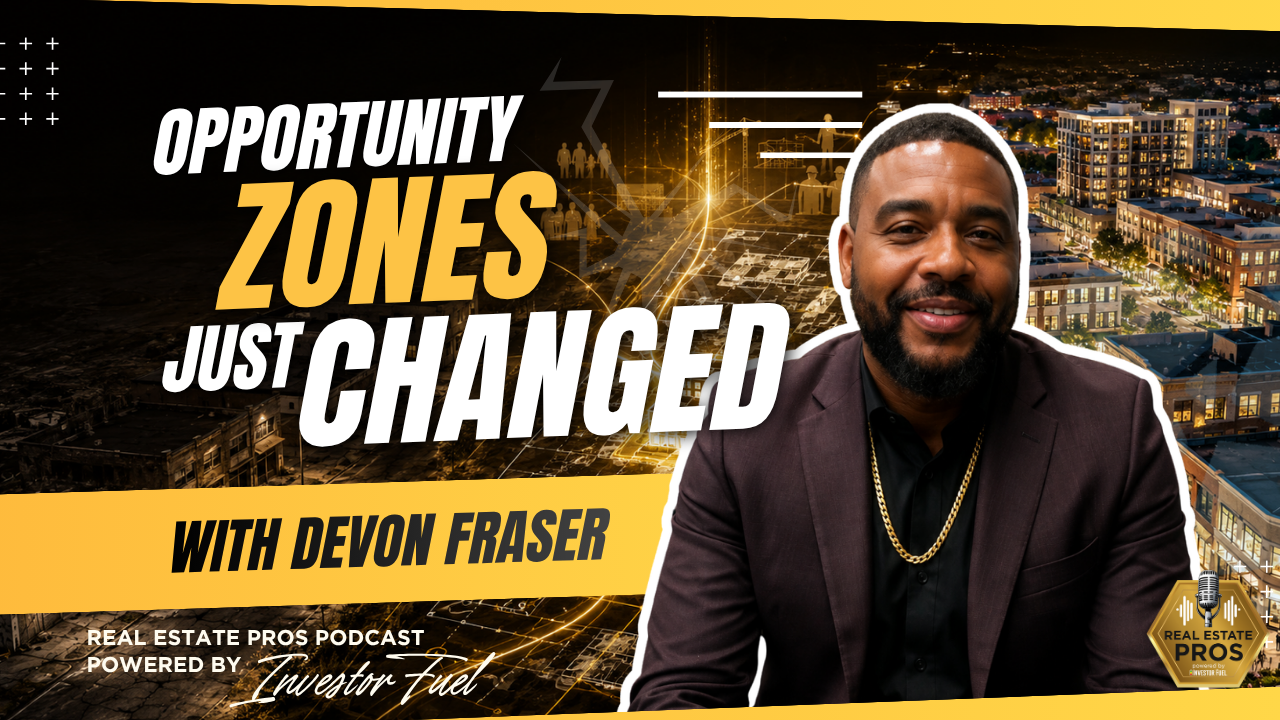
Devon shares his 27-year journey in the title industry and his expertise in CRA funding, opportunity zones, and community redevelopment. He emphasizes education, relationship-building, persistence, and helping underserved communities benefit from real estate growth.

Resources and Links from this show:
-
-
- Investor Fuel Real Estate Mastermind
- Investor Machine Real Estate Lead Generation
- Mike on Facebook
- Mike on Instagram
- Mike on LinkedIn
- Devon Fraser’s Email Address: [email protected]
- Devon Fraser’s Phone Number: (954) 445-3399
-
Listen to the Audio Version of this Episode
Investor Fuel Show Transcript:
Devon Fraser (00:00)
It doesn’t work like that. I learned something and when it comes to title, you said it right, like, I’ll let you close it. My job was to make sure that the agent didn’t have to come to closing. Now if you wanted to show up, you’re more than welcome. But the idea of you trusting me to close your deal gives you more time to sell. That’s a working relationship that cannot be bought or sold or transferred. You don’t want to be in the same place when that—the guy can handle it. I’m not calling you unless I can’t figure it out, and trust me, if I can’t figure it out, that means that you can’t either.
Issa Hanna (01:58)
Welcome back to another episode of the Real Estate Pros Podcast. I’m your host, Issa Hanna, and today I have Devon Fraser here to share his knowledge with us with New World Title. Devon, welcome to the show.
Devon Fraser (02:08)
Hey, thank you for having me. I really appreciate it.
Issa Hanna (02:10)
Super excited to have you, man. You got a lot of knowledge in the game. You’ve been in the game for a while, you’ve seen the ups, you’ve seen the downs. So for people at home wondering what Devon’s into, what—what facet of real estate he’s in, can you kind of break down what part of real estate you’re into?
Devon Fraser (02:24)
Yeah, of course. The facet of real estate that I specialize in is title, right? The transferring of commercial and residential property via deed. And I’ve been in the industry, like you said, a long time. So I’ve seen a lot of transactions go through my hands, get to learn and get to know people, and it’s one of the things I find the most interesting to do.
Issa Hanna (02:43)
Definitely, man. Title work is tedious, but it’s the most important thing. As a seasoned investor myself, I’ve had some crazy stuff pop off with title. I’ve even had somebody try to—try to forge a document and the signatures didn’t match. You guys are like the MVPs because you catch that kind of stuff. You catch the liens, you catch—you make sure when somebody buys a home, they’re buying something with a clean title.
Nothing could come back on them. Over ten thousand closing docs you’ve looked at. I joked with you earlier when we were talking, you probably got it memorized, man. But I want to rewind a little bit and kind of get your background. So we all have that cool “I got into real estate business” story this way. How’d you get into it?
Devon Fraser (03:25)
It’s okay. Yeah. I find my story pretty intriguing. For me, it’s like the classic kid who gets his opportunity in the mailroom. So I started as a courier. I was 19, I started as a courier, and a buddy of mine, he owned the title company and he says to me, “Hey, listen, I need a courier.” Now, if I’m gonna—I’m showing my age here, this is way before you could do same-day deliveries and DHL
and FedEx would come and pick up the same day and take it down. It’s also before a lot of people thought or before realtors really cared to get a wire, because everybody wanted a check to show the check. So I’m in the check days, that tells you how long that is, right? And he told me, “Listen, all I need you to do is deliver this check to each realtor,” and their specialty at the time was “we’ll bring the check to you,” right? So the realtor didn’t have to be at the closing. That was one of our specialties. But I was the guy driving the checks to
the realtors. And at this time, this is the Clinton era, so this is closing through the roof with deregulation, right? And deregulation, I’m sorry. And I’m delivering 10, 15, 20 checks a day. They’re paying me a hundred dollars to deliver the checks. I just got—I was a younger kid driving in my car, like I could do this all day. I actually—we had one really busy month. End of the month for title companies are the worst. Don’t ask for anything at the last three days of the month if you’re watching this.
You just wait till the beginning of the month and we’ll be different people. But at the end of the month, it’s close, close, close, close. So we were actually short a closer, and the owner was like, “Listen, you’re articulate enough. Here’s a package, go inside there and close it. Just read the bold print. If you can do that, you can read, you’re articulate, just do it. You see what happens.” I actually went in and it was—it—I was nervous. I did my first closing
and it was,
I had to explain the buyer and the seller and the realtor, and I’m just reading the highlighter, the dark bold letters, and I make it through it. I just started—it was just like reading a book. It was—I got through it. I came out in thirty minutes and he was like, “Are you okay?” I’m like, “I’m done.” And he was like, “No way!” And I’m like, “Yeah, I’m pleased to…” I listen, ’cause at this time I had this big afro, I’m driving a car, so I don’t know, nobody was gonna see me. I was wearing whatever I wanted to wear, I was eighteen, nineteen, whatever. And he’s like, “Look, cut your hair, take out your tongue ring, and you’ll get a job tomorrow.”
So I ended up going back into the office after I cut my hair. It’s like I’m growing up. I ended up cutting my hair, and I was—and I ended up becoming a notary and I became a closing agent. And for me, it became really liberating because it was like I felt like I had this power that I’m actually transferring the biggest purchase of somebody’s life to them, and they come to me and I have to explain it to them. So for me, it was like—it was a passion. And the funny thing is,
as you grow up, you realize that like people put color and race between you. There’s one thing that’s the same color, and that’s money, right? Everybody wants a house, everybody has a family. I think in the time that I was doing that many closings—and this, like I said when we had said pre-show, this is when closings were out 500, 700 a month we’re doing. And that’s not just us, that’s all over the country. Anybody can get a loan, get a heartbeat. I got to see the similarities that families were families, no matter what household you were in.
Only thing you smell different is the cooking, right? Or the culture. So that was something that I gravitated to, and I ended up like moving my office into one of the processors’. Like I took a little desk in the head processor’s office just to listen to her and regurgitate what she was saying, because title’s very, very—it—it’s not easy. You have to be very, very detailed and it’s a very skilled profession, and they don’t teach it in school. You either know somebody or you’re a lawyer, that’s it. So
I just felt privileged to be able to listen to some of the best in the industry. And we’re—I’m in Miami. So if you could imagine what we were closing and how we were closing, and the lengths that we were going to get things closed, it became like a second muscle, right? So I’m still delivering checks, I’m starting to do closings. And then they gave me an opportunity, like, “Listen, we don’t have—we don’t have a hold on the Black and Brown community,” because I worked for a Latin title company at the time. So they were like, “Look, why don’t you go out and sell, find
Black and Brown realtors, get them to bring—give us business, and I’ll pay you a commission.” So I was like, “Wait, I’m gonna get delivery money, I’m gonna get closing money, and I can sell my own deals?” And I—that’s when I realized what stacking was, right? I didn’t never knew what stacking meant, right? And I learned what stacking was and I was like, “Wow, I could do the same job, I could work the same hours and get paid three different ways.” So that right there, as—as a young man, took me to a whole ‘nother level of real estate. And
innovation. I think real estate is really built big on like innovation. You gotta be innovative, you gotta find new ways. And we started doing mobile notary closings. This is before you could do Zoom closings. Again, I’m showing my age, but I remember driving up and down the coast. I’d do 15 closings in a day from Port Charlotte all the way down to the Keys, and I’d go to people’s homes because it was easier for them to get closings done at their house, because they didn’t have to miss a day of work. And that was like our niche: “Don’t miss work,
don’t come to us, we’ll come to you.” Same thing with the checks. It was like we had to give service, service, service, and solutions. So I just found my way into that business and I stayed in it. I worked for them for a long time, opened multiple offices throughout the state for them. That was the boom, like I said. And then came the crash, and we can get into that. I could talk forever, but I’m sure you have some questions for me.
Issa Hanna (09:02)
I got some questions, but what I was gonna ask you, give me a crash nightmare closing story.
Devon Fraser (09:07)
A typical crash nightmare closing is a divorce, some sort of divorce, and/or a trust settlement between kids after somebody passes, right? And I think this is where I believe that a good closer is the best negotiator, right? And you take your feelings out of it, and sometimes you have to find—and it becomes experience, because the first time you go through it, you’re like,
“I don’t want to be part—” Nobody wants drama. “I don’t want to be part of your divorce,” or whatever it is, but you have to be able to read the room. And one of those was a divorce for me, and it was a—it was a major problem because nobody in my—nobody in my office wanted to close it. It was a doctor and she was a lawyer, right? Big estate, and they’re fighting tooth and nail, screaming in the office, cheating happened, and it was like nobody wanted to touch it, and they gave it to me. They’re like, “You do it.” And I like the challenge. So
I learned early on the best way to do anything is to take—first take the money off the table, get all the docs signed. So let’s sign all the docs. “If you decide to close, we’ll close. But if not, let me get everything signed. Okay, now it’s signed. Now let’s go over the money,” right? And don’t do it in the same room, ever. Separate them. I’ll take the wife first, take the husband second, let them talk shit about each other when they’re not in the room. Before it, everything’s signed, they have to be comfortable. And then, it’s trust. “I want to make sure I get all my money.” So
stay here and wait until I fund it. Then people realize you probably didn’t want to stay and wait ’cause it takes us a while. The bank’s gotta get the docs post-closing, then you gotta wait for funding authorization. By that time, it could be four hours later, and we’re not speeding up anything. We’re not doing anything more, you’re gonna sit and wait. So, they argued like cats and dogs, and I feel like when it was all said and done, I felt like they didn’t even want to get divorced. I think they wanted to keep fighting, but
we ended up getting it done. Look, like I said, there was some cheating issues and this woman put all this man’s business on the table, and it’s better—nothing like a scorned woman.
Issa Hanna (10:54)
Yeah, definitely. And what, man, in the real estate business as a former agent and buyer’s agent, I’ve sat in on many closings. A, these people want these documents explained to them, and when you have a good closer that can explain, it takes a lot of pressure off that agent that’s at the thing. But B, we become almost like social workers. We’re dealing with families, we’re dealing with married couples, divorced couples when we’re listing the house or when we’re closing it.
You’ve got to really learn how to talk to people, calm them down, talk them off that ledge. There’s a lot that comes with it and people that don’t get overwhelmed like you are the ones that stick around. Yeah, I can already tell you’d be one of my favorite closers to use as an agent, just with the calm demeanor and the knowledge. I wanted to flash forward just a little bit,
and I wanted to ask you about Opportunity Zones, because it’s something that is an opportunity, but it’s new and a lot of people don’t know about it. So can you kind of break down what an Opportunity Zone is and how they work?
Devon Fraser (11:51)
Yeah, so an Opportunity Zone is—well, just to fast-forward to today, in the big, beautiful bill act that Trump signed, it’s now been extended indefinitely. But if you reverse from this one, Biden re-signed it and Trump originally initiated it, right? I only say that to say this: This was a program put throughout the entire country in blighted or underdeveloped areas that needed redevelopment. And the idea was that
the government would first identify Opportunity Zones in the hardest-hit ones, and then it would spread out from there. And those Opportunity Zones would get additional funding for you to, let’s call it spruce up the neighborhood, bring in new—new business, bring in new light, take these buildings that nobody wants, “we’ll give you some subsidies, bring your business here.” But the idea was to impact the neighborhoods, right? And
that funding, a lot of that funding you don’t have to pay back. A lot of that funding has certain ties to it and they’re called community impact ties, right? And I think people get lost in that and they don’t understand that. They say, “Well, how do I make community impact?” Hire the painter that lives down the street in the same zip code. Buy the materials from the person down the street in this zip code. It could still be a Home Depot, it’s just in this zip code. If you could find a smaller store and Ace Hardware—man, I’m taking my age for real—
if you can find a hardware store that’s local, those are the things that you have to track and be able to show, because this money is taxpayer money. It’s TIF money, right? And it’s from the tax roll. So based on the amount of homes that are in the area, everybody pays taxes, a certain part is carved out. Each city and Opportunity Zone gets a—just call it a budget. That budget is tied to community impact, right? And to trying to relieve the blight from the neighborhood.
Only people—the only issue, the true issue with CRA and Opportunity Zones is nobody—there’s not a class to take. So if you don’t do it yourself, you probably will get so frustrated if another client is doing it that you’re just like, “I don’t want to touch it.” And that’s what—most people are like, “I don’t even want to deal with it, it’s so much paperwork.” So what I did was, because I’m still in real estate, I had to take a step back, but I ended up building a project in Fort Lauderdale, a community project. What I did was I re—
re-engineered or reverse-engineered a community center, but a for-profit community center where we put a barbershop, a studio, an executive center, and a restaurant, which are like the four needs of any community, right? But I really—I did it for the community, but I needed to learn the documents. I needed to know exactly how to maneuver in and swim with those sharks. You can’t—can’t be a minnow and swim with the sharks. So a lot of it has to do—it’s a lot of very, very political, because you do have to have the sway
from your local commissioners, from your—you gotta know what district you’re in, you gotta know the initiative of the district. And a lot of it is you gotta find out—you have to find out what the neighborhood needs. And then once you figure out what the neighborhood needs, figure out a way that you can try to provide it to them. And the biggest thing for anybody in an Opportunity Zone is you wanna record everything you do, because the taxpayer is coming back to you no matter what.
“Why do we give you five hundred thousand dollars?” “Well, look at this presentation. Hit play.” Once they can see the jobs and you can have a report and you could show how many materials and how you changed the building, then everybody shuts up. And you want them quiet, because you want to be able to get more money later, and you also want to make the commissioner proud of why she signed off for you to get this. So I say all that to say this: There’s a lot that goes with it, and a lot of people don’t know, so they just get reserved. It’s not as easy as you think. So
we decided to dive into it. Now we specialize in it and we’re gonna take it nationally and provide education in order for other people to do it.
Issa Hanna (15:23)
I love that, man. Education is what people need. Opportunity Zones, like you said, they just became permanent. Another fun fact, guys, it’s another avenue to extend that 1031 exchange. A lot of people are not even using the 1031 anymore and they’re going into Opportunity Zones. The whole gist of it is they’re gonna give you this money, you’re gonna spend this money to make the community, the Opportunity Zone better, and you’re gonna spend the money in that zone,
so you’re bringing economy and all different facets to it. I believe it’s a great opportunity. We were talking earlier, you said the “G-word”—it’s a bad word, but people are not educated about it. And what is this G-word? It’s gentrification. You can gentrify a neighborhood, but still keep that integrity, educate the people that live there, and they can make the money off of their own neighborhoods. So
man, I love what you’re doing, I love how you’re educating the people. I can definitely see big things—you doing big things in the future, especially with that extensive knowledge you got in the real estate game. I kinda wanna ask you now in the future, the classic five-year: Where am I gonna see you in five years? ‘Cause you are such a knowledgeable guy, so—
Devon Fraser (16:32)
So it’s funny. It’s—we just had this conversation yesterday. I was talking to my son, he asked me, “Dad, where do you see yourself in five to seven years?” Somebody must have asked him that in college. So—and he said, “I can’t think that far.” And I said, “Well, if you don’t, you gotta plan—plan to succeed.” So where I see myself, I see myself doing classes on stage, selling seminars about this particular Opportunity Zone, working with government, and
I wanna—what I like to do is bridge politics and community. I like to bridge it to where they’re not facing back-to-back, where they’re—they’re looking at each other and taking on the opportunity and making it better, really just by working together, just by figuring out each other’s needs. I think that learning the opportunities is the only way I have is going to change how I do real estate, period. So I’m gonna—
I feel like that’s where being on stage and teaching, I think that I—no, I know that I will be working to do project management for certain CRAs, because people don’t realize CRA people are just your people in your neighborhood. They don’t know everything either, they’re just—they’re government employees. They can only go so far, they can only do so much. You’re working an eight-hour shift. How are you still gonna go and figure out what the community needs? They need people like us to bring it to them. They need us to come to their doorstep and say, “Look, this is a great project.”
And then we have to sell on why it is and then get them to believe and buy in, and then they move from there. They can’t do everything, so it can’t all be put on the government, either. We have to kind of work together. So I feel like I’m—I’m working on trying to become a project coordinator with different CRAs, travel the country and look at projects, assess them, and decide whether it should move forward. And where that stacking comes there is if I find a good project, all I need to do is find a good investor. If I’m already subsidizing the money, if I come to an investor and say,
“This project’s $10 million, but the city’s giving me four. Now it’s six million to you. Like, and you own the building, and I’m rehabbing your building.” There are so many ways to skin this cat that I think that the opportunity in the Opportunity Zone is endless. So I feel like seminars and opportunity, and helping—I want to help the communities and show people that it can be done correctly. And passing it down, or how they—they say it trickles down. It doesn’t have to trickle down. Just put it out and people come.
Put the water out and people will drink.
Issa Hanna (18:39)
A hundred percent. You put that knowledge out there, they’re gonna come. And we were talking about it earlier. When you reach a certain level in your field, in your profession, and everything’s going the right way and the money’s there and you don’t really gotta worry about it, the time is there, you’re sitting in your own podcast studio, right? It almost becomes, I wanna say, like a second nature
to want to share your knowledge with the next generation or the people who may not know as much as—as you do. So I—I’m super happy that you’re sharing your knowledge. And now I want to pick your brain and get some knowledge for our younger viewers, right? So our business depends on establishing relationships, growing your network, right? Nobody’s gonna call you if they don’t know that you’re a real estate agent or you’re a title guy or about Opportunity Zones.
So if somebody was just starting out, what do you think would be the best piece of advice you could give them on establishing that first business relationship?
Devon Fraser (19:30)
My best piece of advice to anybody starting is—and it’s—it might sound cliché, is you have to take the step off the ledge. You have to—you have to get uncomfortable to get comfortable. So for me, it’s
if you’re going to be networking, if you’re going to be meeting people, remove the alcohol. I say that because most of our networkers are at a bar or at a restaurant. Or if you’re just getting in, get the names, build your contact books, and follow up. And follow up to where you—when you feel like you’re being annoying, you’re doing the right job, you’re doing your job. People—people work with the people who follow up. And then they might be like, “Damn, you’re calling me again,” but I guarantee they’re thinking,
“He’s—he’s detail-oriented enough to continue to do my business.” And earning your business and keeping your customers is the only way. You gotta just take them down one by one and figure out a way to do good business so they call you back again or refer you to a friend. So if that’s that extra step, take the extra step. I know a lot of realtors today are like, “I gotta go show the property.” It’s, “No, that’s your job, go show the property.” You wanna meet the other client, you want to be at your open house, and not everything’s a set-it-and-forget-it, not the internet and AI cannot do everything.
So I think that—I think I’m a door knocker, man. I love to knock on the door and see the people in their face. So I wish more people were like that, but I know that not everybody’s as social. Step out of your comfort zone. Yeah.
Issa Hanna (20:42)
100%. Jump in that water. You’re not—what do they say, “closed mouths don’t get fed,” right? So you got to go out there, you got to hit that ground, you got to have that personal touch, and you will be successful. That is how you establish relationships. And another thing I wanted to pull out, the persistence angle, right? When you’re persistent, when you’re following up and you’re on the ball, people take notice of that. And guess what? You might annoy them, but when they go to list their house or they go to choose that title
company, they’re going to go with the persistent, detail-oriented guy over the guy that just, like you said, sets it and forgets it. That doesn’t work in our business.
Devon Fraser (21:18)
It doesn’t work like that. I learned something, and when it comes to title, you said it right, like, “I’ll let you close it.” My job was to make sure that the agent didn’t have to come to closing. Now, if you wanted to show up, you’re more than welcome, but the idea of you trusting me to close your deal gives you more time to sell. That’s a working relationship that cannot be bought or sold or transferred. You don’t want to be in the same place when the guy can handle it. I’m not calling you unless I can’t figure it out, and
trust me, that means—that means if I can’t figure it out, that means that you can’t either.
Issa Hanna (21:46)
So—
Devon Fraser (21:46)
So I think that that’s the type of relationship that we look for, and that becomes synergy, because the four hours that I’m closing or two hours I’m closing, you might sell another house, you’re making money and making money, and that makes you so happy. So you’ll never leave doing business with me, because we might have our disagreements, but you’re like, “No.” And then if I know that you’re a good realtor,
then I’m gonna refer people to you and we’re gonna figure things out. I think working with people in the industry and outside the industry is the way to go, and always ask questions. Cause I notice people don’t like to ask questions. I’m gonna ask you if I don’t know. I don’t feel like—I’m not gonna know unless you tell me about what I don’t know, what I don’t know, right? So I think those are some of the things that make better salespeople.
Issa Hanna (22:25)
A hundred percent. A hundred percent. And as a realtor, somebody who you can rely on, somebody who you could refer that is gonna represent your vouch, your referral, to that client, it goes such a long way. I can’t tell you how many people I’ve seen loan officers refer to real estate agents and vice versa, and the client just goes away and totally doesn’t talk to either of them, because one person dropped the ball with that client. So
man, we’re getting golden advice from you. But now I want to give you the floor, right? So you wanted—you want to coach, you wanna educate the masses, but you do have New World Title still. You’re still the best title guy in the whole Florida, your Fort Lauderdale area. So if people want to get ahold of you and they wanted to reach you and do business with you, where could they reach you at?
Devon Fraser (23:51)
They can reach me at—I’m—I’ll give you my direct phone number, because I’d rather you just give me a call. My number is 954-445-3399. New World Title is not just in Florida. We’re in New York, we’re in New Jersey, we’re in Texas. We have offices all through. There’s a ton of—we hire quality, so there’s a lot of good closers. I’d love for you to contact me, but you can reach me on my email, which is [email protected].
And tap in, give me a call, ask me a question. Or you can always reach out to—you can reach out to Investor Fuel. I’m sure they’ll be able to get you my information. But I’d—I’d love to help, I’d love to see if we can work together, too. And I am coming to Austin for that drink.
Issa Hanna (24:28)
A hundred percent. You come to Austin, drinks on me. It was a true pleasure to host you. Very knowledgeable, personable guy. Guys, make sure you slide into those DMs, shoot a text, give a call, because he could really help you. I didn’t know you guys were in Austin, so if I get a client and I gotta close him, you’ll be my referral partner from now on, so.
Devon Fraser (24:48)
Well, now that we’re—we’re in a—if we could do it live, we’d show this business, right? So we are actually in Houston, in San Antonio. Now that I know that you’re in Austin, I’ll reach out to you, have your guys send me an email. We’re looking for partnerships and looking to open more offices, so I can be the Austin guy.
Issa Hanna (25:03)
Sounds good. And you’re gonna be my Austin guy. Man, Devon, it was a true pleasure having you on the show, man. It was amazing having this chat with you. Truly refreshing.
Devon Fraser (25:12)
All right, boss. I can’t—I’m looking forward to it. Let me know when the show hits. And you guys check out Investor Fuel, they got great information. Real strategies, real results, real freedom. Investor Fuel.
Issa Hanna (25:21)
I appreciate the plug, man. Likewise, man, it’s super refreshing talking to you. And then to our viewers at home, if you enjoyed my conversation with Devon and want to see more like it, make sure to hit like and subscribe. I talk to people every day that can bring us different knowledge on every aspect of the real estate industry. Until next time, the Real Estate Pros are out.