Subscribe via:



Show Summary
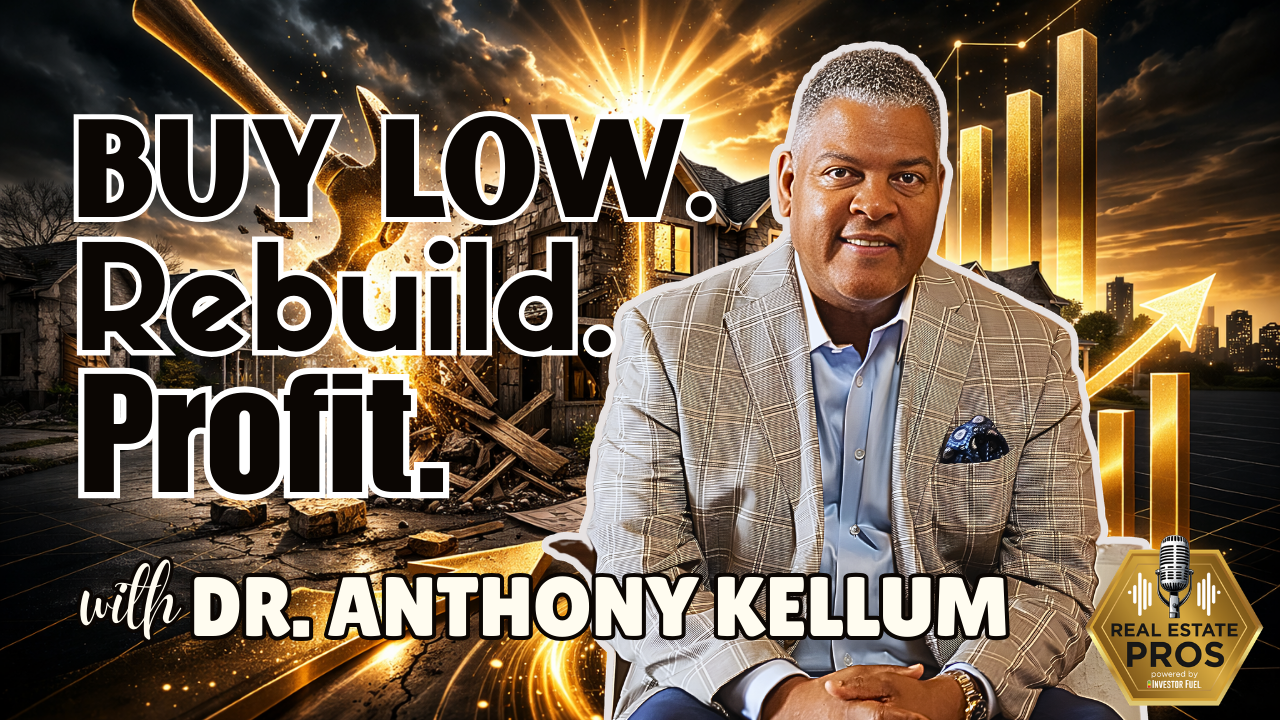
In this conversation, Dr. Anthony Kellum, CEO of Kellum Mortgage and author of ‘Property is Power’, discusses the intersection of investing and mortgage lending, particularly in distressed neighborhoods. He emphasizes the importance of DSCR loans in facilitating real estate investments and shares his strategies for transforming neighborhoods through property rehabilitation. Dr. Kellum also highlights the need for flexibility in real estate strategies and the significance of building strong relationships within the industry.

Resources and Links from this show:
-
-
- Investor Fuel Real Estate Mastermind
- Investor Machine Real Estate Lead Generation
- Mike on Facebook
- Mike on Instagram
- Mike on LinkedIn
- Dr. Anthony Kellum’s Website
- Dr. Anthony Kellum on LinkedIn
- Dr. Anthony Kellum’s Email Address: [email protected]
- Dr. Anthony Kellum’s Phone Number: (313) 263-6388
Listen to the Audio Version of this Episode
Investor Fuel Show Transcript:
Dr. Anthony Kellum (00:00)
No, no. So it’s a tremendous product. I mean, when you look at a town like Atlanta, you look at Cincinnati, Cleveland, look at Detroit, Houston, Dallas, other areas, those are really entrepreneurial areas. And this productreally give people an opportunity to get in, get inside, get involved in real estate. I tell people all the time, if this product was out 15, 20 years ago, I mean, you would probably have to talk to three people before you get to me. Because I mean, just think you can you can use the lease, the potential lease of the property, you know, the current lease of the property is revenue.
So you don’t need tax returns. You don’t need W-2s. You don’t need any of those things that may be a little invasive.
Dylan Silver (02:14)
Hey folks, welcome back to the show. Today’s guest, Dr. Anthony Kellum is the CEO and president of Kellum Mortgage and Kellum Capital Group. With over 30 years of experience structuring capital for real estate investors across residential, commercial, DSCR, and non-QM lending. He’s the author of Property is Power, Building Wealth in Distressed Neighborhoods, and is known for helping investors build sustainable wealth by acquiring, rehabbing, and repositioning properties in distressed and underserved areas.Through a disciplined, impact-driven investment lens, he focuses on maximizing returns while revitalizing opportunities and expanding long-term ownership. You can find him at kellumortgage.com Dr. Kellum, thanks for your time today.
Dr. Anthony Kellum (02:54)
Thankyou. Thank you for having me. I’m excited to be on your show. This is awesome.
Dylan Silver (02:58)
⁓Now, when we talk specifically about the intersection of investing and mortgage, I think a lot of times people separate these two buckets and the sentiment there is, well, you’ve got the residential side and then you’ve got the investor side, but you’re involved in both. I’d like to start there and ask you, is there a space for folks who are involved in that traditional mortgage side?
to work more hand in hand with investors.
Dr. Anthony Kellum (03:30)
Yeah, that’s a great question. It kind of happens organically, right? So once you get your hand around.you know, mortgage lending and you start doing investment loans and things that nature and you have different different borrowers come in and kind of keep your appetite to learn more and have more discovery. And for me, you know, you know, coming out of market like Detroit, I always looked at Detroit as a tremendous real estate opportunity. And I wanted to package that in a way where, you know, people could understand it and see it, see Detroit differently than what they always have. And so I give a lot of shout out to Dan Gilbert.
⁓ who really put Detroit kind of back on the map downtown with businesses, restaurants, a booming, booming area. And so I kind of try to look at that from a inner city neighborhood approach. And I kind of crafted some niche approaches to real estate to say, hey, how can you turn communities around? How can you also build wealth and make money doing that? So rewarding. And also the price points are much cheaper. that’s kind of like, so I typically trend, started
Dylan Silver (04:29)
Trump.Dr. Anthony Kellum (04:32)
to transition more in that space because the demand was there. No one had really reached out. No one had really shared. And I also used and showed ⁓ actual deals. I closed the one that I got fairly cheap. We had made money either with a tenant, made money over appreciation, or made equity in most cases, a lot of cases. And that just became my passion because when people can discover that they can make some money.Dylan Silver (04:58)
Now when,Dr. Anthony Kellum (04:58)
and also changeneighborhoods. Go ahead, I’m sorry.
Dylan Silver (05:00)
Whenwe talk specifically about Detroit, this is an area I think where maybe recently has seen a lot of interest from outside of Detroit and from investors out of the state. Has this been a trend that you’ve seen going on for years or a decade or more? Or is this something maybe newer where you’re seeing more out of state investors in more recent times investing in Detroit?
Dr. Anthony Kellum (06:11)
Yeah, so that’s an excellent question. Yes. So for me personally, I saw the opportunity years before capital showed up. ⁓ So, you know, I always give Dan praise because he put his money.in areas that were underserved and he could have invested in more things with less risk. I don’t think he’s unhappy now. He’s doing great in Detroit. We’re glad to have him.
But I always looked at it like for most investors, I started at the bottom. And so you get in at the lowest point. And when you get in at the lowest point, there’s a lot of opportunity there. And it’s just trying to paint a picture that people can start seeing it your way through your eyes, through your lens. And I’ve been fairly successful doing that.
Dylan Silver (06:57)
Now I know recently DSCR specifically seems to be a product that so many people in the lending space are utilizing. I’ve seen,brick and mortar banks get involved in DSCR. I’ve seen hard money lenders get involved in DSCR. And then I’ve seen folks who are involved in both spheres do DSCR as well. For our audience and for folks who may not be aware.
Dr. Anthony Kellum (07:13)
ThankDylan Silver (07:27)
why this is happening. Is DSCR something that has had a kind of a bull run here or has this been a product that has been around for a long time and now is just gaining popularity?Dr. Anthony Kellum (07:40)
No, no. So it’s a tremendous product. I mean, when you look at a town like Atlanta, you look at Cincinnati, Cleveland, look at Detroit, Houston, Dallas, other areas, those are really entrepreneurial areas. And this productreally give people an opportunity to get in, get inside, get involved in real estate. I tell people all the time, if this product was out 15, 20 years ago, I mean, you would probably have to talk to three people before you get to me. Because I mean, just think you can you can use the lease, the potential lease of the property, you know, the current lease of the property is revenue.
So you don’t need tax returns. You don’t need W-2s. You don’t need any of those things that may be a little invasive.
You’re have to put some money down. And that has been an overwhelming success. So you can close in your business name. You can close in your personal name. So that’s just been a tremendous, tremendous tool that everybody from banks, institutions has jumped on the bandwagon for good reason. I think it’s a phenomenal product, phenomenal program.
And I think that can help turn a lot of neighborhoods around and also create the next set of real estate investors and the next set of real estate millionaires.
Dylan Silver (08:52)
Now, pivoting a bit here, when we talk about distressed neighborhoods specifically, there’s a couple of different ways where I’ve seen ⁓ distressed neighborhoods transform. One is through fix and flip, and an individual investor might come in and ⁓ tear down a property that is a tear down or rehab a property and fix and flip it to sell. But then I’ve also seenareas where you’ll have an area rezone potentially and you’ll see single family to then larger town homes or multi-story ⁓ properties. so whenever there is distress, there does also seem to be an opportunity. If we’re gonna look at Detroit specifically, what approach have you taken to distress properties and neighborhoods that you have seen
Dr. Anthony Kellum (09:41)
Mm-hmm.Dylan Silver (09:51)
work the best.Dr. Anthony Kellum (09:52)
Yeah, so thank you for that question. That’s another great question. So for me, my formula is, know, when you drive through a city like Detroit, there are a lot of strong neighborhoods. ⁓that will have distressed properties in their neighborhoods on that block around the block, couple on the block. So I identify those properties and I tell people, hey, you you’re living in this neighborhood. That’s a great house. It’s got great potential, great value, and it sustain your neighborhood value. So that doesn’t, you know, decrease. Why not buy it? Why not fix it? Why not settle it? Put it back on the market. So my lands, typically I try to ⁓
Source properties that are what I would call strong neighborhoods homeownership neighborhoods where mom family could live in That’s kind of my lens my niche and that’s been very you know, you can pull You know cops you’ve got cops in those areas already So, you know you can you get an idea of value after repair value in those areas. Those things are all
⁓ easier to do and not so tenuous in other areas where the blight is much more significant. So I take a personal joy in going to neighborhoods and help raise the value in those neighborhoods, help those neighborhoods stay clean and have the vision of the makeup of that neighborhood.
Dylan Silver (11:47)
Now, when we talk about rehabbing a distressed property specifically, one of the ⁓ obstacles or bottlenecks that I’ve seen flippers stumble over is they might have like a cookie cutter approach to what their rehabs look like. And it could be beautiful, right? But if they’re not matching that up with what the recent comps are selling for, and if they’re not,and potentially analyzing, are we over rehabbing this property? Or are we prepared to be setting the market here? That could also be a potential problem for folks because if you’re just going based off of what you’ve previously done and what’s worked even just a couple streets away, that doesn’t always mean that that home will sell in that timeframe for that price.
on a street that’s just, you know, maybe a couple blocks over.
Dr. Anthony Kellum (12:44)
Well…if I understand your question correctly, yeah. So each deal is different. ⁓ but you get a really sense, kind of an expert sense of what will happen in the marketplace based on what you’ve done. You know, you’re going to become, you’re going to hire better contractors. You’re going to how to scale your costs. There are things that you pick up. may have over invested too much money in the kitchen, your last property, these things that you learn. But from a numbers perspective, the numbers are the numbers. whatever your acquisition cost is and what you think that value is going to be.
Dylan Silver (13:06)
Right.Dr. Anthony Kellum (13:14)
that current marketplace and you have to work in that area. So I would never recommend someone to over rehab a property or put too much in that property where the value wouldn’t be sustained. But I’ve also told people, I also have done this personally where I bought property whereYou know, I thought it was going to be a flip. The market tilted in a different direction. It became a great rental property. So I cashflow, I make money that way. You know, markets turn around and when they do, you sell. I typically try to find tenants that are future homeowners. So I’m not out looking for buyers at that time. You know, I look at credit, I look at their job, you know, look at resumes. And then then maybe I turn around and rent it to them for X a period of time that I could give them.
you know, concession to help with some of closing calls and that type of stuff for good behavior, right? So they keep the property up, they maintain the property, they pay me every month. You know, I’ll try to reward that because what I’ve discovered, 90 % of people work.
And their housing is very important to them. It’s the cash reserves, the down payment, those things are the real impediment for most people and more importantly, our young people. So we can help bridge that gap by doing some type of concession and rewarding them for good behavior. That’s always been beneficial. So you just got to be able to pivot your mindset sometime. You go on to somewhere, you’re looking to sell it and flip it quickly. Market flips on you. You just ran it.
Dylan Silver (14:48)
Yeah.Dr. Anthony Kellum (14:49)
Sothat’s kind of what I do.
Dylan Silver (14:52)
You know that the ability to not bank on one thing entirely, right? So if you realize, this property isn’t selling, it’s sitting on market. Can we turn it into a rental? I’ve heard this enough times where I’m thinking, hey, if I’m to go do a flip anywhere in the country, even though my exit is going to be a sell, right? I’m still going to look at what the rental rates are, not just so that I can talk to the ⁓ end buyer, but because if I have to hold this property,I want to know what it’s going to look like, right? And I want to know how I’m going to, you know, bridge that debt, you know, or refinance out of that. And I have to be prepared for, you know, that second exit strategy. And I think all too often, whether it’s single family or definitely multifamily, where it does seem like for the last six years or so, give or take, it was a tough time for a lot of multifamily investors. You have to have that ability to pivot and to identify not
Dr. Anthony Kellum (15:39)
Mm-hmm.Dylan Silver (15:50)
just your prime number one exit strategy, but also potentially number two and maybe even number three.Dr. Anthony Kellum (16:39)
Yeah, absolutely. You gotta be able to pivot.And, you know, being an entrepreneur is broad. So you have to be somewhat creative. You have to find the contractors that you like. And then sometime on the work site, you’ll find a team of guys in there working and some guy befriend you and he could do things less. He wants to be more entrepreneur, start his own contractor company. So there could be savings there. But also, ⁓ you know, I would be remiss to say that you want to make sure you bring in top notch contractors to
to
the table because a deal could go sideways quickly. They don’t show up. They don’t put permits. ⁓ You know, the craftsmanship and quality is not great. And we’ve all experienced that. I’ve experienced that many times, even most recently. So I’ve had to recently.
got to the to a a bathroom, you know, spent money. Don’t don’t make me cry here. And then I had to bring another contractor in, rip out the bathroom that they did because it was just just shoddy work. ⁓ So, you know, and I consider myself pretty seasoned and, you know, just stay in the don’t pick up the personality that I have and where, you know, understand
the human dynamic, I’m always trying to give people an opportunity. And sometime you are disappointed. And in this case, I gave someone an opportunity. They talked a big game and someone gave me an opportunity. I tell my wife all the time, like, hey, I’m here because someone gave me an opportunity. that’s so and sometime it works out for you and sometime it don’t work out for you. You know, in that case, it wasn’t, you know, we’re going to be OK, but it didn’t work out for you.
Dylan Silver (18:23)
You know, that’s oneof the tricky things about any type of ⁓ partnership or transaction for that matter in real estate, because just like, ⁓
working with a contractor, you know that you’re depending on that person if you’re working with a seller and you know I’m a realtor representing a buyer. I’m not just dependent on my client I’m also dependent on the seller like the other side of that transaction so even though there may be an adversarial relationship to a degree there we may be you know trying to do best for our clients or
If I’m the seller myself, I’m trying to do the best for myself. I’m also depending on the buyer, right? And so that’s kind of, you know, one of the beauties about real estate is that because, you know, it’s not just, you know, one side, it’s you’ve got the landlord and a tenant, right? You’ve got a buyer and a seller. You’ve got an investor and you’ve got contractors. It’s just as much about those relationships as it is about underwriting the deal, as it is about, you know, the location and, you know, an exit strategy.
Dr. Anthony Kellum (19:00)
Mm-hmm.Yeah, there are a lot of moving parts. ⁓ So it’s just kind of trying to orchestrate all those moving parts and be clear and communicate well with all those parties, which I think we do a good job at is setting expectations, especially when you get real estate agents involved.
Sometimes that can be a little complicated and there’s only so much we can share personally about the buyer and whatever struggles that they have. But just kind of managing the expectations and say, look, we’re both trying to benefit this client. We’re on the same team. You know, I’m not in the business to waste money or your time and I’m respecting yours. So it dodged me a little bit to get this to the finish line. So sometimes you do have some uncomfortable conversations because it’s just a maze that we’re working
in on the back on the backside to get things done so that’s not always appreciated ⁓ let’s say in the real estate space per se.
Dylan Silver (20:19)
We are coming up on time here though, Dr. Kellum. Any new projects that you’re working on and then as well, what’s the best way for folks to reach out to your team?Dr. Anthony Kellum (20:29)
Yeah, so one of the things I’m working on is… ⁓It’s working on a properties power platform, which is a seminar series to reach real estate investors and educate them on the power of real estate. And not only show them that there’s wealth potentials, but also how we save our neighborhoods, how we build good schools, how we become stewards and stakeholders in our community. And in particular for the African-American community, homeownership is just such an important, it’s necessary and viable. It’s not even a luxury.
that
We own homes just because of all the goodwill I just said. In terms of reaching me, would love to talk to your viewership. ⁓ Contact number is 313-263-6388. That’s 313, area code 2636388. And you can reach me email address, anthony at kellumortgage.com. And that’s A-N-T-H-O-N-Y at K-E-L-L-U-M-O-R-T-G-A-G-E.com.
Just one ⁓ So I share mortgage and Kellum. We share the same ⁓ So a lot of emails get kicked back because people put the double in there. So this has been good. I hope that it’s been helpful for your 50 million people that are watching it right now. And it’s great. You’re doing a great job. got it. You got a future in television, man. ⁓
Dylan Silver (21:38)
share the same app.Heya.
I appreciate it. Dr.
Kellum, thank you so much for coming on. Thanks for your time today.
Dr. Anthony Kellum (22:01)
Thank you, have a wonderful day. -