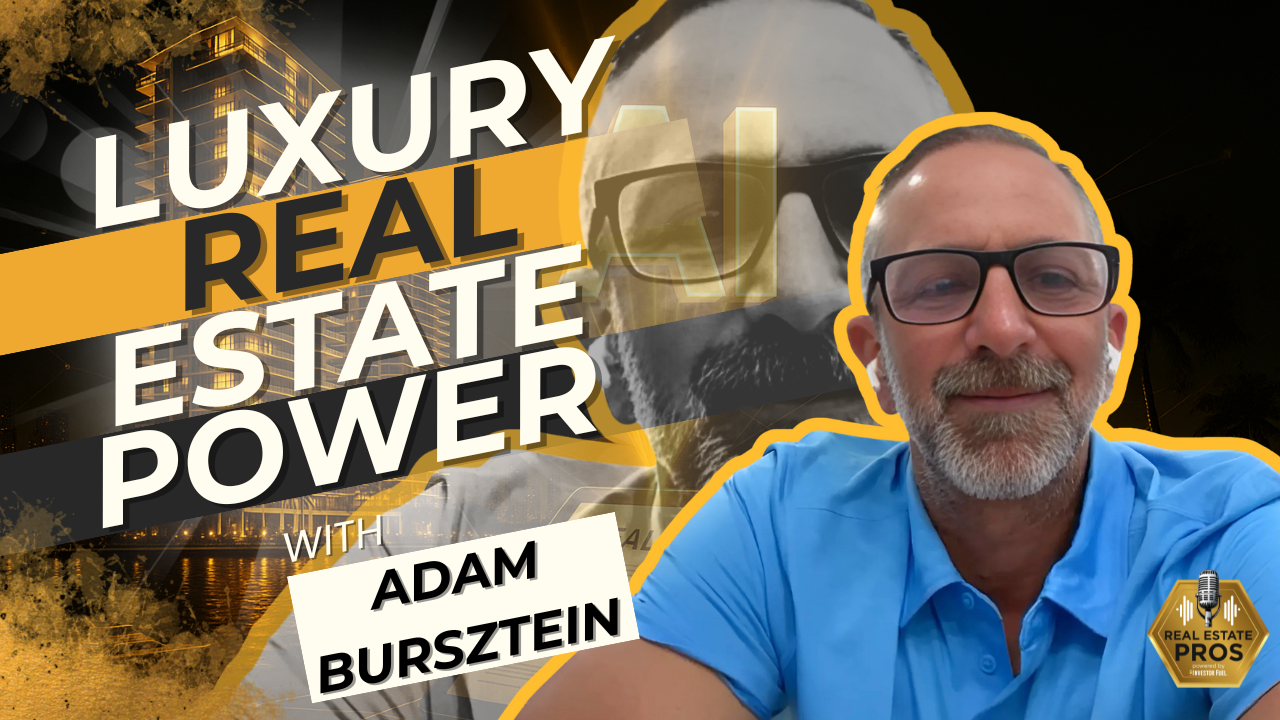
From $10K to 18% Returns: How Blockchain Is Changing Real Estate Investing
Show summary
In this episode of the Investor Fuel Podcast, host Leo Wehdeking speaks with Adam Cohen, a seasoned real estate professional with over 35 years of experience. Adam discusses his dual focus on commercial mortgage banking and the innovative SaxCap fund, which leverages blockchain technology to democratize real estate investment. He shares insights on the importance of experience, navigating market challenges, and building trust with investors. Adam also outlines his future goals for SaxCap and emphasizes the need for continuous reinvention in the ever-changing real estate landscape.
Key takeaways
- SaxCap lets investors put in as little as $10,000 or $50,000 into ground-up construction and real estate projects without personally guaranteeing loans or borrowing money, because projects are fully funded before construction starts.
- Adam targets returns of 18-22% for investors through the fund, positioned against near-zero bank savings rates, citing an example of $10,000 potentially returning $1,800-$2,200.
- Fund buying power matters: moving from roughly a half million to 500 million in capital lowers cost of debt, increases rent roll, and improves overall deal terms compared to individual investors.
- To avoid fund manager misconduct, SaxCap routes all investor money through attorneys who act as CFO, write checks, and manage books, plus separate business attorneys, SEC attorneys, and CPAs for compliance.
- Adam's lowest point was the 2008-2010 crash, where he lost millions, faced lawsuits from investors, and spent two years doing private consulting before a client handed him two stalled construction projects to fix in 2010; he sold them above market six months later and doubled investor returns, relaunching his career.
- Building an investor network starts with proving a track record on small deals first (turning $1 into $2) rather than pitching large projects upfront; beginners should align with an experienced operator to build credibility before going independent.
- Adam's next goal is growing SaxCap into a billion-dollar fund with assets under management globally (including UAE), launching a related company called Smash Mortgage, and eventually stepping back from an 18-hour-a-day work schedule he has kept since age 18.
In this episode
- 02:00Introduction to Adam Cohen
- 02:49Adam's main focus: commercial mortgage banking and SaxCap
- 03:47Markets: US-focused with growing international interest
- 05:55How blockchain and SaxCap democratize real estate investing
- 11:11Adam's recipe: 35 years of experience and building the right team
- 17:55When things got real: surviving 2008-2010
- 24:17Next goal: turning SaxCap into a billion-dollar fund
- 26:06Building investor relationships and growing your network
- 30:22How to reach Adam Cohen
About the guest
Adam S. Cohen has about 35 years of experience in real estate, starting around age 16. He runs a commercial mortgage bank focused on private lending and is launching SaxCap, a blockchain- and crypto-based real estate investment fund aimed at letting investors of all sizes, from blue-collar workers and recent graduates to family offices and institutions, invest in real estate. He has worked as a mortgage broker, real estate agent, developer, flipper, lender, borrower, title lender, and insurer over his career, based between New York and Miami.
Listen to the audio
“Because every project that we do is fully funded before we start. So if there's a significant change in the markets, we've already insured against it so our project can run smoothly no matter what happens.”
Adam S. Cohen
“If you're ever going to build a house, you don't start with the roof, you start with the foundation. And that foundation is one brick. Take that brick and put it on top of another brick and show an investor that you can turn one dollar into two.”
Adam S. Cohen
“When it comes to money, it doesn't matter how much anybody likes you. It's based on your track record and what you can show them.”
Adam S. Cohen
Questions answered in this episode
How can someone invest in real estate with only $10,000?
Adam Cohen says through SaxCap's blockchain-based fund, investors can put in $10,000 or $50,000 into a fully-funded ground-up construction or real estate project without personally guaranteeing a loan, borrowing money, or worrying about the market collapsing, since every project is fully capitalized before it starts.
What returns does SaxCap target for investors?
Adam mentions targeting returns in the range of 18% to 22%, backed by real estate, with cash-flowing assets and upside opportunities, compared to near-zero returns from a bank account.
How does blockchain reduce risk compared to traditional real estate investing?
According to Adam, security tokens and coins let investors limit their risk to the size of their investment, without personally guaranteeing a loan or using their home as collateral, while still accessing the same type of returns larger institutional buyers get through bigger buying power.
How did Adam Cohen recover after the 2008-2009 crash?
Adam says he lost millions along with most people in real estate during 2008-2010 and spent two years doing private consulting and small flips. In 2010 a past client handed him two large construction projects to fix; he resolved the contractor and financing problems, sold them above market six months later, doubled investor money, and rebuilt his reputation and confidence from that single deal.
What's the key to building trust and a network of real estate investors?
Adam says it starts with your inner circle and requires a track record, not likeability. He uses the analogy of building a house starting with the foundation (turning $1 into $2, then $2 into $4) rather than starting with the roof; beginners should align with someone experienced to build credibility before investors trust them with larger deals.
Why does Adam separate control of investor funds from himself at SaxCap?
Adam says he refuses to let raised money go directly into his own control because too many fund managers get into trouble that way. Instead, everything goes through the company's attorneys, who act as CFO, write the checks, and handle books and compliance, alongside business attorneys, SEC attorneys, and CPAs.
Resources and links
- Adam Cohen’s Website
- Adam Cohen on LinkedIn
- Adam Cohen on Instagram
- Adam Cohen’s Email: adam@saxcap.com
Full transcript
Adam S. Cohen (00:00)
It gives people from the ground up the ability to invest in infrastructure deal for $10,000, for $50,000, whatever it is they feel comfortable investing, but they don’t have to worry about building it,
they don’t have to worry about borrowing money, they don’t have to worry about personally guaranteeing, they don’t have to worry about the market collapsing. Because every project that we do is fully funded before we start. So if there’s a significant change in the markets, we’ve already insured against it so our project can run smoothly no matter what happens.
Leo Wehdeking (02:00)
Hey everyone, welcome to the Investor Fuel Podcast. I’m your host, Leo Wehdeking, and today I am joined by someone I’ve been looking forward to chatting with, Adam Cohen, who’s been making serious moves in the real estate and in the real estate industry. Adam, glad to have you here man. How’s your day going?
Adam S. Cohen (02:18)
Everything good,
thank you for inviting me. I’m happy to be here on your podcast. I also was looking forward to this conversation.
Leo Wehdeking (02:25)
Very good, very good, very good. I always, I’m very happy to have people like you over here. ⁓ Adam, I think our listeners are really going to take something away from how you’ve been approaching the real estate business nowadays. So let’s dive in and for people who may not be familiar with your world, can you tell us what is your main focus these days?
Adam S. Cohen (02:49)
Well, I have two focuses and they always go parallel, but everything is real estate. I’ve been in the real estate arena since I was about 16 years old and
51, I don’t know how that happened anyway. So that’s about 35 years of real estate experience, I always say. ⁓ I’ve forgotten what some people will never learn. But…
My main business operates around my commercial mortgage bank, which is private lending, which most people know me for. And we’re launching a new fund called SaxCap, which is an investment fund using blockchain and crypto to help everyone invest in real estate, from large family offices, hedge funds, institutions, to blue collar workers, students just graduating college. We’re creating a product where everyone can get their foot on the real estate ladder.
Leo Wehdeking (03:47)
And Adam, in what markets are you operating in?
Adam S. Cohen (03:51)
For the most part, would say nationwide. We look mostly at the United States market simply because we’re here. People like investing in America. There’s enormous demand for housing. But we’re actually starting to look at projects worldwide for a number of reasons.
Creating with like people that you know, live in a very transient world these days where not everyone wants to stay in one place So we’re trying to help investors from overseas invest in America and we’re trying to help Americans that want to get their money out of the United States into overseas projects But I would say our significant focus is always going to be the US continental United States
Leo Wehdeking (04:29)
All right. right. Love it. Love it. Adam actually something that caught my attention is the way that you’ve been able to help people. All right.
you know, a budget, you know, to invest in a property and how you’ve been able also to integrate your new company, SaaS Cap, all right, with all the automation, with the blockchain and with the crypto thing. So can you please dive in a little bit more into that topic and how you’ve been able to integrate all that and at the same time, helping people with lower budget to make their first investment?
Adam S. Cohen (05:55)
Sure, and I’ll try and keep this short, but it’s not an easy question. There’s some moving parts to that. As I said to you earlier, I chat with my hands. I’m with a British thing, or a Jewish thing, or an Adam thing. It’s like my wife is Russian, and sometimes she’s talking to the kids in Russian, I have no idea, but I kind of follow it by the hands, right? Where the hands are is good, bad, you know? So that’s kind how we follow. Anyway, let’s talk about blockchain and bridge study.
Leo Wehdeking (06:02)
I know.
Adam S. Cohen (06:24)
For many many many years I’ve been in private mortgage lending and I’ve seen the highs, I’ve seen the lows, I’ve seen people make a lot of money in real estate, I’ve seen people lose a lot of money in real estate and I would always say real estate at best is a remarkable opportunity just like the stock market but…
In any investment, it’s a house of cards and it can literally collapse in a second if any one or a number of events come together and the world changes, interest rates, market collapses for international events and things like that. So real estate is a challenging thing. For many investing in real estate, especially if it’s like an investment property, it means personally guaranteeing a loan. If the tenants don’t pay the rent, they can’t make the mortgage payments. Then it can affect their credit. That can affect everything else.
And before you know it, they could be losing just like they’re making. People always ask me, Adam, I have 10,000. How can I invest in Merida State? Adam, I have 50,000. And nowadays, with so many different investment vehicles, blockchain is a remarkable thing. And with security tokens and coins and things like that, people can now invest in Merida State with the risk limited to the size of their investment without personally guaranteeing anything, without…
Guaranteeing using their home without having to borrow money now they can invest in real estate and get the same returns that the big boys get Through blockchain and what’s interesting is a lot of the returns that investors are making are actually Significantly higher than the people trying to do it themselves and it all boils down to a buying power So once you up the ante from say a half a million to say 500 million all right your ability to buy Better like to have lower
of debt, higher rent roll, and all of these things. I specifically, I like construction. So ground-up construction, I’ve always said that’s the golden goose or the oil money or Brunner’s Day, but construction is also the riskiest. So…
It gives people from the ground up the ability to invest in infrastructure deal for $10,000, for $50,000, whatever it is they feel comfortable investing, but they don’t have to worry about building it, they don’t have to worry about borrowing money, they don’t have to worry about personally guaranteeing, they don’t have to worry about the market collapsing. Because every project that we do is fully funded before we start. So if there’s a significant change in the markets, we’ve already insured against it so our project can run smoothly no matter what happens.
Yeah, there’s always risks, yes there’s always things that can change.
But with an experienced team completely capitalized you’re less likely to run into those risks So it’s a much safer way for someone to invest in real estate especially someone who doesn’t have experience And we’re seeing for example the 2030s of the Gen Z as I think they call them They’re living abroad. They’re traveling around. They don’t want to be building something. They don’t want to be Signing their life away. They just want to invest and with blockchain you can invest from anywhere in the world into anything and there’s nothing more secure than real estate
So when you’re looking at investing in 18 % returns, 22 % returns, guaranteed by real estate.
upside opportunities, cash flowing assets. These are very good investment strategies for the younger generation who lack the experience, for the blue collar worker, W2 employee, for doctors, for anyone. The doorman in my building, that they have spare money and they want to invest $5,000 or $10,000. They can invest in something that’s going to grow. It’s going to be like 0.00 % in the bank and it could give them
for every $10,000 that they get $1800 back versus $2200 from their bank, that’s a good investment for them, right? So that’s kind of the logic using ⁓ RID which is secure, blockchain which is regulated, tokens that are monitored by the SEC, transactions that are very stable and tried and true, tested formulas that have been done over and over again, but at a higher level. And that’s kind of the approach.
There we’re taking it. I know that was a bit longer than you wanted, but it the only way I could cover it all.
Leo Wehdeking (11:11)
Okay, okay, that was actually good and that’s not easy, okay? Because of everything, you know, that you need to put in together, all right? So with that being said, what’s being the recipe, what’s Adam’s recipe, okay? To keep that business running.
Adam S. Cohen (11:22)
Yeah.
So,
with 35 years in real estate, I know I don’t look it right. I still have all my hair, I’m still in relatively good shape, you know.
Leo Wehdeking (11:38)
Yeah
Adam S. Cohen (11:50)
35 years in real estate, there’s no hat I haven’t worn. I’ve been the mortgage broker, the real estate agent, the developer, the flipper, the lender, the borrower, right? The title lender, the insurer. Like I’ve worn every hat in real estate. I remember when I first moved to New York and I was working with a commercial real estate company and knocking on like…
owner’s doors, they say, hey, you want to sell your building, and learning the hardware from the ground up, really, and I think what gives me an edge is we did this before the internet. Like the internet.
It made everybody lazy, kind of put them to sleep a little bit. So I think the edge for me is experience. I’ve covered every element. I’ve had the highs, I’ve had the lows, I’ve had the lawsuits, I’ve had the wins, I’ve had the gains, I’ve had the love, I’ve had the hate, I’ve had the good days, I’ve had the bad days. You know, I’ve seen it all and you need that in Ruda’s Day. That’s how you survive. Too many people in Ruda’s Day, problem happens, they don’t know how to fix it and everything collapses. So I think the good thing about me
is I’m a natural born marketer. I’m very good at talking to people, connecting people.
presenting, understanding opportunity, explaining it well and bringing that together. And then I have an amazing team of people behind me who are really experienced in the capital markets, really experienced in crypto, really experienced in banking, really experienced in real estate and construction. It’s the team that makes me look good. On my own, yeah, I’m experienced, I’m confident, I know what I’m doing. But having an amazing team of all
worked together for like more than 20 years. We all know each other’s strengths and weaknesses. That is what makes us a good investment. That’s what makes us a good…
why people should invest with us. And another thing that we do, which I think is really important, is so many funds raise money and they want that money to go into their bank account, into their pocket, and they’re gonna control that money. And I hate that. I think that’s completely wrong. So many of those fund managers end up in a lot of trouble. With us, everything goes through our attorneys. Like our attorney is our CFO. He writes the checks. He’s in charge of books and management, financial records and things like that. And we have business attorneys, SEC attorneys, CPS.
We make sure that all the time we’re dotting our I’s and crossing our T for compliance. compliance is my weak spot. But that’s why I don’t want to handle. I don’t want to handle the things that I’m not good at. Let someone else do that. I want to handle where I am good at. Sales, marketing, training, education, understanding, objectifying, building. These are the things I like to do. And although I love it when my team does my work for me, I’m
really happy if I have to step in because it’s just like jumping into the deep end there’s a problem what do we do and it’s that’s my world and I think that’s why I think I’m a good leader of my company and a good leader of my team and I think that’s why people should invest with our company and also I think we’re doing this very early stages although there’s a few other companies doing it I think we’re going to do it with more class more style more panache we’re going to bring better returns
through connections and that’s
I think it’s a good opportunity for everyone and we’re talking to the student crowd. We’re talking to the medical crowd. We’re talking to the block trade traders. We’re talking to the trader trade Wall Street traders. We’re to everybody and we’re going to be from family office, institutional Beijing, UAE, etc. right down to
You people like, you know, regular people who work for us who help everyone should be able to invest in real estate. And unfortunately, real estate has become significantly uninvestable in. It’s harder to get a loan, requires more money to put down, even if you’re buying for your own home. It’s too many other obligations, the management, tenants that don’t pay the rent, how quickly the banks will hold the mortgage payments against you, the taxes, the insurance, the roof caving in. It’s very hard to manage all of this on a limited budget. When you can, the personal guarantees,
something goes wrong, then they go after your home, then you can’t get credit, then you can’t get back on the ladder again. So if you have like $10,000 or $50,000 and you just want to put that into real estate without any of the risks, you’re still risking your money, don’t get me wrong, and investment is a risk, period. But you’re not investing, risking everything else, right? It’s, and if you’re investing in good people, you’re investing in good real estate, you’re investing wisely, then that’s a much safer way to invest. And because we have the buying power,
We’re lower rates, we’re paying higher returns, we’re managing our properties better, we’re moving faster, we’re getting higher cap rates, higher investor rate of returns, great dividends, and it’s definitely a win for everyone. I believe in this, as you can probably tell, very firmly, and I know it’s the right way forward. And honestly, I think it’s the way that investing is gonna move forward in the future anyway.
Leo Wehdeking (17:32)
All right, all right, cool. Now, Adam, I want to ask you something ⁓ that, you know, it came to my mind. Now, I know that every operator has a moment where things got real. All right. Maybe a deal that went sideways or a time that you had to pivot real fast. Do you mind sharing one of those moments?
Adam S. Cohen (17:55)
You
know the truth of the matter is, how can I say this? Have you ever seen the movies Boiler Room or Warfall Wall Street? We deal with those situations every day nowadays. Every day someone defaults on a note, investors are screaming, every day…
Contractors mess up they go out of budget things given we’ve had some crazy deals But I think honestly if you want to ask me for like a really where it got real and it got painful Was in like 2008 and nine I mean just about everyone I know lost millions of dollars myself included the market collapsed the banks pulled out They demanded their money. They sued everyone investors sued everyone who’s managing their money myself included it was a rough couple of years and It was I think from 2008 to
2010 is pretty much a boxing match for just about anyone in real estate myself included ⁓ as you said shit got real ⁓
So much money in legal fees, much money in compliance, so much money in negotiating with the banks. And at the end of the day, we gave some properties back, we held onto some, we fought with investors that were trying to like accuse us of wrongdoing, we won those cases. And it took a lot of time and effort and a lot of energy. And then in 2010, whilst I was feeling a little bit low and feeling a little bit down and all my energy gone for the past two years,
Literally, we’ve all seen Rocky Balboa boxing match where the guys in the corner He’s just punching them that was two years of everyone that managed real estate That was two that was two years of that pretty much everyone some people stayed down and the millionaires that never got back up I know people that had nothing to build up empires afterwards and It was really hard and two years later an opportunity literally fell in my lap from out of the sky I was just walking I was in Vegas and someone calls me I said hey Adam I need your help with this and I had no idea what they
were
talking about. They had a deal. I knew a little bit about it. I’ve helped them with it previously and I just said to them, you know, you just need to hand this over to me and let me sort it out. I had no plan. I no vision. I just knew if anyone was going to sort out the problems, I would.
For once, the first time, this client, instead of arguing with me about who always knew best, he agreed with me. And he signed this entire, it was two big construction projects over to me and I deeded them to my company. And I flew back to Miami and I started putting these projects together and negotiating with the contractors and fixing all the problems. And six months later, I had these properties up for sale way above market for the time. And I ended up selling them where I wanted to. And it put me back on the map. And everyone was kind of confused
He was like, who is this guy? He was out, he was finished, he was out of the game. And I kind of was for two years. And I was doing some private consulting, flipping a few deals, and just kind of hustling to figure out what my next big move was. And this deal fell in my lap. Literally, it was like a gift from God or something. And it showed everyone.
what I can do when my back’s against the wall and you put an opportunity in front of me that no one else knew how to deal with and everyone else was trying to get. And I turned these two things, I essentially doubled everyone’s money in the deal when everyone was losing. And from that point, everyone was like, this guy’s still amazing at what he does. And that gave me back my confidence. It put a big fat check in my pocket. And I got back in again. I got back in. And from that point,
That’s probably, I guess if you want to know what my… Sorry about that. That’s probably my roughest couple of years. That was my low point. And I didn’t know at that point where the world was going to go. But it got me back in the game and I’m so glad that it did.
Leo Wehdeking (21:43)
Well, I’m happy for you. Actually, a lot of people, they don’t like to talk about that stuff. But honestly, I think that’s what talking about it, you know, and and and putting it like you put it. OK, I think that’s what separates people who just dabble from the ones who actually stay in the game long term. Because look at you, you got your confidence back. OK, that’s what you needed. Because trust me, you were not the only one that got hurt.
in in in 2008. Okay, a lot of people I know many people got hurt.
Adam S. Cohen (22:17)
It was brutal. I don’t know if guys but it was really brutal. A lot of people got hurt so badly. know so many people that… And the funny thing is that a lot of people didn’t understand after 2010 that the world had changed. They kind of kept trying to do the same thing. They kept trying to like not understand that we need to do things differently now. And I think from 2010 until 2020 when COVID hit, it was a pretty smooth run. But again, 2020, COVID, it…
It wiped out so many people again, people couldn’t pay their mortgages. Exactly what we were talking about. losing the properties and now we’re going into… ⁓
They say that the foreclosure rate is going to be higher now than it was ever before in 2000. There’s so many people defaulting on their mortgages. I have lot of friends of mine that work in distressed assets for major banks and they’re all saying the same thing. Foreclosures are on the rise of rapidly alarming rate and that’s kind of what BlackRock wants. It’s what World Economic Forum wants. They want us to own nothing and be happy and that’s one way that they do it. They force up the cost of living, they force up interest rates, they force up the cost of everything to the extent where people can’t afford it and then it starts to collapse.
Leo Wehdeking (23:15)
with the timing.
Adam S. Cohen (23:29)
reason why what we’re trying to do is not foolproof but more foolproof than that approach.
It’s funny because I moved to New York when I was 26 years old and I just think changing direction a little bit. When I was 26, when I moved to New York in 2000, we survived September 11th, we survived 2008, we survived COVID, right? Now we’re seeing the rising interest rates. We don’t know where the world is going. There are a few wars that could be coming about and the market’s going to change again. And the evolution is ongoing. It’s always going to be changing. So in order to be strong, to survive,
to be confident. You have to keep reinventing. You can’t stick to that one plan. I’m just going to do this. I’m just going to do this. You have to be willing to change.
Leo Wehdeking (24:17)
I hear you, hear you. Now, let me ask you something else, Adam. What are you most focused on solving or scaling next? What is the next real goal for you?
Adam S. Cohen (24:30)
My next real goal is to turn SatsCap into a billion dollar founder. Well that’s one of the goals, but that is my biggest goal, is I want to turn SatsCap into a billion dollar founder with a billion dollars worth of British date. ⁓
Under management, doing construction, cash-flowing assets worldwide. We’re global visas now in-bounds in the United States, out-bound to other countries. So that’s kind of interesting, working more with the UAE, working more with other countries. And that’s kind of exciting. We’re launching a new mortgage company, Smash Mortgage, which is to, more to kind of help people get their foot on the Rooster Day ladder if they want to do it independently. And my ultimate goal is, I’m 51.
So I want to retire young, I want to enjoy my wife, I want to travel the world. I’ve worked 18 hour days since I was 18 years old and I’m ready for a rest. So I think my goal really is just to…
make the next couple of projects that I do my best work. The things that I can be most proud of. Work in terms of, I’ve worked all of my life. We had some highs, we had some lows, we had some constants, we had some challenges along the way to get there, but I want SASCAP to be my best work. I want it to be what people remember me for. I want it to help a lot of people. I wanna get out in front of people, more public speaking or public events and…
finish that up and say I did my best work. And at that point I just want to have a quiet life. So I just want to go out with, like Rocky, I want to go out with a ringing that bell.
Leo Wehdeking (26:06)
Right? Cool. Cool. Now, I know that a lot of people listening are either early earlier in their journey or they’re just looking to level up. All right. So I think they will benefit from hearing this ⁓ when it comes about building relationships and growing your network. What’s made the biggest difference for you?
Adam S. Cohen (26:28)
You mean like the type of people you mix with or?
Leo Wehdeking (26:33)
I don’t know, like building relationships for an example with your investors and growing up your network of investors. All right, like what’s made the biggest difference for you?
Adam S. Cohen (26:41)
Well.
Well, growing investors is probably one of the most challenging things that you can do because at first no one wants to believe in you. Your first deal is always your hardest because people don’t trust you, they don’t know you, there’s always something better or safer. growing your network has to start with your inner circle. It has to start with people who know you, believe in you and trust you. That’s the most important. To get past that, you have to have something to brag about. I remember a few years ago, I was living in Los Angeles and a friend of mine, had
big big piece of paper like this. had a billion dollars at the top and he had like nothing underneath and I said to him
If you’re ever going to build a house, you don’t start with the roof, you start with the foundation. And that foundation is one brick. Take that brick and put it on top of another brick and show an investor that you can turn one dollar into two. That’s the start. Once you can turn one dollar into two, two dollars into four, five dollars into ten, people start to understand that you’re capable. They start to understand that you have an idea, that it’s working and they start to believe in you. Growing your network isn’t so much about people liking you, it isn’t so much about
It’s people trusting you even. It’s about people believing in you. And people believing in you based on what you can show them you’ve done. It makes it hard for the beginners.
really does. So for a beginner, the best thing they could probably do is to align them with someone who’s just show them the ropes and has some experience. They can start to build the reputation on there with someone experience and then turn around and say, I worked with this person and now I’m doing this on my own. And they’ve got, and people respect that credibility and they respect that experience and you can now show them things that you’ve done that were in that space give people confidence to you. When it comes to money, it doesn’t
how much anybody likes you. It’s based on your track record and what you can show them. We can’t build a billion dollars starting with putting the roof on first. You’re going to build that foundation and you’re going to put little bricks up every day until you have the first level and then go up and up and up from there. To try to convince people to come in on your ground up project no matter what it is and say hey I want you to… It’s very challenging. I’m not going to say impossible but it’s challenging. But once you have a little bit of experience and track record
Your network automatically comes to you. It’s like a magnet. I don’t look for investors. I don’t look for real estate deals. I don’t look for opportunities. They come to me all the time. Real estate deals. Adam, I need help with the loan. I understand you’re the best guy to help. Adam, I’m doing this development deal. Can you help me put it together? Adam, we’re looking for investors. You have anyone who can come to the table. I call up one of my investors and say, I’m putting this project together.
Leo Wehdeking (29:08)
Correct.
Adam S. Cohen (29:33)
why don’t you come in on it? And they look at everything that I’ve done and they say, okay, so it’s important to grow your network, go into events, giving out business cards, talking to people.
Meeting people is crucial, but in order to get them to invest in you, it’s always based on track record. It’s not even based on trust, likeability. I know people that I don’t particularly like. I don’t think they’re very nice, but I know they’re really good at what they do. I invest in their capability, not whether I like them or not. I know people who talk a great story, but I know they never finish anything. So I don’t invest in things that they bring me because I know I’m I’m helping them out, but everyone’s going to be mad at me afterwards.
circle is about growing trust and proving track record. In this day and age, I track record is the most important thing that you can have.
Leo Wehdeking (30:22)
Yeah, and that’s something you cannot fake. Track record. All right. ⁓ Adam, before we wrap up, if someone wanted to reach out to you, connect with you, or maybe collaborate, or even learn more about what you’re doing, what’s the best way for them to reach out to you?
Adam S. Cohen (30:25)
Yeah.
you
I’d say by email, I’m very bad at answering my phone. I get so many calls a day. I can get like two, three hundred calls a day. I go through, if I was to look at my phone right now, there’s going be a hundred missed calls already, just from this 30 minute conversation. So I’d say email me. The best way to email me is very simple, is adam, A-D-A-M, at saxcap.com, S-A-X-C-A-P dot com. And I’m pretty good at responding to emails, so I sit down every evening with my tea and I just like go through and do the…
So I’m pretty good at responding to emails and if someone shoots me an email and they want to get on the phone, they want to have a conversation, they want to learn, talk about something, I can invite them to an event that we might be doing in their city. I can invite them to a group that we may be doing. We do like little groups here and there in New York and Miami and I like to get a few people together and we invite people. Or we could do a webinar or I can talk to people on the phone one on one if they would like to.
Leo Wehdeking (31:38)
All right, cool, cool, man. Well, listen, Adam, I really appreciate your time, your story, your perspective. We need actually more people like you in this space who are doing it the right way. So thank you very much for being over here.
Adam S. Cohen (31:51)
Thank you for inviting me, it was a pleasure and maybe we can do this again another day.
Leo Wehdeking (31:56)
Yeah, definitely, definitely. And look, for those of you who are just tuning in, if you got value from this, you got to make sure you’re subscribed. All right. We got more conversations coming up with operators just like Adam, who are out there building real businesses. All right, guys. So until then, we’ll see you on the next episode.