Subscribe via:



Show Summary
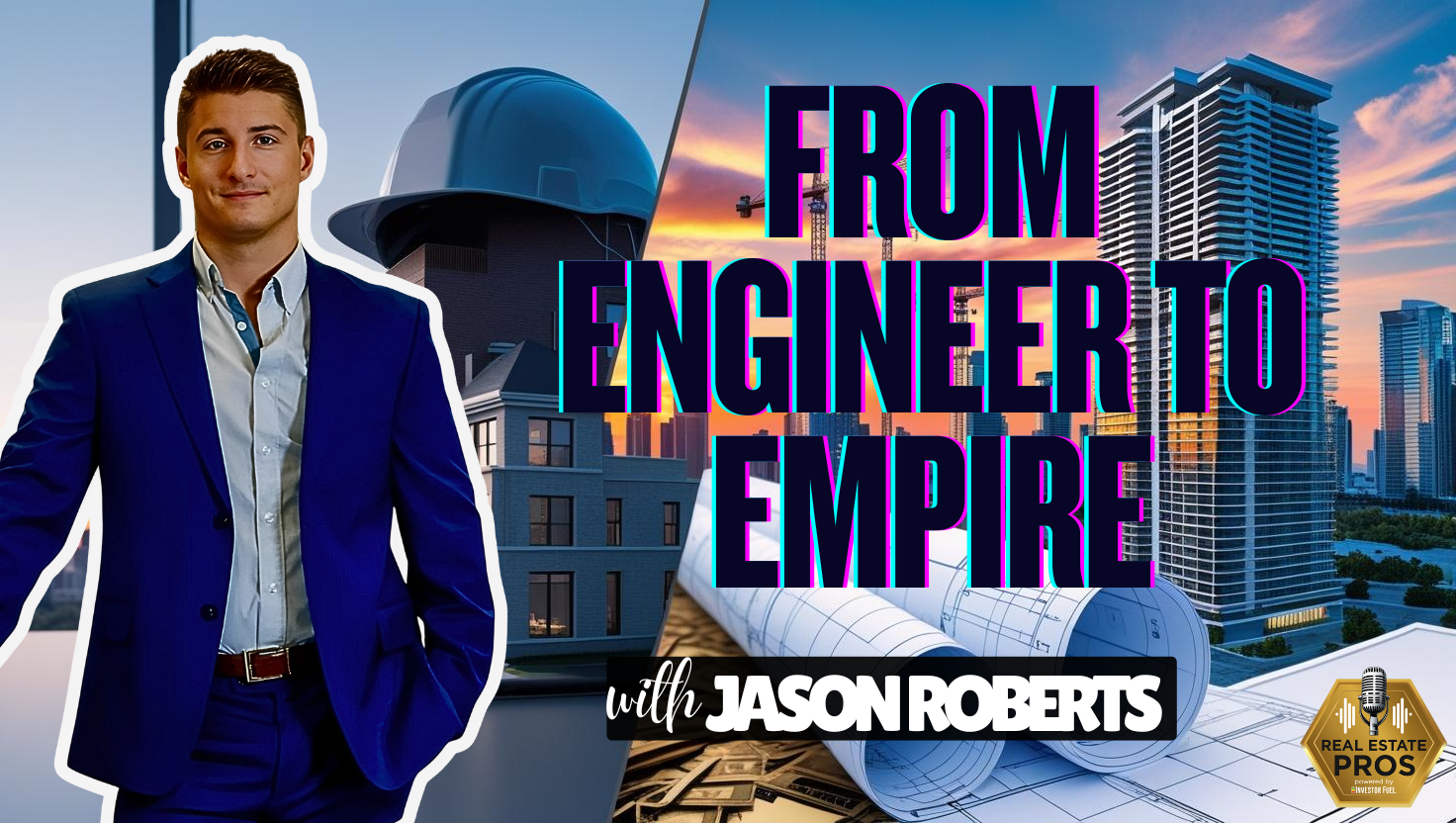
In this episode, Jason Roberts shares his journey in real estate, emphasizing the importance of mentorship and empowering others. He discusses the challenges faced in flipping houses and the lessons learned along the way. Jason also outlines his future goals, including scaling his business and launching a national mentorship program.
Resources and Links from this show:
Listen to the Audio Version of this Episode
Investor Fuel Show Transcript:
Jason Roberts (00:00)
I was making good money as an engineer and was trying to find a way to not retire when I was 75 years old, And so I started, you know, searching through a variety of different, And one of those, you know, being real estate, and very quickly realized like, oh, you can, you can make a lot of money in real estate. If you’re doing it well, if you’re structuring it well, you’re not reinventing the wheel. You’re not gambling on some new widget. You’re not, you know, throwing a ton of money at something that we don’t know if it’s going to make a return or not.
I think we made 400 grand our first year and that was amazing. So that was a huge turning point for us, for our family, for us to figure out how we were gonna create stability and transition.
Quentin (01:46)
Hello everyone, welcome to the Investor Fuel podcast. I am your host Q Edmonds and y’all know my tagline. I’m always excited when I come on here. I’m always excited when I have somebody here who is, just has a wealth, right? Just has a wealth of knowledge that’s going to bring you so much different value. And I’ve been talking to this guy and man, he, he, they’re just, they’re doing things, man. They’re doing things the right way. And
And I just cannot wait that, of course, making major moves when it comes to real estate. This guy, man, got wholesale, broker, investment, mentoring program. Like he has really positioned his business in the right way to really, really help the people that he’s serving. So I am so happy to introduce you guys to Mr. Jason Roberts. How are you doing today,
Jason Roberts (02:41)
I am excited. Thank you for having me. It’s a pleasure.
Quentin (02:43)
Yeah.
No, absolutely, man. Absolutely. I’m excited for them to hear what you got going on. I know people are to get a ton of value out of this. so listen, I want you to be the star of the show, man. So if you don’t mind, I just want to dive in. I think our listeners will love the different way you are approaching business, the strategy you’re making. if people, know, maybe they just
hear about you for the first time. If you don’t mind, just give them a short version of what’s your main focus these days. And if you don’t mind, tell them what markets you’re operating in.
Jason Roberts (03:23)
Yeah, absolutely. Again, I’m Jason Roberts. I own a company called Better Blueprint Realty and we’re Denver based, Colorado based, and that’s the primary market that we’re serving. everything that we focus on is investment real estate or luxury real estate. And we’ve got a few verticals in that space, but that’s really the market that we’re trying to serve.
Quentin (03:45)
Absolutely, man, absolutely. Got different things going on, I love. I, you know, we was talking on the back end. I don’t want to give them all the secrets to your songs. So I’m gonna throw some stuff out there and if you want to elaborate on it, I’ll leave it to you. But I love how you are, you know, better blueprint reality, right? You got things going on on the broker side. You have things going on on mentoring programs. Like you’re helping people.
be able to make real moves and build strains of income. So tell me a little bit about your process a little bit.
Jason Roberts (04:18)
Yeah, think, you know, I got started my my background’s engineering, right. And so
I was making good money as an engineer and was trying to find a way to not retire when I was 75 years old, you know, and have some ownership over my income and my life. And so I started, you know, searching through a variety of different, you know, investment mechanisms. And one of those, you know, being real estate, we looked at everything crypto, gold, mutual funds.
real estate and very quickly realized like, oh, you can, you can make a lot of money in real estate. If you’re doing it well, if you’re structuring it well, you’re not reinventing the wheel. You’re not gambling on some new widget. You’re not, you know, throwing a ton of money at something that we don’t know if it’s going to make a return or not. You know, we’re very much in the lean entrepreneur mindset. So we started flipping properties in 2021,
you know, and
the first project that we ever did. I geez, I just see my contractor on that very first job. took much longer than we anticipated, but we still came out on the other side making 40, 50 grand and immediately jumped into four more flips. So at our peak, you know, we were doing about 20 flips a year and we’re averaging about 120 K net profit per project. But that was my introduction to real estate. You know, very quickly, my wife and I kind of looked at ourselves cause we were
doing this while still working at another job full time, right? This was just a side gig for us to try to figure it out. And we’re like, it probably doesn’t make sense to stay at this W2 job anymore. I think we made 400 grand our first year and that was amazing. So that was a huge turning point for us, for our family, for us to figure out how we were gonna create stability and transition.
And that just led to…
diving deeper and deeper down the rabbit hole in real estate in general. You know, after two years of having my real estate license, I was able to open up better blueprint realty, which is our brokerage, which focuses on investment properties and luxury properties. And then we just started building these different verticals, you know, like, how do we find more deals and how do we find better and more profitable deals? Well, let’s go build a wholesale business and acquisitions arm, you know, so that we can get the best deals for ourselves.
Okay, well, what about the deals that we can’t take on? Well, let’s dispo those. Okay, well, we’ve had some really good success over the years, and our life is completely different. And you know, you can make 100 grand in four months and then kind of sit on the sidelines the rest of the year. How do I give back and, you know, teach other people how to do this? You know, my my passion in life in a lot of situations, I’ve had a very rough upbringing, a very rough, you know, initial set of years. I love connecting with people that
are real and are struggling and are trying to figure it out. How do we get them knowledgeable to where they can find some success and ownership in their life as well? So we started a mentorship program then to teach people how to flip. And that’s been mainly in the state of Colorado. But we are now launching that nationally with multiple products. So we’ve got these three or four arms, the wholesale business, the real estate brokerage, our own investments, which are flips, Airbnbs, multifamily.
And we’re now transitioning out of flips and just kind of leveling up our business to where now we’ve put together a private equity firm. We’re starting to go after a 40 lot new construction development. We’ve got all the partners in place for that. And the thought process there is just, know, hey, instead of doing 15, 20 projects a year, let’s do one bigger project over three years. And maybe that’ll net us five to seven million. But that’s kind of a natural progression for us there.
And then obviously we have the mentorship side of this. So all of these are different verticals of the same business that we all love is, you know, investing in real estate and they all add value to either our mentorship either to us or just adding profitability as a portion of the leg of each part of the process. So we can kind of control and not rely on any other business for our success, not rely on wholesalers for our success, not rely on contractors for our success. How do we
How do we take ownership over each one of those pieces and phases of the project?
Quentin (09:27)
And I absolutely love that. And in that climate, it’s not always easy, right? Because some people are just more about themselves instead of empowering somebody else. And so if I got that right, that you want to empower people, what is it that keeps you kind of motivated to do that? And how do you keep things running smoothly while empowering somebody else?
Jason Roberts (09:48)
Well, running smoothly while empowering other people is a challenge. Staying motivated to empower other people is not right. Like seeing the success stories and seeing people kind of break away from the daily grind and have like now a really clear vision for like, they can become a millionaire or they can have enough passive income to to achieve their goals or they can retire in the next five to seven years. Like that’s that’s really powerful and giving people the tools and they got a grind. They got to learn like this is.
Quentin (09:52)
Mm-hmm.
Jason Roberts (10:51)
Not an easy process, you know, but that’s fun. So that’s life giving for me. I think, you know, the relationships and the friendships that we’ve built from that have been amazing. know, most of all of the agents at our brokerage have all gone through this program first and then are like, you know, we love what you’re doing so much. We want to be a part of it. And they’ve joined kind of full time after that. So it’s been really cool to build those relationships, those friendships.
⁓ You know, in terms of trying to get everything to run smoothly while all that’s happening, know, business is hard. You launch four verticals as well that exacerbates it, right? So there’s always an issue in terms of staffing appropriately and having the right people in place and hiring appropriately and just having bandwidth. But I feel like that’s kind of the masochistic side of entrepreneurship in general, right? Like you gotta be willing to put that type of effort and energy into it and not… ⁓
Quentin (11:39)
Hahaha, yeah.
Jason Roberts (11:46)
know whether there’s gonna be a payoff at the end of the tunnel here. But at the same time, I think if you structure things well, if you structure it to where everything that you’re doing is very high margin, you’re not creating a ton of overhead and everything else like that, you can see immediate results from each venture, each arm, each piece of the puzzle here rather than.
I’m gonna go take on $400,000 of debt and bet on this marketing plan. And then if it works, it works. And if it doesn’t, that’s a huge issue. we’ve been very, I think, strategic in terms of how do we go about launching these things in ways that they’re making money from day one, so that we’re not winding up in trouble on the back.
Quentin (12:27)
I love it, man. I love your realistic approach. I love having people like you going that just, that keeps it real, keeps it authentic, that tells like just the realness of it all. You know, every day is not, you know, every day is not strawberries and rainbows, right? But we got to keep pushing through because, you know, eventually if you keep going at it and you come at it with the right heart and with the right mindset, eventually things work itself out. And that’s what it sounds like it’s doing for you.
And I’m gonna dig a little deeper, man, if you don’t mind. would love, you know, things get real. Sometimes deals go sideways. You got a pivot fest. You mind sharing one of those stories on your end that maybe that happened to you when you had the pivot kind of fest?
Jason Roberts (13:09)
I mean, we live in the world of flipping, my friend. That’s the reality, unfortunately, that we deal with, right? you know, we’ve had a number of deals where we had to learn. We had a couple of people that taught us along the way when I first got started. You know, I joined a small investment-based brokerage that had some experience in this, but we had to learn a lot of our lessons the hard way, which we’re hoping other people don’t have to do. But the very first project I took on, man, it was a
you know, cosmetic flip, we bought it at 400 grand and the plan was in eight weeks to get it turned around and sell it at six. And it just so happened that we bought it, you know, kind of right before the market started to turn in 22. So if we were late at all, you know, hindsight as if we got delayed at all, the pricing in the market and everything was going to start to change pretty quickly. But, you know, my, my employer,
was the person that started this brokerage was an agent and an investor and a general contractor. And they started this firm together and they were the ones that owned it. And they helped other individuals with flipping and they flipped a lot of properties themselves. And so we picked up this property and we analyzed it with them and they’re like, yup, looks like a good deal. And one of the owners was going to be the general contractor for it. Great. Like we’ve got a teammate that we can count on and rely on to do this project with us. And
We got into the process and again, it was probably $40,000 on the interior remodel. And then we had some structural damage that needed to be done. you know, four weeks go by and not a lot’s really got done. And I’m really scratching my head and I’m starting to kind of push back and be like, what’s going on here, guys?
Like I’m not seeing the progress that we were promised. Oh, well, we’re just really busy. We’re not behind. We can get this done. We can get it pushed through. No worries, right? I’m an experienced. No, I don’t know.
and these guys are 15 at a time. So they’re doing some volume. Then we get, after four weeks, they finally demo it. And then it sits another four weeks. So now we’re eight weeks in and all that’s happened has been, this has been demoed and that’s it, right? And I’m, at this point jumping up and down, like all the red flags are going on in my head. I’m worried that we’re at all this carrying cost that’s gonna take us under. And…
Eventually, had to, had a business partner that went in and provided some funds on this. We had to put together a demand letter and sue our contractor, who is also our employer, ⁓ which puts me in a really tight spot. How do you manage keeping a relationship intact while also just being very plainly like this is not acceptable and this is not working? So we filed that lawsuit and
Quentin (16:18)
Hmm.
Hmm.
Jason Roberts (16:37)
Fortunately for us, that demand letter, that lawsuit worked in our favor. It scared our contractor enough to get him to move forwards and to get this thing done. But you know, our very first project, our very first intro, we were supposed to make 80 grand. We made 40 instead. We were lucky to get out and be profitable on that project. But you you’ve learned very quickly, nobody cares about your projects more than you do. And you have to take initiative early and often and on a daily basis. Otherwise, things are going to slip.
And you’ve got to catch them in that two, three day timeframe, not that two, three, four week timeframe. Otherwise these projects are not going to work out.
Quentin (17:13)
Yeah, man, listen, thank you for sharing that. That’s the stuff people are not talking about these days. This is the honest transparency, the realness that comes with the business. And so I thank you, man. I thank you for sharing. This is the kind of stuff, the difference between people that’s just dabbling in it and people that’s going to be in the game for the long term. And so I appreciate you sharing. How about this? What are you next focused on solving?
What’s the next scale? Like what’s your next real goal?
Jason Roberts (17:45)
Yeah, I think our next real goal is kind of twofold, right? We’ve got all these bases, quote unquote, set up and I think set up well. And the mentorship course, we’ve just spent seven weeks filming in studio. We’ve got a starter kit, a main course that focuses on teaching people how to build, you know, six figure net profit flips consistently, and then a fast track coaching that teaches people how to
scale that business to two, three, five at a time and really become seven figure earners. And that’s something that we’re launching nationally right now. So I think going out and competing with Pace and with Grant and with these big boys in terms of marketing and in terms of, you know, social presence and digital presence, that’s kind of been our big next focus is going out and building just that attention and spreading that message as well as
getting this private equity firm in place so we can take on this next big project ourself, as well as scaling this brokerage, man. I I believe in the value that we’re offering on this brokerage so much. I mean, there’s five streams of income as an agent in our brokerage compared to just one for everybody else. So getting the right people in place to scale that to where we can get 50 to 100 agents underneath us in the next 12 months.
is another kind of big venture for us. So those are the three big things that we’re focused on. I would say immediately is that mentorship program because we are pushing that nationally right now and we’re really in the trenches on that. But man, it’s such a cool product and it’s great to finally see it come to life here.
Quentin (19:27)
Absolutely, man. I love it. You know, as you’ve said, you know, on numerous occasions since we’ve been talking, listen, we got, we got four branches here. We got the investing, we got the brokerage. We have, you know, we’re investors ourselves. We got the wholesale. You’re doubling down on the mentoring program. Like, hey, we’re building this thing. You want to scale the brokerage. So I think you know, probably more than everybody, like the next move, it can either compound things or create chaos, depending on how you play it.
think you probably know that better than anybody. And so for the people that’s listening, they’re at different places of their journey. They’re looking to level up. And I think they have benefit from hearing this when it comes to building relationships and growing your network, which made the biggest difference for you.
Jason Roberts (20:31)
I think for me it’s, and it’s hard, especially as you start to kind of grow in this space, but just being authentic and being observant and wanting to learn and grow, like not having that ego that says, I know everything. You know, this is a space that’s been around for hundreds of years, right in the U S and there’s so many different strategies out there and there’s so many people doing it.
at a higher level and no matter what level you get to just about there’s always going to be a higher level. But you know if we can offer value if we can in earnest try to learn or offer value to those individuals that are around us as well and just talk strategy. mean I think that’s been a really powerful mechanism for just building those relationships because.
You can ask a ton of questions and that’s one thing, but how do you offer value to the person sitting next to you? ultimately, how do you work together with the people that are then better than you or at a similar level to you? And how do you improve your skills together? So we talked about this offline a little bit earlier, but everybody that’s joined us, we’ve kind of rigged the game in their favor, right? Like if they want…
to work with us, they have the opportunity to go make two, three, 400 grand by doing so. And so like as an employer, I think putting together a system or a structure that allows individuals to kind of eat what they kill, like they can make an unlimited income, like that is really powerful and it de-risks us. Like it’s no overhead costs for us now because it’s more performance-based.
But just from a relationship perspective, man, I think as much free value as you can give away, as much collaboration as you can, you can create and the less ego that you know, still make sure that you’re, you’re presenting, Hey, we know what we’re doing. We have, we have a lot of strategy here. We have some experience. Like we’ve looked at it from this angle on this angle. What do you think about these angles? Right. But
Quentin (22:20)
Mm.
Jason Roberts (22:40)
leaving that ego out of it, think really does just help and opened up the doors to maybe there is some ways that you can work together on those things. And I think, you know, for example, we started this arm to go out and build this subdivision and we just started hunting for strategic partners like, hey, who is a bunch of people that have done this at this scale? They’re not national home builders.
but they’ve done it at this scale and how do I go be humble and ask them a bunch of questions that I don’t know anything about? Okay, now we’re building our financial model and our deal analysis. Let’s go run this by some people. And you learn, you know, both for the good and bad. Like some people that have done this at a really high level of success had no idea what they were doing. And you’re like, man, I have no idea how they made that work. But then at the same time, there’s other people that have so much knowledge that you’re like, man, I’m not even close.
Quentin (23:33)
Yeah.
Jason Roberts (23:33)
And
so I think it helps calibrate you too, in terms of like, how much risk am I taking on? I, I jumping way out over my skis or am I on the right path? And I just need to continue to take initiative and be aggressive.
Quentin (23:46)
them. Now, man, so, so well said, so, so well said. Relationships are everything in this space and to be able to build them without the ego, build them, you know, with humility and build them, you know, even with a sense of reciprocity, right? Like, you know, there, there is a give and take. We both can bring value to this relationship. And let’s talk about how that looks. And so I think that was so very well stated.
So right on stage. Well, listen, Mr. Jason, listen, before we wrap, if someone wanted to reach out to you, connect with you, maybe collaborate, they like what you’re doing, and what’s the best way that they can reach out to you?
Jason Roberts (24:29)
Yeah. You can look at better blueprint, realty.com, better blueprint, investments.com and better blueprint academy.com, or you can find us on Instagram at better blueprint, realty. And you can get through any of our channels at that point. I’m really easy to reach. Probably a little too easy to reach, but anybody can reach out to me through there. And we’re pretty quick to respond.
Quentin (24:50)
I love it. Well, there he is everyone. Mr. Jason Roberts. Listen, I thank you for your time, your story, your perspective. We definitely need people, more people like you within this space that’s doing it the right way, just like you’re doing it. So again, sir, thank you so much for your time and being with us today.
Jason Roberts (25:09)
Thanks for having me. It’s been a pleasure. Excited to see what this brings to your listeners and hopefully get to connect with somebody who wants to improve their journey here a little bit.
Quentin (25:21)
And listen, for those tuning in, if you value what you’ve heard, please make sure that you are subscribed. You do not want to miss out on these amazing conversations, just like the amazing conversation I had today with Mr. Roberts. So until the next time, we’ll see you.