Subscribe via:



Show Summary
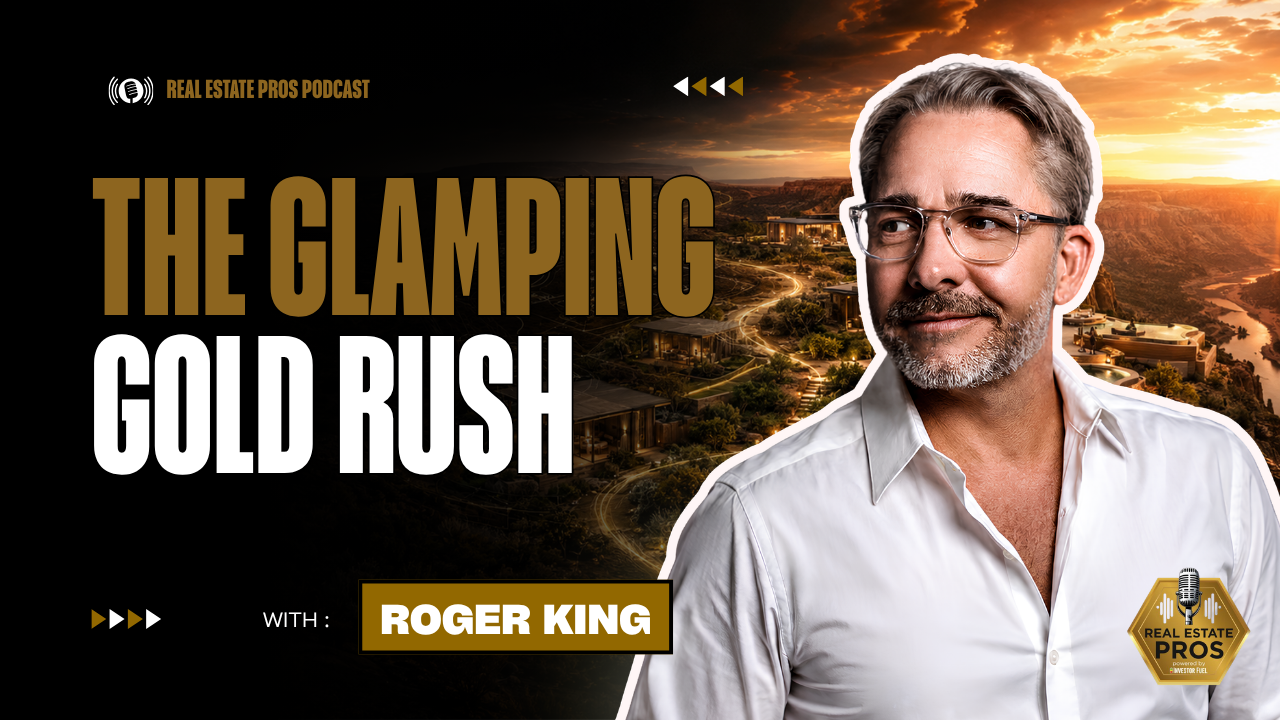
In this episode, Roger King shares his journey from a jazz musician to a real estate investor, focusing on his innovative eco-luxury glamping resort project and insights into real estate investing during uncertain times.

Resources and Links from this show:
Listen to the Audio Version of this Episode
Investor Fuel Show Transcript:
Roger King (00:00)
For people who have not started investing yet and are listening, you’re gonna need to get your feet wet. And for those people who have been investing for a long time, congratulations for staying in the game. It’s not easy. I don’t really see there’s anything as a quote unquote passive investment. I’d say that you need to do a bunch of due diligence if you’re gonna place your money with somebody.
Whether it’s Merrill Lynch or, any of the big banks, or if it’s going to be, a fund that you meet on a podcast.
Cody Crabb (02:00)
Welcome back to the Real Estate Pros podcast by Investor Fuel. I’m your host, Cody Crabb, and today I’m joined by Roger King. Roger is a longtime real estate investor with experience across everything from fix and flips to mobile home communities. And today he’s focused on building an eco-luxury hospitality platform. Roger, welcome to the show. Thanks so much for coming.
Roger King (02:20)
Thank you, Cody. It’s a great to be here. Thank you.
Cody Crabb (02:22)
Yeah. So just to start us out, you told me before we started recording here that you’ve been investing for 30 plus years. What pulled you from traditional real estate into this experiential hospitality real estate that you’ve kind of narrowed down into?
Roger King (02:38)
Yeah, I think it’s a, pretty logical pattern. We we’ve got to start somewhere. And because I didn’t start off with a finance degree, so I couldn’t go to any of the big firms in New York or San Francisco or Los Angeles or Chicago, I started off as a professional musician. And so I really
Cody Crabb (02:55)
It’s
like you how people do, the traditional real estate path, yeah.
Roger King (02:58)
Right. Very traditional, right? I if you don’t have, a master’s from Stanford, you gotta start flipping houses, right? So I started wholesaling and flipping houses back in 1996, down in Orlando, Florida. And, it’s been a natural progression of let’s, get our first property under contract, let’s fix it, let’s flip it, borrow hard money, take a loss or start doing lease options or
start to renovate and rehab larger properties. And then that morphed, into the mortgage industry in 2006. And then we have the crash in 2008. And you go through all these different cycles and you just learn all this stuff. And then you start to really focus what is it you’re looking for? And when I was in the fix and flip model or the wholesale model, I was just churning. I was just going for the next deal so I could get some cash and then.
Parlay that into the next thing. And after I fixed and flipped a bunch of homes and I started private lending and then started partnering with folks. And I really discovered that, not only do I want to do that sort of transactional thing a little bit less, right? I also want to build those long-term cash flow plays. And that is, the really the reason I started in the multifamily and then into the mobile home communities that we started buying back in 2018.
And after getting into a bunch of those, you just start to get these opportunities and you start to look at some of the metrics and some of the, different purposes for what cash deployment can bring and why you would do this versus that. And so I’ve just been growing and exploring and different things. And the eco-luxury glamping is really where I’m focused right now.
But I’m also focused still on developing our mobile home community because I really enjoy this idea of, how do we, capture the top of the market? Luxury hospitality is really on a boom right now. But I also see that there is a safety net, if you will, in these mobile home communities. Affordable housing isn’t going anywhere. In fact, I projected it’s going to increase.
Over the next decade. And I, having been in it for nearly eight years now, I think that our thesis on that has proved itself based on our returns and our, equity growth. So I’m really exploring, the this differentiation between the two markets, the luxury and the afford
Cody Crabb (06:10)
Yeah. You’re kind of finding you’re kind of playing both ends of these spectrum the spectrum. So I think it’s interesting. So what do you what do you think is driving each end of the growth? I mean, because these are two very different things, but at the same time, like they’re and the crowds that they’re servicing are not really the same either. So I’m just curious what you what you’re seeing there.
Roger King (06:29)
Well, it’s harder right now than it has been to live right now in the United States in particular. And I’m seeing that the this displacement is causing these market shifts. I think everybody’s seeing it, right? The richer getting richer, the poor are getting poorer. I mean it’s a pretty standard saying through millennia.
And I’m just trying to figure a way to best protect my investors. And I see that playing the spectrum, the ends of the spectrum is really, sort of the safest play. And how can you hedge the bet on the luxury with the affordability or vice versa? And that’s really, this is my thesis. Like play both sides of this because they’re both likely or like more likely to win. And that’s why I’m, really taking that approach.
Cody Crabb (07:17)
Yeah, I think that’s cool. That’s a cool way to look at it because I think there’s just people can say all the things that they they you can follow the textbook line by line and then COVID happens. I mean, I just know there’s no there’s no possible way to know what’s gonna happen. And even if you do everything exactly right, sometimes you invest right before two thousand eight and you have the market crash. So yeah if that divide keeps widening the way you expect.
I mean, what does it actually mean for the opportunities for each side? So like specifically, you said it’s gonna grow, but like what changes for your mobile home communities? What changes for the luxury hospitality stuff?
Roger King (07:53)
Well, I think what it does for both sides really is it provides opportunity, right? That if you have the capital and the experience to buy more, then you can create leverage for investment. And that leverage, everybody’s always looking to invest money. Every year, independent of interest rates or the economic system
what we’re doing right now economically in terms of policy doesn’t matter. Everybody’s got money to invest. Sometimes they’re less shy. Sometimes they’re more shy. They’re bullish. They’re bearish. But everybody always has capital to invest. And that experience is really what’s gonna, set the difference for people over the course of the next 10 years. I’m 58 now. I don’t see myself, actively investing.
much past year 12 from now. I I’m hoping that by the time I’m 70, I’m in a better spot that I can just say, okay, let somebody else do all the hard heavy lifting. But I think that the experience is really what’s going to set it apart on both sides.
Cody Crabb (08:57)
So tell me a little about this experiential, you said this is a very specific is something you’re passionate about. I’d love to hear a little bit about this for someone who that caught their attention. Tell me a little bit about how it works and what it actually looks like.
Roger King (09:09)
Well, about four years ago, I bought into a minority ownership stake in a hospitality asset on the Brainerd Chain of Lakes up in Minnesota. And I’ve really enjoyed my partnership on that. And I’ve seen the pluses and minuses for that size and that type of property. It’s not a high-end luxury, but it’s not, a low-end luxury. It’s definitely a middle class luxury where people have been coming to this particular
retreat for the last 80 years. And so there’s something that’s baked into the the personality of those folks that have, hey, we just spend, a week or two on the lake and we go to Heath’s Resort. And I love that. They’ve created part of their family history as part of that. And that really stuck in my brain is like, how do you really create something that is so memorable?
That people come back year after year after year. And then how do you
Cody Crabb (10:04)
At that point.
Roger King (10:05)
It’s a tradition? And I just love the idea that you can create an environment that people love to be themselves and they just come back generationally. And that’s really what I want to attract. But I’m also, experienced enough to know that, the middle market isn’t the quote unquote best market right now. Maybe in 15 years it
may be. But right now I would say that the ultra-luxury model is really what’s most enticing, both from economic standpoint, but also from where the nation or well, a portion of our nation’s population is headed, right? More and more millionaires, centimillionaires, billionaires are just amassing this wealth.
And they don’t normally have a place to stay that is they’re matching economically. They could stay at a lovely, chain hotel that’s, four or five years old, but that’s not the stay they want. And so the idea of putting it up at these national and state parks around North America just makes the most sense to me. And that’s what we’re focused on primarily right now. It’s been great.
Cody Crabb (11:13)
So give me an idea of like what are the what does this one of these actually look like? You say it’s you use the word glamping, but I mean that can mean so many things. So like in your mind, like what is this what does this kind of look like?
Roger King (11:22)
Well, I would say that it’s not truly it’s not a tent. It’s not a wagon with a, canvas top on it, right? These are actually cabins. I use the word glamping more as a marketing ploy, if you will, because I think that a lot of people will say, hey, what is glamping? It’s glamorous camping. And the property that we’ve identified and we’ve got here in Southern Utah is just a spectacular place that nobody is really providing this type of service and I think it’s a really rare site we’ve got 20 mile wide canyon views and we have a cabin design that we’re gonna refine of course with our architecture firms and what they’ll do is really provide that adventure but the luxury so luxury adventure travel
This is who those folks are designed for. You get the sheet count, right? The outdoor shower, the but the also the spa, a truly luxury stay.
Cody Crabb (12:19)
Mm. It’s interesting because when you think of it like the term roughing it, just means camping. Like it actually just means going camping. But I mean I could see I could really see this appealing to like, I don’t know, I was just mentioning before we before we got on here, like my wife is like very much like I love outdoors, I love doing stuff outdoors, and I am so not like that. But I could be convinced to do something like that. I mean, that’s it’s a whole new demographic of people that probably wouldn’t have gone camping, that maybe would be
open to something camping adjacent or something like that. So yeah. Especially in a location like you said, it’s in Southern Utah, which is you’ve got this gorgeous outdoor possibilities. I mean, it’s in a desert, you can do it year round. There’s so many things that go into that. So if somebody’s interested in this kind of investing in something like this for themselves or where they are, what sort of things should they keep an eye out for where they are that make it a good fit for something like this?
Roger King (13:53)
That’s a great question. I would say that, you have to have some idea of place. I hear that phrase thrown around, but I do think that it accurately describes what we’re trying to do. And if you can take an environment and add to it and create some benefit to the land.
But the land being the primary benefit, if that makes sense, how do you really, how do you really take the land and just put a little accent here and there to open up and invite those folks in? I would say that really has a massive impact. One of the things that I’ve discovered in, fixing and flipping 180 houses is the houses with the best yard or the best view always sell fastest.
And I think that translates to just about everything. If you have some place that is magical in some way, you’re gonna have people that want to come back and find that point in themselves and relax and to help them calm down because we’re just so connected. How do we disconnect but still have the luxury, but still have, some of the amenities that we’ve come to enjoy?
Cody Crabb (15:04)
Yeah.
Roger King (15:04)
I think that I think that other investors really need to find those types of places.
Cody Crabb (15:09)
Yeah, I think you hit it the nail on the head there. I think you I mean you use the word magical. How do you know when you’ve actually found that? I mean, what makes you walk onto a piece of land and say, Yeah, people will come here? I mean, are you just are you a particularly avid outdoorsman that you’re like, I know what people want to see? I mean, I’m just curious what is it that you see that what are you seeing that I’m not probably a better way to put that.
Roger King (15:31)
I don’t even know that I’m right. I’m smart enough to know that I’m not as smart as I think I am. Okay. So I know as a Capricorn that I have logic. And if I can pay attention enough to myself and how I feel on a piece of land or in a house or an apartment building, I have a sense and I’m, still developing this, intuition.
sensibility and saying, okay, just listen for a minute. What’s coming in? I know it sounds woo-woo and I’m okay with woo-woo. I’m 58. I’m really into my I don’t care anymore phase. So I think that we know these things if we just can listen for a minute. And when I stepped onto this land, I knew instantly, wow, this is magical.
And I use that word. I like it’s not even a word that I comprehend much anymore. But it truly arrived to me that way.
Yeah. I have a limited word of magical or wow or just stunning, and none of it does it justice. When you get on the land and you listen for a few minutes and you hear the breeze and you just shut everything off and you’re there and you’re looking 20 miles away to the other side of the canyon, and you’re up at seventy-eight hundred feet elevation, and you can calm yourself.
And you can distance yourself, you’re gonna see it. You’re gonna feel it. You’re gonna know it. And can you do that at the back of a house when you’re looking at a swimming pool that’s been, degraded for four years, right? As a fix and flip. I think you can.
Cody Crabb (17:02)
True. I I suppose you could do it sitting at a desk in a cubicle if you really are good at it. But I yeah, I think I you hit I you really hit on something there, which is I think yeah if you’re able to do that yourself, then you’re can then logically you’re like, well, I’m not gonna be the only one. Like this is gonna feel special to somebody. I and like maybe not everybody, maybe not everybody’s gonna agree with me.
But to me this is something special. So I feel like other people will too. So there’s a yeah, there is a little bit of intuition in there. Like you’re kind of just going on gut stuff.
Roger King (17:34)
Well, the people that have come up onto the site with me, they all say it. They’re like, yeah, this is just an amazing view, an amazing vantage point. So let’s do it. Let’s build it. And to me, that just reinforces that I’m not as crazy as I may also believe I am at times, that something in my psyche is saying, okay, you’re right.
Cody Crabb (17:56)
Yeah, external external validation. They’re actually saying that there’s something to it. Yeah. Right,
Roger King (18:00)
Social proof.
Cody Crabb (18:02)
So after thirty years, I mean, you’ve done all types of real estate here. What do you where do you think what experiences of yours have changed your decision making the most? I mean, what do you look at today that you see very differently than maybe twenty years ago?
Roger King (18:17)
Yeah, that’s I know that I’ve had my teeth kicked in quite a bit. I’ve partnered with the wrong people more times than I want to admit, but I will admit. I’ve believed in people. I have trusted people. I’ve believed that people were my friends that ultimately had no intention of being friendly and became adversarial.
So I think that, how do you discern more quickly? And that’s really the biggest lesson. How do you discern who is, the right person for you? Do they, have they conducted themselves so badly with other folks that, there’s some reputation stuff like hinting? can you pay attention to any of that? Have they been involved in,
frivolous lawsuits that they’ve, lost or have they gone to jail even? I would say that all of those things are warning signs. It’s not me it’s not the end all be all, but yeah. Right.
Cody Crabb (19:12)
It I always say kind you want to find like the guy that’s like my mom’s mechanic. I always talk about this. She he she would do anything he said. Like if she if he was like you need a whole you need to rebuild the whole engine, he’d be like she’d be All right, and start break out the checkbook and start. But he’s like, Go home, your car’s fine. It’s fine. Just it’s good, it’s fine. And I will go to I go to him now and I will go to him forever because I I trust that he’s not gonna take advantage of somebody. But it’s to but that
goes so deep because now it’s like if he told me anything, like if he recommended someone else to me, if he was like, I have a guy that could look at your HVAC, like I would trust him through anything. Yeah. So it just as easily as trust can kind of fall, it can also be pretty simple to build it up. So I think you kind of have to keep an eye on the small things, both positive and negative.
To really see, although that’s impossible. I mean, it sometimes you’re just gonna get bamboozled and there’s no way around that. You gotta just try your best. And but it sounds like you’ve had some mistakes or some missteps, or even just some things that both happened to you. Yeah. And it sounds like you’ve kind of learned from those and been able to kind of take advantage of the lessons that they’ve taught you.
Roger King (20:20)
Well, I mean, I really feel like that’s our purpose, right? We put ourselves in these situations, we win or lose. And if we quote unquote lose, we need to win still. And that’s through gaining the experience. And I don’t see it as a loss. I see it as, man, I wish it didn’t happen that way, but I value what I’ve learned from it. And I’m a much better investor at fifty-eight than I was at 48, certainly than I was at 38. And
that’s part of my path. I don’t know of another investor who’s not ever had some, catastrophic thing happen to them. Whether it’s losing $50,000 when your portfolio is only worth $25, or if it’s $10 million. Or I even look at the guys that invested with Bernie Madoff. Smart, intelligent, experienced people. And even they got bamboozled.
So I don’t think it has anything to do with intellect necessarily on its own. I think it has to do with, how well can you assess, how well can you, trust. But we’re investing. Nothing is guaranteed. One of the stories.
Cody Crabb (21:25)
So yeah.
Roger King (21:27)
One of the stories I talk about is my father, back in 1980 started investing in real estate when he was buying these houses and then selling the notes to these.
We’re selling the houses on owner finance notes. And then they changed the tax laws in 1986. And he lost everything because the capital gain tax said, you need to claim all of your capital gain this year. He’s like, I have no capital gain, but I on paper, and of course he lost everything. And so it wasn’t necessarily his fault, but it took him out of the game for a while. And that’s how do you deal with that? You just gotta.
Cody Crabb (22:00)
Good example of like you could do everything right and then just look at AI. This is kind of in general example, but like you could be the best copywriter in the whole world and then one day, whoops, there’s a robot that can literally do it better than you possibly ever could. Like it one day to the next. And so yeah, it’s you just because we don’t ever know for certain what’s gonna happen or how things are gonna happen or who to trust or whatever, I think we just kind of have to operate on
the best information we have, like do our part, do the due diligence, but at the end of the day, we kind of just have to move forward anyway, because there’s no avoiding some of that stuff.
Roger King (22:34)
Yeah, it’s true. And for people who have not started investing yet and are listening, you’re gonna need to get your feet wet. And for those people who have been investing for a long time, congratulations for staying in the game. It’s not easy. I don’t really see there’s anything as a quote unquote passive investment. I’d say that you need to do a bunch of due diligence if you’re gonna place your money with somebody.
Whether it’s Merrill Lynch or, any of the big banks, or if it’s going to be, a fund that you meet on a podcast. I would say you have to do your due diligence and that’s the main work you got to do. And you’ve got to check on it every quarter. And call the principal, if you can, or your at least your contact, and just stay up to date. And I think that that’s really important for people.
Cody Crabb (23:16)
Okay. So tell us a little bit about what you’re working on right now. What you’re excited about, what’s kinda happening for you right now.
Roger King (23:22)
Sure. Well, the primary focus right now is obviously my eco-luxury glamping resort. I am so excited about it because the market itself is just wide open. There are no luxury stays next to Zion National Park. And to me, that
Cody Crabb (23:37)
What I can I can actually vouch for that. I’ve literally tried to do something very similar to that and I couldn’t find anything. So yeah, I can actually specifically vouch for that.
Roger King (23:46)
That’s not to say there aren’t some nice places to stay there, right? They but there’s just no truly luxury, people want to say it a Ritz-Carlton or St. Regis or whatever, but there’s nothing like that there. And that’s what we’re developing. And I’m truly excited about that. My business partner, he’s built 300 hotels in his career. He’s very experienced in the construction and project management side. And I’m more adept at the
raising capital and deal structure and outreach and putting all of the pieces together with the architecture, with just the vision of the entire property. So that’s really where I’m focusing probably 85, 90% of my time every single day is okay, we’re pushing this forward. And so that’s what’s most exciting. Second to that, we’ve got this mobile home park portfolio that we’re we’ve been building since nineteen since
2018, and we’re expanding for another 2,000 spaces over the next 24 months. Very exciting about that.
Cody Crabb (24:45)
Mm-hmm. So thank you so much for all that you’ve given us today. This has been really great. And if someone wants to reach out to you, they want to get in contact, first of all, who should be getting in touch with you? Who would be the ideal person to get in touch with you and how can they do that? Sure.
Roger King (24:58)
Sure. Well, I think that everybody knows that all real estate developers are always raising capital. So if people are interested to learn more, let’s go to RogerKing.com. You can get in touch with me through that. We’ve got some presentations. It’s really simple to go in and look. You can reach out directly to me there. Check out my Instagram. I’m not a big Instagram guy right now.
But I’m also on LinkedIn and I’m happy to have those conversations, whether it’s you just want to understand the business model, or if you’ve got a question about, something that I’ve said about, flipping 180 houses, or how do you set up a trust to buy a house? Any of those questions are just fun for me to answer. And I’m, starting to be one of the older guys in the business now. And so as a jazz musician,
As a young guy, I always wanted to play with the older jazz musicians. So now that I’m an older, real estate guy, I want to help out the younger generations too. So feel free to just reach out. Yeah, let’s jam.
Cody Crabb (25:56)
Well, cool. Thank you. Thank you so much for all the great stuff you’ve given us. I love episodes like this because we can really kind of hone in on one specific thing. Someone out there is gonna have a really great huh. I never thought of that. And so hopefully that that’s you that’s listening. And so one more time, Roger. Thank you so much for joining us today. Audience, if you liked what you heard today, make sure you don’t miss the next one. And we’ll see you next time. Thanks again. Have a good one.