Subscribe via:



Show Summary
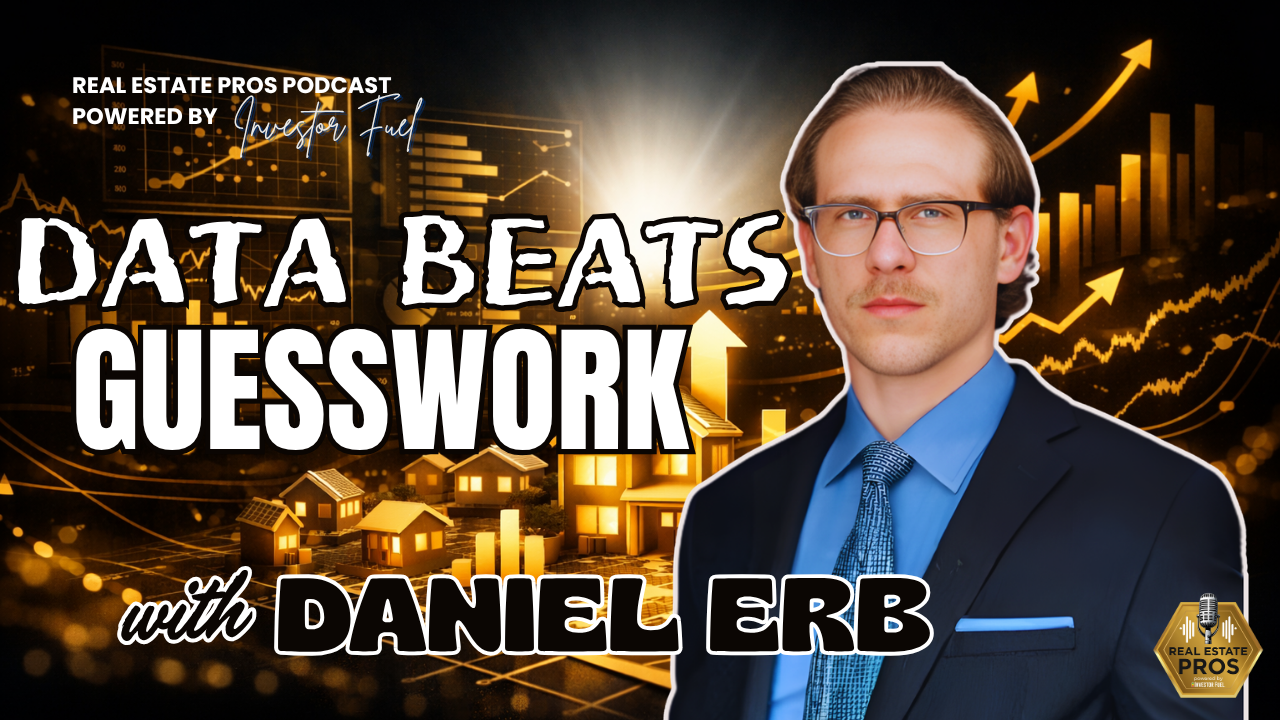
In this episode, Daniel Erb shares how he applies Wall Street rigor to the single-family rental market, discusses his data-driven approach, and offers insights on market strategies, leadership, and building a network.

Resources and Links from this show:
Listen to the Audio Version of this Episode
Investor Fuel Show Transcript:
Daniel Erb (00:00)
it seems like Wall Street is the boogeyman in this housing crisis. And so I find myself ⁓ impassioned with providing some education and giving some data points to people because my greatest fear is as we regulate and take away
large swaths of capital flowing into the space that we’re only going to be in a worse position in five years from now.
Scott Bursey (00:00)
Hi everyone and welcome to the Real Estate Pros Podcast. I’m your host Scott Bursey. And today I’m joined by someone I’ve really been looking forward to chatting with, Daniel Erb, who’s been making serious moves in the institutional finance and single family rental space. Daniel is a bridge between the world of elite high finance and the modern real estate landscape. He has spent years as the lead instructor for Wall Street Prep, mentoring the next generation of analysts.
the world’s most prestigious investment banks. Today, he is the CEO of Strand Capital, where he uses the same Wall Street discipline to identify high growth opportunities in the real estate market. If you want to know how the big money actually moves, you’re going to want to listen to Daniel. Daniel, welcome to the show.
Thanks, Scott. Appreciate you having me on.
Scott Bursey (02:48)
I think our audience is really going to take something away from how you’ve managed to take the high level rigor of Wall Street and apply it to the single family rental market. Daniel, let’s dive in, shall we?
Daniel Erb (03:01)
Sounds good. Looking forward to it.
Scott Bursey (03:02)
So first off, for people
that may not be familiar with your world, give us the short version. What’s been your main focus here recently?
Daniel Erb (03:11)
Yeah, so our focus recently has been on a data-driven acquisition and asset management platform focused on single-family rentals. We target non-coastal supply-constrained markets and do this through a blend of direct ownership or structured capital. And our core objective is to maximize total all-in returns.
Scott Bursey (03:37)
And what markets are you operating in?
Daniel Erb (03:40)
Yeah, so currently we’re in right now growing ⁓ underserved, overlooked, however you want to frame it markets such as Chattanooga, Tennessee, Birmingham, Alabama, and Indianapolis.
Scott Bursey (03:56)
Love it. What caught my attention about you was the way you’ve been able to take the sophisticated modeling you teach at Wall Street Prep and apply it to the single-family rental space to achieve a staggering 101 % growth rate. That’s not easy, especially in this climate. What’s been the key to keeping your machine running smoothly?
Daniel Erb (03:58)
What’s
Yeah, so I think that a large amount of the credit, I would say, goes to the support that we have at Strand. And then as well, a lot of the mentors and colleagues who’ve gone above and beyond to support me as I’ve built this company. I think what you’re alluding to specifically is
the Strand Score algorithm, is something that we applied from our experience on Wall Street. What the Strand Score is, is a proprietary predictive analytics engine that common sizes and ranks all 387 metros across the US for three year growth.
Scott Bursey (05:53)
sophistication. That’s just awesome. Now every operator I know has a moment where things got real. You know maybe a deal, Daniel went sideways or a time that you had a pivot fast. You mind sharing one of those with us?
Daniel Erb (05:54)
multiplication of 2S minus 1.
Yes, I would be happy to. This one actually goes to while I was working in investment banking and trying to do this as a side hustle. Luckily, it was all my money that was invested. I didn’t take on any other investors, but this was an opportunity when the interest rates were 3 % and I was able to secure a 30 year mortgage at less than 3%.
And looking back, there was just such better opportunities. ⁓ Where I think I went wrong was I mispriced risk. I was looking for the easiest possible property to manage. ⁓ And I was really, really focused on how much lower I could buy the property versus its list price. The two problems with that, I would say, is by really trying to
bid down the seller, I may have felt like I was winning, but even at the price we were able to acquire at, which was over 10 % discount to what it was listed, it didn’t quite make sense. ⁓ And the reason why it didn’t quite make sense is because this was a high-end luxury condo where we had zero control over the HOA. ⁓ Our fees and the policies that were written
were not very favorable to landlords and especially out of state landlords. And so through that process, I definitely learned that avoiding risk isn’t necessarily the best way to approach this. And list price, when someone is willing to sell a property, it is not a fair bogey ⁓ that you need to develop your own view on value.
and you need to be confident in the valuation and you almost need to ignore what the seller puts in their list price.
Scott Bursey (08:02)
point while taking. It’s incredible how the moments that feel like a disaster in real time, you know, often become the foundation for the next 10 years of growth. And honestly, Daniel, that right there is the filter. It’s what weeds out the dabblers and defines investors who actually have the staying power to wealthier cycles.
Let me ask you this, what are you most focused on solving next?
Daniel Erb (08:29)
I think what I’m most focused on personally is educating ⁓ both institutional allocators and first time home buyers on the current situation in the housing market. What has led up to this affordability crisis? Why people such as myself, this millennial generation is having such a difficult time.
buying their first home or feeling a part of the American dream. And how we as a country really need to focus on the supply side of this equation and build more single family homes. And that’s just something I’m very passionate about. I’ve experienced personally, and I’ve been able to actually talk a little bit with NPR about ⁓ it through their newsletter, Planet Money. ⁓ And even in that conversation, something that was
You know, discuss that length is just how by buying single-family rentals in nicer neighborhoods, fixing up older inventory, we’re allowing for social mobility for folks that want to live in an area with a nicer school district, but can’t afford to buy a house on their own. And we’re investing in the community.
And so I think that recently, especially there’s just been a lot of ⁓ finger pointing and it seems like Wall Street is the boogeyman in this housing crisis. And so I find myself ⁓ impassioned with providing some education and giving some data points to people because my greatest fear is as we regulate and take away
large swaths of capital flowing into the space that we’re only going to be in a worse position in five years from now.
Scott Bursey (10:55)
and quite frankly, your passion resonates. What’s the next real big goal for you?
Daniel Erb (10:56)
and quite frankly.
Yeah, as a company, we’re launching and scaling an institutional quality SFR platform. And so that includes raising structured capital through a blind investment vehicle, closed-end fund structure, as well as more direct alternative vehicles or joint ventures with family offices and RIAs.
Our next goal, I would say as a business is to keep expanding and we have a list of markets that we’re excited about heading into 2026 that we think are positioned extremely well for the next three to five years. so expanding into three additional markets beyond Chattanooga, Birmingham and Indianapolis is a big goal of ours.
Scott Bursey (11:48)
That’s big, that’s huge, and I love the vision. But we both know that new levels brings new devils. Who do you need to become, as a leader in the next 12 months in your organization, to be ready for that version of your life, the next goal that you have, Daniel?
Daniel Erb (12:08)
Yeah, think that continuing to learn, ⁓ continuing to take guidance, advice, feedback, I think that’s a superpower of mine. And so I’m not unaware of the fact that, you know, I’m relatively green or only 30 years old ⁓ and that real estate historically has been dominated by people with decades of experience. And so to me, it’s just…
building this close network of mentors, mentees, as well as other big players in capital allocation, education, and real estate. So that way I can serve as this, or I have the ability to be the middleman when people have problems and to help add value and that historically, at least throughout my career.
that that’s been a great way to get some guidance and help when it’s needed.
Scott Bursey (13:05)
Well said, thank you for that. Now, your next move. It’s where the leverage perhaps lives. It can either perfect your operation or detonate your workflow, depending on the strategy that you deploy. Interested to know, you can’t build an empire alone. When you’re looking to bring someone into your inner circle or your relationship team, what is the one non-negotiable trait that you look for that isn’t on a resume?
Daniel Erb (13:32)
Yeah, so I would say that for people that I want to ⁓ surround myself with, think dependency, transparency, and accountability are big. ⁓ That’s just how historically I’ve found I’m the most productive is when I’m working with people that think accountability, good or bad for actions, are dependable, and are transparent.
⁓ and not afraid to call me out internally, would say capital I initiative as my old, ⁓ MBA professor used to say, it is the number one quality of somebody that, know, I want to help grow their career in or outside of my company. ⁓ when I can go to sleep at night and wake up with a problem solved that I wasn’t even aware about.
or a new initiative in the works that can bring in additional capital or open up a new acquisition channel. Those are really the folks that I’d love to bring on to my business.
Scott Bursey (15:16)
great perspective. Now I know a lot of our audiences either earlier in their journey or looking to level up and I think they benefit from hearing this from you. When it comes to building your relationships and growing your network, what’s made the biggest difference for you?
Daniel Erb (15:32)
⁓ One, you need to put yourself out there. There’s so many times where it may feel cringy or you’re speaking to an empty room, but now in the 21st century, in 2026, social media is a gigantic opportunity. ⁓ And you can be a silent follower of big accounts and CEOs and people like John Gray.
who post daily videos and get access to some of the smartest, successful people in the world, you know, in the palm of your hands. And if you want to grow your audience or start building your own audience, the only way to do that is to put yourself out there. I think once you get over that fear, the second order, really even the primary goal, if you’re trying to…
or if you’ve identified somebody that you want to network with is find a way to add value. Find a way to make their life slightly better. ⁓ And there’s this reciprocal effect to that where if you give free guidance, if you give free advice, if you give ⁓ a free problem solve for them, they want to reciprocate. They want to help you.
And when you’re going to people that are further along in their career, that are higher up and have a lot more influence, that’s a good situation to be in, is to have a few favors to call.
Scott Bursey (17:04)
couldn’t agree more, I’m with you on that. That really hits home. In an industry that is so transactional, being the person who actually shows up when there isn’t a deal on the table is what creates the competitive edge around your business. You know, it’s that unsexy consistency that most people aren’t willing to do. Daniel?
Before we wrap, if someone wanted to reach out, connect with you, maybe collaborate or learn more about what you’re doing. What’s the best way for them to reach you?
Daniel Erb (17:31)
Yeah, so I’m active on LinkedIn. My DMs are open, so I’m always in conversations, and this is from college students to a first-year analyst all the way up to managing partners at other firms. ⁓ And so that’s a great way to get in touch with me. ⁓ There’s also my website, strandcapitalholdings.com.
where there’s a contact us form and that way our team can kind of take in, take form and point you in the right direction, including a call with me. ⁓ I always try to make myself available. I have a personal rule that if somebody follows up with me, that I’ll take 15 to 30 minutes to take the call. And so I think that people are more willing to help and provide mentorship or
or even just answer questions that you may think are dumb than you think.
Scott Bursey (18:28)
Perfect. Well, listen, I appreciate your time, your story, and your perspective. We need more people in this space who are doing it the right way. Thanks again for being here, Daniel.
Daniel Erb (18:39)
Thanks, Scott. Glad we were able to talk.
Scott Bursey (18:40)
And for those of you
tuning in, yes, it’s been our pleasure. What great nuggets we can take away from this conversation. And for those of you tuning in, if you got value from this, make sure that you’re subscribed. We’ve got more conversations coming up with operators just like Daniel, who are out there building real businesses. We’ll see you in the next episode, everybody.