Subscribe via:



Show Summary
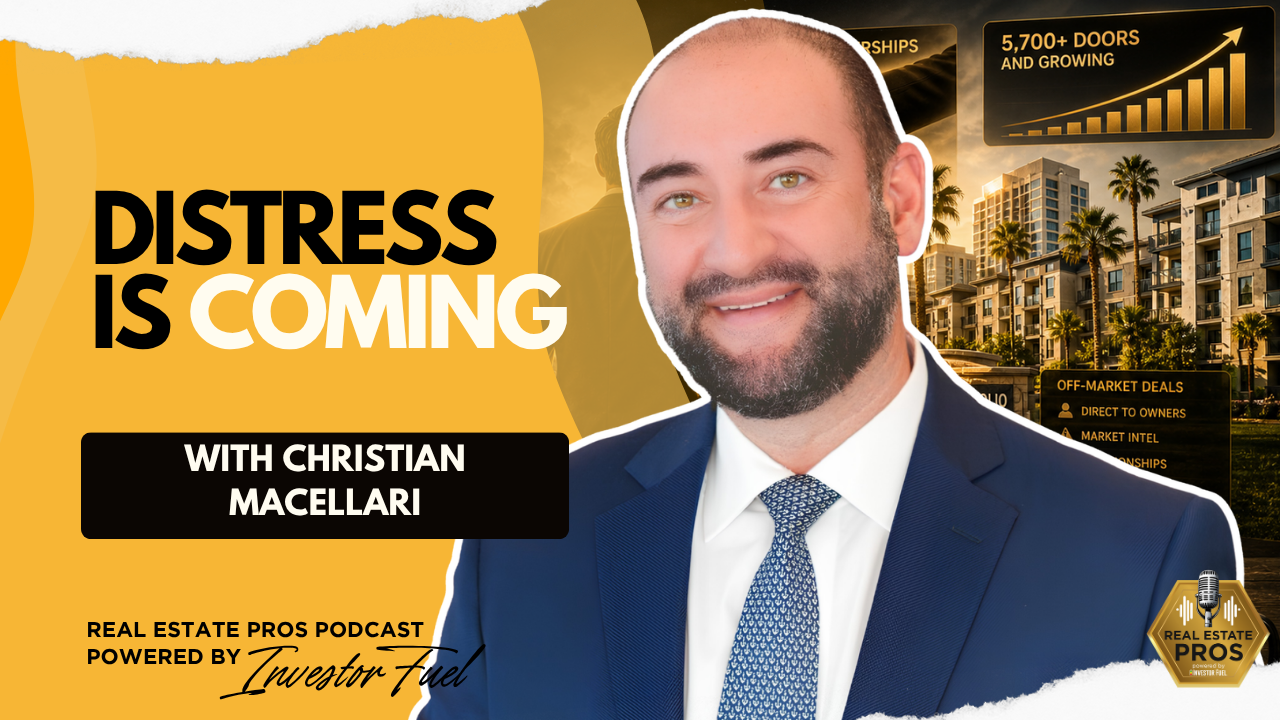
In this episode, Christian Macellari, CIO of RSN Property Group, shares insights on value-add multifamily investing, market strategies, and navigating market shifts. Learn how disciplined market focus, partnerships, and understanding interest rate impacts drive success in real estate.

Resources and Links from this show:
Listen to the Audio Version of this Episode
Investor Fuel Show Transcript:
Christian Macellari (00:00)
Well, you know, I’m a big believer that while we’ve seen a big kind of, ⁓ you know, drop in valuations, I think that a second reset is on the horizon. ⁓ I think, you know, if you look at interest rates in May of last year, and I always follow the five-year treasury because that ultimately will dictate, you know, what loans and, you know, in my space, I typically take on five-year loans.
Michelle Kesil (01:59)
Hey everybody, welcome to the Real Estate Pros Podcast. I’m your host, Michelle Kesil, and today I’m joined by someone I’m looking forward to chatting with, Christian Macellari of RSN Property Group, focusing on value add multifamily and syndication. So, excited to have you here today, Christian.
Christian Macellari (02:20)
Thanks, Michelle. Excited to be here.
Michelle Kesil (02:22)
Awesome,
let’s dive in. So first off, for those not yet familiar with your world, can you share what your main focus is?
Christian Macellari (02:32)
Sure, ⁓ so I’m again, Christian Macellari I’m the Chief Investment Officer for RSM Property Group. ⁓ RSM Property Group is a multifamily ⁓ owner operator of ⁓ apartment ⁓ assets. We primarily focus ⁓ across the sunbelt of the United States. So our portfolio consists of about 30 different properties that we’ve acquired as an owner and operate.
sometimes also some of those properties we co-own with other groups as well, which is something that we’ll probably talk about in a little bit here. And we’ve got about 4600 Im sorry,
I actually correction on that. It’s actually 5700
our portfolio currently, and that’s, as of next week, gonna expand by another 110 units. So very excited about the growth that we’ve experienced.
so we’re trying to break the 6,000 door figure this year and I think we’ll get there.
Michelle Kesil (03:40)
Awesome.
And what have been some of the main keys that have allowed your business to be able to grow and run successfully.
Christian Macellari (03:50)
I think the biggest key to success for us ⁓ has been our ability to be nimble and ⁓ decisive in a market that has been dislocated. ⁓ think opportunities are very time sensitive and you have a very limited amount of time to make a decision and to be able to execute. And a lot of sellers are very cognizant of the challenges that are being faced in this market.
really prefer to work with folks that can stick by their guns if they make a decision, follow through with it, and have surety of execution. And I think that that’s something that RSN has built as the cornerstone of our brand.
Michelle Kesil (04:35)
Yeah. And how are you approaching things differently with how you see the market shifting or how would you evaluate the current state of the market and how are you, yeah, tailoring to that?
Christian Macellari (04:52)
Sure. I think for anyone that is in our industry that either buys or owns multifamily,
they understand that there’s been quite a few challenges over the last, it four years. I think 2021 and 22 were really the heyday. It’s where we saw valuations really peak. A lot of folks entered into the space. Everybody was throwing the dart at the board and making
money. ⁓ Since then, we’ve seen a value reset of anywhere from 20 to 40 percent of in certain markets where values have dropped from kind of the heyday in 2021 to where we sit today. And it’s been kind of a painful drop. And most of that, I think, is attributable to interest rate risk. Right. So we’ve seen interest rates go from the lowest that they’ve been in the last 30 years right after covid to where they moved up almost 200
basis point. you know, the ability to borrow money and buy assets, which is what we do, we depend on that ability to borrow money, became more expensive and more challenged. so values have really been impacted by that. And the way that we’ve overcome it has really been by focusing on target markets that we have conviction in. We’re very disciplined in our approach. ⁓ We, unlike other operators, I think that
that really just look at a deal and say, wow, you know, on paper, this deal could make, you know, a ton of money for us and for our investors. We focus more on the market. And do we believe in those markets in the long term, not just today, but do we want to own there in three years? Do we want to own there in five years and possibly even 10 years? And if the answer is yes, then we dive head in and we really, really get to know the market. We get to know who the players are. We’re getting opportunities to
to look at deals that are off market before they get listed because of the relationships that we’ve built in those markets. So that’s been a big pillar of success for us to navigate these difficult markets is really to uncover every stone and get shown every opportunity possible in the markets we cover. So I think that’s one of our keys to success.
Michelle Kesil (08:03)
Yeah, absolutely. And what do you see as maybe some shifts that people need to start to implement as markets are shifting as well?
Christian Macellari (08:18)
Well, you know, I’m a big believer that while we’ve seen a big kind of, ⁓ you know, drop in valuations, I think that a second reset is on the horizon. ⁓ I think, you know, if you look at interest rates in May of last year, and I always follow the five-year treasury because that ultimately will dictate, you know, what loans and, you know, in my space, I typically take on five-year
So looking at that treasury rate is very predictive for me.
If you look at the five-year treasury going back a year ago, you know, it was around 4.2, you know percent was the yield and It actually dropped down in September, you know to kind of the mid threes and all of a sudden you saw a spike in activity So if you look recently a lot of transactions that are happening You’re seeing valuations start to push up a little bit and cap rates are coming down For those of you that don’t understand what a cap rate is a cap rate is a measure that we use
to determine ⁓ how expensive an asset is. So the lower a cap rate, it usually means the more expensive the asset is relative to the income it produces. So we’ve actually seen values come back up, and we think it’s correlated to interest rates. But in the last 45 days, rates have climbed back up. So we’re sitting very close to 4%. I think if interest rates were to continue to go up because of inflation, we all
know what’s going on in the world.
maybe we don’t know what’s going on in the world. It’s kind of a crazy place right now, but what we do know is the price of gas goes up, the price of our Amazon deliveries goes up. When everything prices go up, usually interest rates go
And if that were to happen, I think that there’s a chance that you’re gonna see a lot of distress in the market. You’re gonna see a lot of folks that bought multifamily assets that can’t afford to refinance and they can’t to effectively
Sell at the price that they want to sell because there aren’t enough buyers So there’s a good chance if rates move up that you’re gonna see a whole new wave of Distressed sales and that will drive values down and so I would really be keeping my eyes on the 10-year Treasury the five-year Treasury And as that continues to scale up you’re gonna see an opportunity on the flip side of that I think the other thing to look for is if interest rates go down ⁓ If interest rates were to stay around three and a half percent for for the five-year Treasury
I think you’re going to see a slow trickle of buying movement ⁓ and you’re going to see opportunities come about. There’s really only ⁓ two ways that you can make money in real estate and that’s either values dropping enough to where you can make the returns you need to for your investors or interest rates dropping so that the debt that you’re taking on to borrow to buy these assets is cheap enough to where you can make money. So, ⁓ know, in the first scenario I gave you guys,
values drop I think it’s a good buying opportunity in the second scenario if interest rates I’m sorry if interest rates were to go down then I think that you will see ⁓ buying movement so that’s what I would keep my eyes on is the interest rates in the market
Michelle Kesil (12:10)
Definitely that makes sense. And so what are you most focused on solving or scaling to next?
Christian Macellari (12:19)
⁓ I’m always focused on scaling our portfolio. I’m very blessed in that it’s been kind of a slow market for a lot of folks and we’re closing our sixth transaction in 24 months, ⁓ which will be about $163 million worth of assets that we’ve acquired in one of the more challenging markets that we’ve seen. So, I’m very, very blessed and fortunate and thankful for that opportunity over a very
tough period to be able to say that we’ve been able to accomplish that. I think there’s a lot of uncertainty right now. you know, most of my day to day is around trying to figure out how we can navigate some of the challenges in the capital markets. You know, it’s harder to raise money today, you know, before I could do a deal and raise, you know, 10, 15 million dollars in 60 days. Now it’s taking 90 to 120. So how do we overcome, you know, kind of the
challenges of raising capital in a difficult environment where there’s a lot of uncertainty. So a lot of my day is cornered around that and really finding new partnerships. So one of the ways that we’ve been able to overcome and actually accomplish what we’ve done is by teaming up with folks. You know the old saying of if you can’t beat them join them. Three years ago some of the groups that we’re partnering with are groups that were direct competitors that we would have never dreamed of partnering with and you know instead what we’ve done is taken a proactive
approach to say, guys, you’re facing the same challenges we are. Let’s partner up, assuming that we have alignment in our strategy. the proof is in the pudding of those six transactions, five of them have been done with a large institutional group out of New York that we’ve built ⁓ a great friendship with and we’ve tackled deals together, which otherwise maybe we would have done half as many deals. So I would say trying to find partners so that you can split
the risk versus taking it all on your own shoulders is a wise thing to look at doing.
Michelle Kesil (14:26)
Yeah, absolutely. And what have been some obstacles or challenges that you’ve recently had to overcome and find new ways or strategies of doing things?
Christian Macellari (14:43)
Well, mean, going back to what I just mentioned, right? ⁓ I think the capital markets are probably the biggest bottleneck. mean, finding good deals that make sense for our investors certainly is a challenge. But I think that once you overcome that challenge, you you found the right deal in the right market.
Michelle Kesil (14:46)
Yeah.
Christian Macellari (15:43)
You’ve negotiated with the seller. You’ve got it under contract. The next big looming, you know, axe over your neck is really, are you going to be able to raise the money in time to be able to
to
close without putting ⁓ investor capital at risk, right? ⁓ Because there’s always transaction risk, right? You don’t know 100 % for certain unless you’ve got a blank checkbook ⁓ whether you’re gonna be able to execute, at least not in the syndication model. ⁓ knowing that that challenge exists, I think for me has led me to really ⁓ make sure that I’m looking at the partnerships on certain transactions
ahead of time. when I walk into a situation where I’m negotiating a deal, I already have ⁓ a partner identified. I’ve already discussed it with them. I’ve, you know, I’m not hoping and praying that I get the deal awarded and then I find my partner like I need to go into the knife fight, you know, fully prepared. And so ⁓ that that’s one of the key things that I’ve been doing is making sure that I have a partner to come into the transaction. A, it gives more credibility to the seller. So let’s
them know that you’re not doing it just on your own. ⁓ It combines the track record of both companies so that gives ⁓ more surety to the seller that you’re going to be able to execute. really from your own perspective, having a partner that has their own asset management team that has their experience, their infrastructure, and then us having our asset management team with our infrastructure, allows two groups to really come together and leverage the best practices.
from both groups. So it just makes you that much more efficient. But I will caveat that it’s very important that you choose your partner wisely. You you’ve got to do the research. You’ve got to understand, you know, their philosophy. The last thing you want is owning an asset for five years with a group that has totally different beliefs than you do, you know, on the markets, on how to run the business. So you got to do your homework. But I would say during this time where it’s a little slower, if I’m a smaller group, I’m focused probably 80
of my energy is focused on getting to know the brokers and the markets that I want to be in so that I can be an expert in those markets and get the right opportunity shown to me first. And the second thing I’d be doing is talking to every group, including ourselves. Feel free to reach out to me if you have an opportunity that you think that you’d want to partner on. We’re very open to that. We’ll evaluate the opportunity. We’ll evaluate kind of your business plan. But you should be doing that anyways, talking to different groups to see who you align with so that
that you can start identifying the right partner and then go after the transactions because you’re have much more, ⁓ higher likelihood to succeed doing that, you know, if you have a partner.
Michelle Kesil (18:37)
Yeah, absolutely. And how do you find the best leads and types of projects? Is there a specific ⁓ strategy that you have for finding what you find most suitable?
Christian Macellari (18:55)
Yeah, so it’s really a combination of ⁓ three things. It’s ⁓ the first thing is obviously on market deals, right? So, you you should always regardless of what you hear today, which everybody wants an off market deal. Everybody wants a story. Everybody wants two thousands or newer, you know, vintage assets. You know, the reality is that you don’t know what a good deal is if you’re not underwriting, you know, multiple deals. So sometimes
you’re looking at deals that are on market simply as data points just so that you can understand how these deals are being priced. Even if you don’t plan on submitting an offer on a particular deal you should really be running your reps. So just to give you an idea my analyst team you know will underwrite anywhere from three to five hundred deals a year to basically get to four transactions. And those are in markets that were very very focused. That’s not just across the United States every deal that hits my inbox. So you know
I’m making sure that I’m underwriting all of the, you know, the marketed deals just even from a data gathering perspective and because it’s a numbers game. The second thing I’m doing is I’m running off market screens. I use CoStar. Some people don’t have access to CoStar. They may have other ⁓ platforms like, ⁓ you know, I mean, there’s quite a few different ones. I use CoStar and I have certain filters that I apply and then I basically start looking at the markets that
I want to be in. look at the assets that are there and then I have my own way of looking at which ones are likely to be good acquisition targets and I’ll do a direct to owner outreach. So I’ll literally send an email follow up, you know, as you can imagine a lot of times it’s a cold outreach. you know, the success ratio is probably under 1%. So you’ve got to pick and you, you know, choose your time, how much time you allocate to it. But that has produced good results. ⁓ And really the other one is
using market intelligence, right? So what I mean by that is talking to owner operators, asking them questions. You I can’t tell you the last three deals that I’ve been working on have been because one of my operator friends worked at another group and told me, hey, that asset that you really liked when I was working there that you tried to buy from me, but I said no, I just found out that, you know, they’re given the keys back to the preferred equity or they’re given the keys back to the lender.
And now all of a sudden I know something that other people may not know. Right. So I’m going to go directly to that lender. I’m going to do the research. I’m going to introduce myself and then I’m going to say hey look I’ve been tracking this asset. I want to talk to you. So you know that’s one way using market intelligence and the only way to get that market Intel is by being an expert on the markets. Right. So that’s why I go back to what I said earlier. You always always want to be disciplined on picking one or maybe two markets that you’re really really passionate about.
believe in, get to know the brokers, get to know the banks, get to know the operators in that market. And that’s how you get that third ⁓ bucket, is kind of market intel, and then leveraging that market intel to do direct outreach. hopefully that answers your question. But it’s a combination of on market, off market, and market intel.
Michelle Kesil (22:15)
Amazing. Thank you for sharing.
Christian Macellari (22:17)
Sure.
Michelle Kesil (22:19)
Well, before we wrap up here, if someone wants to reach out, connect and learn more about what you’re up to, where can people find you and connect?
Christian Macellari (22:28)
Yeah, I would say, ⁓ you know, ⁓ feel free to reach out on LinkedIn. You know, I’m very active on LinkedIn. ⁓ You can search my name, Christian Macellari at RSN. And if you shoot me a message, it might take me a day or two, but I’ll definitely respond. You know, otherwise my email is [email protected]. ⁓ So that’s, you know, RSN, Romeo, Sam, Nancy, propertygroup.com (RSNpropertygroup.com).
my first name Christian. ⁓ Shoot me an email, let me know. We’re always looking for opportunities to partner with new sponsors. So even if you’re a smaller sponsor and think, well, a group that’s got almost 6,000 doors isn’t gonna talk to me, that’s not the case. ⁓ We’ll definitely talk to you. And if there’s a good opportunity, we’re happy to explore it. So we’re always looking to work with good people that are honest and have similar views on the investment markets that we’re in.
Michelle Kesil (23:28)
Perfect, well appreciate your time and your story. Thank you for being here.
Christian Macellari (23:33)
Sure, it’s my pleasure. Thanks for having me, Michelle.
Michelle Kesil (23:36)
Of course, and for those tuning in to the show, if you got value, make sure you have subscribed. We’ve got more conversations with operators like Christian who are building real businesses and we’ll see you on the next episode.