Subscribe via:



Show Summary
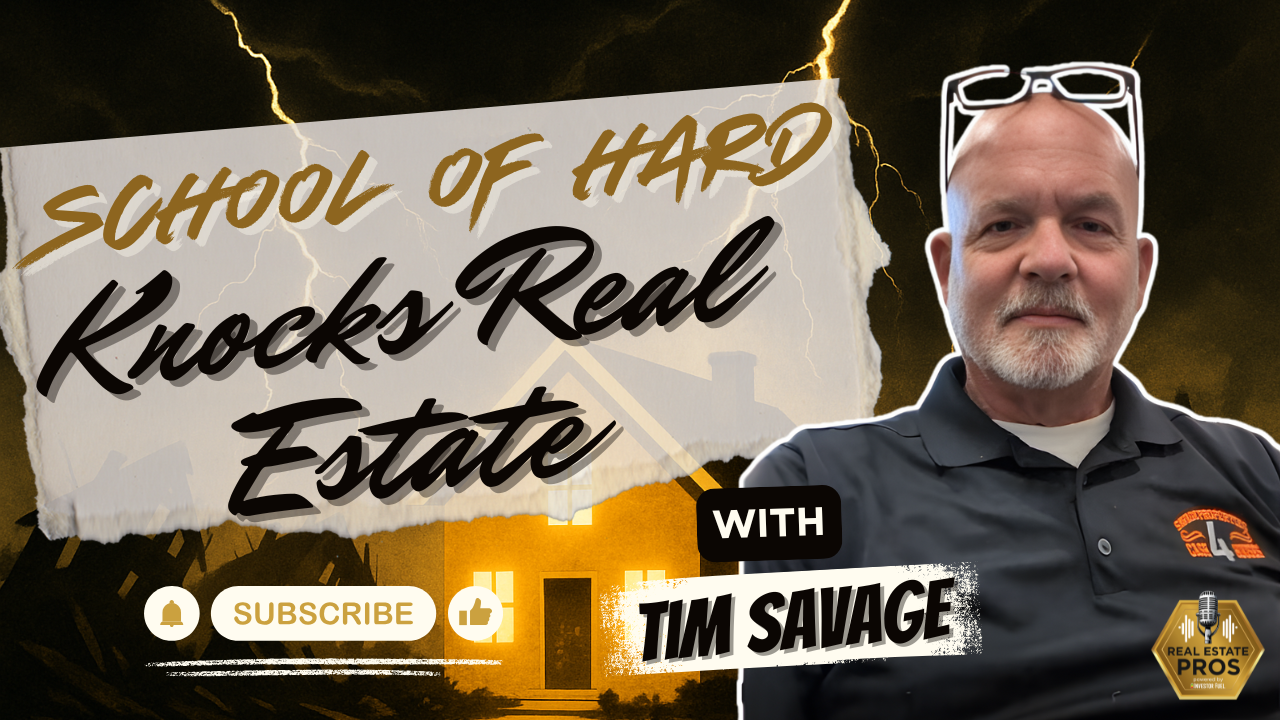
In this conversation, Tim Savage shares his extensive journey in real estate, starting from his early influences in the Air Force to becoming a successful single-family investor in North Carolina. He discusses his initial foray into real estate, the challenges he faced, and how he transitioned from a buy-and-hold strategy to flipping properties. Tim emphasizes the importance of networking, finding deals, and managing risks in the flipping process. He also shares his aspirations for future investments in multifamily properties and new construction, highlighting the evolving landscape of the real estate market.

Resources and Links from this show:
-
-
- Investor Fuel Real Estate Mastermind
- Investor Machine Real Estate Lead Generation
- Mike on Facebook
- Mike on Instagram
- Mike on LinkedIn
- Tim Savage’s Website
- Tim Savage’s Email: [email protected]
- Tim Savage’s Phone Number: (336) 240-8535
Listen to the Audio Version of this Episode
Investor Fuel Show Transcript:
tim (00:00)
Uh it was all by trial and error. I knew nobody. I have never had no mentors. I never even knew anybody that did what I did. and I so it was a school of hard knocks. everything was a struggle. I I couldn’t afford to hire people to work on my properties because, you know, money was tight. So I started to learn how to do carpentry, plumbing, a little bit of electrical work.Roofing, siding, putting windows, flooring. I see these guys say, well, you just pay somebody to do it. Well, what if you ain’t got the money to pay somebody to do it? What do you do then? I mean, that’s how I was. I mean, I mean started from nothing.
Dylan Silver (02:14)
Hey folks, welcome back to the show. Today’s guest, Tim Savage is a single family investor based out of North Carolina. Tim, welcome to the show.It’s great to have you on here, Tim. I’ve had quite a few guests from the Carolinas. I was mentioning before hopping on here that I really think it’s a hotbed of real estate. If you haven’t looked at the Carolinas and you’re listening to this podcast, take a look at them. There’s really some great opportunities out there. Before we get into the Carolinas and talking about regionally what it’s like to do business out there, I do want to ask you how you got into real estate. What was your entry point into the real estate space?
Tim Savage (02:55)
Well, I was in the Air Force and I joined the Air Force when I was 20 and I worked the third shift and on a pediatric board as a med tech. And so at night I’d go in one of the rooms and watch these late night real estate Carlton sheets and how I got started. And I’d watch them every night and I’m like, man, one day that’s what I want to be in real estate.Kind of my first taste of real estate right there.
Dylan Silver (03:25)
Was this early 2000s?Tim Savage (03:28)
No, this was 1984.Dylan Silver (03:33)
84. I’ve had a couple people from the podcast mentioned the Carlton sheet. So he’s brought a lot of people into the real estate space. Do you remember your first deal as an investor?Tim Savage (03:46)
Yeah, so after I got out of the Air Force and then I did some other things and then I went, was selling cars and then out of dealership and I was 31 years old and I was thinking to myself, I have no 401k, I have no retirement, no nothing and who in world can live off of social security? So at an early, you know, I say at an early age, I was 31 years old.Dylan Silver (03:58)
youTim Savage (04:15)
I said, well, I want to start buying some, some property. And I bought my first property at, at 31, for $35,000. I still own that property and I don’t get rid of much. I usually keep everything. and that’s, so that was my first, first property. And then, I would just buy one, fix it up, rent it out, save a little bit of money. And then next year I’d buy one or two more. Next year I’d buy one or two more.Dylan Silver (04:40)
Okay.you mentioned getting out of the Air Force and realizing, hey, I’ve got to find a way to ⁓ create wealth for myself. Did you know based off Carlton Sheets that this was going to be
tim (05:38)
No.Dylan Silver (05:44)
your passion for the next foreseeable future or what was your sentiment like, you know, after you had done that first deal?tim (05:52)
Yeah, well, after I’d done my first deal, I think it’s just one of those things that uh, I mean, was, after I’d done my first deal, it’s like I always wanted to do it. And I guess it was just in me, you know? I don’t know what makes people start something and they keep going and they keep going and they keep going during the hard times, the good times, the bad times, they keep going. And then that was me. I mean, it was very difficult for me. I mean, honestly.I mean, you’re talking about rental property, and I was lucky to net $100 off of one rental property. mean, you know, this is a lot. I mean, you people think, you know, well, you get a rental property and you make all this money, but unless you’re flipping it, you’re looking at 15 years. I knew it was going to be 15 years, but I started adding up. said, well, I could retire by the time I’m 50 if I get, my goal was to get 10 and make $4,000 a month. That was my goal.
Dylan Silver (06:24)
from them.tim (06:45)
And which I’ve reached that I’ve got 45 rental properties and I’m just kind of continue to add on to that. It does take more than 10 properties though to make a living though, unless they’re all paid for.Dylan Silver (06:58)
I want to ask you about those early deals, then also if your buy strategy changed over the years. It sounds like everything was buy and hold for the most part. Did you have any experience flipping homes or did you hold on to everything?tim (07:11)
Yeah.Okay, so for the first 15 years, I just bought a hold bought a hold and some of up. But then I was like, man, you know, I’ve been struggling for 15 years, you know, like this, you know, paying the bills or whatever, but I’m not, I’m not this rich millionaire that I keep reading about on these kind of things like this right here. I’m like, you know, there’s gotta be something else. So I started flipping properties five years ago and
Dylan Silver (07:34)
Yeah.tim (07:42)
My goal was to flip 12 properties a year. And I see a lot of people on here or whatever that do much more than that. I’m doing seven a year. I’m flipping seven years. So, but it takes me longer than it these others. I don’t know how these people can flip properties so quickly. I have no idea because I get in there and I work six days a week. I hire crews out, I sub stuff out, but I still can’t get nothing done or more quicker than three months, no matter what. And then you got to sell it after that.Dylan Silver (08:08)
That’s right.tim (08:10)
So I don’t know how they do it. I’m doing the best I can. I flip about 70 a year and I take that. So what I’ve done is I said, well, the rent will probably take care of itself. I’ll do some flips and then with the cash I make, I try to make about $50,000 a flip. That’s what my goal is. It used to be 25,000. I bumped it to 50,000, just looking for better deals. Then I’ll take that money and use it as a down payment to get a hard money loan. I use hard money loans to to uh you know get a lot of ⁓ rent.A lot of my real estate, I’m not paying cash for it, they’re cheapening them.
Dylan Silver (08:42)
Did you have a background at all? Did you have friends, family who were contractors? How did you, you know, learn to effectively flip these homes?tim (08:51)
Uh it was all by trial and error. I knew nobody. I have never had no mentors. I never even knew anybody that did what I did. and I so it was a school of hard knocks. I mean, everything was a struggle. I I couldn’t afford to hire people to work on my properties because, you know, money was tight. So I started to learn how to do carpentry, plumbing, a little bit of electrical work.Roofing, siding, putting windows, flooring. I mean, because I really, you know, I see these guys say, well, you just pay somebody to do it. Well, what if you ain’t got the money to pay somebody to do it? What do you do then? I mean, that’s how I was. I mean, I mean started from nothing.
And then I thought, man, I’d love to have a, when I was growing up, didn’t really have mentors. You might hear about it every once in while. But uh
And then I said, man, I’d like to have one, but it was like 5,000, 10,000, 20,000. I ain’t even got a thousand dollars in the bank. How am I going to get a mentor? You know? So it was school of hard knocks.
Dylan Silver (09:52)
Yeah.I want to ask you, when you’re looking at these flips, I know that was the space that I was involved in as as a wholesaler in Texas. There is a higher degree of ⁓ risk, I would say, because you could take down a wall and now you have another issue. You could take up the subfloor and now you’re looking at foundation issues. So you do have to manage risk in that regard. Do you have a specific buy box or?
area that you are specifically looking at. Are you very much privy for instance to a certain area in North Carolina? How do you approach these deals?
tim (11:13)
Well, the way I look at it is…If I can’t buy them, I probably do it a whole lot different than a lot of people. I’ll go in and look at the house, but I’ve been doing it for a long time. you know, it used to take me about 25,000 to fix up one, then I went to about 50,000. Now I spend usually 100,000 plus fixing up one. and because much of the stuff I buy is, most people wouldn’t buy it, you know, on the retail side, because it just has too many issues.
Dylan Silver (11:46)
Yeah.tim (11:48)
You know, you’ve got floor sagging, rust not right, foundation cracks and stuff like that. I’m like, it’s going to, it’s going to probably take me a hundred, 125,000, but I just back out the numbers, you know, like I’m going to, I got, I got four right now that I’m working on. got two contracts that right now and I’m finishing up a fourth one right now. But I just, uh I just look at the numbers and back those numbers up to where.everything goes wrong, I still won’t lose money. If everything goes wrong, I’m still will not lose money. I have never once lost any money on any deal ever in 30 years. Not one time. I broke the deal.
Dylan Silver (12:19)
deal.That is
incredible. That’s a claim I don’t know any other guest on the show that I’ve had who’s been active uh as long or even half as long can make. I want to ask you a follow-up question to that. When you talk about not losing money on deals, how are you finding these deals? You know because I’m imagining you have to pass on a lot of deals as well.
Are you finding these deals off market? Are you going on market? Do you have relationships with realtors, wholesalers? Are you finding them yourself?
tim (12:58)
Um, well, I hustle. That’s a big part of it. but, uh I’ve only bought like maybe one or two, maybe three. That was only MLS. Very rarely will I ever buy one that’s, that’s already for sale or, anything like that. It’s usually now I’ve been in it long enough now it’s kind of like word of mouth. They’ll say, Hey, well such and such Tim, yeah, he buy houses like it.You know, they call him, you know, and they’ll call me. So that’s, I get most of my deals by word of mouth. ⁓ But I do, but I’m looking all the time. mean, I’m looking at houses all the time, whether it’s tax foreclosures or bank foreclosures, auctions, just anywhere and everywhere. I do put signs out. ⁓ You know, anybody I talk to, I give them a card.
I’m pretty active. You got to be a little bit of a salesman, know, too, you know.
Dylan Silver (13:56)
I mean, you have to put yourself out there. You mentioned all the ways that you’re doing it. I look at it as it’s like death by a thousand paper cut. It’s not like the one is gonna make ⁓ a sizable difference, but in totality, you’ve got signs, you’ve got your going to the auctions, you’ve got connections with folks. They know that you’ve bought certain deals in the past. You’ve also got people that you’ve maybe previously bought from and they might refer you to someone they know going through a similar situation. It all adds up.tim (14:23)
It does. It does.Dylan Silver (14:26)
I do want to ask you specifically about being in real estate for so long, right? You talked 30 years. You mentioned, you know, first 15, you were buying and holding, you got into fix and flip. Have there been any other significant, turning points or pivot points in your business? And, what could you attribute that to?tim (15:29)
Well, like right now, so ⁓ I’ve bought the rentals, I’ve done the flips, and but I still think these flips are very difficult because it’s hard to find good workers. That’s my biggest issue is finding good workers. Everybody says they can do it. Everybody says they can put down floors, do sheetrock, paint, but honestly, most of the people I’ve hired, I’ve had to fire. I go through a lot of people who says they can do stuff that really can’t.But now I’m thinking, well, I’d like to get into multifamily. I did buy an 18 unit little apartment house. It used to be like uh like uh where everybody just lived in one big house, but it’s actually kind of got turned into little apartments. Everybody has their own bathroom and stuff like that. I bought it cheap. I bought it for $35,000 here in Lexington. But I’m wanting to get into where I fix these up and rent them out.
And start, I mean, I wouldn’t mind doing some new stuff. I don’t have a general contractor’s license, which I know, you know, you can get a general contractor to do it for you. I wouldn’t mind doing some apartments and some, some maybe a couple more duplexes. And I like to go bigger, you know, if I could.
Dylan Silver (16:42)
I want to ask you about, you mentioned some of these other deals, Whether it’s small multifamily, know, apartment complexes. What’s your perspective on on flippers right now getting into development and ground up construction? It is a little bit trickier to flip in the last year than it was five years ago, right? So have you noticed this trend out there as well that more flippers may be, you know, dipping their toes in the water of development?tim (17:09)
Yeah, the new construction has really, you know, gone up here in the Lexington area. I’m seeing more more new construction and so, and a little less rehabbing. And which I think I understand that a little bit because ⁓ the rents have gone up. So when the rents go up,If you build something and you got a positive cash flow, that’s great. See, it used to not really be that way. You build a new house and you’re going to be losing money if you rent it out. And I think that’s why everybody kind of went and started rehabbing. But now, like for me, our area was stagnant for 20 years. I was renting the same place out for about 20 years for $4.50 a month here. And then five years, all of a sudden it changed. So in five years, I went from $4.50 to $8.50.
So that’s helped me a lot, you know, doing that. But I think things are hitting more for new construction than they used to be. And I’d like to be a part some of that.
Dylan Silver (18:03)
Wow.It’s definitely an interesting shift to see. I mentioned, I’ve seen a lot of flippers right now moving from the rehabbing space into development and ground up construction. We are we are coming up on time here, Tim. Where can folks go to reach out to you? How can folks get in contact?
tim (18:30)
Well, like I say, my name’s Tim Savage and I do have a website savagepropertiesllc.com. You can email me at soukie97 @ aol.com. That’s s-o-u-k-i-e-97 at aol.com. You can email me there, but I’d to get some more contact with other people, you know.Dylan Silver (19:00)
Absolutely. Tim.tim (19:01)
Yeah, they can callme too at 336-240-8535. I get out, give out all my information. I ain’t got nothing to hide.
Dylan Silver (19:10)
Tim, I appreciate you coming on the show today. Thank you so much for your time. Thanks for coming on the show.tim (19:17)
Yeah, you too Dylan, Bye. -