Subscribe via:



Show Summary
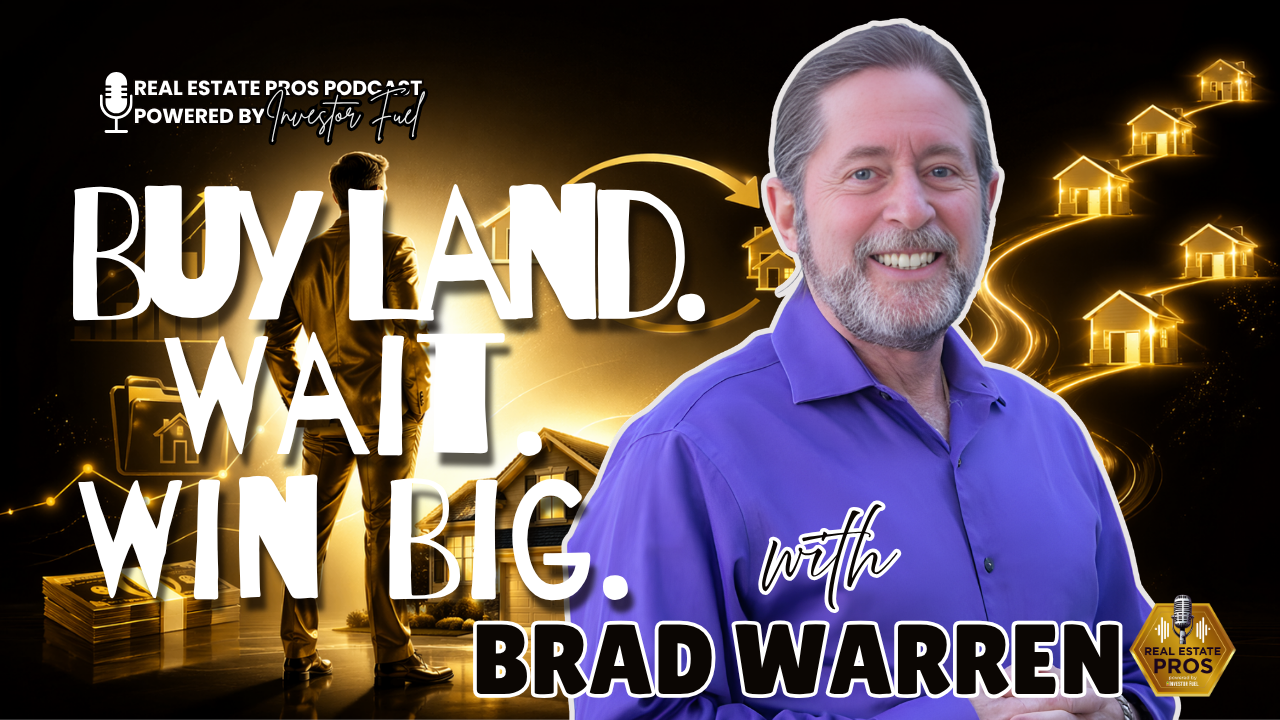
In this episode, Brad Warren shares his journey from business coaching to land banking, highlighting the opportunities in renewable energy land development, the importance of due diligence, and strategies for navigating market uncertainties.
Resources and Links from this show:
Listen to the Audio Version of this Episode
Investor Fuel Show Transcript:
Brad Warren (00:00)
So doing your due diligence, knowing your exit strategy,
before you even invest. That’s always been something that I’ve been taught as an investor. I’ve invested in lots of things. I’ve lost a lot of money, made a lot of money, actually made more money than I’ve lost, but I’ve still lost a lot. And a lot of times it was because I wasn’t always sure how I was gonna get out of the investment before I even got in. So one thing that I encourage all investors to do is, well, two things. Do your due diligence on your own, not just with AI, but research.
go to the county, look at the newspaper reports, attend city council meetings, read the general plans, find out where development is coming and where it’s going, what direction it’s heading in. So whatever investment, if it’s a single family residence, apartment building, it’s where people want to be.
Why would you build something like that if you didn’t first find out where do people want to live? So doing your due diligence, doing your research,
and then knowing when you go in, like in our industry, we’re very conservative.
Scott Bursey (02:34)
Welcome back to the Real Estate Pros podcast powered by Investor Fuel. I’m your host Scott Bursey. And today we’re joined by a strategic mastermind, someone who doesn’t just see the future of real estate. He’s shaping it. Brad Warren is here from Bradley K. Warren and Associates. And let me tell you, this man brings the fuel we all need to ignite our next major deal. Bradley, welcome to the show.
Brad Warren (02:58)
Great, well, thanks for having me, Scott. Pleasure to be here.
Scott Bursey (03:01)
It is just wonderful having you here and for our listeners who may not be familiar with your journey, please tell us how did your career begin and what is your primary focus now?
Brad Warren (03:11)
Well, my career began back in 1978. I set myself up as a business coach and eventually evolved into a seminar leader and traveled the world actually internationally and nationally teaching lots of seminars, coaching mostly real estate agents, did that for many, many, many years. And then in 2018, I got my real estate license and became a salesperson for
a real estate company that sells dirt. So that’s what I’ve done for the last eight years. I sell dirt to investors.
Scott Bursey (03:43)
And that’s an incredible journey. So let me ask you, let’s start off with some core strengths. What are some of the core strengths that your company offers in your business currently?
Brad Warren (03:53)
Well, we call it land banking because you take it to the bank or you can bank on it and it’s the process of buying what we call pre-developed land, which could be just a dirt road, maybe not even a road. Occasionally there might be some telephone poles, things like that. But we do all the research, we find the land, our company buys the land first, then we sell that land to investors. They hold
We’re very conservative. We tell people seven to 10 years. And then they sell their land to a developer to get anywhere from three to seven X returns. And one of the strengths is the due diligence process that we put in upfront. We have something called a 16 point comprehensive analysis checklist. And that’s a long way of saying we don’t buy land unless it meets 16 very comprehensive points that we have about that land.
If it gets 16 yes checkmarks, then it’s one that we want to acquire because we know it doesn’t have title issues. There’s no red-legged toads running around. There’s no water culverts and things like that. So our strength is in the research that we do before we even get the land to sell to the investor.
Scott Bursey (05:07)
And Brad, in today’s fast moving environment, what is a common operational weakness you see scaling investors struggle to overcome?
Brad Warren (06:02)
Right now, I would say it’s the current war, and for lack of a better term, I will call it the war with Iran. It is basically putting a halt, at least in our industry. A lot of people are just nervous. They’re uncertain. There’s a lot of fear. And when there’s fear, the markets tighten up a little bit and investors hold on to their money. They don’t want to put it into something, especially a longer term investment.
when they don’t know how much longer this is going to go on. Also, we’re seeing for my fellow real estate agents that do residential, they’re seeing interest rates either staying where they are or recently I read that they’re considering raising interest rates again, which makes it harder for a buyer to get into a home. So a lot of reluctance, a lot of fear, a lot of uncertainty right now in the market, and I think it’s impacting investors of all kinds.
not just in the land that we sell but also in other areas as well.
Scott Bursey (06:56)
think that hits home for so many pros right now. What sort of opportunities do you feel are available in the market?
Brad Warren (07:05)
Well, in our line of work, which is is dirt, that’s what we sell, is vacant land, the opportunities are actually being driven by law. So in the state of California, there’s a few laws on the books that require the state of California to get all of its electricity for businesses, homes, buildings, all of the electricity for that category. This is not talking about electric cars, electric buses,
just homes and buildings by 2045 all of that electricity in California has to come from renewables. Right now we’re nowhere we’re maybe a third of the way to that goal and we’ve only got what have we got 16 more well 20 more years not even 20 years this is 2026 to 40 now even 20 years it’s taken over 30 years to get a third of the way it’s not looking too good unless
A lot more solar farms are being built. There’s hydro, there’s geothermal, there’s wind, but the vast majority of renewables in this state of California is coming from solar. So right now that opportunity is to own the land that the energy companies need to build the solar farms and the battery storage facilities. Because remember, solar only generates during the day when the sun is out.
What happens at night when people come home from work, they turn on their TV, they start cooking, they charge their car, they need all this power. Well, it’s, we’ve got to store the excess power that’s created during the day. And so they’re building a lot of what are called battery energy storage system. It’s called a BESS, B-E-S-S, a battery energy storage system. Only these batteries, they’re not like your car batteries. They’re not like your flashlight batteries. These are batteries the size of a house.
and there’s like 20 or 30 or 50 or 100 of them built on a 10 acre lot and it stores all of that excess energy that’s not used during the day, it stores it to be able to use it at night. So tremendous opportunities in solar farms and in the battery energy storage systems.
Scott Bursey (09:13)
And what strategies is your firm going to implement or what are you going to employ short term? Let’s talk 18 to 24 months.
Brad Warren (09:56)
Well, mostly it’s just continuing to find the land at a very reasonable price. We try to find, let’s say, divorcing couple. And the court tells them, California is a 50-50 state community property, and one of them has to buy out the other, and they don’t want to do that. So they sell it, and they just want to dump it quick and get a few thousand dollars. So that’s one of the areas that we need to keep looking, is to keep buying the land.
We used to say that we invest within a 60 mile radius of downtown LA. We’re now at about a 65 mile radius. We’ve had to extend out further into what’s called Kern County. So we have Los Angeles, the city, then there’s Los Angeles, the county. Well, just north, the next county is called Kern County. And now we’re seeing a lot more sales.
in southern Kern County where most of our sales used to be in northern LA County. So we’ve gone another five miles out in order to find the land. So that’s one of the challenges right now is to keep finding cheap dirt.
Scott Bursey (10:58)
Thank you for dissecting that. And Brad, beyond interest rates, what silent threat is currently eroding profitability for experienced real estate pros?
Brad Warren (11:07)
Wow, I’ll think a little beyond just land. Right now for investors, it’s always been due diligence. And now you’ve got to do even more. The thing is…
Everybody can do the due diligence now. You know, they use AI and they go off and do their own but is that reliable information? Is AI actually giving you the truth? We’re finding that a lot of these things that AI is saying, they make up. They actually lie sometimes. People are researching this and finding that they sometimes come up with answers that have no basis in fact.
So doing your due diligence, knowing your exit strategy,
before you even invest. That’s always been something that I’ve been taught as an investor. I’ve invested in lots of things. I’ve lost a lot of money, made a lot of money, actually made more money than I’ve lost, but I’ve still lost a lot. And a lot of times it was because I wasn’t always sure how I was gonna get out of the investment before I even got in. So one thing that I encourage all investors to do is, well, two things. Do your due diligence on your own, not just with AI, but research.
go to the county, look at the newspaper reports, attend city council meetings, read the general plans, find out where development is coming and where it’s going, what direction it’s heading in. So whatever investment, if it’s a single family residence, apartment building, it’s where people want to be. You don’t want to be building apartments like in China. They built thousands and thousands, tens of thousands of apartment buildings and they’re all now completely empty because no one wanted to move there. Well, that was kind of stupid.
Why would you build something like that if you didn’t first find out where do people want to live? So doing your due diligence, doing your research, and then knowing when you go in, like in our industry, we’re very conservative. We tell people seven to ten years. If you want land and you come to me and say, Brad, I need cash flow or I need to flip something quickly inside of a year or two, I hang up the phone. I’m not going to help you because our land isn’t going to flip that quickly. So you got to know all that.
in advance.
Scott Bursey (13:11)
Take us all the way back to your first deal. What was the fuel that started your enterprise?
Brad Warren (13:18)
Well, I bought my first property when I looked at one of my quarterly net worth statements. One of the things I was always taught is to keep track of your net worth. I do it at the end of each quarter and it was December 31st, 2011 and I looked at the numbers and I realized my wife and I could retire together using her Oracle 401k. She could retire on her own if she divorced me using her 401k.
from Oracle 401k from Oracle but I looked at what I personally had invested in and there was not going to be enough for me to retire and this I would at that point I was 60 years old in 2011 I was 60 years old I was looking ahead you know retirement was kind of coming up I’m now 75 but at that time I realized I couldn’t retire so I called my land banker her name is Marcella and I had known her for a few years
I was at her wedding to one of my best friends who I’d known for 25 years. I said, I need to buy some land. I need to be looking ahead to a bigger payday, even if down the road. She came over to the house in January 2012.
showed me what Land Bank was all about, did a 90 minute presentation at the kitchen table, and two months later I owned my first property. A year later I got another one, a year later I got another one, and then my wife, who was at that kitchen table, walked out and said, no, seven to 10 years and dirt and there’s nothing there and there’s no collateral. And so she went out and she just kept doing her investing in the stock market and mutual funds. But after watching me for three years,
She was interested enough to attend a seminar. Marcella was doing a seminar in a hotel and people were inviting their friends that the investors were invited to be there and bring their friends to introduce them to Marcella and the CFO at the time, Chief Financial Officer. So she came with me, but the whole thing in the car, Scott, Scott, she’s going, now I’m not going to buy. I’m not going to buy, but now I just want to go in here. Maybe I miss something. I said, okay, don’t buy. We even had our gym clothes.
in the back seat of the car because we were going to leave at the end and go to the gym. Anyway, Marcel does the presentation. At the end, she says, now for those of you that would like to see actual properties, I have four available. We’ll take a short break and then we’re going to show them. So I stood up and I turned to my wife, Marina, I said, sweetie, let’s go. They’re done. She says, no, no, I want to see the properties. Yeah, but you tell me where I’m going to buy. I’m just curious. Very long story short, she brought two out of the four.
She brought her checkbook with her, hadn’t even told me that. She bought two out of the four, that was properties four and five, and now we own 12. So that was kind of my journey from, and then eventually I got my real estate license and went to work for the company in 2018, six years after buying my first property.
Scott Bursey (16:40)
truly fascinating. And what advice would you like to leave with our listeners today?
Brad Warren (16:45)
Well, would, oopsie, there’s somebody calling me right now. Let me, let me just get rid of them. I would say general overall advice is do your due diligence, do your research, look at your risk tolerance.
You know, can you afford to always, you’ve got to ask yourself, can I afford to lose this amount of money? If I invest $25,000 with Brad and I buy land and for some reason, 20 years later, I still haven’t sold it and I just write it off and say goodbye to it, is that something you can do and still have a good portfolio left over? And if the answer is yes, then those are the kinds of things where you take a risk because all investments, not just real estate.
crypto and single and rental houses and stocks and bonds and mutual funds. There’s risk in all investing. So you just got to decide how much risk are you willing to bear and what’s the return? I mean, the higher the risk, the higher the return. We know that. So if you want to be slow and steady like my wife did, great. I’m more entrepreneurial. I like to turn things around a little quicker. So I bought some stocks. I bought in the video when it was $21 a share.
It split four for one and then it split 10 for one. My 50 shares went to 200 shares and now it’s at around ⁓ 195, 200 when I last looked. So a thousand dollar investment got turned into almost, what is it, $400,000 today. So I got very lucky and I was willing to lose the thousand dollars. A thousand dollars was not that much to risk, but I bought 50 shares at $21 a share several years ago and it’s turned out to be huge.
So that’s a big part of my retirement fund now. So I don’t have to tell you so much about her Oracle 401k anymore.
Scott Bursey (18:25)
Hey Brad, this has been pure fire. For those of our listeners who want to follow your journey or collaborate with you, what’s the best way for them to reach you?
Brad Warren (18:33)
best way to get a hold of me is actually email. I’m not a big fan of texting. don’t, I, TikTok and Instagram, all that stuff. My daughter, my millennial daughter does all that, but she calls me technologically challenged. My email is just my name, Scott. It’s brad at bradwarren.com.
And even when I’m on, I just got back from vacation in Cancun. had my laptop and I had people emailing me while I was down there. I respond even when I’m on vacation. So just email Brad at bradwarren.com. Tell me that you heard me on your show. Cause I always ask, how did you hear about me? And if they don’t tell me how I usually hang up because then they’re either a scammer or there’s somebody trying to learn more about our business. They’re from like another land banking company. So they need to tell me where I heard you on Scott’s show.
I said, okay, great. The other reason why I do that is I do pay referral fees. And so I always need to know how somebody heard about me because whoever referred that person is going to get a very nice referral fee upon the close of business for any land that I sell. So, at bradwarren.com. Look forward to hearing from you if you want more information. We call them finders. That’s our referral partners. We call them you want to be a finder or you want to be an investor, either one, Brad at bradwarren.com.
Scott Bursey (19:46)
Brad Warren everybody. Brad, thank you so much for joining us today.
Brad Warren (19:50)
My pleasure. Thanks for having me.
Scott Bursey (19:52)
And to our listeners, we appreciate each and every one of you. If you got value from today’s episode, please subscribe. We’ve got a lineup of exceptional guests, just like Brad, who are making huge moves in the business. Until next time, keep your standards high and your vision clear. We’ll see you in the next episode, everyone.