Subscribe via:



Show Summary
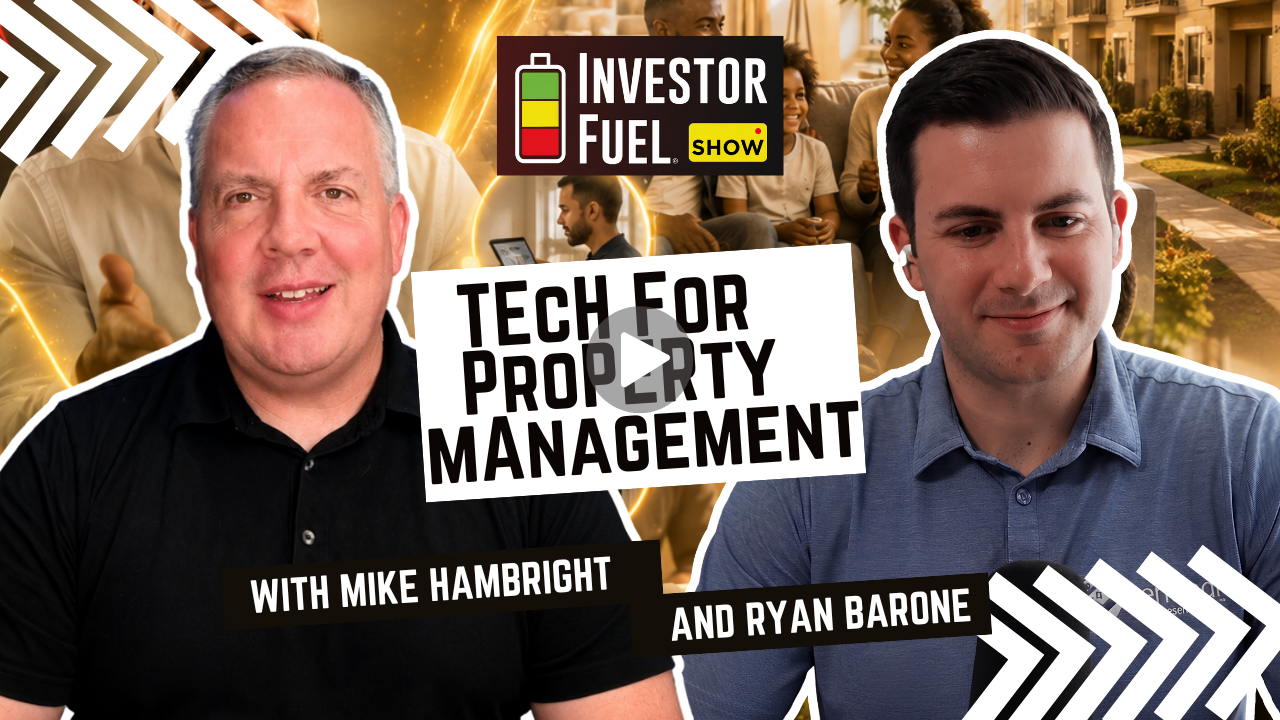
Mike Hambright interviews Ryan Barone, founder of RentRedi, about how technology is changing property management for small and mid-sized rental owners. Ryan shares how RentRedi started as a tenant application tool and grew into an all-in-one platform for rent collection, maintenance, reporting, tenant communication, and portfolio performance tracking. The conversation focuses on avoiding landlord mistakes, using automation and AI without losing control, improving tenant retention, and managing rentals more like a real business.

Professional Real Estate Investors – How we can help you:
Investor Fuel Mastermind:
Learn more about the Investor Fuel Mastermind, including 100% deal financing, massive discounts from vendors and sponsors you’re already using, our world class community of over 150 members, and SO much more here: http://www.investorfuel.com/apply
Investor Machine Marketing Partnership:
Are you looking for consistent, high quality lead generation? Investor Machine is America’s #1 lead generation service professional investors. Investor Machine provides true ‘white glove’ support to help you build the perfect marketing plan, then we’ll execute it for you…talking and working together on an ongoing basis to help you hit YOUR goals! Learn more here: http://www.investormachine.com
Coaching with Mike Hambright:
Interested in 1 on 1 coaching with Mike Hambright? Mike coaches entrepreneurs looking to level up, build coaching or service based businesses (Mike runs multiple 7 and 8 figure a year businesses), building a coaching program and more. Learn more here: https://investorfuel.com/coachingwithmike
Attend a Vacation/Mastermind Retreat with Mike Hambright:
Interested in joining a “mini-mastermind” with Mike and his private clients on an upcoming “Retreat”, either at locations like Cabo San Lucas, Napa, Park City ski trip, Yellowstone, or even at Mike’s East Texas “Big H Ranch”? Learn more here: http://www.investorfuel.com/retreat
Property Insurance:
Join the largest and most investor friendly property insurance provider in 2 minutes. Free to join, and insure all your flips and rentals within minutes! There is NO easier insurance provider on the planet (turn insurance on or off in 1 minute without talking to anyone!), and there’s no 15-30% agent mark up through this platform! Register here: https://myinvestorinsurance.com/
New Real Estate Investors – How we can work together:
Investor Fuel Club (Coaching and Deal Partner Community):
Looking to kickstart your real estate investing career? Join our one of a kind Coaching Community, Investor Fuel Club, where you’ll get trained by some of the best real estate investors in America, and partner with them on deals! You don’t need $ for deals…we’ll partner with you and hold your hand along the way! Learn More here: http://www.investorfuel.com/club
———————–
🎧 Subscribe to the Podcast
Apple → https://podcasts.apple.com/us/podcast/investor-fuel-real-estate-investing-show/id943707421
https://open.spotify.com/show/0yjlEMMn52BRrrlhfxCn4S?si=48f4b577276246e6
YouTube →
https://www.youtube.com/@investorfuel
🤝 Stay Connected with Mike
Follow on Facebook → https://www.facebook.com/realmikehambright
Follow on Instagram → https://www.instagram.com/realmikehambright/
Follow on Linkedin →
https://www.linkedin.com/in/mikehambright
📈Free Training and Resources for Professional Real Estate Investors
Acquisitions Manager Hiring Guide → https://my.investorfuel.com/if-lm-optin-acquisitions-guide
COO Hiring Guide → https://my.investorfuel.com/mm-lm-coo-hiring-guide
Executive Assistant Hiring Guide → https://my.investorfuel.com/mm-lm-ea-hiring-guide
Fuel 5 → https://my.investorfuel.com/mm-lm-fuel5
Triple Your Profits Masterclass → https://go.investorfuel.com/triple-your-profits
🏠Free Training and Resources for New Real Estate Investors
Rehab Live → https://my.investorfuel.com/rehab
Find Your First Deal in 5 Days challenge → https://go.investorfuel.com/find-your-first-deal-5-day-challenge
Join My next 4 Day Live Training Event (Virtual)
https://investorlaunchpad.com/
Resources and Links from this show:
Listen to the Audio Version of this Episode
Investor Fuel Show Transcript:
Mike Hambright (00:01.314)
Hey, everybody. Welcome back to the show. Really excited to have Ryan Barone with me today from RentRedi. He has software that manages over $35 billion in asset value in terms of rental properties, a lot of smaller portfolio owners and has really kind of taken the world by storm. going to talk about property management today. The thing that everybody loves and hates has a love-hate relationship with, right? But we’re all on the path of trying to build wealth with our rental portfolios. And if you can find a way to do it better and easier, then why not? So, hey, Ryan, welcome to the show.
Ryan Barone (00:31.416)
Thanks for having me, Mike. I’m excited to be here.
Mike Hambright (00:33.698)
Yeah, excited to talk today. So I’ve had I’ve been building a rental portfolio. I have a lot of multifamily, but I also have a single family portfolio here in Dallas. And it’s always been a love hate relationship. Like it’s even though I don’t manage them myself, I still get pulled in all the time. And I think a lot of people are that way. A lot of people are kind of under like there’s a lot of people that just end up self managing. And, you know, it becomes a job like they don’t really think about it. But I think there’s a lot of tech coming on, including
RentRedi that makes it more efficient and easier than ever. And so I think for folks that are out there with smaller portfolios or even larger ones, like if you’re not using cutting edge tech, it’s probably taken a lot more years off of your life. You’re getting to that gray hair stage faster. Probably you’d agree with that, I assume, Yeah. Yeah. Yeah. At some point you just give up. So you’ll see. You’ll see. But hey, just before we jump in,
Ryan Barone (01:20.76)
Definitely, definitely. I’m trying to keep the grace away as long as I can.
Mike Hambright (01:32.15)
Tell us a little bit about you and your background.
Ryan Barone (01:34.351)
Yeah, happy to. so I got started on RentRedi, um, really out of trying to solve my own problem, uh, honestly, and it wasn’t even intended to be a business. Um, I went to school here in New York city, double majored in economics and mathematics, minored in computer science. I’d gotten my first internship at Goldman Sachs and that was my chance to move out of dorms, stay in New York city for the first time. It seemed like it be this great summer. I’d find my first apartment. I’d walk to school. I’d walk to work and,
I ended up missing out on that apartment. didn’t have my documents together that I needed to actually rent that like W2 letter, employment, bank statements, tax return, student transcript, two roommates. All of us had guarantors and I came away from that feeling like I was bad at renting, which I probably was bad at renting, but there was a little more to the story there than, than, scratch the surface initially. And so I came away from that feeling like, it would have been great if there was an easier way for me to rent apartments. And as I talked to people, I was
Then working with, they kind of said to me, hey, Ryan, it’s not just you. This is how hard it is. It doesn’t really get too much easier. And so I started building an app for myself and friends to really apply to apartments more easily. Initially, it was just a tenant-facing app for applications. And I started bringing that to some landlords, some independent investors that I didn’t know were independent investors at the time. And they said to me, Ryan, why didn’t you change our side? Why did you only make your side better?
And I had a moment there of realizing that I had no idea how big the problem was. were like, our side’s way worse than your side, and you’re only scratching the surface here. It’s about rent, maintenance, all these other things. I don’t want you to send me a bunch of documents over email for you to be sending me cash and check and all these other things. And it was really a labor of love. The first three years of the business, I wrote all of our code, our native iOS and Android apps, and our backend and our frontend.
Myself, my co-founder did every single chat that was on the platform. And so I talked to literally thousands of landlords and tenants that were saying, this is my specific problem that I need solved and here’s why I need it solved. And we didn’t do any of those things when they were first telling me about it. And it was a kind of this iterative process of saying, okay, if you have a problem with like water, isn’t water, as one of the landlords said to me, like if it’s destroying my kitchen floor, I’ll get out of bed and go fix it. But like, if you can throw a bowl under it, I don’t want to.
Ryan Barone (03:58.127)
I don’t want to get out of bed. like, send me a video of that. And he was like, okay, fine. We can do video maintenance or like COVID hit and it’s a whole host of things that came out of that. And so it was a kind of this organic, naturally, pro growing process of kind of working with the individuals, landlords and tenants on our platform to kind of make a, it came became today, which was the all in one platform for them to basically do whatever they needed to. but it didn’t really start that way. It really started with like individual people with individual stories of pain points they had.
Mike Hambright (03:59.766)
Right.
Ryan Barone (04:27.752)
and kind of falling in love with just saying, can we take one more step forward and solve one more problem for that next person? And it’s been a lot of fun to create it.
Mike Hambright (04:36.543)
That’s great. Yeah. And it’s a similar story. Like I obviously talked to thousands of entrepreneurs, I have a huge network and a lot of service provider type folks always started with trying to solve their own problem. And then they realized like, hey, I’m not dealing with this problem. There’s a market for that. And I and I can I can kind of lean into it. Right. And so, so that’s great. mean, talk a little bit about where you see tech and kind of data going for on the property management side or the rental management side. Like, where do you see that going? It feels like
Ryan Barone (04:47.128)
Yeah.
Mike Hambright (05:05.579)
So I’ll say this when I first I actually left the tech company in 2007 and I started real estate investing in 2008. And I remember there were there was zero CRMs like people were literally using whiteboards and notebooks and legal pads and Manila folders and stuff right. And then now there’s there’s so much more tech like here 18 18 years later right. But it feels like we’re still at the infancy of where things are going with AI and all I mean talk a little about where you kind of see things going over the next few years in this space.
Ryan Barone (05:13.443)
Mm-hmm.
Mm-hmm.
Ryan Barone (05:35.491)
Yeah, yeah, you’re absolutely right. So I started RentRedi full time about 10 years ago. know, first it was that passion project for myself. Eventually, you know, graduated school and was working full time, ended up leaving that job. To your point about there not even being a category, I remember when I first started going to like trade shows for startups and things like that, they put you in categories at those shows. There was no category for prop tech, for property technology.
They were like, are you, are you fintech? Are you something else? Like what, what category do we even put you in? And I think that to your point really encapsulates that even still like we’re in this infancy of technology being applied particularly to the real estate space. I think the way that I think about it is I think it’s about striking the right balance between control and work. And so my, my view is actually that
Mike Hambright (06:03.19)
Yeah.
Ryan Barone (06:32.718)
the right approach to technology is not the completely hands off, it does everything and I don’t look at it because at the end of the day, rental portfolios, through people that we work with, are anywhere from like one single family home to a hundred units, they’ve invested their life savings into buying these properties, managing their properties. And if that works, that’s like putting a kid through college, retiring early, like that’s their livelihood. And if it doesn’t, it’s a massive impact. so,
I really don’t see it heading in the direction of like completely autonomous where you have no purview, no control over what’s happening. But I also think the opposite is true of where we’ve been living so far, which is almost a complete control, but also all of the work associated with it. And I think where technology is pulling us and really where we’re trying to walk with it as well is saying, how do you have all of the oversight with none of the actual work? And so it’s almost like training a great employee or teaching
Somebody that really understands real estate quite well of saying, this is the way I like to do things. This is how I want them done. This is how I want tenants reminded or their late fees applied or my PNL calculated or what I want to look at for my units to know if I’m being successful or not for my goals. But it doesn’t necessarily mean I’m putting together every line in the spreadsheet, logging every rent check that comes in and everything else that comes along.
Mike Hambright (07:48.161)
Mm-hmm.
Mike Hambright (07:56.418)
Yeah, yeah, yeah, it’s an interesting time. I think, you know, in a lot of areas just from a tech standpoint, it’s just it’s it feels like there’s a tsunami coming that’s going to benefit. I mean, on some level, people are worried and hurt people right to write jobs and stuff like that. But it’s it’s such an interesting time of what you can do with tech these days, especially with AI. I it’s pretty crazy. Yeah.
Ryan Barone (08:09.528)
There is.
Ryan Barone (08:17.048)
Yeah, it really is. mean, I really view it as like anything else in the past. It’s, it’s, it’s the creation of a new tool. And I think even still the ideas of how we apply that tool or I think still in its infancy. I remember back like pre even the launch of things like open AI and things like that. You had like machine learning and other things and things like AWS and Google cloud. And it was almost like people that were building software almost couldn’t even
consider what they could do with it at that point. There were programs, I know of people saying, can train it to identify an apple versus an orange. And you train it of, OK, this one’s a little smoother. It has these blemishes here, like color differences, size differences, things like that. But we’ve obviously come a long way from that of being able to obviously talk to an agent and have it draft different things on your behalf, take actions on your behalf. But I still think the application of that is
is in a lot of ways still in its infancy in terms of, like you said, in some ways it will replace the old work we used to do. In other ways, it actually creates new work for us in terms of someone to maintain those things, to train those different things, to tweak it because in a lot of cases, like how you prompt or the context or the data that you provide to one of those agents drastically changes the output associated with them. I think in a lot of ways it
It kind of opens us up to an opportunity where we can in many ways kind of create a more out of the box solution for people that doesn’t require them to become like an engineer overnight and understand how they’re going to apply to their business.
Mike Hambright (09:58.647)
Yeah.
Mike Hambright (10:02.219)
Yeah, yeah, that’s great. Well, let’s talk about some of the mistakes that landlords can avoid. You’ve seen a lot of I’m sure you’ve seen lots of success stories and lots of failure stories. And I think if you’ve been doing this long enough, like me, you make nothing but mistakes, it seems like for a long, long time. And then and then I don’t know, I don’t know what happens, you just become more tolerant or you, you know, eventually start to learn like what not to do for sure. what are some of the top mistakes that landlords can avoid doing?
Ryan Barone (10:12.141)
Yeah.
Ryan Barone (10:30.466)
Yeah, yeah. I think there’s two that come to mind for me. One of them is what I often refer to as the procrastination penalty. You can think of it as like a lobster being boiled alive. Everything’s fine until it’s not, right? You don’t really feel it when it’s happening. And that is one that we see a lot in our space from especially the more traditional methods of you either hire a property manager for 10 to 12 % or you do it yourself on spreadsheets.
spreadsheet crew in a lot of ways is like the lobster crew where it is fine until it’s not. It is a great approach from a cash flowing standpoint, from a profitability standpoint, but it puts that pressure on it in terms of like manually asking for rent and manually applying late fees and calculating that P &L, being able to syndicate to different places, showings and all of those different things. So one of the things that we focused on is trying to make it
very easy for people to get out of that. think when you talk about like AI and the application of that, one of the things we’ve been able to do in more recent years is like, just take people’s unstructured data, things like their leases or spreadsheets or other things that they have and completely like set up an automated approach for them to run the rentals. Like just drop it all in, draft everything for them, let them review it so that they’re ultimately the one to click. Yes, this, this looks right to me. but at that point.
handling the automatic notification of tenants and having them pay and keeping track of everything and notifying you and keeping you in the loop. so I think it’s helping people get out of that. The boiling pot is one of the two that we see early on. And the other, I think, is around ROI. We’re just getting through tax season. a lot of people, I think, think about taxes, think about P &L, think about profit around this time of year.
Mike Hambright (12:13.194)
Yeah.
Ryan Barone (12:27.82)
But in a lot of cases, aren’t calculating that on a day-to-day basis. And one of the things that I’ve thought about, you know, from the early days of RentRedi, when it was just like myself, myself and my co-founder to today, where we’re a team of almost a hundred people on the team, $35 billion in assets spread all across the country. I could not imagine looking at our own financials even once a month, let alone once a year to understand how are we doing, how are we growing? Like I’ve built real-time dashboards that I look at every day and
I remember at one point, we know one of our investors talking to us saying like, hey, like if some of the best, you know, reports in terms of monthly updates we’ve ever seen, why can you not do this for the real estate industry? Like do it for them as well. And I took that to heart. I, it made a lot of sense to me. If like, you shouldn’t have to be manually putting together spreadsheets and figuring out what your ROI is just to understand. I cash flowing? Is my equity growing? what’s my cash on cash return look like? And so.
It’s one of those things where, candidly, I, I didn’t plan on it when we first started out, building platform for people to do things like collecting rent and managing maintenance and other things like that. But as it just naturally expanded into people saying, well, Hey, can you give me PNL by property more easily than me having to go into like QuickBooks and set up these sub jobs and have that work more complex. Then we okay, well, yeah, we could probably allow you to track your expenses and probably extract that and automatically book that to schedule lead categories. And then.
Once we had both sides of equation, it made it easier to put those two together and say, okay, well, if we have all the income side and all the asset, side of things and, and expenses, then can’t we just basically show you that, that real time ROI? And I think that’s where, it’s been fun to, I think we’re still in, some of the infancy of that. And it really is one of those still to this day, like iterative processes with people on the platform. but it’s been really fun to see that, evolve from almost like.
automating away the action that you’re taking to almost giving you the strategic insight that you’d operate with as like the CEO of a fast growing startup.
Mike Hambright (14:32.597)
Yeah, that’s great. I think one of and I don’t if you track this on your platform, but one of the biggest expenses that people have, but they don’t see on the PNL out and this is real time. I was actually with a friend, one of my one of my best friends last night and I he’s not even in the real estate space. He’s he works in different industry, but he happens to have a fourplex and so he told me two things. One is 22 of the four units have been vacant for months and months and months and he’s managing himself and they’re not using any software. They’re using anything.
And I’m like, why aren’t you using a property manager? Because it’s costing you every month because you have this obviously vacancy. And then the other thing he said is, well, we’ve we’ve purposefully kept the rents kind of low so that people don’t turn over. It’s like these phantom expenses that aren’t on your P &L. It’s just a reduction in revenue. Right. But it’s not like a line item that people see. And I think a lot of smaller investors have those very real expenses and they don’t even think they’re there. They don’t even think about it it’s not on the P &L, if you will.
Ryan Barone (15:29.58)
Yeah, yeah, it’s so true. You you talk about like retaining tenants and the reliability of them paying. I think it’s one of the most underappreciated aspects of owning and operating a successful rental portfolio is can you retain that tenant and can they pay on time? Because ultimately like that reliability of them paying on time directly impacts your cash flow, your profitability. If they’re late, you miss mortgage payments or they become delinquent and then you have to
Mike Hambright (15:52.011)
Right.
Ryan Barone (15:56.471)
evict and then you have a vacancy and you have to turn over that unit. It has to your point, real impacts on their profitability that you really never get back. There’s a portion of time there. So the way I view it is there’s preventative measures that you can take. There’s things like the leading indicators like on time payments is one of the ones that we look at that’s a really strong indicator for is that tenant going to stay with you?
are they likely to continue paying on time, not become delinquent and ultimately lead to one of those vacancies or evictions? It’s one of those areas where no one’s really had the insight into this in the past for independent investors. There’s things like NMHC, which is looking at larger property managers and the impacts of them through different periods of time. Once we started hitting more critical mass a handful of years ago, in terms of landlords across the country, we were able to actually
Mike Hambright (16:33.374)
Right.
Ryan Barone (16:53.846)
look at on-time payments. It’s actually something we publish publicly at this point to be able to allow people to see how is the market moving in different areas across the US in terms of on-time payments. It’s been really interesting when we released the first one, we actually got some calls even from lawmakers saying, hey, we’ve never had insights into this when things like COVID hit. We had no way to even create policy for independent investors because we didn’t really know how they were impacted. We knew how large investors were impacted.
but not really more of the small to medium size investor. And it’s been really interesting to see. it’s become almost a tool for them to understand how am I performing compared to the market or where should I consider investing or other things like that. But it’s also kind of given an insight to an industry that in many ways has been a bit of an unknown in the past.
Mike Hambright (17:44.332)
Yeah, that’s great. Can you share some of those insights that you’ve seen? Because it’s interesting because I, you know, I represent hundreds of people in the real estate space and hundreds of entrepreneurs. And, and so I think a lot about like, on one hand, I see the stock market is hitting all time highs, it’s roaring, roaring, roaring. On the other hand, I feel like there’s this huge divide of people that are not doing well at all. And, and, you know, a lot of media will tell you that things are are great economically. We also know
credit card debt is an all time high student debt is an all time high there’s all these issues out there and it seems like that indicator are some of the indicators you would have for sure of percentage of on time payments from tenants and other things that would be an indicator for how the market the economy really is doing do you have any kind of insights that you can share today that might be eye opening
Ryan Barone (18:34.082)
Yeah, we do. One of the things that we are constantly looking at are almost these nudges or these micro actions of like, what are things that, like you said, some people are doing really well and some people are not. And what is the difference between those two people? Like, what are they doing differently that’s causing such a difference? Some of it are almost shockingly trivial things, but almost surprising how much of an impact they have. Things like,
reminding your tenant to pay rent, which you would think sure it has some impact, but how much of an impact does it actually have? We’ve actually been able to measure it and you know talking about a at scale for a very large portfolio of 35 billion dollars in assets across all 50 states at this point. Tenants are 27 % more likely to pay rent on time if they get a reminder to pay rent.
Mike Hambright (19:23.947)
Wow. And it was just like text reminders, like, your rents do or. Yeah.
Ryan Barone (19:26.734)
Exactly, just a text reminder or an email to your tenant saying, hey, your rent is due, is 27 % more likely to have them pay rent on time? And you’d think it would have some impact. March, even before we did the analysis, I thought maybe five, maybe 10 at the most, but 27 % difference. And it goes to show that a tenant missing rent payments or creating that instability in your cash flow isn’t necessarily necessary. Yes, there’s times where they like,
Mike Hambright (19:35.583)
Wow.
Ryan Barone (19:55.595)
legitimately do not have the funds to pay. But there’s other times where you can actually encourage it through these little actions. Things like those nudges. Things like you talked about debt, credit card debt and other things. One of the biggest factors of continuing that credit card debt or eliminating it is the fees that come with that, right? Like the interest rate that you have on those cards. The real estate industry has the ability now and it’s something we do ourselves, but you can do.
is like report rent to the credit bureaus. We report to all three bureaus when tenants pay rent on time and it makes tenants pay their rent on time 13 % more likely. You take the same tenant, same credit score, same income, but you say, hey, if you pay rent on time, right, this is like the carrot option of this. You give them this carrot of saying, if you pay rent on time, we’ll report to all three bureaus, you build your credit, your effective credit card rate goes down.
your debt goes down, the pressure on your life goes down, I’m actually, instead of taking this transactional experience that you may view renting as and turning that into something where I’m actually helping you as a tenant almost build wealth or get out of debt. And so I think it’s one of those really powerful factors of where, you know, we in the real estate industry can actually like play a big part of not only having tenants like living there, but like actually love living in that particular unit.
Mike Hambright (21:05.515)
Yeah. Yeah, yeah.
Mike Hambright (21:21.109)
Yeah, that’s awesome. That’s awesome. Well, so that the stick side of that is if you don’t pay your rent on time, it’s going to hurt your credit, right?
Ryan Barone (21:29.194)
Yeah, yeah. I think like the stick side of it is, is the automatic, like the, the automatic late fee application. I think, you know, one of the things that we’ve been able to study on the platform is, I think for early investors, make the mistake of, trying to be almost a little too nice of saying like, if you miss this late or you missed paying rent and this late fee applied, then the tenant comes to you they have this, this kind of awkward conversation with you of saying like, Hey Mike, could you cut me some slack this month? Could you, could you
charge me half the late fee or none of the late fee. And we’ve been able to study that and actually show that like that actually increases their likelihood to continue paying late as opposed to if you can set up a system where you say like, Hey, it’s not, it’s, it’s, it’s not me applying this. Like I’ve set up the rules. It’s in our lease. just, that is what applies. I can’t really change that. It puts you in a position where you actually encourage better action. think that that’s more of the stick side of the versus the carrot side. I think it’s beneficial to have both.
But it’s one of the areas where it’s been really helpful in terms of ultimately allowing people to cash flow better on their properties. And in many cases, I don’t view it as zero sum. It’s really like a positive sum game in terms of where it’s not just one person generating more revenue and the other generating less. think that’s one of the misnomers, I think, of the industry of looking at things like, I just like only maximize rent is the only way that I can cash flow more. And while, yes, that’s one of the most
direct ways you can think about cash flowing more. There’s so many other aspects that we’re talking about here that play a factor like vacancy and delinquency and other things like that, that you’re actually improving the lives of the other people living in that unit. They end up loving you as a factor of that, and you’re also cash flowing more. And I think that’s a really cool outcome to be able to achieve.
Mike Hambright (23:18.827)
Yeah, yeah. Can you share a couple of those this kind of like turnover reduction type stuff? What are some other things that you can do to help landlords minimize turnover?
Ryan Barone (23:21.901)
Yeah.
Ryan Barone (23:27.916)
Yeah, yeah. I love giving ones even sometimes where it’s like, can do this with us, you can do it without us. One of them is, there was this one study we did, we took landlords on the platform that had an average tenancy of five to seven years per tenant. And looked at those people of saying, okay, if you have five plus years, seven plus years on average for your tenants, you’re doing something different than the average investor. What are you doing different? One of the things that we found
Now, when we went and interviewed one of these landlords, she was telling us that her secret to this, which I think is analogous to how a lot of companies think about software or excuse me, about support for their software. She said the biggest difference she believes to retaining her tenants is replying quickly to a maintenance issue. And she said, I don’t even do the maintenance. I don’t do it myself. have somebody that, you know, I asked them to go do it.
But just replying to them saying, I hear you, I’ve got it, it’s tracked, I’m reaching out to somebody, makes the biggest impact for her retaining her tenants. And I think it’s another one of those small ones that makes a lot of sense when you sit down and really think about it. A lot of support teams measure their success on first response time. When you reach out to them and say, hey, I have this problem, how quickly they reply back and say, hi, Mike, thanks for reaching out. Here’s what I’m going to do about that, is actually
critical measure of how a lot of support teams measure it. And I think you can apply that same type of thing to the real estate industry. And that’s what she’s doing, is saying, how can I apply that first response measure to that? And that’s not time to resolution. That’s a completely different metric of how quickly to actually resolve the issue. But it’s so interesting that she doesn’t even attribute the resolution time to retaining the tenants. It’s just knowing that if I reach out with a problem, somebody is there to help me. And I think there’s some beauty in that, of knowing like,
Mike Hambright (25:23.425)
Yeah, that’s great. Yeah, yeah.
Ryan Barone (25:26.402)
You’re not alone in this. think we feel that way as like a real estate investor sometimes with like the reason communities like your own exist to not feel like you’re alone in terms of growing and creating your business. And I think the same thing applies to your tenant of like, okay, if I’m in this unit and something goes wrong, I know that Mike is at least going to hear me that something’s happening.
Mike Hambright (25:45.216)
Yeah. And that’s one of those areas where AI is coming on strong. know that I’ve heard of some people that are using AI agents for support calls, maintenance, maintenance specifically, because no landlord wants to get that 2am call, especially if it’s like a light bulb or like, dude, that’s your responsibility, you know, but like AI can assess that. And if it’s urgent to do X and if it’s like if it’s you know, if it can wait until tomorrow morning or something, we’ll call you back and we’ll do whatever.
Ryan Barone (26:05.58)
Yeah.
Mike Hambright (26:15.073)
Are you seeing some as well?
Ryan Barone (26:15.17)
Yeah. Yeah. And we’re even going a step further where we’re automatically routing it. So rather than even saying, just take it in, triage it, understand is this the tenants responsibility? Is this the landlord’s responsibility? and this is, this is optional. view it as like flavors of how you want to manage things. I think it’s the part of that control aspect. Like there’s the do it yourself.
There’s the edge or teammate and have them look at it. But there’s this third aspect that you’re talking about, which is like, can I really go to the extreme of automating this, which is we work with a group that traditionally works with very, very large institutional investors. And I think it’s one of the benefits of being such a large community at this point is we were able to go to them and say, hey, we want you to treat RentRedi as one giant portfolio so that we get access to the vendor networks you’ve created, the discounts you’ve created, the triage that you’ve created so that
when a 2 a.m. call comes in, we want somebody to actually triage this, decide if it’s the tenant responsibility or the landlord responsibility. If it is the landlord responsibility, operate within these constraints of cost, similar as you would with a property manager where you establish, if you spend over this threshold, I want to call for it before you go, you know, rip up my water tank in my unit or vice versa, if it’s, you know, within some reasonable amount.
And I know and trust you then great. And we’ve been able to create that for landlords where they actually get discounted as if they’re this massive portfolio. They get the automatic triage. They don’t have to take the call in middle of the night. Ultimately the work gets done without them having to do it. It still lives in their dashboard as if it was a teammate in their account doing all of that for them. So they get all that oversight, all that control. They can step in at any point, but they don’t have to do all of the work. And I really think that’s the direction we’re going where you become more of the
the operator, the CEO of your business and less so, the individual that’s having to take the action to do those individual things. and I believe me, I resonate with that, that you have to do those things at day one, right? Like I had to do all of those things day one, but I think you hit a point where you say, okay, if I understand how it’s being done now, I can instruct a person or in these days, as we’re talking about now, a software to do it for me, to take the actions I want taken to do it reliably.
Ryan Barone (28:37.838)
that same way every time to account for these mistakes that others before me have tripped over and ultimately helped me be successful.
Mike Hambright (28:46.005)
Yeah, that’s awesome. Well, Ryan, if folks wanted to learn more about you more about RentRedi, where can they go to to learn more?
Ryan Barone (28:53.342)
rentredi.com, it’s R-E-D-I. We’re a startup, so we still have to spell things wrong, but they can find us at rentredi.com. Like we were talking about in the maintenance case of replying quickly, that live chat, like I said, has been part of our course since day one. I was our first chat rep and it’s near and dear to my heart. I still jump in there secretly from time to time just to talk to people and stay close to what they’re looking for.
But we’ve got a great team there that’s on 24-7 now, so if you ever want to chat and talk to somebody, we’re always around. Yeah, you can swing by any time and hopefully we can help you out.
Mike Hambright (29:30.209)
Fantastic. We’ll add a link down in the show notes before for those that might have spelled it the right way, we’re going to show you what the wrong way is. And we’re already and they’re doing amazing things and working with lots of landlords. I mean, I think a lot of folks that watch the show a lot of the folks that are in my circles all know that acquiring real estate that holding real estate instead of just fixing flipping everything or wholesaling everything. If you don’t keep some you’re not building any wealth and it comes there’s pros and cons, right? I it’s it’s a love hate relationship sometimes. But
Ryan Barone (29:35.31)
I like it.
Ryan Barone (29:56.152)
Yep, it is.
Mike Hambright (29:59.498)
There’s a lot of tech out there like RentRedi to help kind of make that easier And if you’re not in tune with what with what these guys are doing you should definitely check it out So appreciate you joining us today
Ryan Barone (30:07.874)
Thanks again for having me, Mike.
Mike Hambright (30:09.439)
Yeah, everybody. Thanks for joining us. We’ll see on the next show.
Go deeper on this topic