Subscribe via:



Show Summary
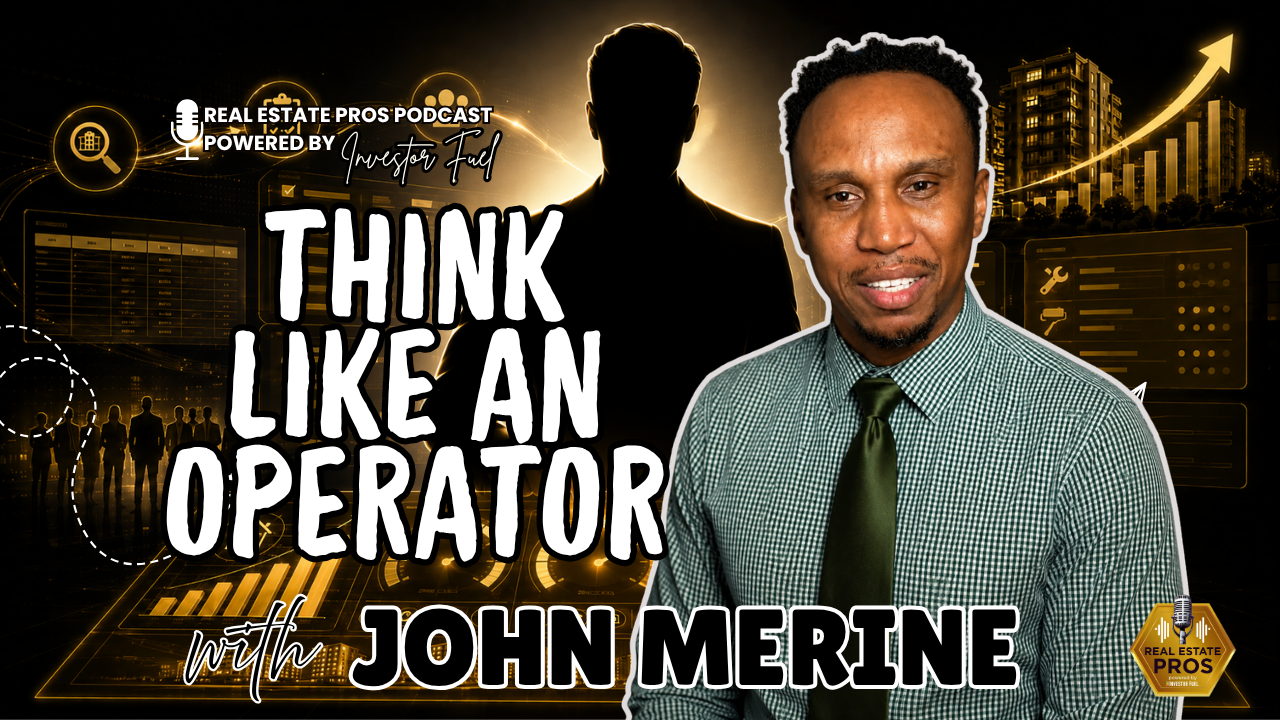
John Merine shares his journey from traffic engineering to successful multifamily real estate investing in Tampa. Discover how his analytical skills, market strategies, and operational insights drive his growth and success.

Resources and Links from this show:
Listen to the Audio Version of this Episode
Investor Fuel Show Transcript:
John Merine (00:00)
When you’re doing it, have to think like an operator, right? Buying the property is only the beginning. operation is what’s going to determine whether you succeed or fail. And also, access management is actually where wealth is created. So you have to be able to have good people to manage your assets. That’s good. Today market is what’s separating the real operator.
operators from opportunities people. So opportunities gonna see the deal, say, that’s a great deal, let’s go get it. But the operator is gonna go in detail in the numbers and make sure everything makes sense when they’re the investment.
Scott Bursey (00:00)
Welcome back to Real Estate Pros podcast powered by Investor Fuel. I’m your host Scott Bursey. And today we are absolutely pouring some high octane fuel into your investing tanks. Our guest, John Merine is the real deal who has engineered his way from being a traffic engineer to a massive player in the multifamily space. He’s bringing the fuel of data-driven strategy and scale focusing around the booming Tampa market. Get ready, Pros, because John is here to share. how he identifies those rock solid opportunities and scales them into larger assets. John, welcome to the show.
John Merine (00:28)
Thank you, Scott. a pleasure to be here with you again. .
Scott Bursey (00:39)
It is just fantastic having you here and for our listeners who may not be familiar with your journey. Please give us a front row seat and how your career ignited and where you’re pouring your fuel now.
John Merine (00:51)
Yes, sure. Thank you again for those comments. I started here in Tampa. That’s where I’m located, Tampa, Florida. again, as you say, I’m a traffic engineer by trade. I’m a professional traffic engineer by trade since 2008. I’ve been doing that. then around a few years ago, I decided to join real estate. So I started doing real estate, but as an agent for a realtor, as a single agent in the residential.
family unit. So I quickly realized that the best way to get cash flow is not to residential unit, it’s to multifamily. So then I invested myself in studying multifamily learning the NIO, NOIs, how to calculate them, everything, cash flowing, creating my own spreadsheet, and now starting and get that good grasp of it and now I’m able to bring that.
to the table for my investors to invest in opportunities when they do come around.
Scott Bursey (01:50)
Thank you for that, John. I love how you invested in yourself. You know, what really caught my attention about you was the way that you’ve been able to leverage a highly analytical background, starting in engineering and even the residential market to quickly realize that multifamily was the vehicle for consistent cash flow. You built your own DSCR spreadsheets and
immediately started underwriting duplexes and quads to build that foundation. That that intentionality and quick shift is pure investor fuel.
John Merine
Yes, absolutely. It is. I started to do it. When you do it, when I was involving residential, I see about like a 10 % on the side. So I realized, okay, how do I get consistent? Because as you know, the temper market right now,
I’ve slowed down completely in residential. We have houses that are sitting for like months on the market. You’re not getting clients to buy, so you’re not buying, you’re not listening. I’m like, okay, let’s focus, let’s pivot, let’s pivot to what’s really making real estate grow. What is that? That’s multifamily. So I’m like, okay, what do I need to learn in that market to get the leg up? So that’s why I went and invested my time learning about it, and now I’m…
well invested in the subject matter. So, like in school, I use my knowledge and engineering the numbers to understand the numbers now and understanding them, making sure they make sense. So now I’m ready to point to my investors when they have questions I can answer.
Scott Bursey (03:24)
Yes, you’ve clearly mastered the transition from a technical mindset into a full-scale real estate operator. Let’s dig into your market focus and strategy. What technical skill from your engineering background is the biggest strength in consistently underwriting deals?
John Merine (03:35)
All right, awesome. That’s a great question. So it’s going to be in speed and understanding the points, right? You have to understand the seller’s point. And you have to also be active in the market. But you cannot own that right if you’re not active in the market. So you have to be active in the market as an operator to get the constant market intelligence so you can know.
where they fatigue mommy and papa owners that want to get rid of it. Some other, again in the temple market, the unions are a little bit rich. So you have to find the people that’s looking there at deferment, but they don’t want to deal with it. They’re to get rid of it. then finding those other deals that when you receive the rent going to T12.
Is there any operational inefficiencies there? And then to get those ones, so you say, I can improve operations on that. And then you have also looking to see, okay, the temper again, a lot of people are moving in. Is the market rate at where it is? And if it’s not, why is it not there? So do I need to improve the units to get the market rate up? Can I do it? Because yes, you can improve the unit, but you’re actually not.
Cannot raise the rent right now because it’s gonna be a burden on the renters and you have moving out So it’s understanding all the numbers everywhere coming from finding the relationship building on the relationship with your Realtors the listing agent and the mom and pops also that’s looking to get get out of it or a kid that was Inherent the property, but they don’t want to take care of it because too much head and find out
and then get to talk to these people and then see if we can get those deals using your brokerage channels to get to them.
Scott Bursey (05:27)
I love that John, that analytic rigor is the foundation of smart growth. Let’s shift gears here a little bit. In a competitive market like Tampa, what’s the toughest hurdle right now for securing deal flow on larger assets?
John Merine (05:45)
Yeah, so the toughest hurdle hurdles right now, two of them are men when I can think of. The aging of the units, are lot older than regular units, and when you look into the investment in those units, you’re at properties that are built in 1980s and up, newer, but in the 10-pound market, you’re finding properties that are built in the 60s and 70s. So that’s one of the hurdles. It’s like you’re gonna have a lot of potential plumbing issues because if you know
Anything about plumbing? The plumbing in the early age before 80s were in the iron. But now you’re with copper. So it’s different to deal with. And then the other issue that’s most hardest hurdle for a lot of investors is capital raising. Finding those investors that trust your judgment when you find a deal to invest in your deal.
Scott Bursey (06:36)
Those multiple components keeps the focus clear. Let’s rev up the engines here a little bit. John, what single trend or factor is driving your strategy to scale unit assets right now in your two to three hour Tampa radius?
John Merine (06:37)
Single scale driving, it’s boots on the ground. So I want to be able to go out there to see the units themselves.
When I find those units in the two or three hours radius of Tampa, I want to be able to drive to that location. also, since the location is so close to Tampa, I have to have a good understanding of the market also. So you have to understand what’s going on in the market in that area, in that region. So before you go invest in it, you can go try to invest in Tallahassee, but that’s six hours away from Tampa. So what do I really know about Tallahassee?
But something closer to temper like the Ocala region, Bradenton, Salsoda, that’s still considered in the temper of the region. So I can get there and not only that, it’s closing off the temper that I have a basic understanding of the market, what is happening in that market region. So that’s one of the biggest thing I like about the radius I set up.
Is to be able to get there when I get down that tie so I can go look at the properties Talk to the listing agent talk to the property management so I can get a understanding of what’s going on with the property because I don’t want to get there and I’m too tired to talk or I miss something because you don’t want to miss Something that’s going on with the property. So that’s why that radius is perfect
Scott Bursey (08:15)
Having the boots on the ground, that deep understanding of your local market, of your niche market, that is so, so critical. And on that note, what is some long-term strategy for the Tampa market?
John Merine (08:16)
oh… growing the region is growing a lot of people are moving into that region right now in the temporary region Pasco County that’s one of the fastest growing county in the nation period and then if you listen to what’s going on like the temporary race actually looking to move in the Tampa area not incentive they’re trying to move in downtown Tampa again that’s going to create opportunities
The rent is going to keep growing, you’re going to have more people coming, you’re going to have have unity, because you’re to have have supply issues. So you’re going to have a lot of demand, but you’re not going to have the supply. So that’s the long-term outlook for the temper market. Again, it’s growing. There are some headwinds, again, with the insurance. But the growth is still happening. People are still moving down here for the sunshine.
Scott Bursey (09:29)
Let’s raise the RPMs here a little bit. For investors looking in the Tampa market, what overlooked risk should they be stress testing for right now in the due diligence process?
John Merine (09:30)
That’s a great question. You have to stress your deal. The thing you have to look at is the insurance. The insurance are highly volatile right now.
One way the government is looking to combat that is with the property tax. They’re trying to either reduce or eliminate it, for you to be able to afford it. That’s one of the things you have to look at. And since, again, the units are older, you have to look at your capital planning. That has to be on point if you’re looking to go for the units that are in built in 1960s. Because you’re gonna have issues and plumbing they’re gonna lose you.
because those units are older and you’re going to need to do a lot of updating to them. those are the two things the insurance because again it’s highly volatile one hurricane away insurance can go from a thousand to four five thousand easily. But I’m seeing right now in the market we have a lot of units that are coming on the market right now because the insurance the owner the property they can afford it it would be like
1000 then it’s like 7000 all of a sudden so that you have to stress test that because for your dsr to work now looking at how pi i always look at the ptia to see everything ensuring and also an interest to make sure that you have a good dsr ratio even when you stress test it even if your rent was to stay current and your insurance will keep rising because insurance is going to keep rising
So you have to stress this product.
Scott Bursey (11:23)
100%. I love how you frame that. What is the most critical piece of data you rely on when identifying a true value add opportunity versus just a poorly managed one?
John Merine (11:45)
Yeah, so the most important data you have to look at is, have to look across the board on your seat well. See what happened and understanding either in your rent if it’s good they’re doing concession a lot because again the market is softening and You have to look at your repairs and maintenance. You have to look at already last 12 Months or the last three months What happened are you seeing consistent? Repairs consistent cross across the board or you are using up and down
Those are the things you highlight and then when you call the agent or you call the property manager you go talk to them about okay what happened he helped me understanding what the issue was so I can see and I can underwrite the property data better. You have to look at those to make sure they’re And the information comes in the data. Fantastic advice John consistently in the underwriting phase of things if I’m getting you correctly.
Scott Bursey (12:30)
That was fantastic, fantastic advice, John, consistently in the underwriting phase of things, if I’m hearing you correctly.
John Merine (12:40)
Yes, yeah, consistently. Now it’s time to move to the main event, the part of the show where you supply the high octane fuel. This is our money question. Given your successful transition from starting with duplexes and quads to scaling into larger multifamily assets, what is the most important metric or piece of due diligence you rely on to confidently decide when to transition from managing smaller value add properties to underwriting?
Scott Bursey (12:42)
Now it’s time to move to the main event, the part of the show where you supply the high octane fuel. This is our money question. Given your successful transition from starting with duplexes and quads to scaling into larger multifamily assets, what is the most important metric or piece of due diligence you rely on to confidently decide when to transition from managing smaller value add properties to underwriting and acquiring a
full scale institutional asset?
John Merine (13:08)
and acquiring a full-scale institutional
asset? Yes, that’s a good question, Scott. Thank you for that. So when you’re doing quad, duplex, and triplex, something technically you should be able to manage yourself, or even you can find some good software, management software out there to help you with that. But when you start moving into 50 to 100 units,
then you have to have a team built around you that understands these spots. The team has to consist of you have to have your underwriting, you have to have your asset management, that’s the biggest one because those people are to manage the asset. So you have to have a good team that knows how to manage the asset. They have a relationship already with multiple property managers out there, not just one. So you have that and then the capital raising.
So you have to build that credibility before you can go out there and raise capital because there are three things I think people need to know about. it’s about know, trust, and like. So if they don’t know you, they’re not going to trust you. They don’t like you. If they don’t know you, they can’t like you either. So they have to know you. So you have to go out there. have to build that credibility with the capital raising. But the asset management team has to be solid.
The under riders around that on that team also have to understand not only understanding number What do they numbers make sense? So that’s how you can scale up from the duplex to? 1500 units
Scott Bursey (14:41)
John, you just ignited the fire for our pros. Is there any additional advice you can leave with our listeners today?
John Merine (14:52)
Yeah, sure. I can give them a lot of advice a good one. It’s like When you’re doing it, have to think like an operator, right? Buying the property is only the beginning. operation is what’s going to determine whether you succeed or fail. And also, access management is actually where wealth is created. So you have to be able to have good people to manage your assets. That’s good. Today market is what’s separating the real operator.
operators from opportunities people. So opportunities gonna see the deal, say, that’s a great deal, let’s go get it. But the operator is gonna go in detail in the numbers and make sure everything makes sense when they’re the investment.
Scott Bursey (15:30)
John, this has been an absolute clinic. For those of our listeners that want to keep this conversation moving or collaborate with you, what is the best way for them to plug into your pipeline and reach you directly?
John Merine (15:44)
Yeah, sure. I can give them a lot of advice a good one. It’s like The best way to reach out to me is at [email protected]. John @ greenlightinvest.com. And when you do reach out, I will send you a free copy of this education book to help you understanding the best way to get into bigger property in the multifamily market.
Scott Bursey (16:06)
John, thank you for joining us today.
John Merine
Thank you. You’re welcome.
Scott Bursey
And to our listeners, we appreciate each and every one of you. If you got value from today’s episode, please subscribe. We’ll be fueling your tanks with a lineup of elite guests, just like John Marine, who are accelerating and setting the pace for the rest of the industry. Until next time, keep your standards high and your vision clear. We’ll see you in the next episode, everyone.