Subscribe via:



Show Summary
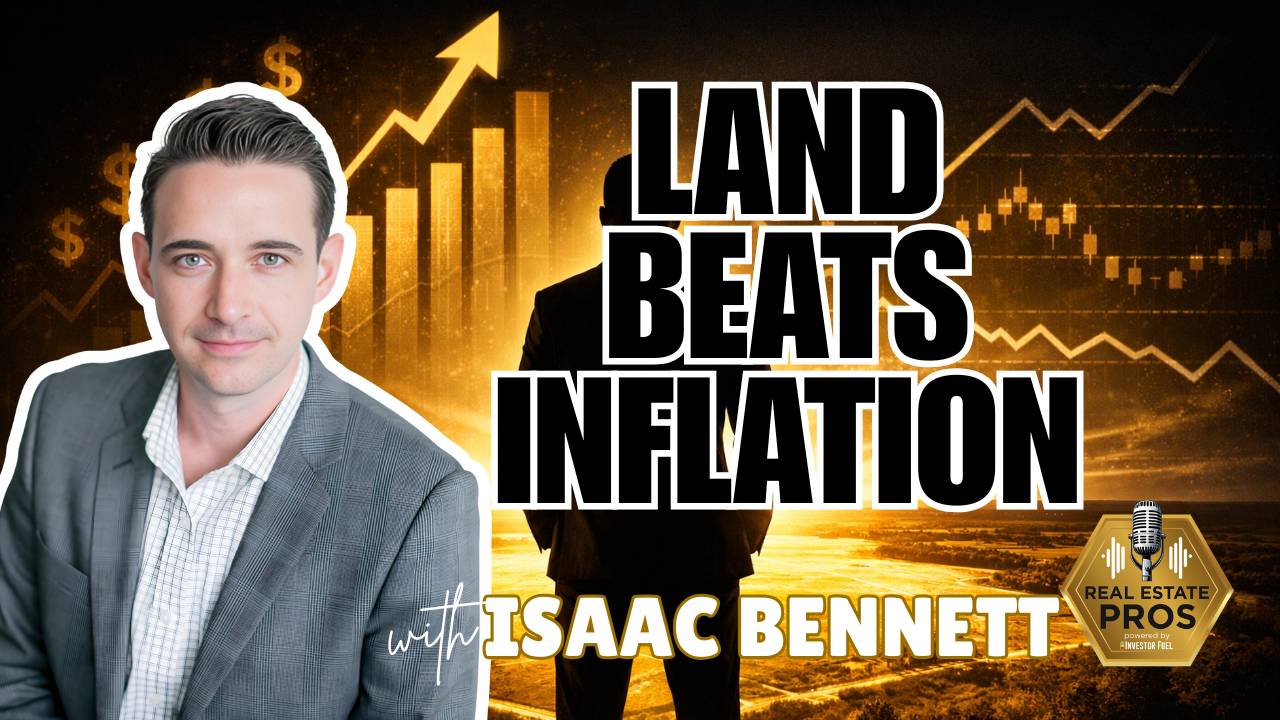
In this episode of the Real Estate Pros Podcast, host Micah Johnson interviews Isaac Bennett, a seasoned real estate investor focusing on land development. Isaac shares his journey from residential real estate to land development, discussing the current economic climate, the importance of understanding market cycles, and the philosophy of creating mutually beneficial deals. He emphasizes the significance of heart posture in business and the value of building genuine relationships. The conversation also touches on future projects, including an AI data center land fund, and the importance of self-reflection in personal and professional growth.

Resources and Links from this show:
-
Listen to the Audio Version of this Episode
Investor Fuel Show Transcript:
Isaac Bennett (00:00)
the problem with cycles is that expenses oftentimes grow faster than rents do. And problematically, ⁓ real estate does not appreciate, right? The land around it either appreciates or depreciates based on all the economic surroundings around that piece. The real estate on top of it always depreciates, always depreciates.So if you can force, uh, force equity through, you know, so when you’re in an environment where expenses rise at least as fast as rents or faster, which is typical of an inflationary environment that the expenses will rise faster. There’s it’s a real problem to be in it.
Micah Johnson (02:07)
Hey everyone, welcome to the Real Estate Pros Podcast. I’m your host, Micah Johnson. And today I’m joined by Isaac Bennett, who’s been making serious moves in the land development space. Isaac, welcome in, man. Glad to have you.Isaac Bennett (02:19)
It’s great to be here, Micah. Thank you for having me.Micah Johnson (02:22)
Absolutely, absolutely. I’m excited for you to be here. I think our listeners are really going to take something away from one, your approach to real estate, how you’ve gone about it, how you’ve thought about it, ability to even pivot, even when you were in one for a certain asset class for a really long time. So let’s dive in. For people that may not know you yet, what is your main focus right now and what markets do you work in?Isaac Bennett (02:44)
Yeah, our main focus at the moment is really land development. So we are primarily in the central Texas markets and also Virginia. We’ve got development all over the place, Georgia, Illinois, Tampa, Florida, really all over the place. But at the moment, we’re really seeking deals, particularly in central Texas and in ⁓ sort of the Leesburg area of Virginia, the DC suburbs of Virginia.Micah Johnson (03:12)
Gotcha. ⁓Gotcha. Okay, so let’s take a step back. That’s what you’re doing now. What got you to where you are today? Like led into real estate and know, Isaac got started now he’s here. Fill us in on some of the gaps.
Isaac Bennett (03:26)
Yeah, I’ve been investing in real estate for about16 years. And I started like most people started with, you know, buying a condo, renting out an extra room, doing that, doing one deal, one deal led to the next led to partnerships led to ultimately syndication. And I’d really focused on residential real estate for a very long time, including multifamily and some other residential asset classes. But really what brought us here was, first of all, we just felt like the multifamily space got
too precious as some of my friends would say overseas, too dear. And we just watched people paying three cap for A class properties and you get all these crazy listings, trophy listing and all this other stuff and it just got overheated and we really just felt like it was very vulnerable and we just backed off and said, okay, well, where else should we think about going? Where do we think there’s opportunity? So. ⁓
Micah Johnson (03:57)
YouIsaac Bennett (04:18)
The rise in interest rates crushed a ton of multifamily investors, as you know, and thankfully we were spared from that. Our timing was ⁓ reasonably good to avoid that. It hurt for a while and it really going up and we kind of exited a little early. But then the other side of that pain really came home. So we started looking for asset classes that we thought were highly defensive and that we didn’t have much of a downside in and we could try to create some asymmetric upside.That’s really what led us down to the path of land development and getting ready to start our AI data center land fund as we speak.
Micah Johnson (04:56)
And what was it about that class that made you feel that way, that was those better opportunities? What in it said, okay, this is something we can pivot to.Isaac Bennett (05:52)
Well, I think I’ll answer that question with a question. How many people do you know doing land development, Micah?Micah Johnson (05:59)
that many.Isaac Bennett (06:00)
Not that many. Yeah, I know a lot of people doing multifamily, a lot of people doing mobile home parks, lots of people in industrial and the only people I knew doing land were like all the crotchety old guys that had been doing it for 80 years and, you know, inherited a bunch of ground from their family. we just saw a niche in the market that we thought, you know, really might be attractive and there’s, there’s inherent problems with it. And the first one is very obvious to anybody listening. There’s no cashflow, right? SoYou have to understand how to position and structure these. we’ve been iterating through that very thing on how to structure something that doesn’t have cashflow. ⁓ And then the other thing people might not see is actually how to add value into it, right? Because real estate is really a terrible investment unless you know how to really add value and force equity into something. And so we did a lot of work and a lot of study around understanding how to add value to land and to develop it.
Once we got to that point and really started to understand what it was, we felt like it was an opportunity where there was just so much less competition and ⁓ really just as many opportunities to add value and maybe even to a greater ⁓ scale. But it’s a different skill set and it’s something that maybe a lot of people haven’t looked at.
Micah Johnson (07:14)
I agree. I think, like you said, when at different times, different classes do they get, they get wore out like that. mean, this is a simple analogy, but it reminds me of when the auctions for storage units started becoming super popular, right? You used to be able to go to those things. I knew guys that would go get all kinds of stuff from them. And then all of sudden it was on TV and you’re buying people paying thousands of dollars for this.Isaac Bennett (07:30)
⁓ yeah.Micah Johnson (07:41)
cardboard boxes full of nothing and it got to where you couldn’t do it anymore. There’s no point. There’s so many people in there doing it that really don’t know what they’re doing because it’s kind of the next cool thing to do. All right, we’re going to go over here and they’re buying stuff that’s never going to pencil. It doesn’t make any sense. It’s not what a real investor would do. It’s just to say, I got a deal.Isaac Bennett (07:45)
Yeah.Mm-hmm.
Cycles matter. Cycles matter a lot. think that’s what you’re touching on really well. you know, when you look at
Micah Johnson (08:05)
Yeah. ⁓Isaac Bennett (08:08)
the problem with cycles is that expenses oftentimes grow faster than rents do. And problematically, ⁓ real estate does not appreciate, right? The land around it either appreciates or depreciates based on all the economic surroundings around that piece. The real estate on top of it always depreciates, always depreciates.So if you can force, uh, force equity through, you know, improvements or, um, growing in a lie through whatever strategy you may be employing, that’s fantastic. And it is a vehicle to do that. But, um, ultimately the thing that you built always depreciates. And so when you’re in an environment where expenses rise at least as fast as rents or faster, which is typical of an inflationary environment that the expenses will rise faster. There’s it’s a real problem to be in it.
Land is a little bit the opposite. There’s really not a lot of inherent expenses in holding land. So if you get into an inflationary environment, a lot of times the land will benefit, but you won’t really have the concurrent expenses growing along with it. So we think it’s why farmland for one does really well in inflationary environments. We think that if we are in a protracted inflationary cycle, which I think is almost irrefutable at this point, that land should do really well, even if you’re not asymmetrically growing value through.
Micah Johnson (09:06)
Mmm.Isaac Bennett (09:23)
So we just believe the cycle right now suggests you should be in something that has a tendency to do well with inflation as opposed to being crushed by it.Micah Johnson (09:35)
Yeah, touch a little bit on the part of the cycle that we’re in right now. You know, expand on that idea of, again, this is why I’m here and this is what I’m seeing and what determines that decision.Isaac Bennett (09:47)
Well, we’re in a cycle where we have massive debt loads. And I think when you have massive debt loads, that they’re always going to win the day. So there’s always going to be pressure on interest rates going down. mean, it’s actually a two, it’s a two-edged thing. Massive debt means interest rates should be going up, right? Because naturally to clear, to clear the debt rates should be going up.But from the federal government standpoint, they can’t afford that, right? So they’re always going to have to be pushing
rates down and injecting more liquidity into the system to get the bond markets to actually function. Well, problematically, when they’re doing that, they’re also introducing capital into the system. That’s the way it works. So if they’re artificially suppressing rates, then we’re going to have massive amounts of capital coming in just to service the debt over and over. So it’s a bit of a doom loop, actually. That’s a really scary way to put it. But it’s ⁓ a bit of debt cycle doom loop. And we just think the only way out of this is to inflate it away.
Micah Johnson (11:11)
Right. Yeah, no.Isaac Bennett (11:19)
And we, know, they’re going to obfuscate the numbers for sure. But, you know, they’re going to say, look, we’re, one thing you’re going to see, and you’ve already seen the language changes, you’re going to see them target inflation at 2%. That number is eventually going to move to 3 % and then maybe even 4%. Well, the net effect of a 4 % inflation compared to 2 % inflation is the currency dying between here and there, between 2 4%. That the reality of can a currency sustain it? No inflation is a good thing. That’s always been a lie.that the school systems have taught people. Inflation is not a good thing. The great miracle of capitalism is deflation. It’s people going out there and competing with each other, you and me going and competing and trying to drive prices down for consumers. That’s the miracle of it. So all of this comes back to the fact that the debt is in such a place right now that there’s basically no way out of it other than inflating it away and then lying about how much the inflation is. And so that’s why you’re seeing this incredibly bifurcated economy that we have where
Most people are struggling and really struggling and only the people who can really understand the system and benefit from it are doing well. And that’ll get worse and worse and worse until something really bad happens. And I’m not here to sell fear. That’s not what I do at all, but that’s just what history tells us will happen.
Micah Johnson (12:32)
Exactly. At some point you got to look at the facts soberly and come to some conclusions and at least come up with an idea, something like it’s what you’re, it’s literally what you’re doing in your own business. You saw this thing. You can’t just fake it away. You can’t smile it away. You have to deal with it in some form or fashion. The longer you wait, only the harder it’s going to be. Even in your case, the multifamily.Isaac Bennett (12:45)
us.Micah Johnson (12:57)
You got out when you did and it was still a little bit tough, right? Like doing the, it just is at some point you got to rip off the bandaid and it’s going to be, it’s already hard. Like you’re saying, it’s really hard out there just in the normal landscape. There’s certain sections doing great, but the majority it isn’t. And that is something we’re going to have to solve at some point. It just is.Isaac Bennett (13:06)
Mm-hmm.Micah Johnson (13:22)
The more people being sober about it now, the better chance we have, even if it’s just in your own business. Like the fact that you’re even thinking about it, this is, I think it’s important. It’s an important message folks need to hear.Isaac Bennett (13:32)
Yeah, it definitely is. And really just understanding what to do during those times. And it’s not obvious, actually. It’s not obvious. I I think dividing sort of portfolios into, you certainly don’t want bonds. You don’t want long bonds, probably at all. ⁓ But dividing it into something like land, ultra high quality businesses that are trading at fair prices. And the good news is, is there is actually those out there. ⁓And then, you know, some really, really hard assets like precious metals and those have gotten a lot more expensive, but I, at the end of the day, I would still want them allocated in a portfolio for sure.
Micah Johnson (14:09)
Well, it’s finding those things that have stick and power. And that’s one of the reasons I like land so much is there ain’t no more land being made, right? Like if you can get some land, like you got something in your hand at that point, like it’s lasting. It’ll outlast you for sure. And it’s, it’s even goes back to when we left the gold standard. There was a reason that we did that, ⁓ cause we defaulted on our debts. couldn’t pay it back. So we invented a new way to keep going and it’s cranked this problem up. So it’s man, I find it fascinating. So.Isaac Bennett (14:16)
Mm-hmm.Mm-hmm.
Mm-hmm.
Micah Johnson (14:39)
What’s your focus for 2026? You’re in this environment. This is what you’re doing. What’s the business got its nose to the ground getting done?Isaac Bennett (15:30)
Yeah, I think there’s, depends on which sort of facet of the business you’re talking about. If you’re talking about on the land side, we are, the deal flow that we’ve had on the land side has been spectacular. We haven’t marketed it at all. We can put it out there, just our network of relationships. So we’re really focusing on these parcels where we think we have, our downside is basically selling it for a small profit for its base case. And let’s call it space case. could be a lot of different things. Space case could be farming or it could be single family homes or whatever it may be. And it’s.upside, you we might be 20, 30, 50, 100 X if we can actually effectuate a strategy that lands a data center on it. Right. So we’re focusing in on these deals where we can do that. And a lot of these are participation deals, Micah, where a landowner might have a couple hundred thousand acres in their portfolio and say, yeah, we would kick two, two thousand or 3000 acres into a participation deal where, you know, their land value is preferred. Let us go do the work and we’ll try to try to hit a home run with a, you know, a data center development or something like that.
And those kind of deals work really well for us because they’re not really taking any risk, the landowners not, and they might have land that’s been sitting there for 60 years and somebody comes along and says, let us do something with that. So we love those deals. We’ll put the investment into them and do them. So got a bunch of deals coming on the AI data center land fund. And we think it’ll be a very ⁓ popular investment when we actually haven’t even opened up, opened to the public for investment yet, but we will soon. I think that’ll be a very popular investment. ⁓ On the venture side, we’ve had some incredible
incredibly impactful ⁓ business deals that we’ve been able to do. haven’t taken a deal in 18 months, but I think we’ll take a deal or two this year. We’re looking for things that impact people that are basically for the good of humanity that also have asymmetric. I’ve used that word too many times, but it’s what we do. Upside. Yeah. Yeah. Cause we, we do think people need some venture in their portfolio. That’s very carefully selected and
Micah Johnson (17:14)
No, it’s one of my favorite asymmetric bed to the upside baby. Come on.Isaac Bennett (17:25)
And obviously we’re betting on founders that have really incredible IP or ideas, designs, inventions, et cetera. So I think we’ll take one or two deals in that section. So it’s for a small port of your portfolio, but if you want to try to make a 5, 10, 20 X on something over five years, this is the place to try to do it. And then we’re, you know, we’ve been setting up our royalty business, ORA Royal, and we’re working on building out our board members for that. So that’s a passive business that again, it’s probably a conversation for another day, but it’s been fun.Micah Johnson (17:55)
Well, it just shows you how much that you’re into, man. That’s what I appreciate about the conversation is it’s you’re taking it serious from each level. And one of the things we talked about pre-call was it’s actually your approach across all businesses. The one thing that is unanimous. And I think you said it this way, no deal unless mutually good was something that y’all it’s it’s it’s the filter before you even act and expound on that a little bit. Why is that such a big impact in your business? And what what has it done for you in your career?Isaac Bennett (18:13)
Mm-hmm.Well, I think it’s an intrinsic sort of belief system, first of all. And then within business, I have just been around so many people who want to win a deal. And they’re just not that enjoyable people to be around. And I don’t think ultimately you make an impact on this earth if you’re trying to win all the time. And ⁓ it creates a zero sum game.
And if that is where you keep going, eventually everybody ends at zero. We just think that the world is big enough and that ⁓ abundance is prevalent enough that everybody should be able to have a mutually good deal. That’s every stakeholder, right? That’s anybody that’s sitting at the transaction table, that’s customers, that’s clients. Do we do this perfectly? Absolutely not. No, we let people down all the time, but we use this filter to say, before we sign anything,
We say, this for the mutual good? we checking ourselves and serving everybody within this? ⁓ know, Sam Zell, I don’t know if he actually did this, but he said he did this. He said that he intentionally left money on the table on every single deal. And he just felt like it was a better way to do business and he could do business repeatedly with people for over and over over over and over. And that’s what we want to do. And transparently, Micah, we have run into multiple partners who quite simply didn’t believe that.
they really did not work that way. And inevitably, they weeded themselves out of our sort of ecosystem because it just didn’t work that way. So ⁓ yeah, I just think sitting down honestly and looking at each stakeholder’s position and saying, this work for them is something that we’re always going to try to do.
Micah Johnson (20:13)
And that’s commendable, honestly. I, I approach life and things the same way where it’s a people first mentality. the end, humans created everything that we see around us. Like even our financial systems, we made all of this up y’all. We made it up. So at the very beginning is just you and I working together. And even with a business mindset involved, the most expensive part of your business is usually new customers. Those are the most expensive. If you can get a customer and stay with a long time.Isaac Bennett (20:33)
Mm-hmm.Micah Johnson (20:42)
That’s how you generate wealth with a customer. And so I love what you said about Sam. I hope he did do that. Cause that mentality and discipline to do it, it brings you more deals than you could ever imagine throughout your lifetime. That my mentor, calls it paying it forward to your future self. Like if you really want this life that you say you want, then treat people this way on the way. And that’s how you create it. It’ll constantly farm itself.I grew up farming, so I call it farming time. Like if I’m farming time well, then what I’m gonna do today should grow this crop at some point in the future, because that’s just how farming works. You’re gonna grow something, it’s gonna be weeds or what you were hoping to pull off in the beginning, but it’s always gonna do it. So the more that you, and…
It seems too simple, honestly, is what I feel most people think, but it’s not. They’re really actually caring is a game changer and your life, your business, the whole nine yards just actually carry.
Isaac Bennett (21:39)
Mm-hmm.It is, and it comes down to heart posture, right? And so the one thing I would say is don’t fake it. Do not fake it, right? Like it actually has to be something that you feel in your heart and that you want to do from your heart. I’ll just give you a really short, and my heart doesn’t always feel that way. Like there are times when I have to really check myself in a deal or, you know, I’m greedy about something or, you know, I’m short with people about it. It happens all the time. But, you know, I was sitting with a partner of mine in a deal.
and or just sitting with him talking before another another person came in. He goes, why did you what was the wire you sent me last week? I said, what do mean? He said, what? did you send me that money? that was your your your your take from XYZ. He goes, I didn’t know I was a part of that. You are you get paid for it. And it was just like this. It’s just like this idea of of it. I don’t know. It’s just fun to see somebody getting rewarded where they didn’t think they were getting a reward.
Micah Johnson (22:40)
Yeah.Isaac Bennett (22:43)
And honestly, that’s very rewarding to have that kind of thing happen. So was pretty cool.Micah Johnson (22:46)
Sure.It’s like going on offense and doing good, right? Like getting out there, doing it on purpose where it is. It’s like Santa Claus, right? When you get to be that way, when you really get to show up. Because there’s, know, altruism is an interesting thing, but you feel great after you do that. There’s an emotional paycheck that you get paid when you go about living that way. One, I have a 10 and a 12 year old. I got to teach them to be good people before anything.
Isaac Bennett (22:51)
Mm.You see that?
Mm-hmm.
Micah Johnson (23:14)
If dad can’t go home and put his head up on his pillow at night, I got a problem. I got to, I’m doing something wrong. Cause that’s who I care about most. I grew up in a bizarre environment where I watched behaviors that weren’t the healthiest. And what I learned throughout my life was it’s not what you told me. It’s what I saw you do over and over again that had the biggest effect. And so if that’s the case for me, it’s 100 % the case for my kids. So they need to see dad doing awesome stuff, not just me saying, be awesome.Isaac Bennett (23:15)
Mm-hmm.Yeah. Yeah. Yeah.
Absolutely. That’s exactly right. And that’s, you know, it’s important to both for your family and for yourself. It’s important to surround yourself with people who encourage you to be that way and sharpen you in that way. Right. That’s one of the hardest lessons I’ve had to learn is who I tolerated and was around who the denominator was, who was lifting the denominator and who was lowering it. Right. And that’s, that’s a very challenging thing to think about in our own lives is to be that person that raises that for, for people raises that bar.
Micah Johnson (24:14)
Right? Absolutely. it’s like you said, it’s not a journey to perfection. You’re not going to do it perfect all the time. But if you can at least see that, you’re miles ahead of most. Like being able to at least see you’re doing it means you can adjust, means you can learn, means you can at least, because what is it? I know that sometimes with my daughter, some of the most powerful moments are when I went and said I was sorry. Hey, I messed up. Right? I messed up. Sorry about that.Isaac Bennett (24:37)
Yeah, yeah, humanity, yeah. Yeah.Micah Johnson (24:41)
Even to people in business, different things. Hey, this happened. I didn’t mean for it to happen. I’m to face you, head up on it just tell you it has actually strengthened more relationships than it breaks typically because that’s really what it does. And we were talking about this a little bit before in the pre-call. And the way you answered the question, I really appreciated. We tossed the term networking around and then there’s the term relationships.The key is the relationship part. Knowing a lot of people, okay, but do you have those solid relationships in your life that are for each section, right? Are they ones you can count on? Can you really count on them? And those require you to be part of it too.
Isaac Bennett (25:23)
Yeah, it’s slowing down, I think, and it’s seeing the other person, you know, not for what you can take from them or what they can bring you, but seeing the other person for who they are and their identity and ⁓ ultimately how you can serve them. again, that’s much easier to say than do. But ⁓ I think we were talking about networking. I don’t really network. I feel like that.Micah Johnson (25:40)
Mm, it is.Isaac Bennett (25:47)
the right people come into my life when they need to, and it’s taking the time to be present with them and to serve them in any ways that you can. And I don’t know, when you serve people, it tends to be reciprocated, right? It tends to take care of itself. ⁓ try my best to do that. I fail at it a lot, but you could ask my wife. I fail at it all the time. But no, I mean, think that’s the basic premise, right? So it’s, I will say that.There’s not a lot of people who have that mentality, I think. And so, you know, you have to be careful not to just get used constantly, but ⁓ ultimately, I think again, it comes back to our heart posture.
Micah Johnson (26:28)
Well, and that goes back to being sober about the facts. Like if you keep serving and you keep getting used at some point, you have to be honest with yourself. You have to be able to do that because it’s you’re right. A lot of folks lead with that heart and get burned a lot and end up being hard later in life. And it’s just like, okay, we just need to balance that. Like you were full burn on service, but you weren’t doing it in a way that was mutually beneficial. It was only tilted one way. Even though serving people is good. If you do it to your detriment,Isaac Bennett (26:31)
Mm-hmm.Mm-hmm.
Yeah, right. Yeah.
Micah Johnson (26:58)
That’s not service anymore. That’s self-inflicted wounds. That’s what you shifted into and don’t confuse the two. So it’s, man.Isaac Bennett (27:01)
Be gays.But I think
you’re exactly right, Mike. And it probably gets down to actually motive and motive for why you’re serving them in the first place. Because if your motive is even slightly wrong when you’re serving somebody in any capacity, you will get bitter so fast. It’s just not working. yeah, mean, that’s. ⁓
Micah Johnson (27:20)
Right? Right. It’s easy to farm resentment. It’s not hard.And that’s kind of the indicator, honestly, in my own life when I’m doing it. If I start to feel that resentment feeling, I’m off. It’s a check. It’s like a check in my system. Okay, something I’m doing has triggered this and I need to go see what it is in this situation because I’m not showing up the way I want to. If I’m feeling resentment, it’s me first. Like, what am I doing and what do I need to fix?
So often we do wanna throw it outside of ourselves first. It’s like, no, hold on, that’s about you. The first, when you get bothered, that’s information for you. Check yourself and then look outside. Now you can read the terrain.
Isaac Bennett (28:00)
Because the resentment and the bitterness, I mean, it really is not affecting anybody but you and those around you. You know what I mean? So you might as well go look at your own soil and see what’s happening.Micah Johnson (28:06)
Exactly. Right.Well, Isaac, man, I really appreciate this conversation. For those that are listening, someone that would either want to follow what you’re doing or learn more about one of your projects, what’s the best way to find you?
Isaac Bennett (28:23)
I think our website is a good place. It’s apeoplebrand.com. That’s our slogan. ⁓ Or just email me, Isaac, I-S-A-A-C at apeoplebrand.com. I’d be happy to, email’s a great way to get ahold of me.Micah Johnson (28:37)
Excellent. for those listening, we’ll make sure and watching that we’ll make sure that those are in the show notes so that you’ll be able to get a high, get a hold of Isaac, find out more about what he’s doing. Again, Isaac, thanks for being here, man. Those of you tuning in that got value, please like this episode, share it, subscribe to our podcast. We’ve got more episodes coming up with operators just like Isaac out there. They’re building real businesses, being real people. And I appreciate that. So until next time, we’ll see you on the next episode.