Subscribe via:



Show Summary
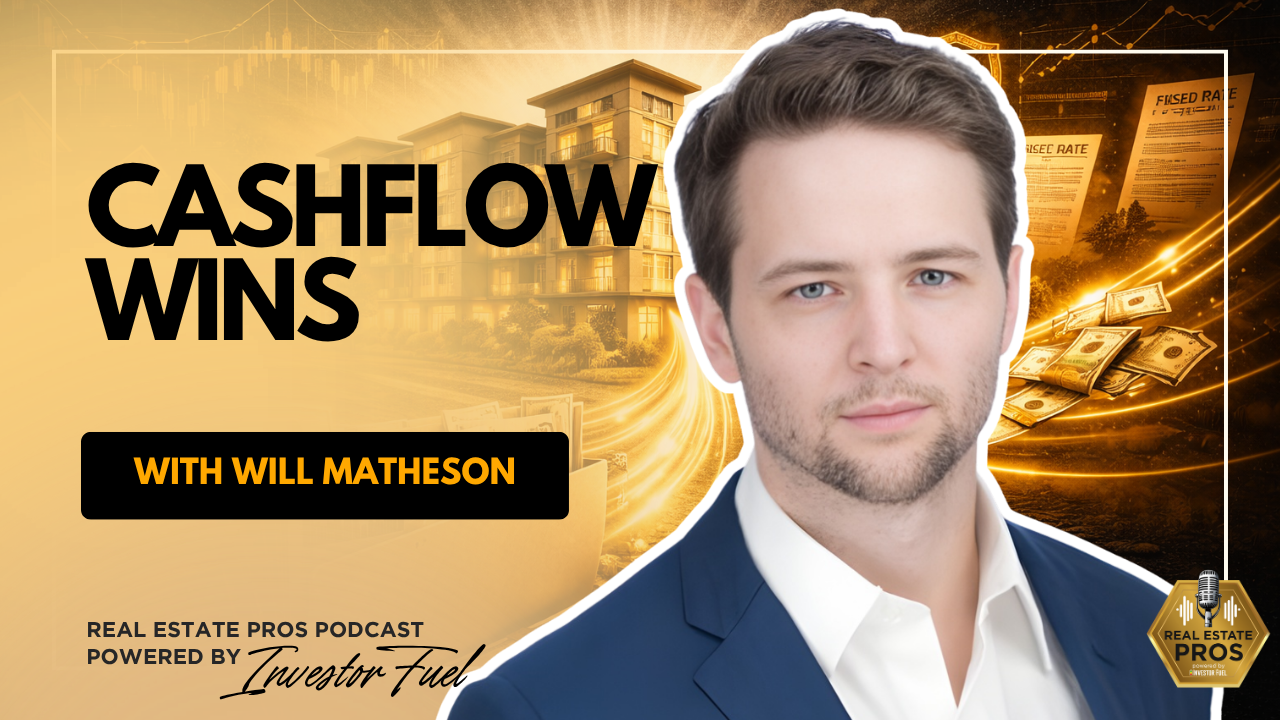
In this episode, Will Matheson of Matheson Capital shares insights into his journey in multifamily real estate, strategies for growth, and how to navigate market challenges. Discover how timing, investor relations, and risk management play crucial roles in successful real estate investing.

Resources and Links from this show:
Listen to the Audio Version of this Episode
Investor Fuel Show Transcript:
Will (00:00)
I think it’s largely just the market in general has been really difficult. If you bought in 2020, 2021, you don’t want to sell. The values of absolute cap rates, interest rates have really not helped you. So there’s not a lot of people who want to sell properties they bought in 2020, 2021. So from a supply side, from a buyer’s perspective, there’s not a lot of supply of available properties to buy.
Michelle Kesil (00:04)
Hey everybody, welcome to the Real Estate Pros podcast. I’m your host, Michelle Kesil. Today I’m joined by someone I’m looking forward to chatting with, Will Matheson of Matheson Capital, who works on multi-family deals in the Southeast US area. So excited to have you here today,
Will (02:23)
Thank you for having me.
Michelle Kesil (02:26)
Yeah, of course, let’s dive in. First off, for those not familiar with you and your work yet, can you share what your main focus is these days?
Will (02:36)
So at Matheson Capital, main focus is multifamily properties in the southeast, or in United States. We’ve owned in North Carolina, South Carolina, Georgia, and Alabama. And generally, we have a strong focus on cash flowing assets. That’s primarily been our focus the last few years.
Michelle Kesil (02:58)
son and how did you get into real estate?
Will (03:04)
So I work with my twin brother Evan and we have ⁓ a bit of a family history with real estate. There have been quite a few brokers, people who worked at CBRE and our family. Our first jobs out of college were at Marks and Millichap down in North Carolina. Did that for a few years and decided we really wanted to be on the ownership side of things. So we left Marcus, we spent a year in grad school at Columbia. Then we just decided, look, let’s…
start trying to buy these deals ourselves. It’s a big world in real estate. It’s a really diverse, not highly concentrated world. So I might as well go out and try to buy a piece of it for ourselves.
Michelle Kesil (03:46)
Awesome. And why specifically multifamily?
Will (03:51)
So it’s kind of funny thinking back on it now when we got into, when we were brokers, we were primarily doing retail, net lease retail, strip centers. And we had this theory at the time that if you do a retail deal and you lose a tenant,
you can just get completely wiped out. Obviously you can re-tenant the property, but there’s always a chance. We had seen so many examples, because we were brokering in 2015, 16, 17, we’d seen so many examples of, hey, this is a new construction in 2007 build, triple net lease deal at $45 a square foot in rent, and then it got re-tenanted and it was $30. there’s, like your equity is just getting hammered if that happens.
And we, you know, similar with grocery anchored, you lose your anchors, strip centers, you go backwards. We saw these backwards tradeouts in retail. So we thought multifamily seems like a much harder thing to screw up and lose all of your investors’ money. Now, I say somewhat ironically, that was the reasoning because
a lot of people have gotten hit really hard in the last three or four years in multifamily specifically, so.
We’ve managed to avoid that, in hindsight, that being a big part of the rationale is kind of funny.
Michelle Kesil (06:07)
Yeah, absolutely. And what would you say have been some of the main keys that have allowed your business to be able to grow and run successfully?
Will (06:18)
Well, I mean, if I’m going to be completely humble about it, luck and timing have a lot to do with it. We got into the industry in 2018 where you could still buy properties for under $100 a unit, which is increasingly rare. And we sold almost everything we had bought. So about seven or eight deals we had sold by the end of Q1 of 2022. So right at the peak of the market, we had sold most of our portfolio. It wasn’t a large portfolio. We started with very small deals.
But due to that timing, we had a lot of really happy investors and we didn’t have a lot of legacy asset issues like a lot of people who were very actively buying in 2020 and 2021. So that allowed us to really grow our investor base and do acquisitions in 2022, 2023, 2024, And we’re currently under contract with another asset to close this year. So I’d say we were very fortunate with the timing. were very, you know.
I don’t want say we were lucky to deliver our investors some really strong returns in 21 and 22, but we delivered good returns for our investors. We sold at the peak, so we didn’t have lot of legacy issues a lot of other owners have had. And that’s allowed us to be active the last few years and raise money from investors as opposed to capital calling our investors.
Michelle Kesil (07:40)
Yeah, amazing. And so when you say your investors, what specifically does that look like? Like, what are they investing? Are they investing in the deals with you? Or what does that relationship entail?
Will (07:53)
So we do not have a fund structure. We’re not a blind fund where we raise $50 million and we have discretion over where it goes. We raise on a deal by deal basis. So we always say, hey, investors, this is the opportunity we’ve found. We think it’s a good opportunity. Are you in or are you out? It’s an a la carte option. Sometimes they’ll join us for one. Sometimes they’ll join us for another one. Some investors join us for all of them.
And we’ve also worked with, you know, I want to say close to half a dozen private equity firms who will write a majority of the check or 90 % of the equity or something like that. So we’ve done a lot of syndicating with investors. We’ve done quite a few joint ventures with PE firms. But that’s, you know, that’s how we do it. It’s always one deal at a time.
Michelle Kesil (08:44)
Awesome. And what opportunities are you excited about for where you’re continuing to grow into your business?
Will (08:55)
So mean opportunities that we’re specifically excited about. We are under contract on one deal in upstate South Carolina right now. It’s a HUD loan assumption that we’ve been working on for quite a while. But broadly speaking, you know, I’m sure you’ve heard this a million times. I think there’s some really interesting opportunities of, you know, newer construction that’s been absolutely hammered by the new supply in major markets so you can get newer construction.
assets at very compelling basis. And we’re also starting to see receiver sales, ⁓ bank-owned real estate that is just being pushed onto the market ⁓ because they don’t want to own it anymore. We’ve seen a handful of those opportunities as well. Those, think, are fairly compelling.
Michelle Kesil (09:49)
Yeah, absolutely. What are you most focused on solving or scaling to next?
Will (09:56)
As far as what we’re focused on solving to or scaling for, obviously, first and foremost for everybody, it’s delivering for your existing investors on the projects
currently own. You never can take your eye off the ball on those, beyond that, we’re just, because we do one raise at a time, we’re really focused on, what can we do? How can we grow our equity platform? How can we make more investor connections? We have new investors sign up.
for our newsletter, our mailing list every single week, but it’s just constantly how can we cultivate that and how can we serve more investors.
Michelle Kesil (11:10)
Yeah, and how do you currently connect with the investors that you’re best suited for and get those leads?
Will (11:19)
I mean, so we, I know this is, I don’t know if it’s that atypical, we’ve never done paid ads, we’ve never done anything like that. Really, most investor traffic just comes to us through referrals, through people finding us on LinkedIn. We’ve had a ton of success with ChatGPT. People have just searched for, like we apparently come up pretty well with ChatGPT. We have quite a few investors come to us through an investor review platform called Invest Clearly.
We have really highly rated investor testimonials on that website. And also, to be honest, on the private equity side of things, cold calling. I’ve cold called I don’t know how many real estate investment firms over the years, and we’ve even had some of them result in partnerships because of it. So, you you can’t take the broker fully out of me. I have no fear of getting rejected on a cold call.
Michelle Kesil (12:19)
Yeah, amazing. And what are the types of projects that you’re typically after?
Will (12:27)
Typically it really falls into two buckets which we describe as either cash flowing or opportunistic. know cash flowing is really, it’s hard to find a cash flowing asset these days. We’re looking for a lot of assumption loans or something we can do to really juice the cash immediately, not so much. We don’t really want to be buying that fore cap and taking it all the way up to a value add.
immediately it’s not 2021 anymore. on the other hand, as I mentioned, we have a lot of cash flow focused, but we’re also looking for distressed opportunities. Just call it your opportunistic investing where we bought a BTR neighborhood at $215 a unit, $100 a square foot back in 2024. was a really opportunistic price.
We bought another asset in 2023 that was facing foreclosure and we were able to buy it for less than it was marketed to us back in 2020 after they had put all this additional investment into it. So those kind of fell into the more opportunistic bucket where we told our partners like, look, don’t expect any cashflow from this one, expect it all to come into sale or expect, you know, start cash flowing at a refi opportunity.
So those are the two buckets, opportunistic and cash flow.
Michelle Kesil (14:04)
Awesome. What have been some of the biggest challenges and obstacles that you’ve overcome in your real estate journey?
Will (14:15)
I mean, challenges, obstacles specifically. I mean, one of the challenges Evan and I had when we started is, you we were 25 when we bought our first property. And I always joke that this isn’t tech where people just give a 25-year-old $20 million. ⁓ It’s real estate. It’s much more slow going. So raising equity from when we started was always really difficult. ⁓
That’s why we started with really small deals, buying two unit, four unit, 15 unit properties. So that’s been difficult and it’s been something that we’ve been growing and succeeding more at year over year. We now raise more money than we ever have, but that’s with the caveat that it’s just a tougher market to raise money than it used to be.
that’s been a challenge. And then in the Southeast in particular, just not exclusive to us.
New supply, the market in general, there’s, you know, renter fraud is becoming much more difficult to detect, it’s become much more sophisticated, ⁓ pricing on properties has become much, much more competitive, new supply has really hammered a lot of the major markets. Charlotte and Raleigh, among them, are just awash with new supply. Savannah has a lot of new supply as well. So, operationally, new supply is…
over the last few years has been tough. I’m sure you’ve had this conversation a million times, but multifamily the last few years has been really, really difficult.
Michelle Kesil (16:34)
Yeah, absolutely, that makes sense. And when you’re saying that it’s been difficult the past few years, do you feel like there’s something that would be supportive to shift that? Is there anything on your side that you’re doing or it’s like a more of a external market collective energy?
Will (16:58)
I think
largely just the market in general has been really difficult. If you bought in 2020, 2021, you don’t want to sell. The values of absolute cap rates, interest rates have really not helped you. So there’s not a lot of people who want to sell properties they bought in 2020, 2021. So from a supply side, from a buyer’s perspective, there’s not a lot of supply of available properties to buy.
Michelle Kesil (17:03)
Right.
Will (17:28)
On top of that you have the new construction supply which has put lot of downward pressure on rents, Austin, Texas being chief among them, but you’ve seen a lot of new supplies, Charlotte, Raleigh, Atlanta, a lot of Sunbelt cities. So that’s been difficult from an operational perspective, just dealing with all of that supply. then, like I said, renter frauds become more sophisticated. People talk about insurance taxes, all things going up.
It’s just been a tough few years, which is one of the reasons that we did find ourselves putting such an emphasis on cash flow starting in, call it 2023, either doing loan assumptions or similar things, because we view cash flow as a hedge against risk. If you’re buying a neutrally levered deal and doing a value add program, all of these things, you need a lot of things to go right.
If you’re buying loan assumptions, day one cash flow, it’s really more of the case that nobody knows what the future is going to hold when you sell the property, but at least you should be able to pay dividends to your investors on a pretty frequent basis. And like I said, we do that as a hedge against risk.
Michelle Kesil (18:40)
Yeah, definitely. And what are some of the ways that you make sure the cash flow is in the way that you desire?
Will (18:50)
Well, to the extent, I was just going to say, as a company, things we do to try to de-risk investments for investors were almost exclusively a fixed rate debt borrower. I think I’ve only used one floating rate loan on an acquisition, and that’s because we closed it in 36 days. It was kind hard to line up fixed rate debt in that time. So we did that. We primarily use fixed rate debt. We don’t use Mez, and we don’t use Pref.
And I say that in response to the cash flow question because if you have a lot of Meas and Pref on top of your properties that’s getting priority distributions, if things just go down even so just slightly, your investors are the first ones who don’t get paid because the debt’s getting paid and the Pref has to get paid or the Meas has to get paid. So we use a really simple capital structure, fixed rate debt.
I know taxes and insurance get a lot of attention, but your biggest expense is your debt. So we use fixed rate debt and we avoid the Mezzanpref and that really gives you a baseline of, if I clear this much, I can distribute to my investors.
Michelle Kesil (20:06)
Yeah, amazing. And it sounds like there’s some exciting opportunities to connect with. More investors is networking, something that you’re doing, and how has that made a difference in your business?
Will (20:23)
I mean, you know, this is one of those industries where unless you have a family office or a private equity firm backing every single deal you do, which does happen, you always want to be meeting new people. You always want to be finding new investors. It makes your life easier. also, you know, I think it’s good for investors in a lot of ways as well. So, you know, to the extent we can, we go to NMHC. We go to
the big conferences like that but really in the sense simplistic ⁓ my brother and i just try to post on linkedin pretty consistently put our thoughts out there and that attracts a lot of people ⁓ just to the platform they see us they see our thoughts they’re not mortally offended by them ⁓ so that that always helps there’s only so much in-person meeting you can do and you we live in charleston south carolina you meet a lot of people here but it’s ⁓ you know
Michelle Kesil (21:13)
Yeah, absolutely.
Will (21:20)
Social media is an amazing thing.
Michelle Kesil (21:24)
Definitely, it’s good to expand your network and make connections in this industry.
Well, before we begin to wrap up here, if someone wants to reach out, connect and learn more about what you’re up to, where can people find you and connect with you?
Will (21:46)
I always say the best way to reconnect is either through LinkedIn, Will Matheson, Matheson Capital. I’m on there pretty frequently. But you can also go to our website, mathcap.com, M-A-T-H-C-A-P dot com. You can join our investor list, mailing list for our newsletter. Those are really the best ways.
Michelle Kesil (22:07)
Perfect, well I appreciate your time and your story. Thank you for being here.
Will (22:12)
Thank you for having me.
Michelle Kesil (22:15)
And for those tuning into our show, if you got value, make sure you’ve subscribed. We’ve got more conversations with operators like Will who are building real businesses and we’ll see you all on our next episode.