Subscribe via:



Show Summary
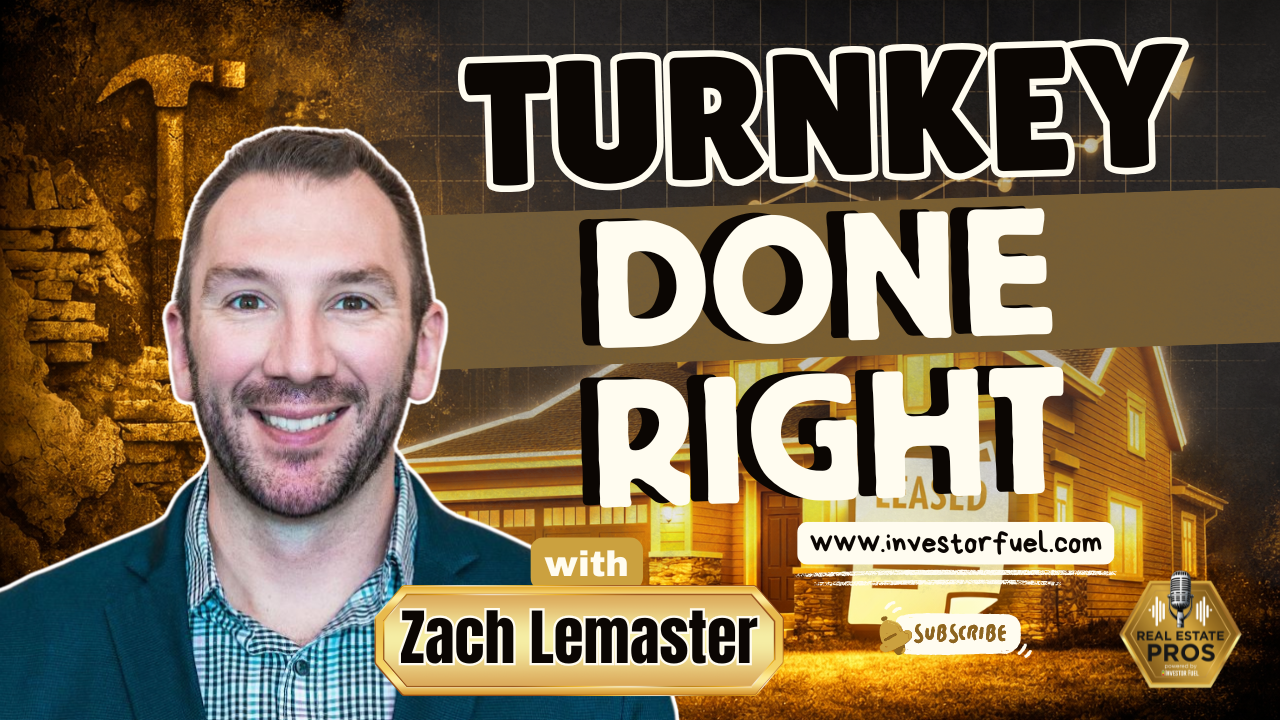
In this conversation, Zach Lemaster, CEO of Rent to Retirement, discusses the concept of turnkey real estate investment, sharing insights from his journey in the industry. He emphasizes the importance of strategic investment locations, effective communication with clients, and navigating current market conditions to create opportunities for investors. Zach also highlights the resources and support available to help individuals achieve financial independence through real estate.
Resources and Links from this show:
-
-
- Investor Fuel Real Estate Mastermind
- Investor Machine Real Estate Lead Generation
- Mike on Facebook
- Mike on Instagram
- Mike on LinkedIn
- Rent to Retirement’s Website
- Rent to Retirement Invest on Instagram
- Rent to Retirement on Linkinbio
- Text: REI to 33777 to set up call with Zach’ team
- Rent to Retirement on Facebook
- Rent to Retirement on Tiktok
- Rent to Retirement on X
- Rent to Retirement on Youtube
Listen to the Audio Version of this Episode
Investor Fuel Show Transcript:
Zach Lemaster (00:00)
let’s say interest rates are higher. It’s harder to make numbers cashflow with the same down payment if you’re using leverage. And so what we’ve done is we’ve been able togo to these national builders. know, we’re, builders as well. And we mainly focus on new construction. We’ve been able to create relationships with the largest national builders that do have excess inventory that mainly sell to retail buyers. They also sell the institutional buyers, like, you know, BlackRock and some of these reits and things like that. sell them at, this huge discounts because they’re selling hundreds or thousands of houses at the same time. Right. So they’re doing these huge blocks.
We’ve been able to create partnerships and opportunity with them where we’re able to move the same amount of inventory and mass volume, where we underwrite, right? We choose the market. get a cherry pick the best deals across the country. And then we acquire those from the builder at a steep discount. pass those discounts on to the investor. And that makes a deal very attractive because of the market dynamics. That’s not going to last forever. But the reality is, is there’s excess inventory and builders are highly motivated to get them off their balance sheet. And so if we had, like we were talking about, if we have a $300,000 house,
We get a 10 % discount on it. We get to pass it on to our investors that they get to use that 10 % not only as a price reduction, they could also use it as cash back. So in a $300,000 houses, 30 K that’s 10 % back that they can cover half of their down payment. That skyrockets ROI helps with cashflow. They can use it to buy the rate down. We got people buying the rates into the mid threes right now in 30 year fixed loans.
Quentin Edmonds (02:51)
Hello everyone. Welcome to the Real Estate Pros podcast. I am your host Q Edmonds and I’m excited to be here today. I have a fantastic guest. This gentleman, the nation largest turnkey provider. Now I know you think you know what turnkey is, but he’s gonna explain what real turnkey is, right? And so I’m excited because I think I’m gonna be.Educated right along with you. I think I may know what it is, but I think he’s gonna drop some nuggets We’d be like, ⁓ yeah, that makes kind of more sense And so I am so excited to introduce you all to to present this time I introduce the others because some of y’all may know him. Mr. Zach Lemaster This is Zach. How you doing today,
Zach Lemaster (03:34)
Hey, Quen, thanks so much for having me on here. It’s a pleasure to be here and yeah, excited to go through turnkey and some creative options people have today.Quentin Edmonds (03:43)
Absolutely. Well, man, I’m excited that you’re here and listen, I want to dive right in I want you to tell people what your main focus is these days Zach if you want to give us an origin story, we love the heroes journey So if you want to walk us up to how you got started how you got into this we want to know that too And then man, tell us tell us what part of the world you’re in and so Mr. X are you have the floor, man?Zach Lemaster (04:02)
Yeah, appreciate it. And again, appreciate you having me on. So, I started my journey in real estate, probably about 15 years ago. my wife and I are both optometrists by education. I was on scholarship with the air force. So as a commission, as a captain in the air force and state active duty for about seven years before I went on to start private practices. that’s out here in Denver, Colorado. I’m from, from Wyoming originally, my wife’s Canadian, but we settled here. We just love the front range and love doing the outdoor stuff, butReal estate early on for me was just something that I wanted to start in because like many people, read the books, the Kiyosaki sagas, all the things of like, I’ve never had money. This first time, my first year as a captain in the Air Force, which is my first year practicing optometry, I started to earn my first legitimate paycheck and it was like, I want to be smart with money, right? So what do do? I didn’t know anything about stocks or anything else. I read the books, was like, real estate makes sense, it was tangible.
I ended up buying my first house with a VA loan, which is zero money down, no mortgage insurance. I bought a duplex. I house hacked it, lived in the top, rented out the bottom. Saved that house for, lived there for a few years, sold it, no capital gains because I lived there two out of the past five years and just reinvested that capital into investing. So that was about 15 years ago, Quentin. And since that time, I always tell people I never took a year off investing. And we’ve built a very large portfolio and active real estate business now that has allowed us to retire from our career paths of medicine.
⁓ to just do full-time real estate. And we do that because we really love it. And that’s not because I disliked optometry. I love helping people see it’s still passion, but we were able to have a larger impact globally and have a lot of philanthropic efforts because of that. But we started a business about 10, 11 years ago called Rent to Retirement. And we’ve grown it every single year to today. We’re the nation’s largest turnkey investment company. We do over thousand properties across 18 different markets to help our investors.
Build financial independence through investing strategically in locations that make the most sense. So regardless of someone’s experience, their, you know, their, their time or whatever the case is where they live, they can invest strategically in the locations that make the most sense because that’s the number one thing that allowed my wife and I to achieve financial independence is being intentional about where we invested. We started locally in our own backyard, which is great because that’s what we felt comfortable with and knew. But then we started to look at other areas where there’s better opportunity. once we, and that took a long time.
to build that up. But once we were able to strategically invest in areas where that had the best returns, then we were able to really expedite our goals. And that was a birthplace of rent to retirement. And so essentially what we do is we help people do the same thing that we did, which is strategically invest in the right locations throughout the country where our teams handle everything for them. So they don’t have to go and be a property management. They don’t have to decide where to invest and try to analyze thousands of different markets across the country. We’ve already done that, that heavy lifting for them. So turnkey to us is where
We have a marketplace and offer multiple opportunities to our investors where it’s the homes are either newly renovated or fully built. Most of what we do is new construction, leased and managed by our local teams in a market that we know is going to be successful for them long-term. So they can strategically build financial independence, investing in those locations. And then we coach them through, you know, things like how to maximize your tax advantages. Do you need an LLC? Like how do get started? What are the financing options? How do you take your goals and expedite them?
and just help people avoid the pitfalls that set many of us, you know, back many years when we first get started. So I can be long-winded. I’m going to stop there.
Quentin Edmonds (08:19)
Man, I appreciate you. I appreciate you. Everything you explained was succinct. It was concise. But it was so important to take us through your journey. Walk us up to where you are now. So I appreciate the journey. Man, as you was talking, I was writing down a resume, man. Air Force. I’m not going to get the word out. Optima, help me out, dad. Thank you, sir. I wrote it down, but I can’t get it out my mouth. So thank you for that.Zach Lemaster (08:38)
Optometry, yeah.Quentin Edmonds (08:44)
Fifteen years ago, you started your real estate journey. Now you built rent to retirement man You have been busy and you have been through different transitions within your life And so I had to say why say destiny has no wasted moments, right? Meaning no matter what we go through do life It helps us become who we are now and we borrow from those moments and we pick back and we reflect to say man You know, that was very useful to me that I can use now So I want to ask you man as you went through your journeyWhat has this journey taught you about you? Like has it unlocked your superpower? Has it taught you consistency? Like what has this journey taught you about you,
Zach Lemaster (09:22)
That is a very interesting question. And I got to hand it to you because I’ve been on probably over a thousand podcasts in my time and no one has ever asked me that. And I do agree with you. My wife and I were just talking about this, that, you know, you’re a collection of all your, your experiences and the good and the bad. And those are all lessons, both the good and the bad, right? And, and you can use those to better your life if you, if you choose and apply those to, to business relationships, all the things. So,know, what’s interesting to me is I think having, you know, having the background in healthcare, probably, I went into healthcare because I’m very empathetic. I, I care for people. I care for their health. I have had bad eyes, multiple surgeries my entire life. And so, you know, my eye doctor was very, close to me and a big, you know, mentor and impactful. So I decided when I was like eight years old, like I was going to be an optometrist. So, I did that.
And I really enjoyed helping people see and care like that bedside manner, right? That connection with people as a caregiver. and that was really important to me. That has been very important to me in other aspects of business. I’ve learned that the real estate world, the business world, the and a world, like it can be cold and cutthroat and people are generally skeptical. when, when someone is in there, so many gurus online, right? So there’s so many pitches. It’s like, even with AI, it’s like, this real? this legitimate? Bringing that like.
empathy and that compassion and that just that warmth into relationships with our investors with other business partners. That’s been huge. I always tell people we’re in the we’re in the we’re in the people business and communication business, even though it’s real estate is the is a widget, right? It’s we’re in and I think that’s true of many, many businesses. And so that was, I think that’s the biggest thing I’ve learned over time is like applying those type of lessons. You know, of course, many people say leadership in the Air Force. Yes, that’s true. And
you know, things like that. really, that’s probably the biggest thing I’ve learned about myself is just that you can take, you know, your own personality and apply it to lots of different aspects in your life. And, you know, don’t feel like you need to change yourself, you know, lean into that. And that compassion and that competence, I think those two things are like the two most important things to blend well, to be able to build someone’s confidence. And I think our investor community sees that.
Quentin Edmonds (12:15)
Man, thank you for that eloquent answer, man. When you was talking, so many things were sparking in my mind. And one thing I know for sure is that success is a magnifier, right? And real estate is a tool to be successful, but successful money, it magnifies just the thing that’s inside. And the thing that’s inside, comes out. And so I love the fact that since eight, you knew what you wanted to do.And since eight, you wanted to help people. And then when you got, you know, the mentor, I can’t, why can’t I this word out? But your mentor in your field, I’m a paid, I don’t know the word is there, I’ve written the word, but I can’t pronounce it for whatever reason. But I love the fact that this, your journey just magnified who you were to help people, to really serve people. And, and I, I, again, I love you. Absolutely love your answer. And I just want people to know that, you know, this real estate thing is a tool, it’s a tool to be successful.
Sometimes we got to look back and rewire and see, okay, how did I get to where I am and how is this journey affecting me so it can continue to affect my future and where I’m trying to go and my goals that I’m trying to reach. And so I appreciate your answer, man. I really do. I really do. So let me ask you to say, of course you’ve been living long enough, 12 years in the business since you’ve been building real estate, 15 years. So I know adversity.
had to have shown is not even an ugly head. It’s just part of the game, right? Adversity is something that we face. Nothing goes exactly as planned. So let me ask you, how have you overcame adversity and actually how have adversity looked in your part of the world in the things that you do?
Zach Lemaster (13:52)
Yeah, so much. and it’s, it’s constant and never goes away. Right. I mean, life, I think everyone paints this picture. Many people do in their head of like, you know, retiring, especially through real estate. think that’s what attracts a lot of people to the real estate is like, Hey, I haven’t had rentals. I can have X amount of cashflow. It’s a lot of maybe financial or free. And it’s like, life is good, but like, as you make more money and own more assets and like, like life gets harder, actually, you know, there’s just more to think about. So, but that’s, that’s part of the journey and you, gotta embrace it because.every, every adversity that you experience is going to make you stronger. It’s and also can be opportunistic. You know, I’ve, there’s been a lot of times like one of my first business partners ended up in another business, but real estate related, like ended up stealing a significant amount of I thought that was the end of the world. Because quite frankly, it was at that point financially, but
that opened the door because it actually wronged multiple people, and then he declared bankruptcy. And then we were like in this, you know, basically the, the group of creditors to be, you know, on the bankruptcy docket, but they anyways, I met, met some other people that were also, you know, in an unfortunate situation that I ended up performing partnerships as well over time with, we did like, like exponentially greater, right? So you just don’t know that.
But I just just understand that like you got it, you got to welcome it, you got to learn to manage it. It’s very difficult for some people to do. I think that’s what I was entrepreneurs really excel is like, be comfortable in the uncomfortable and always use those those lessons to learn. But yeah, I mean, shoot, we had early on as we were talking about in contractors, you know, that would also take money and do terrible jobs, property managers, like, you just got to go through, you know, you find better systems to vet people. And ultimately, it’s sometimes you just got to understand like,
You got to go through and work with someone and give them a chance till you truly know how things are going to go. And that’s why you date before you marry. today we were talking about the biggest thing like relevant right now is market conditions. So there’s really not a lot of inventory. And this is something relevant to our business, but anyone in real estate, interest rates are still high. Like what do you do, right? To make the deal, make the numbers work. And there’s a lot of people that they let them, that paralyze them because they’re, it takes extra work or they’re fearful or whatever.
Guys, this is a long game. Real estate is a long game. Time is either your biggest adversary or your biggest advocate because it’s like the longer you own property that multiplies over time with appreciation, rental increases, tax benefits, leverage, all the things. So one unique way that we’re combating that right now, like to be very specific about what we’ve done as a company,
let’s say interest rates are higher. It’s harder to make numbers cashflow with the same down payment if you’re using leverage. And so what we’ve done is we’ve been able to
go to these national builders. know, we’re, builders as well. And we mainly focus on new construction. We’ve been able to create relationships with the largest national builders that do have excess inventory that mainly sell to retail buyers. They also sell the institutional buyers, like, you know, BlackRock and some of these reits and things like that. sell them at, this huge discounts because they’re selling hundreds or thousands of houses at the same time. Right. So they’re doing these huge blocks.
We’ve been able to create partnerships and opportunity with them where we’re able to move the same amount of inventory and mass volume, where we underwrite, right? We choose the market. get a cherry pick the best deals across the country. And then we acquire those from the builder at a steep discount. pass those discounts on to the investor. And that makes a deal very attractive because of the market dynamics. That’s not going to last forever. But the reality is, is there’s excess inventory and builders are highly motivated to get them off their balance sheet. And so if we had, like we were talking about, if we have a $300,000 house,
We get a 10 % discount on it. We get to pass it on to our investors that they get to use that 10 % not only as a price reduction, they could also use it as cash back. So in a $300,000 houses, 30 K that’s 10 % back that they can cover half of their down payment. That skyrockets ROI helps with cashflow. They can use it to buy the rate down. We got people buying the rates into the mid threes right now in 30 year fixed loans.
So not to get too into the weeds, but I wanted to give you a concrete example of how we are reacting.
to the market and creating opportunity, which is sometimes what you have to do.
Quentin Edmonds (18:39)
Yeah, yeah, that man. Thank you. I’m glad you brought that in. I’m glad you kind of walked us through that. I think that again is just absolutely great nuggets for the people that’s listening. And so Zach, I want to ask you this. What is your next real goal? Like, what are you looking to solve a scale next?Zach Lemaster (18:55)
We’re always, we always keep our pulse on the markets, right? Like that’s what our company does is we scour the country to find the most strategic investment markets where there’s the best opportunity based on our criteria, which just to briefly go over that, that’s we want to be in landlord friendly States. We want to be in areas that are tax friendly, both on business and real estate taxes. We want to be in areas where there’s, you know, growth and population where there’s a diversity of industries, not just to say something local.place that’s reliant on like oil and gas that could change. We want to have, you know, diversity of economy. So, so we can thrive in multiple market cycles. We want to be below the median house price point, which rough is 400 K. So like there’s an affordability crisis in the U S and there’s the highest tenant demographics and buyer demographics below $400,000. It’s just affordable for people. so those are in good neighborhoods, like being a class neighborhoods for new construction homes. So anyways, we scouted the market to find the best markets. There’s a lot of opportunity coming up right now in the markets.
We just opened up Colorado for the first time. Colorado has been a place, and I live here, this has been a place that’s too expensive to invest in the taxes, but there’s some unique pockets where taxes aren’t high. But certainly this is a growing area. So anyways, we’re just excited to open up markets where there’s the best opportunity that’s really where we thrive. And of course, we’re always ramping up our educational and coaching program, the Rentsch Retirement Academy, that helps.
thousands of people achieve financial independence through real estate investing. we’re just excited about what we do, Quentin. We’re passionate about it and excited to do more of it.
Quentin Edmonds (20:25)
Man, and I’m loving I’m so glad you mentioned the Academy, which I was not aware of. I love it, man. I’m glad you mentioned it because that actually takes me right where I want to go because I want to talk about relationships because I’ve listened to you a constant through line that I keep hearing you saying that you want to help people. And so I want to get your perspective on relationships, relationship within business, relationship with your potential clients. Like, how do you view relationships and how do you go about building healthy relationships?Zach Lemaster (20:53)
Everyone and this is this is an interesting topic as well because this is a hard balance when you’re in a for profit company where you’re selling a product. And the biggest I want to say this again to reiterate the importance of it is that being just authentic with people and and direct but also you know welcoming is is important likeDon’t get me wrong. Like we sell real estate that we try to set our investors up for success and we do a very good job of that where it’s generally a passive investment where things are handled for them and they’re, really successful, but it’s still real estate. Things happen. Tenants move out. They’re still like, the manager management is handling that for you. You don’t have to do that, but like you still hear about it. It’s still noise and that bothers some people. Right? So my point is, is that there’s, there are issues that come up and that’s part of real estate and that’s part of the game. and we always take the time to first.
over communicate with people and and then help them strategically plan. You know, if someone has a life experience or life circumstance where they have to sell the asset, like walking them through selling that and optimizing the sale of it, like, that’s really important, especially in stressful times for them. Point is, is it’s all about communication. I think all relationships and all business lists like if you approach communication the right way, which is promptly communicate and consistently communicate.
with the right tone, that’s going to set you far and away above 90 % of people out there. And that’s so important, especially with AI becoming more prevalent. The human interaction is so crucial. I feel like I’m getting a little sidetracked, but that’s the way we approach all of our relationships. Whether you’re a client, whether you’re a business partner, whether you’re a colleague, is just be authentic, right? And come here ready to serve and
and help people because that’s really what it’s, you know, most people are motivated by money early on. I get that I was as well and I was very interested in like creating financial impedance. Once you get there, it’s like, all right, well, what’s what’s what’s fulfilling now? And yes, there is like the thing of like, ⁓ I’ve got I met my financial goal, I’m going to set a higher one, like, that never goes away. Like, sure, that’s a motivating thing. But it’s like, what else wakes you up in the morning? Or what else? And, know, you can get burnout really quick in any industry. And so really like, leaning into
certain things in life that you feel passionate about and truly helping people, whether you’re someone who’s really giving or not, like that has an effect on you, helping people reach their financial goals, seeing how things change their lives, like helping people see. mean, yeah, I think selfishly, that’s what I truly enjoy the most because it’s what gives you the feel good, right? And keeps you going regardless of the money.
Quentin Edmonds (23:41)
Man, Zach, again, man, thank you so much. I think you just eloquently said so many different things. And I wrote down when you was talking about communication, you said, it be prompt, consistent, and you said tone. A lot of people don’t even talk about the tone, right? And so I love how you brought that in with communication, with them building relationships. And I tell people, know, communication, it’s mathematically and scientifically that communication has a 55-38-7 rule, right? 55 % as body language.38 % is the tone that you actually said and only 7 % is actually the words that you said. And so I love how you again bought in tone because it matters 38 % of the time when it comes to communication. And so I love that you said that. And again, just being prompt, consistent. Angelou said people very rarely remember what you said, but they definitely remember how you made them feel. And so being prompt and consistent, I mean, you just, again, just gave us so many nuggets that people can kind of hold on to.
Zach Lemaster (24:39)
Let me throw in one more because you, did this when we first jumped on and I, and you’re an excellent communicator as well, especially when I got, you know, a thousand reminders about the podcast, butNo, look, I love it. There’s a system in place. I’m you crap. Here’s a piece of advice and this is exactly what Quen did. Which this does people, this does have an impact on people and they will remember you whenever you go into a meeting or any type of any type of meeting for whatever, whatever reason, or if you’re even, well, maybe be creepy if you’re dating someone, but if you’re here’s, here’s how you people to really remember you and open up as a, your research on them and find out one or two.
interesting things about them. If you can online to the extent that you can, if you can’t, no worries, but start the conversation with at least two or three questions specifically around those items for that person specifically around those, those items that you were aware of, right? Just on someone’s profile, LinkedIn, whatever, ask them about that right out of the gates, just say, this is very interesting if they, you know, career hobbies, whatever it’s like, I saw this on your LinkedIn. That’s super interesting. Like, how’d you get into that? Or tell me about
And it’s just like all this people love to talk about themselves. And so that’s, that’s the one way to get people to like you. And so if you can start a conversation, whether it’s two questions, like that immediately sets the stone, the tone where it’s like, I’m here, I’m interested in you. Right. And that’s exactly what you did, Quentin. And that’s, that’s memorable.
Quentin Edmonds (26:08)
Man, I appreciate that you have no idea. I mean, I’m just taking notes on things that you said. I don’t know if you can see it, but I’m taking notes, man. You have given me a lot of gems. So I know our viewers got a lot of gems, but you give me a lot of gems that I’m taking to heart. So I really appreciate you, Listen, Zach, if someone wanted to reach out to you, connect with you, collaborate, learn more about what you’re doing, how can they get in contact with you,Zach Lemaster (26:33)
Yeah, great. I always want to drive people to our website, which is renttoretirement.com. You can also text REI to 33777 and set up a time with our team. We don’t charge investors anything. Guys, we make our money from building and selling houses. We’re here to help people build financial independence through real estate investing done the right way. Where our local teams handle everything for you. But we have a lot of market data and a lot of market research. We have a huge YouTube channel, a huge podcast following.We put out new content every week just about market data. We have investment calculators. Like there’s a lot of things for people to use to advance their real estate investing goals. And of course our team is here ready to help you at no cost to help you, you know, build your investment portfolio. I guarantee you’ll at least, you know, learn something with conversation. We have a lot of lender resources as well. We have 5 % down loan options that whether you’re investing with us or not, you can use those with local credit unions on non-owner occupied investment properties. Did you know that Quen, you could put 5 % down.
With no PMI, these are portfolio loans, a 30 year loan. you’re like, what? That’s not even, you gotta put 20, 25 % of that. Point is, is reach out guys, follow our stuff. We’re here to help however we can.
Quentin Edmonds (27:43)
Absolutely. Well, listen, I want to say three things to you that first, thank you for your time. I mean, you know, time is precious. We we do things to get our time back. Right. So the fact that you’re here spending time with us, thank you for your time. Secondly, man, thank you for your story. Thank you for giving us the gift of your vulnerability, the gift of your transparency, the gift of your authenticity. Thank you so much for your story. Lastly, man, thank you for your perspective, your mindset.and bringing that mindset to this platform. Really appreciate you being here today,
Zach Lemaster (28:17)
Yeah, pleasure’s all mine. Thank you so much.Quentin Edmonds (28:19)
Absolutely. So listen y’all heard Mr. Zach. You can’t tell me you didn’t get the nuggets. You can’t tell me you didn’t So looking at show notes get in contact with him now. Listen, I love that He’s a great guy get in contact with him, but definitely make sure you are subscribed here because I promise you we’re gonna continue to bring up amazing people Just like Mr. Zach. So sir. Thank you again. It’s everyone else. Y’all have a fantastic day -