Subscribe via:



Show Summary
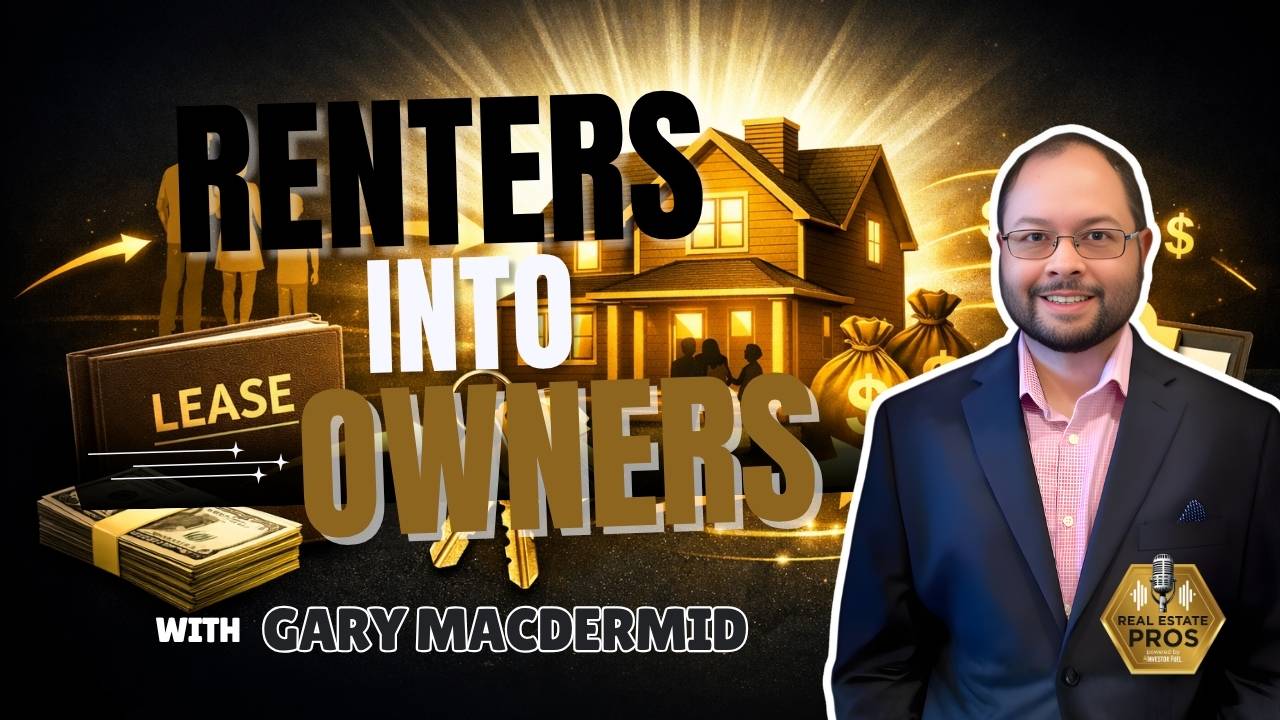
In this episode, real estate investor Gary MacDermid shares his journey from Navy electronics technician to successful real estate entrepreneur. Discover his strategies for building a focused portfolio, helping families achieve homeownership despite credit challenges, and scaling a brand in the real estate market.

Resources and Links from this show:
Listen to the Audio Version of this Episode
Investor Fuel Show Transcript:
Gary MacDermid (00:00)
So that’s kind of the advice is really, if I boil it down to is, like, start with the end in mind. And it doesn’t have to be, you don’t have to necessarily think like a hundred houses. Like, let’s just look at what do you want to do in one year? Take it one step at a time, but have that clarity. Don’t just do the activity or don’t just go from deal to deal. Like let’s put some targets on this.
You want a certain number of income work backwards. That’s X number of deals. What’s your conversion rate? That’s X number of offers that you have to make every year or every week.
Michelle Kesil (02:01)
Hey everybody. Welcome to the real estate pros podcast. I’m your host, Michelle Kesil Today I’m joined by someone I’m looking forward to chatting with Gary MacDermid, who is a real estate investor who has built a private equity and property management company. So excited to have you here today, Gary.
Gary MacDermid (02:23)
Awesome. Thank you for having me. Looking forward to our conversation.
Michelle Kesil (02:26)
Yeah, let’s dive in. First off, for those not familiar with you and your work, can you share what your main focus is?
Gary MacDermid (02:34)
My main focus in the real estate space is basically providing home ownership to families that want to own but don’t have credit. In doing that, that’s the focus, but it also is an income stream. We work with investors to help share in some of the passive income that is generated through real estate. What we do with this model is there’s a lot of the risk and some of the negatives to a traditional rental where you’re
working with ⁓ more tenant-minded folks.
we offset by providing the home ownership opportunity. And so what that does is it gives us an audience that we’re able to help with something that they want, but is not currently available because of things like FICO score, or maybe being a business owner and not writing off too many expenses in the W-2’s week. So we create the win-win for the family that wants to own and also the investor so that everybody kind of gets a little bit of what they are looking for.
Michelle Kesil (03:40)
Awesome, and is this something that you do nationwide in a specific market?
Gary MacDermid (03:47)
Good question. So when I first started, ⁓
There was a little bit more of the deal chasing mentality. so when we saw that we got a deal and say, you know, I’m in Arizona. so there’s been times early on when we get deals in Texas that were really, you know, they added buy low, sell high. So when we saw something that was under market, we kind of jumped on it. And so then I started having properties in Texas, then in Georgia and Missouri, Florida. And it became a little bit of a challenge over time because what
this model were long term and you do have to have some infrastructure. So over time we learned to pare that down and so I focused. Focus is a very important word when you’re looking at business development and what we’ve done is ⁓ with the exception of Mississippi where
We had an opportunity to buy 40 houses at one time, a 40 house portfolio. We basically pared down. So really trying to keep focus ⁓ in two markets.
It’s not to say that if there was a portfolio like we did by 13 in another ⁓ market last year, but we did that purposefully with a way that we can transition that into one of our markets by basically ⁓ over time moving it into one of the markets. So selling, doing 1031s, whatever is needed to move that ⁓ capital into the market that we are more comfortable with.
Michelle Kesil (06:07)
Awesome. And how did you get started in real estate?
Gary MacDermid (06:13)
That’s an interesting question because I did get started very early and it was kind of an accident. ⁓
I was forced to join the military out of high school when I was woken up January my senior year. My father basically ⁓ woke me up. was like, I don’t remember what day it was. We didn’t have school for some reason. And he told me, said, I got good news and bad news. The bad news is there’s no money for college. The good news is I have a plan, get in a car. So he drove me to the recruiting station and basically before I do it, he signed some parental consent forms and basically,
shipped me off to the Navy. So how does that get me started in real estate? Well, right after I graduated boot camp, I was in the A school where they basically teach you your technical trade. I was an electronics technician and there was a master chief. So these are the senior enlisted officers that kind of give the new people like me advice on life. And what he told us, there was a group of us, probably about 20 or 30 in this classroom, and he says, I’m going to give you some advice that will probably, it’s
helped me and it will probably help you. Buy real estate everywhere you get stationed and you’ll make more money than the Navy will ever pay you. And so that was the seed that was planted that sort of got me into real estate. I didn’t know what to do with it. I had no money. When I was in high school, I was working at a diner making probably, I think my last promotion before I joined was about 9.50 an hour.
And that seed though, however, by rental real estate, I took with me. I saved every money that I could. And then within a couple of years, I bought my first house at the age of 21. And then everywhere I got stationed, I tried to do the same thing. And so the rest is kind of history. I did it kind of as an amateur for many years. And then when the Navy got tough and, then I kind of got thrown out of the Navy, not in a bad way. was just, I separated, but I retired. did do the full 20.
years
but when I say that it was kind of like a difficult separation because what do you do ⁓ and so I followed my whatever I did in the Navy I became a consultant for doing nuclear power plants because that was the field I was in and then I realized that if I were to continue what I did because I had the passive income why not see if I could get more so it was like one of those things when when you’re kind of paid but you want to have a little bit extra on the side
in case something happens to you, that was what really did it for me was if I was a consultant and I was something, if I got sick or got hurt, how would I provide? So by building up the passive income and then realizing that this could become instead of an amateur thing on the side, it could really become some real money. That was what I learned. And after really studying and focusing, you know, with groups like Investor Fuel that kind of teach you the
ways to grow a business in real estate, I was able to do the same where I eventually replaced my passive income, or replaced my active income with passive income. And so that is basically how I transitioned, retired from the Navy, became a professional investor, and the rest is kind of history today.
Michelle Kesil (09:42)
Yeah, that’s amazing. And so what do you feel have been some of the main keys that made the biggest difference in allowing your business to grow and become successful?
Gary MacDermid (10:31)
Yeah, the main keys are just realizing that a business is exactly that, it’s a business. So when a lot of people, especially like when I started, you learn sort of…
Like you might learn the model, right? But to really take, and a lot of times when we learn it, it’s mostly like a side hustle or a hustle. And so the mindset of taking something that is a hustle and transforming it into a professional business, that is a skill. And for me personally, I had to realize,
that it’s not just a one trick show with grinding out and it was like you have to take some time to actually understand the different pillars of a business. So whether it’s ⁓ sales, marketing, operations, administration and finance, each one of those things is a skill set.
Real businesses have heads of departments or C-suite executives to run those pillars. And so as a business owner, you might learn, you know, the most important, know, what is the way to really make the sale or those first couple of deals, and then you go from deal to deal to deal. But the sooner that you can understand each of those pillars and develop the skills to run those as a department, which I had to learn from the military, is really what
I need it to kind of take me to that next level.
Michelle Kesil (11:58)
Yeah, absolutely. And what have been some of the biggest challenges that you’ve overcome as an investor?
Gary MacDermid (12:07)
Some of the biggest challenges are ⁓ just the learning curve. ⁓ In each one of these pillars that I just described, there is a significant learning curve. And the other thing is when you start with something ⁓ like just even buying some of these houses or with any new business, the learning curve can sometimes be painful. So for me,
I was ⁓ more of a cautious engineer type and so a lot of times there would be opportunities that would pass me by because there would be analysis paralysis. And so I might take forever to go make a decision or pull the trigger on something that would be a good deal. And so my growth would be slow. So it really came down to what we started this call with was with the SWOT analysis and looking at, you know, what are my weaknesses? So how do I partner? ⁓
acquire
or hire my weaknesses and continue to build out all the pillars of the business. And so the challenge is there’s a lot of pain points, right? Like how do you do the marketing? How do I consistently? So you can build systems around the challenges or you can partner with the challenges, but there are a lot of mistakes that I’ve made.
Not knowing how to repair something, not knowing how much something should cost. ⁓ Ultimately, ⁓ I could go into any of those details, but hopefully that gives a picture of some of major challenges that I had and how I’d overcome them.
Michelle Kesil (13:41)
Yeah, definitely. And what are you most focused on solving or scaling next?
Gary MacDermid (13:48)
Yeah, so what I’m focused on scaling now is really just the more on the brand building, right? So what we’ve done has been very successful in building and maintaining a large portfolio across a couple of major markets.
But there’s still some challenges that we could improve on, some opportunities that we could improve on, right? And that has to do with, when you look at some of the biggest companies in the country or in the world, the biggest expense is marketing. And so when you look at what we’ve done, we’re already successful, but we could be a lot more successful. So how do we take it to the next level? When I started…
My introduction, I talked about how we help families that want to their own home, but don’t, but, can’t right now because of credit or other reasons. So we do a lot of grassroots marketing in the neighborhoods. You know, maybe that’s door knocking. Maybe it’s even putting up some, some yard sale type signs for the homes. But really one of the things that would take us to the next level is building up that marketing and that brand awareness. One of the portfolios that we bought, the portfolio that we took over was built by somebody that
basically worked with a church. And anytime in that church that somebody was looking for a home, this person would buy the house and then rent it to the person. And so through that congregation or through that large church, she built a portfolio of over 40 homes and that was that large one that we purchased. So one of the things that you asked, right, like…
for us to get to next summer, what would we focused on? It’s really that brand awareness. We want to let people know in the markets that we are that opportunity.
And we want people to know that if you don’t have that FICO score or if you’re self-employed and maybe you write off your expenses because that’s what we’re trying to do, take advantage of some of those tax deductions. But at the same time, you might not be able to qualify for a bank loan. And so we want to be able to get the word out that we’re a serious opportunity for somebody that wants to own and can’t.
Michelle Kesil (16:42)
Yeah, absolutely. And so how does that process work when someone works with you?
Gary MacDermid (16:50)
So when it’s a family that wants to own that process, we make it pretty easy. So we’re not trying to reinvent the wheel. What I’ve learned from some of these times like 2008 is we want to conservatively underwrite the home. So when you look at an FHA loan or some of the underwriting guidelines,
They’re there for a reason. So we kind of just take some of those basic guidelines and put them in our rule book and we implement them. And there’s only one difference. We just take the FICO score and ignore it. But everything else, income, ⁓ you know, the quality of income, the ⁓ underwriting that thoroughly, we are basically looking for
the ability to afford the home. we need them, although they might not have good credit, as long as they have the income and can financially afford the home, that is key.
Michelle Kesil (17:49)
Yeah, amazing. And are you also currently working on your own investment portfolio?
Gary MacDermid (17:56)
I am so personally, know, separately from the real estate, I am doing mergers and acquisitions ⁓ in the financial services space. So the same way that you can buy a home for a low price and then rehab it and then sell it for a higher price, you can also buy companies with lower revenue or maybe that aren’t professionally managed, owner operated.
assemble them together, put in professional management, increase the valuation immediately, and then exit. So I do personally ⁓ invest and work with ⁓ companies as well as real estate.
Michelle Kesil (18:42)
Yeah, amazing. And what are you most excited about or see as an opportunity in real estate right now?
Gary MacDermid (18:53)
So what I see as an opportunity in real estate is basically just this, the continuing of this brand building. When we looked in some of these other markets ⁓ outside, there’s just like not a lot of people that are doing what we’re and ⁓ offering this opportunity of homeownership. So.
It’s really a fun time, although market-wise, there’s been a little bit of softening in valuations and rents are kind of down ⁓ in the major market that I’m in right now. But at the same time, when you just look at the opportunity, ⁓ it’s getting harder to own a home. And so it doesn’t mean that there’s…
less of a desire, if somebody wants to own, then we’re a pretty good opportunity. And so just understanding that marketing and brand building and the fact that there’s not as many people doing this in other markets, it is pretty exciting to look at the possibilities of growth.
Michelle Kesil (19:59)
Yeah, definitely. Is there any advice you’d give to someone that’s newer in the industry?
Gary MacDermid (20:08)
The advice that I would give is to have clarity of vision. A lot of times that I see when people are new in real estate, don’t really know what they… They don’t look far ahead. They might learn a technique and they just kind of focus on the technique, but not on the end game. And so, ⁓ you know, in my tax companies, I also have a lot of real estate investor clients.
And so sometimes I have to go through this with them and that it’s like, okay, you want to buy rental real estate. You want to buy, you want to be a flipper. Well, let’s look at that. You know, what is your goal for one year? What is your goal for three years? Because if you tell me that you want to, you know, flip 10 homes or you want to buy, have a portfolio of 10 homes within one year or within two years, that’s going to be a lot different than if somebody says I want to have a hundred homes in a year or a hundred homes in three years. So you really have
have to have a little bit of that clarity of like what do you really want in a short term and what do you really want in a long term? Because if you, the amount of effort and the way that you structure yourself and all your companies to build a 10 home portfolio versus 100 home portfolio is going to be significantly different. And yes, you could start and then grow.
But you have to, it’s very important to think through that because there’s certain things that you might want to do at certain points. I mean, even a new business, somebody just starting right now, when you structure yourself, are you going to be doing business as yourself or are going be doing business as an LLC? If you’re doing business in LLC, which I would recommend, is it going to be a single member LLC or you going to have partners? When you get to a certain revenue level, you need to understand tax because as a… ⁓
as an LLC disregarded entity.
You’re going to pay all of your income on self-employment tax, but if you realize that after a certain threshold, maybe it’s $40,000 or $70,000 in income, then you would want to elect an S Corp. So there’s a whole bunch of things. And then if you’re buying a bunch of rental real estate, you don’t want that in the S Corp. So you got to think about how do you… Real estate’s inexpensive. These are assets. So if you’re going to hold real estate, we want to make sure that you protect it, asset protection, and structure yourself. So you need the holding companies. You need the operating company.
All these details are important when you look at what type of income. Are you a flipper? That’s active income. Are you a buy and hold? That’s passive income.
So that’s kind of the advice is really, if I boil it down to is, like, start with the end in mind. And it doesn’t have to be, you don’t have to necessarily think like a hundred houses. Like, let’s just look at what do you want to do in one year? Take it one step at a time, but have that clarity. Don’t just do the activity or don’t just go from deal to deal. Like let’s put some targets on this.
You want a certain number of income work backwards. That’s X number of deals. What’s your conversion rate? That’s X number of offers that you have to make every year or every week. Sorry
when I started I also did a bunch of the short-term stuff So I set a target for myself one written offer every day seven a week Could I do all seven in a day? Could I not do one like you have to go with what you want work backwards and set those targets
Michelle Kesil (23:31)
Absolutely. Great advice. Thank you for sharing.
Well, before we wrap up here, if someone wants to reach out, connect and learn more, where can people find you and connect with you?
Gary MacDermid (23:43)
So ⁓ my website, garymacdermid.com, and also my book page for the book I wrote, setyourgoalsbook.com, are probably the easiest ways. And Gary MacDermid on all social media.
Michelle Kesil (23:58)
Perfect, well I appreciate your time and your story. Thank you for being here.
Gary MacDermid (24:02)
Awesome, thank you for having me. I appreciate it.
Michelle Kesil (24:05)
and for the listeners tuning in. If you got value, make sure you’ve subscribed. We’ve got more conversations with operators like Gary who are building real businesses and we’ll see you on our next episode.