Subscribe via:



Show Summary
In this engaging interview, real estate broker Matthew Ablakan shares his inspiring journey from entrepreneurial roots to building a successful real estate career in Toronto. He discusses the importance of honesty, resilience, and adding value, as well as his plans to expand into legal services and community advocacy.

Resources and Links from this show:
Listen to the Audio Version of this Episode
Investor Fuel Show Transcript:
Matthew Ablakan (00:00)
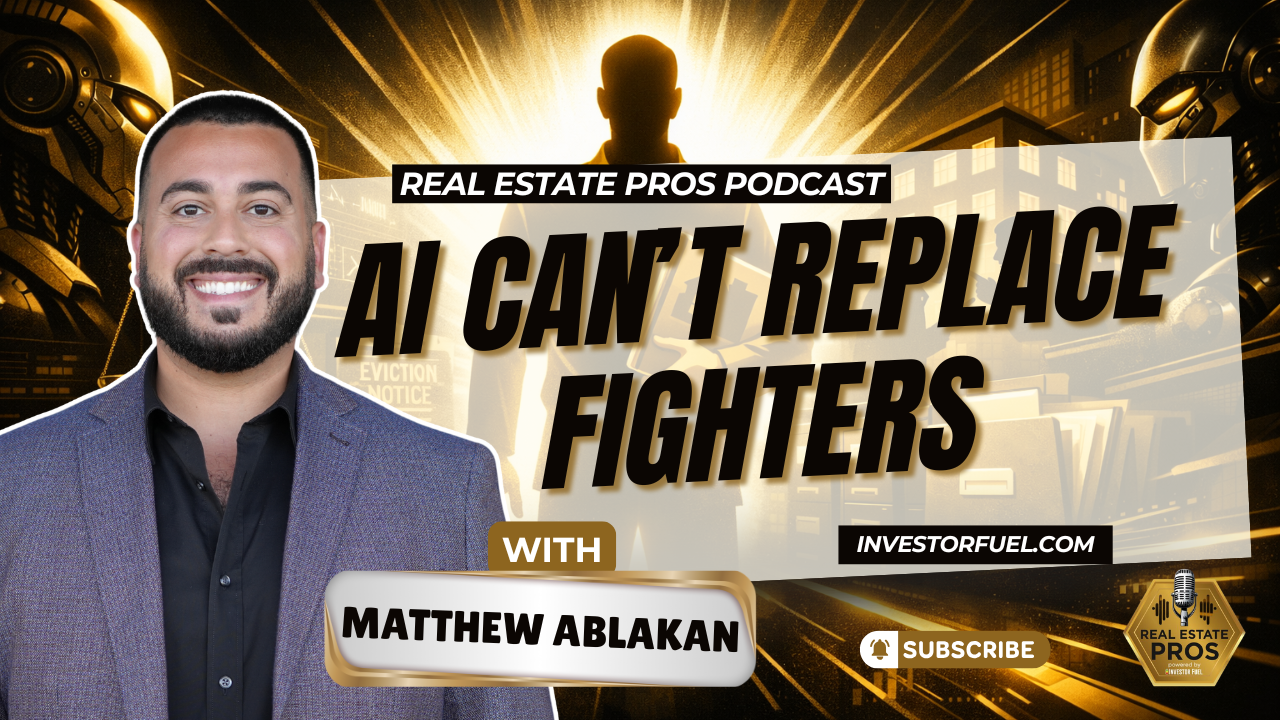
And also like the thing that’s been on my mind too is real estate here has been changing significantly. And you know, with the rise of AI and whatnot, it’s going to, it’s going to displace a lot of jobs and a lot of people. Sorry. It already is. It already has been. and so with regards to the law field, the way I look at it is you could put into chat GPT, this is my case. What do you recommend? And it could, you know, it could spit out cases for you and it could put things together, but
Not everyone is a born fighter.
Quentin (02:01)
Hello everyone. Welcome to the Real Estate Pros podcast. I am your host Q Edmonds and I’m excited to be here today. And you know what excites me is because we have new people who we get to talk to. Like, learning new things from different people is always the plus. And so, you know, I say we can all be literally doing the same thing, but because we are unique and different, we’re always going to have our approach. It’s going to be different. And so I’m so excited about this guess because
The number one word that I wrote down when he said something was the word honesty. Y’all know how I feel about honesty. People giving the gift of their transparency and vulnerability. I love that. And when people, business owners leave from a place of vulnerability and transparency and honesty, I think it just sets the stage for people, their clients, customers, whatever you want to call it, to get a holistic, really good experience. And so I’m so excited.
to introduce you all to Mr. Matthew Ablakan Mr. Matthew, how are you doing today? Well, yeah, I’m still going to ask you, how are you doing today,
Matthew Ablakan (03:09)
I’m good. I’m good. All things considered Q, I’m good and I’m really happy to be here. Thank you for doing this. It takes a lot of work and time, effort, energy, money. So I appreciate you.
Quentin (03:13)
I’m dead.
Hey, I appreciate that, sir. Thank you. Thank you for that recognition. I appreciate that. We do it for the love, but everything you just said is so true to you. So I appreciate you, Listen, I kind of just want to dive in. I would love for you to tell the people what your main focus is these days. If you want to give us a little bit of an origin story, kind of how you got to the point where you are, we love origin stories. And man, tell them what part of the world you’re into.
People seem to want to know that geographically because they like, hey, he right next door. I might work something out with him. So what you do, your origin story and where you are in the world. My friend, you have the floor,
Matthew Ablakan (03:58)
Awesome. So my primary business right now is real estate. I’m a real estate broker. I had my own brokerage for the last five years, been in the industry for 14 years, and I partnered my boutique brokerage with Remax, the Remax brand. So we are now an affiliated Remax company and we have been in the business 14 years, primarily dealing with residential real estate. so buying and selling of homes, rental properties for investment purposes, condominiums.
So where I’m at in Toronto, Ontario, Canada, we’ve got a lot of buildings and condos are not something new to us. think in 2025, if I’m not mistaken, we had the most cranes around the world at that point. Yeah, a lot of, a lot of development here. It’s a big city, global city. And so that’s my primary focus is the real estate. My origin story. Let’s see how far back I want to take you.
Quentin (04:34)
Mmm.
Matthew Ablakan (04:52)
I was always entrepreneurial. My parents always were entrepreneurs. They were teachers back home and then when they came to Canada, they had to be, they were forced to become entrepreneurs because their credentials did not transfer over here. So they were not entrepreneurs because it was a cool thing to do. They became entrepreneurs because it was pure necessity and they did well for themselves. They had a home for us, always put us in school, brought us with them, watched what they were doing. So I learned a lot of things.
just by watching as a little kid what they were doing. And then fast forward in high school, my first job I was 14 years old and I was working in the kitchen at a Chuck E. Cheese’s. I don’t know if that’s something you guys have. Yeah, so Chuck E. Cheese’s, my first day for initiation, I had to put the Chuck E. Suit on and it was a lot of fun. I had a good time there, moved on to a different restaurant, served in the kitchen there and then waited when I was 18 years old. We were serving alcohol, so you have to be 18 to serve.
Quentin (05:33)
If we do? Yes, Yep.
Matthew Ablakan (06:39)
19 to drink it, but 18 to serve it. Weird, Canada. Just weird. And you can drive a car when you’re 16, but you can’t drink the alcohol. get it. So I was waiting tables, serving, and so I always had this knack for entrepreneurship because when you’re waiting tables, I tell my teenage cousins now, you learn so many skills, like communication skills, and also you earn your wages because you earn tips.
Quentin (06:43)
Yeah
Matthew Ablakan (07:06)
If you’re not good, know tip culture nowadays has changed, if you’re not good at what you’re doing when you’re serving people, chances are you won’t get a tip. That’s how it was when I was doing it. And then when I was 19, so actually when I was 18, I started thinking about buying real estate, investing in real estate, really just investing to make money. And so by 18, I started looking into it. When I was 19 years old, I was able to purchase using part of my student loan.
pre-construction condo here and All I needed was $15,000 to get into the market So I had that from the restaurant jobs. I had that from school I got into my first purchase and why I went that route is because at that time there’s no way I was getting a mortgage I did not have a down payment did not have a job that I was settled into our career So there was no way I was qualifying for a loan here And so I bought that condo because it was gonna be ready four years from then
Quentin (07:40)
Mm. Mm.
Matthew Ablakan (08:04)
It was gonna be ready when I was 23 years old. I said by then I’ll figure it out. And so I got licensed, bought the condo. Two months later I was licensed as a real estate salesperson. And the rest was history. That’s how I got into real estate. I was full time since day one. I finished my schooling. I was in university. Majored in law. So I was educated but.
I was really always about business. I didn’t want to go to law school. I didn’t want to work for the government. I didn’t want to represent criminals. I was always into criminal law. And so I said, that’s not something I’m going to do. I won’t sleep all night. But I got into real estate and fast forward now, 14 years later, still here.
Quentin (08:39)
Steve, bro, thank you for this story. I love stories, man. I think I put a premium on stories. So much so this is what I’ve built into my podcast. I have a moment, a saying where I say this for every podcast. Destiny has no wasted moments, right? Meaning no matter what you’ve been through in life, those moments build up to the moment where you are now. So I absolutely love you walking us through the story.
I love how you talked about in the kitchen and Chuck E. Cheese putting on the Chuck E. Suit, man. I love how you talked about waiting tables, help you learn communication skills, interpersonal skills. So for me, listen to your story. You are the prime example how destiny has no wasted moments. Even back from your parents coming here, they almost was kind of forced into entrepreneurship, right? Their skills not transferring over. They got the skill set, but
They don’t recognize it. You know, they don’t recognize the credentials. And so it’s these moments have kind of been building up to the person you are now. So I always ask, what has those moments taught you about yourself? Has it taught you discipline, resilience, humbleness? Like what has these moments taught you about you, Matthew
Matthew Ablakan (09:56)
all that that you just mentioned. I mean, humble because you see what your parents went through. It wasn’t easy, it hasn’t been easy. And what we go through every single day, just this morning, was so complicated for no reason. And it just happens, though, every single day. And you have to not let it bring you down, not let it hold you down. But at the same time, when you have success, don’t let it get to your head either. So.
So tell me all that stuff. Discipline. Man, you gotta sweat to earn your meal. And it’s not just gonna come to you sitting on the couch daydreaming and hoping that it’s gonna come to you. It doesn’t work that way. There are natural laws in the universe that we have to abide by. And just like gravity, you have no choice. You can’t go on the building and jump off and say, ⁓ gravity’s not gonna impact me today. Trust me, you’re gonna make an impact on the floor.
So you gotta, it’s the same thing. It’s the same thing with, you like that one, AQ. You’re gonna make an impact, but not the one you want. And it’s the same thing with business. And then also, also like I’m 34 turning 35. I’m a father now. I did things in my twenties very differently. From now I’ve learned more patience, right? I’ve learned more mature. I’ve been more mature and kids help you.
Quentin (10:59)
You’re gonna make me a thing.
Matthew Ablakan (11:20)
achieve that, you know, just having kids on your own, you’re gonna be, hopefully you’ll get more patient. But in business, you know, especially in real estate, you send an offer to somebody, you’re waiting to hear back, you need patience. You need patience, things don’t happen right away.
Quentin (12:11)
Yeah, man, everything you brought in, I appreciate. I tell people the one constant in business, because there will be ups and downs. You’ll make a lot of money at one point. Sometimes things may stay steady, things may dip. But the one constant in your business is you. You’re the one constant. You’re the one constant. And so sometimes we got to reflect to see, OK, what happened in the past? That didn’t break me. It may bent me, but it didn’t break me. It didn’t snap me. And then you
you look at where you are now, I’m like, you know what? I know I can get through this. And I think, again, it’s just you. It’s about your perspective. It’s about not giving up. And I love it, man. I love everything you’ve said. And I just, I’m glad you said it, because everybody that listened, I just want them to know that all of us, no matter what journey we’re in, in this space.
All of us are to reach some ups and downs. We want to reach something that’s in front of us that’s going to try us, but we all can get through it because I think we’re all built differently, but still we got something in us that can make us continue to go on and continue to find the light at the end of the path. And so I appreciate you, man. I appreciate you leading with that transparency, brother. Let me ask you this. What’s the next real goal for your business? Like, what are you looking to solve at scale next, sir?
Matthew Ablakan (13:31)
I’m working on something really cool, but I haven’t told anyone. I think I can tell you. So basically I’ve grown my team to where I want it to be organically. And then also because we’re partnered with Remax, in our office we have 320 agents. So we can work with whoever we want to work with. But why I say that is because after 14 years I have a database. We’re putting the systems in place. There’s business happening.
Quentin (13:35)
Okay, okay, nobody’s listening.
Matthew Ablakan (14:02)
I’m growing my team and they’re working on a lot of those deals. And I actually did something that I didn’t, wasn’t sure if it was gonna make sense to do, but it was really in my heart to do it. And it’s gonna be totally a compliment for our business. I went back to school. And I ended up, instead of going to law school, I ended up pursuing a one year program for what’s called
I don’t know if you guys have it where you guys are, but paralegal studies. So it’s a new thing in Canada. It doesn’t exist in all across Canada, but in Ontario where I’m at, it’s here because the idea is to have access to justice. And so some people can’t access lawyers, it costs too much money and whatnot. But the scope of what a paralegal can do here, it’s very vast. Like you can do criminal law, you can represent landlords and tenants, can go to small claims court.
Quentin (14:29)
Yeah, yeah, absolutely. Yep. Okay.
Yes.
Matthew Ablakan (14:55)
for lawsuits, all those things. And I said, with my degree, with how our business is set up now, if I do take a little bit of a step back, it could still function. And by step back, I mean go to school. And so that’s what I’ve been enrolled in. I’m almost done. I’m almost there. It’s an intense program. It’s supposed to be a two year program, but I condensed it to one year. And my goal this year is to have that completed, ready to go, and I’m licensed at the beginning of next year.
Quentin (15:05)
got you.
Matthew Ablakan (15:24)
And the areas that I’m gonna focus on are the landlord and tenant matters, because I deal with a lot of investors, got a lot of guys, they own buildings, got hundreds and hundreds of tenants, there’s always issues. I already refer a lot of deals out now, but that’s where I wanna be. I wanna have a full operating firm as a paralegal law office, as real estate office, and finance as well.
Quentin (16:28)
Yeah, I love it, man. And I’m so interested, because it seems that honest approach, you lead with honesty, but it’s also, it sounds like you want other people, you want to be able to hold other people accountable at the same time. It just seems like honesty is a big thing for you. That’s how it seems. Even just, you know, like you said, look, I don’t want to be defending criminals and stuff like that, but it seemed like you, on this paralegal side, you do want to be able to hold people accountable for things that they said they were going to do at the same time.
Matthew Ablakan (16:57)
I’ve already been doing it without even having the license. I’ve been approaching things in a certain way, whether it’s like a fraudulent… Someone lied about my wife hitting their car and getting into a hit and run, just like last week. So I approached the police a certain way. We won, of course. It was thrown out right away. It’s not real. But I approached it a certain way. And I like that. I’m an advocate. I fight.
Quentin (17:12)
Mm-hmm.
Matthew Ablakan (17:23)
for my clients now, I fight for everyday people. I don’t like people getting taken advantage of. I don’t like that I get treated better if I wear a blazer versus if I’m wearing a track suit. I don’t like that. I don’t like that how people operate that way. So obviously I don’t care when it happens to me, like it is what it is, but in the area of law, I don’t want someone to get taken advantage of. So still not gonna get involved in the criminal stuff, cause that goes against what I believe. But yeah, here.
Tenants have a lot of power and there’s a lot of professional tenants out there that live in a property for eight months without paying rent. It takes a long time to kick them out. And even if you have your documents filled incorrectly, like you literally didn’t cross your T’s, they’ll throw it out and say, come back with the correct documents. So I want to fight for that. want to probably represent more landlords than tenants. There are bad landlords out there, but from what I’ve seen, most of my clients are landlords.
and they’re good people and they get taken advantage of. I get taken advantage of too. So I wanna have the license, because here it gives me a little bit more of the authority to pursue something. You get a letter from me, it’s from my law firm. You might think twice. I don’t know, we’ll see.
Quentin (18:38)
Again, bro, you’re the perfect example of the one constant in the business is the person. And so because of who you are, because of the way you are, the way you think, what you’re passionate about, you’re creating a new lane within your business. Like you’re creating that, I don’t know if we call it a value add. I don’t know if that’s the correct time to look at it, right? But you’re creating a space because of who you are, because of what you’re passionate about. And I think for me, that’s why I love and what we love for people that listen.
Matthew Ablakan (18:53)
Yeah, value add. Yeah.
Quentin (19:06)
sometimes to dig a little deeper and think about what you’re passionate about. And there is spaces within real estate to add to what you’re passionate about. mean, it could be real estate, but it’s so many different facets that we are, we can add these things together because we are the main person that’s in the business. And it just gets people a different mindset to think about things going forward. Does that make sense?
Matthew Ablakan (19:28)
Yeah, so Jim Rowan, that’s one of my mentors, he says, you your economic value to society is based on what you bring to the table, it’s based on you. So how valuable are you? And so, not as a person, not as a human, we’re all equal, but in terms of the economic value, how much I’m able to get paid, well, if I wanna now tap into the, so let’s say I have a landlord client, we find them a tenant, tenant’s great for six months, six months later. So we got paid on that deal.
Six months later, the tenant becomes delinquent. They need to kick him out. I can help with that now versus referring it to someone else. And so it goes hand in hand with the business. If it didn’t, then it wouldn’t make sense, but it does. And you know what? I’m turning 35. I get this license now. I have it for life. It’s up to me what I want to do with it. At least I have it.
Quentin (20:04)
Yeah, yeah.
And man, you saying so everything you say is so layered because, like you said, we’re all equals as human beings, but the economic value. So to those professional tenants out there, your your brain is brilliant. I’m going to talk to you, professional tenant. Your brain is brilliant. But what is your economic value? Like, how are you adding value? Are you taking away? Are you adding value? And I think that’s the difference. Right. We
Matthew Ablakan (20:43)
They’re taking it away. Yeah.
Yeah.
Quentin (20:48)
All of us, we are all brilliant in our own way. We all have our skill sets, but what is your economic value? And I think this is what we talking about. How are you adding to the economy? How are you adding value to the community? How are you adding value to the world? You know what I mean? And I mean, I just want to plan that. I’m not trying to come down too hard on people. Maybe I am a little bit. I don’t know, but I’m just saying, you know, like economic value.
Matthew Ablakan (20:54)
Yeah, they’re taking more.
Yeah.
Yeah.
And also like the thing that’s been on my mind too is real estate here has been changing significantly. And you know, with the rise of AI and whatnot, it’s going to, it’s going to displace a lot of jobs and a lot of people. Sorry. It already is. It already has been. and so with regards to the law field, the way I look at it is you could put into chat GPT, this is my case. What do you recommend? And it could, you know, it could spit out cases for you and it could put things together, but
Not everyone is a born fighter.
So somebody gets punched in the face, they back up, they don’t know what to do, they freeze. I’ve tested myself when I would train, when I would be in the boxing gym consistently for years, and when I get punched in the face, I move forward. And that’s how I always was. It wasn’t even a response, it was a reaction. I just would. I don’t know why, but I would. So…
I’m the same way in business. I’m not a pushover, but I’m not also going to be biting everybody’s head off. not a bully, but at the same time, I know how to fight. So AI cannot replace people like that. It just can’t. Unless they overhaul the whole system and now you’re in front of an AI court and an AI judge and it’s different. The traditional system…
You’re gonna need a strong advocate to fight for you and your rights. And not everybody is a fighter. I could see it in the program. There are some people that never wanna go in front of a judge. They just wanna do the research behind the scenes. And that’s fine, you need that too. The way I am is I’m a fighter. So I feel that ability, that license, I think it’ll be with me forever. I don’t think it’s ever gonna get replaced.
Quentin (22:56)
Matthew, sir, I greatly appreciate you being here, man. I love your perspective. I love the way you think. If someone wanted to reach out to you, connect with you, collaborate with you, learn more about what you’re doing, how can they get in contact with you,
Matthew Ablakan (23:11)
So two things, I’m just gonna move the camera. So I’ve got my own podcast, it’s called the Millennials Choice Show, the MC Show, all things real estate. then also if you’re into like, told you I was into criminal stuff, right? So not criminal stuff activities, but like criminal law. And so I’ve interviewed like ex-mopsters from the states, all the New York guys from the families. I’ve interviewed all kinds of people like CIA, KGB. So if you want another podcast to tune into.
I got the podcast. If you want to send me a message and reach out to me, I’m on Instagram, just my first and last name at Matthew Ablohcan and I’ll reply to your message personally.
Quentin (23:48)
Well, I will definitely be checking out your show. You just, that’s right up my alley. just, you know, true crime, just, unfortunately. I grew up in Baltimore. Are you familiar with Baltimore, Merlin?
Matthew Ablakan (24:02)
I’ve heard of it, but I’m not too familiar with it, no.
Quentin (24:04)
Okay, you heard the show, The Wire. Have you seen The Wire, heard of The Wire, the show? So yeah, so that’s Baltimore. I tell people that show is probably 3 % embellished. So probably 97 % of it is true. I’m a 90s baby, so I grew up at that timeframe that it’s talking about. Well, I’m an 80s baby, but I grew up 80s and 90s. So that timeframe is specifically. And my sister, unfortunately we lost her to violence in Baltimore.
Matthew Ablakan (24:07)
Yeah, yeah, yeah.
Quentin (24:30)
And so I’ve always since then, don’t know, I’ve kind of like you, I’ve never did any kind of real education, but I’ve always been into just the criminal element, like how the criminal element think, why they do the things they do. Cause this is what I understand for sure. I grew up in Baltimore. My life could have been a different way, just from one decision. If I made one or two decisions, I could have led a whole different life. And so I’m always,
Matthew Ablakan (24:31)
you
Quentin (24:59)
understand that people make decisions for a certain reason. I’ve always just wondered why people make certain decisions when they get into crime and stuff like that. And so I know your show is going to be fascinating. I can’t wait to dig into that, man. So thank you for mentioning that. Let me say three things to you, sir, sincerely. First, thank you for your time. You could have been anywhere in the world, but you chose to be here. So thank you for your time. Secondly, thank you for your story. Thank you for the gift of your vulnerability, the gift of your transparency. You’ve planted some seeds here that I know is going to impact people.
So I appreciate that. Lastly, thank you for your perspective, the way you think. You’ve paid good money for the way you think. You’ve paid for what you think in your experience, in your life. Your life has led to why your perspective is the way it is. Thank you for bringing that perspective and mindset to this platform. I greatly appreciate you, sir.
Matthew Ablakan (25:47)
I appreciate you, Q, like I said, it takes a lot of time, effort, energy. I know, I’ve gotta show myself. So the fact that you’re doing this and putting yourself out there and you’re not sure how it’s gonna do and you have those moments of doubt that are you even on the right path and you’re still pushing ahead and pushing forward, good job, good on you. I wanna give you your flowers today.
Quentin (26:08)
I greatly appreciate that. Many don’t do what you just did. So trust me, I appreciate that and I accept it. Thank you so much, man. Well, listen, y’all heard Mr. Matthew. Get into the show notes, get in contact with him. Definitely check out the MC show, the Millennial Choice Show. Did I say it right? Definitely look in the show notes, check it out. The link should be there, but definitely make sure you’re subscribed here because I am telling you, we’re going to continue to bring up amazing people.
Matthew Ablakan (26:26)
You got it right, yeah.
Quentin (26:38)
just like Mr. Matthew. So sir, I say thank you again and everyone else, y’all have a fantastic day.