Subscribe via:



Show Summary
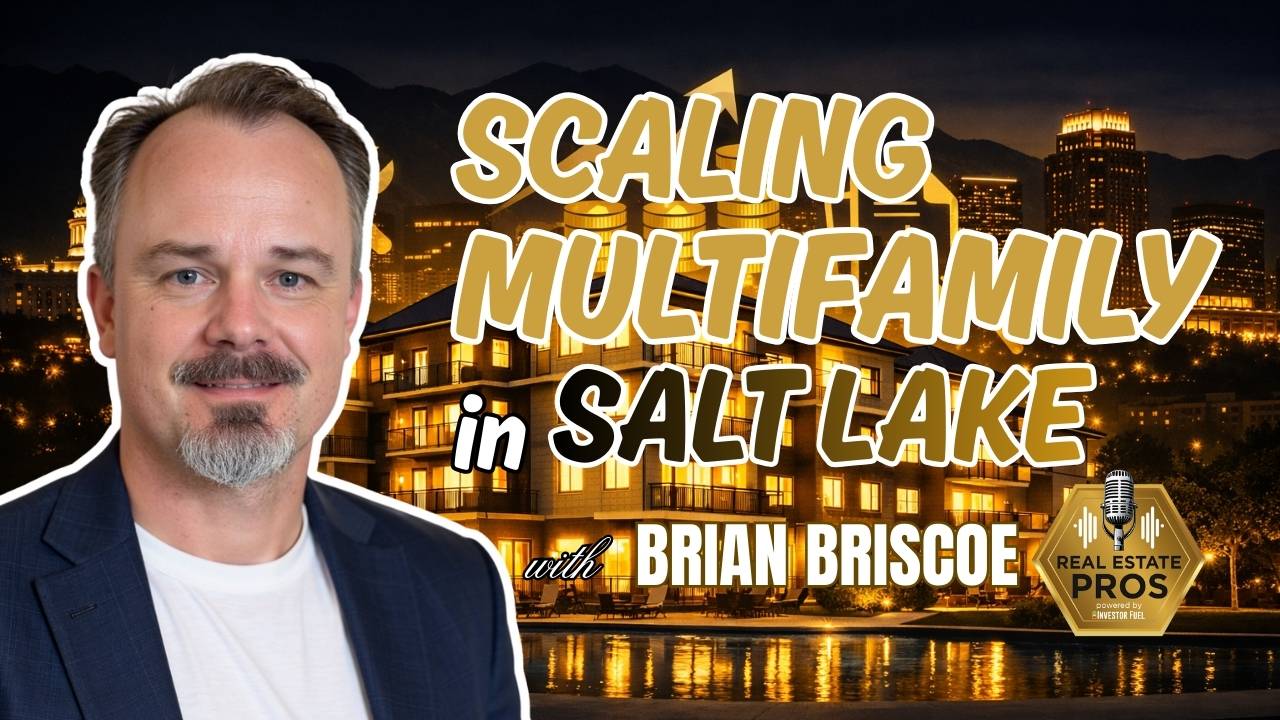
In this episode of the Real Estate Pros podcast, host Michelle Kesil interviews Brian Briscoe of Streamline Capital, who specializes in multifamily investing in the Salt Lake City area. Brian shares his journey from military service to real estate investing, discussing the transition from single-family homes to multifamily properties, the importance of mentorship, and the current market dynamics in Salt Lake City. He emphasizes the significance of motivation, education, and building relationships with brokers for successful lead generation. Brian also reflects on lessons learned from market fluctuations and offers advice for new investors looking to enter the real estate space.

Resources and Links from this show:
-
Listen to the Audio Version of this Episode
Investor Fuel Show Transcript:
Brian Briscoe (00:00)
Yeah, so one thing we do, ⁓ we chose an operating system to operate our business by, right now we have a really small team, there’s just three of us, but we use ⁓ what’s called entrepreneurial operating system and it just provides us a framework for solving all of our problems. ⁓ As I mentioned before, we hit the record button, we’re doing our annual goal setting meeting.we have is we have a 10-year goal and, you know, just to put that out there to the universe, you know, I want to have 10,000 units in the greater Salt Lake area in 10 years.
Michelle Kesil (02:09)
Hey everybody, welcome to the Real Estate Pros podcast. I’m your host, Michelle Kesil, and today I’m joined by someone I’m looking forward to chatting with, Brian Briscoe of Streamline Capital, who’s focusing on multifamily investing in the Salt Lake City area. So excited to have you here today, Brian.Brian Briscoe (02:26)
ThankThanks, Michelle. Excited to be here.
Michelle Kesil (02:33)
Absolutely. So let’s dive in. First off, for those not familiar with you and your work yet, can you share what your main focus is?Brian Briscoe (02:43)
Yeah, main focus, we buy and manage apartments in the greater Salt Lake City Metro. And we’re typically looking for value adds. So properties that are, you know, 15 to 30 years old that just ⁓ need a little bit of little bit of tender loving care, the TLC as they call it. So yeah, but we buy, renovate, manage, hold properties for five to 10 years and then, you know, sell them and just keep doing more and more.Michelle Kesil (03:14)
Awesome. How did you get started in the real estate industry?Brian Briscoe (03:19)
You know, ⁓ I was active duty military for a long time. I’m one of those guys that on September 12th, 2001, ended up at a recruiter station ⁓ where I didn’t realize at the time that it would turn into a 20 year career. ⁓ But the way I got into real estate investing is I was moving every two to three years, sometimes as short as nine months, you know? And so home ownership didn’t reallyIt wasn’t really possible for us or it wasn’t easy for us. so instead of buying a house for us to live in, I decided to buy a house, rent it out, and over the long term would get the same benefit. ⁓ I did that a couple of times, ended up with three rentals over about 15 year period and saw the growth in that and figured out, tried to figure out how to scale what I was doing. And the obvious answer to me, I there’s lots of ways to scale that.
⁓ But the obvious answer for me was, you know, start doing apartments where I could do roughly the same thing as I was doing with single family at a much larger scale.
Michelle Kesil (04:30)
Yeah, amazing. And how did you transition from those single family to the multifamily? Did you just do trial and error or did you like work with mentorship courses? Like how did you learn those next steps?Brian Briscoe (04:44)
Mm-hmm.You know, I started out thinking trial and error would work. I started out, I had a handful of properties and I said, okay, if I sell all my properties, here’s how much cash I have in the bank. ⁓ I think I visited three different banks in the local area and I just figured out what lending terms were and I figured I could buy about a five unit apartment complex, right? Five to eight units with the equity that I had.
And after searching for about a month and a half, two months, I finally realized that I had no idea what I was doing. And that’s when I got into a coaching program. And that’s really when things kind of launched for me was having somebody to basically walk me through all parts of the purchasing process, the managing process, and everything else. And after I signed up for coaching, within the first year, I had three properties. ⁓
total of 88 units in that first year. then, fast forward to now, it’s been seven years since that coaching. ⁓ I’ve been involved in about 1,600 units. right now Streamline Capital manages 150 in the greater Salt Lake area. yeah, was trial and error until I realized that I was gonna make more errors than I wanted, I was comfortable with, and I jumped into coaching.
Michelle Kesil (06:58)
Awesome. And what do you feel have been some of the main keys that made the biggest difference in allowing your business to be able to grow and to run smoothly?Brian Briscoe (07:09)
You know, I think the first thing is, you I was very motivated. Really motivated to get it working. When I decided to do coaching, I was still active duty, which, you know, is a full time job and a half, depending on, you know, how you’re looking at it. you know, I had been in the military long enough. I was… It’s just, it’s hard for families. You know, I was getting to the point to where I didn’t want to put my family through one more move.I didn’t want to put my family through one more deployment. And so I was really motivated to stop that cycle, stop the moving every two to three years, stop the going overseas for six to eight months every two to three years. ⁓ And that motivation really pushed me to take a lot of action. And I think more than anything else, was just try to improve ⁓ the conditions that I lived in every day and try to improve
what my family was dealing with ⁓ every couple of years. Because it’s not hard. I got five kids. It’s not hard for kids to pick up and move, especially as they get older. yeah, end of the day, think the biggest single thing was just motivation to change.
Michelle Kesil (08:27)
Absolutely. And so what are some of the ways that you are solving the next aspect of your business right now? Like what are some of the things that you are working to solve and scale to?Brian Briscoe (08:42)
Yeah, so one thing we do, ⁓ we chose an operating system to operate our business by, right now we have a really small team, there’s just three of us, but we use ⁓ what’s called entrepreneurial operating system and it just provides us a framework for solving all of our problems. ⁓ As I mentioned before, we hit the record button, we’re doing our annual goal setting meeting. ⁓you later this week where we pick out our annual goals. So ⁓ what we have is we have a 10-year goal and, you know, just to put that out there to the universe, you know, I want to have 10,000 units in the greater Salt Lake area in 10 years.
You know, it took me four years to get to a thousand and now I’m going to give myself 10 years to get to 10,000. ⁓
You know, and so we have that 10-year goal out there, and then we take that 10-year goal and pare it down to a three-year picture. And we really try to, you know, be really clear about what we’re trying to do in the next three years. And then, you know, from that three-year picture, we come down to a one-year target, and then from one-year target, we set our quarterly goals. And then our day-to-day operations, what we’re doing on a daily basis is we’re looking towards those quarterly goals.
⁓ I mean, so that’s the framework that we use. What are big issues right now is multifamilies kind of in a funk right now, which to me says it’s a really good time to buy. ⁓ There’s not as many buyers on the market, and there’s not many sellers out there, but because of that, there’s not a lot of money moving either. And if there’s not a lot of money moving, it makes the transactions difficult.
So our biggest issue right now is being able to find good deals because there’s not a lot out there and find investors who are willing to ⁓ put money in right now when there’s not a lot of good things happening. So we’re trying to paint the picture that now is the time to buy. We have a really good cash basis on properties. We’re buying low.
relative to the last five years. mean, prices in Salt Lake City right now are equivalent to where prices were in 2021. So we’re buying at 2021 prices in 2026 is kind what we’re looking at. yeah, end of the day, we’re in a market that’s difficult to operate in because there’s not a lot of transaction volume. And so we’re just trying to do our best to be quick.
when properties come up. ⁓ know, make that the process between seeing a property and communicating with the brokers and making offers is relatively quick. At the same time, we’re being disciplined with pricing. And then with investors, we’re doing a whole lot of ads right now to try to attract new investors, which has done pretty well for us. So end of the day, we understand where we are in the market. ⁓
We’re not fairy dusting anything, we’re just ⁓ methodically working towards our goals.
Michelle Kesil (12:38)
Yeah, absolutely. That’s amazing. And how I know that when we chatted before, you mentioned that you’re narrowing in on the Salt Lake City market. Is there anything specifically that you kind of foresee within your current market?Brian Briscoe (12:55)
Yeah, there’s a lot of growth in Salt Lake City. has been, ⁓ I mean, between the 2000, 2010 census, Utah was the fastest growing state and 80 % of the population of Utah is in the Salt Lake Metro. So you can say Salt Lake was a really fast growing area. Between 2010 and 2020 census, Utah was the second fastest growing state. And so,There’s 20 years of cumulative growth that’s happened there and there’s zero signs that it’s gonna stop. And looking at 20 years worth of fastest growth in the nation, ⁓ there is a lag between population growth and housing growth. Right now there’s a housing shortage. part of the reason we’re targeting Salt Lake is because the growth and the dynamics there.
Another big part of it is that’s where I was born and raised. So I know the area extremely well. ⁓ mean, quick, really easy example, I was in an apartment complex a couple of weeks ago, pulled it up, looked at the address and I’m like, ⁓ yeah, my elementary school bus went by that apartment every single, and I knew immediately what neighborhood it was in and… ⁓
In that case, I knew immediately not to pursue it because the neighborhood I grew up in wasn’t the best one 30 years ago. 40 years ago? Who cares? ⁓ So yeah, mean, yeah, looking at why there’s a lot of economic growth ⁓ throughout some other just quick things people can Google. know, US News every year puts a top 50 state ranking out there. Utah’s been number one for three years straight.
And most of that growth, once again, 80 % of the population is in that Salt Lake Metro. ⁓ So if Utah’s top of the map, there’s some pretty good indications that Salt Lake City is going to be on the top. So ⁓ yeah, end of the day, we’re sitting in a really good area to invest. The dynamics there are probably top in the country to be able to invest. ⁓
and it’s my hometown, which makes it lot easier for me to get traction there.
Michelle Kesil (15:54)
Absolutely. That’s incredible. What are some obstacles or setbacks that you’ve experienced as an investor that now looking back in hindsight, you can see the lesson more clearly?Brian Briscoe (16:07)
You know, ⁓ market, know, looking at the market. I started investing, mean, the first, ⁓ you know, when I started doing multifamily specifically, ⁓ you know, we’ve seen rates come down dramatically. You know, I think when I first started looking at apartment complexes, you know, the federal funds rate was, you know, two, two and a half.And in 2019, if I remember right, rates came down and things changed dramatically. Lenders were lending a lot more, investors, it was really relatively easy to find investors and find money. And now I think that that’s kind of flipped around. A couple of years later, 2022, I think most people know rates went up dramatically as well. ⁓ So I’ve been through a roller coaster.
because of market. really what that roller coaster has taught me is there are certain fundamentals that have worked in real estate for a long, long time. And what doesn’t work is buying a property and expecting to sell it 12 to 18 months later at double the price. So ⁓ that has us leaning to lower leverage on our loans. We’re pursuing deals that are a little bit safer.
over a longer period of time. And that blueprint for investments is typically going to work in any economy. So if we happen to buy and the economy goes bad or we get another correction or crash with real estate, ⁓ as long as we can keep on paying our mortgage and hold for several years, it ends up working out. So really just reinforced…
investing fundamentals. We’re in this for the long term. ⁓ That doesn’t mean if market conditions are awesome, we’re not going to turn around in two years and sell a property, but we’re going to come in and approach every investment from a longer term perspective so that if there is something that pops up between now and when we want to sell, we’ve got time to weather the storm.
Michelle Kesil (18:26)
Yeah, absolutely. I think that’s important when you’re here for the long term game.So what are some advice that you would give to investors that are earlier on in their journey or just looking to start out?
Brian Briscoe (18:41)
You know, first you got to know what you want. I think there’s two pieces to it. There’s the motivation and then there’s the education. You know, if you don’t have either one, you’re not going to be very successful, right? So if you can have all the motivation in the world, ⁓ but you know, if you don’t know how to take the right steps or what steps to take, that can lead to problems. On the flip side, you can have all the education in the world and no motivation and never do deals. So I think there’s…There needs to be a healthy balance between the two. But ⁓ I do strongly recommend that people find mentors, whether it’s ⁓ something that just develops or pay to play. ⁓ What I will say about the mentorship relationship is there has to be a mutual exchange of value, ⁓ which makes the pay to play mentorships probably the easiest ones to manage.
⁓ You end to the day, you you’ve got to be motivated. You got to know what you want, what your goals are, what you’re stretching for. And, you know, get some help. Get a mentor, get somebody who’s done it before. Because it’s not as easy as, you know, finding a property on the MLS or, you know, making 2,000 lowball offers every single day. It’s a completely different business than what people see in the single family market.
Michelle Kesil (20:12)
Yeah, absolutely. think that the education and the mentorship can take you so much further.What about lead generation? Is there a certain strategy that you use that you find helpful?
Brian Briscoe (20:24)
Yeah, for Leeds, the only thing we’re doing like maximum lead generation with, I mean, we have two things that we’re looking for, looking for deals, we’re looking for investors. And right now, you know, we’re putting money into lead generation for new investors. We’re using meta ads and, you know, so far they’ve performed pretty well for us. ⁓ On the property side, I mean, we build relationships with brokers because most… ⁓read a stat in a book recently saying 92 % of multifamily properties are broker deals, you know? And so we’re not chasing the 8%, you know? We’re basically working with the brokers to leverage their time and their expertise. So as far as finding new properties to purchase, we’re 100 % reliant on brokers. And, you know, we know every major broker in the greater Salt Lake City area.
We’re on their list. We exchange texts and phone calls with them quite frequently. So for the deal flow, it’s just building relationships with brokers. For marketing to investors, do a lot of, like I said, we’re doing a lot of ad spend for lead generation there.
Michelle Kesil (21:49)
Yeah, amazing that you’re building those relationships at networks in those ways.So before we begin to wrap up here, if somebody wants to reach out, connect, learn more about what you’re up to, where can people find you and connect with you?
Brian Briscoe (22:09)
Yeah, think best place, LinkedIn. I’m on LinkedIn pretty frequently. Just send me a note ⁓ and we’ll be connected pretty quickly. ⁓ Yeah, that’s probably the best way right now.Michelle Kesil (22:24)
Okay, perfect, well, appreciate your time and your story. Thank you so much for coming on here.Brian Briscoe (22:31)
Yeah, absolutely. Thanks, Michelle.Michelle Kesil (22:34)
Of course. And for those listeners that are tuning into the show, if you got value, make sure you have subscribed. We have more conversations coming with operators who are like Brian and are building real businesses, and we will see you all on our next episode.