Subscribe via:



Show Summary
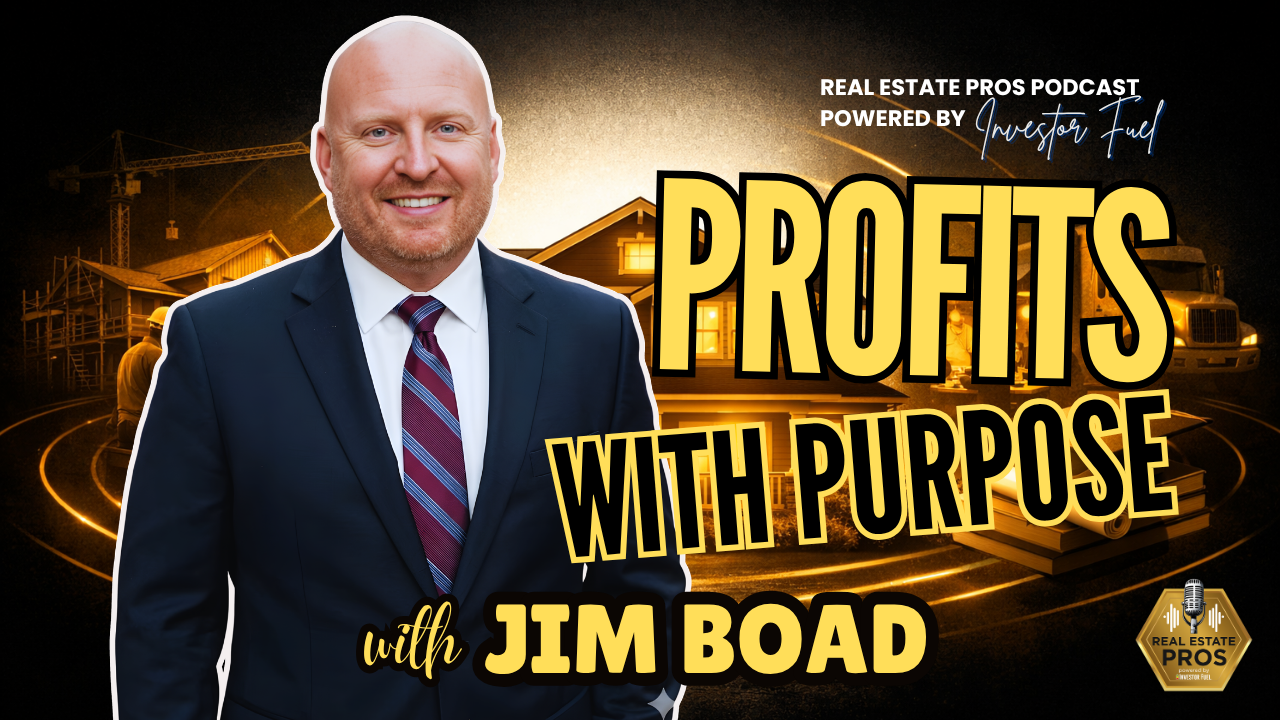
Jim Boad shares his journey from traditional real estate investing to pioneering sober living homes, highlighting the social impact, operational strategies, and entrepreneurial ventures that support recovery and community development.

Resources and Links from this show:
-
-
- Investor Fuel Real Estate Mastermind
- Investor Machine Real Estate Lead Generation
- Mike on Facebook
- Mike on Instagram
- Mike on LinkedIn
- Jim Boad’s Websites
- Jim Boad on Facebook
- Group Home Accelerator on Instagram
- Jim Boad on LinkedIn
- Jim Boad on X
- Jim Boad on Youtube
- Jim Boad’s Book
- Group Home Accelerator ‘s Website
- Shelton Housing First’s Website
- Jim Boad on Calendy
- Jim Boad on Skool
-
Listen to the Audio Version of this Episode
Investor Fuel Show Transcript:
Jim Boad (00:00)
So ⁓ I just was doom scrolling one night after I was done looking at enough red on my spreadsheet to fill the ocean. And I found just a little online course about group homes. Wasn’t specifically sober living. It was a little more generic.
But I ended up jumping on it, I bought it, I watched every module that night. The next day I got up and I kind of started making moves. I had some houses that I was getting ready to rent. And I just started turning them into sober living homes.
Micah Johnson (01:59)
Hello everyone. Welcome to the Real Estate Pros Podcast. I’m your host, Micah Johnson. And today I’m joined by Jim Boad who’s been making some serious moves in real estate investing now for the last 25 years. Jim, welcome in, man. Glad to have you.
Jim Boad (02:11)
I am super happy to be here.
Micah Johnson (02:13)
I’m excited for you to be here. We’ve had an awesome pre-recording call and the last four years you’ve dug into something. It’s a super interesting niche because it not only really solves a math problem well, but more importantly, the impact that it has is, is tremendous. It’s a domino effect. That’s going to, in my opinion, change society when this is done really well, it has, it’s going to really do some awesome things. So.
Let’s dig into it, man. For those who aren’t familiar with yet, you know, tell us a little more about yourself and what your main focus is right now.
Jim Boad (02:47)
Absolutely. You know, right now my main focus is ⁓ scaling my sober living slash recovery homes and really teaching people how to start and scale their own recovery homes. So like you said, I’ve been doing it for about four years now running recovery homes and it’s been a wild ride. You know, I started out with ⁓
just going into my rental portfolio. So the homes weren’t ideal for what I was doing. Some of them were like two bedroom, one bath condos and like, know, duplexes and things like that where over this past three years, I’ve reduced the amount of homes that I had, because I started out and had 14 pretty quickly, but I’ve got it down to five now, but I actually have about the same amount and starting to crass more beds than I had when I had more homes. And they’re just, they’re much easier to run when you have those bigger homes.
And I’m developing some small parcels here in my town and getting ready to build out a bunch more of these houses.
Micah Johnson (03:46)
market are you in doing this?
Jim Boad (03:48)
I’m outside of Seattle. I’m actually in a small town. There’s only 11,000 people in my town. So one of the things with that is I have over 50 beds right now that I have full all the time and I have a whiteboard with people on it on a waiting list. So you don’t have to be in the heart of the city to make this actually work and thrive at this and change a lot of lives.
Micah Johnson (04:08)
Take us back, man. You’ve been doing real estate a long time. And then four years ago, you make this shift. What led you to where you are today? What did this for you?
Jim Boad (04:18)
Well, COVID is actually what put me into this shift. ⁓ Because I have been a real estate investor for a long time, started out as a fix and flipper, kind of worked my way up to being a burghuy, where I buy it, renovate it, refinance it and repeat. And I was building my rental pool and when COVID hit, was like overnight that almost every single person that lived in my homes stopped paying rent.
And I reached out, what’s going on? Did you lose your job? I understand there’s a lot happening. How can I work with you? And they just simply said, I don’t have to pay you anymore. And they weren’t wrong. They didn’t have to pay me anymore. There was nothing I could do.
So ⁓ I just was doom scrolling one night after I was done looking at enough red on my spreadsheet to fill the ocean. And I found just a little online course about group homes. Wasn’t specifically sober living. It was a little more generic.
But I ended up jumping on it, I bought it, I watched every module that night. The next day I got up and I kind of started making moves. I had some houses that I was getting ready to rent. And I just started turning them into sober living homes. And ⁓ I haven’t looked back since then.
Micah Johnson (06:16)
Was this is this something I hope this ain’t too personal but is it something you dealt with in your own life and shifted into because I’ve heard that story where people get into it or Just found it through this video and and connect it in
Jim Boad (06:30)
I’ve always wanted to give back and I had 20 years of I was just too busy. I’ve got this project going. I’ve got this going. I’ll get to it next year. Let me just hit this pinnacle of success in my career and I’ll start helping out. So I’ve always had that one and that desire to help and yes, I was touched by drugs and alcohol at a very young age. Both of my parents were alcoholics and pretty heavy heavy drug addicts. So I was blessed that I saw everything I don’t want to do.
So I never went down the drug path because I saw how it ruined families and ruined our family and just really made life hard.
Micah Johnson (07:04)
All right, you’ve seen it.
Yeah, well, and that’s the thing too. It doesn’t have to like what inspires you to a mission. A lot of times is that you’ve seen like it doesn’t have to happen to you. You don’t have to be the one struggling to get inspired. You can have seen it because when you’ve seen something firsthand. You deal with it in a completely different way. It actually allows you to create space like when you and that’s that’s the thing. I when I’m looking at people, I’m more interested in what you’ve overcome in life than what you’ve accomplished.
Because what you’ve overcome required you to become somebody new. That is not a simple task to do, to overcome hard things. And the folks that do, what I really love about their mentality is they leave that door open behind them. They created access to a place where it’s like, okay, I’m not really that special. I’ve got out. How can other people get out? And it’s when you realize most, you’re the most people.
and like how this happens and stuff like it affected me and then you can go plug in and touch base with them. It becomes powerful man because we were talking a little bit about this. There’s a separator when it comes to running one of these well is and it’s kind of your greatest fear in the industry a little bit too. You were saying dive into that for us. What what makes you stand apart and then tap into that worrisome?
Jim Boad (08:25)
Absolutely. I think the biggest thing that makes me and really good operators stand apart is we care about the mission. And the mission here is to get people sober and stable again, because there’s a really big miss. There’s a lot of treatment centers out there. There’s a lot. I think you’d be shocked if you Googled drug inpatient treatment centers around me, just as a Google search, I think you wouldn’t even realize, wow, I didn’t realize there were 15 of these around me.
then try to find sober living homes. And I’ll bet you find three to five. And those three to five are not supporting those 15 full centers that bring people in, get them clean, and then put them back out on the street basically. Now they help. There’s counseling and there’s reports and there’s meetings they send you to. But when you don’t have that bridge of safe, stable, sober housing, it really affects everything. The rate of people going back on the drugs that…
don’t go into sober living or only go into sober living for 30 or 60 days is insanely high. You start getting that 90 plus day mark in sober living after treatment, your rate of not going backwards is exponentially more. And there is the loom in this business that you can make a lot of money. So you could be a slumlord in this business and financially do well, but you’re not helping people.
and then you potentially jeopardize the rest of the good operators out there because we do have protections to remove people from these types of programs. Because the way these work is people come into these homes and they’re in a sober living program, they’re not a tenant. So we’re not, right now we’re kind of dancing on that Landlord Tenant Act information or rules. But if too many bad operators get into this market, it could easily shift it to where, okay, we’re not gonna protect you anymore. And then,
Micah Johnson (09:54)
Right.
Right.
Jim Boad (10:16)
it ruins
the whole aspect of what sober living homes actually do.
Micah Johnson (10:22)
Right, because the whole thing’s about accountability for the person that’s staying there. And what I love about how powerful they are is it’s accountability with other people. And I think it’s fascinating that you said the 90 day mark, because there’s something magical about doing something for 90 days. If you can do something for 90 days, your chances of doing it for a long time dramatically improve. There’s much science as you want about it. And what I love about
Jim Boad (10:25)
apps.
Micah Johnson (10:49)
these homes are when they’re run well and done right, these the guys in them support each other. And that’s what makes it all go round is the fact that you have other people around you that are doing the same thing. It’s why investors join masterminds. It’s literally the same thing is surrounding yourself with people that are doing what you want or have done it already and give you the confidence they give you the hope they they show you the way. Right. That’s the that’s
Humans don’t do things well alone, but together it is an unstoppable force.
Jim Boad (11:58)
What is it they say? Show me the five people you spend the most time with and I’ll tell you who you are.
Micah Johnson (12:02)
Right. It’s a cliche for a reason, right? Like cliches are cliches for a
reason, y’all. a, yeah, it’s why it’s there and…
Jim Boad (12:10)
Yep. Well, and
that wants me right into something as well, because like the way we run our homes is we put two people per room. And there are two reasons for that. And the main reason for that is exactly what you were just saying. We have found that our highest rate of recidivism with people going back onto drugs are when we get put them in one of our solo rooms, because you do have to have a certain square footage to be able to put two people per room.
And I have a couple of places where there’s a couple smaller rooms. So I can only put one person. And now we’ve got it to where people kind of graduate into those rooms. Because when we put new people in those rooms, it’s staggering how much more they relapse than when we put them in a room with someone else. And it really matters. Just like you said, people like being around people.
Micah Johnson (13:00)
Yeah. Yeah. And then we keep each other going. We keep each other going. And accountability is always thought of as like this negative thing. It’s not when it’s, when it’s done correctly, it’s more of just holding your feet to the fire. Hey, what’s going on? We know where you at. What’s happening? Like it’s, it’s, it’s the same questions that you have again. It’s like, it’s literally the same thing, but applied you to apply it at these different levels and
I think that’s interesting about the single room thing. Cause again, yeah, that makes complete sense where if you’re new, cause it’s not just about getting out. said this earlier, 30 days just gets you clean. Now we’ve got to, we’ve got to restructure your mind. We got to restructure that story that you tell yourself. That’s, and that can’t be done quickly. That, that does take a minimum of 90 days. mean, then now you’re dealing with straight personal development and that is a long, you got to like,
be you enough days in a row while still choosing to do these things. That’s what it takes, right? Like we’re the one that change each day. The decisions we make are the ones that stay the same. The versions of us doing it, we got to do them enough, right? To get those to stick. And ⁓ I get hyped on this stuff.
Jim Boad (14:13)
And it gets you away from those bad influences. You we had a guy who’s been with us. He was with us for about six months and he finally was like, okay, I’m gonna go visit home. He went home. He came back. First thing he told us was I relapsed when I was at home. He was standing around with people that he used to hang out with. And I know this sounds weird that it’s as casual as it is, but somebody hit a meth pipe, handed it to him. He hit it and went, oh my God, I just relapsed. And I mean, he came back, told us right away.
And that’s one of the things about that accountability. What we did with him was we don’t just arbitrarily throw people away. It really depends on how they relapse and how they handle their relapse. We will hold beds for people often, hey, you need to leave the house for two weeks and get yourself clean. You we had a guy who literally went and stayed in a tent for two weeks because that’s all he had the ability to do and then came back was clean. And now he’s been with us for another three months, killing it.
But this guy came back, went to another 30 day inpatient clinic. We held his room, let it all stay set up for him. He got out, he’s been back now for a few months and he’s just, he’s killing it again. He’s back into it, he’s trying to help other people, he’s getting a job, like, but it’s going back to where you were. That’s where the power of these really come from. They take you out of that bad environment and they put you in an environment that is completely conducive to you being the best you you can be. So.
Micah Johnson (15:31)
Right,
exactly. And teaching, know, this is the environment, how you create this for yourself once you leave. That really key part that you keep going on. But you do, I want to delve into something else. So you’re an entrepreneur more than just real estate. You got a restaurant that you own, a construction company, there’s a nonprofit that you have going on as well that helps with this. So you’ve found a way actually to kind of, I mean, vertically integrate for lack of a better term, of the…
Not only are these guys coming here and needing to do this stuff, but they need jobs too, right? They need places to go be active in society. Tell us how you’ve also leveraged that into what you do.
Jim Boad (16:52)
It’s been an amazing journey with that. The easy one that started was construction, because we mainly help guys. Guys seem to be in our area a little more underserved than females. There’s quite a bit of help for them here. So guys come in and I have a lot of easy trade stuff. mean, picking up garbage, I mean, all the way up, because we do almost everything. The only thing we don’t do in our construction company is electric. So I mean, from roofing to foundations and everything in between. And I found some amazingly skilled and talented people.
that have come in to help me with that. But the coolest one was I was in my restaurant with my wife the other day and we were sitting there having dinner and we’re kind of looking around and realized that every single person that was working there was in or been through our program. And that was kind of surreal. Like, wow, like we’re having so much more of an impact here. They actually have jobs. They got clean. They’re staying clean. It was pretty cool.
Micah Johnson (17:47)
And
it’s powerful because you kind of, you’re, developing your own workforce in a way where it makes hiring simpler, right? You understand the people and they also have more of a dedication in a way to you. Like you’re doing so much for them upfront that as these opportunities come along and finding good help is the hardest thing. It’s the hardest thing in business. is the absolute hardest thing to do and the ability to. ⁓ I mean, you’re it’s like.
Jim Boad (18:07)
Yes.
Micah Johnson (18:15)
It’s honestly, it’s a bad analogy, but it’s how I see professional investors that wholesale buy and hold, or fix and flip and buy and hold, right? They bring in a property and then run it through. Where’s it fit best at? Again, terrible analogy, but you’re almost able to do that with people in a way because they come in, you have other, you’re an entrepreneur, you create opportunities. You’re able to look at these and say, Hey, this could be an opportunity. And boom, now it’s moving in and dude, that’s cool. And I,
Jim Boad (18:44)
What?
Micah Johnson (18:45)
Take us into that feeling. So you’re sitting in your own restaurant, which is already awesome. And then you look around and you look at who’s working there and you see, cow, these are, these are actually changed lives. These are, these aren’t just random folks working here.
Jim Boad (19:00)
No, you’re absolutely right. And it’s it it took a minute to get over that and really let that feeling digest and set in because you know, like I said, for 20 plus years, I’ve wanted to help and wanted to give back. And and now it’s actually happening. And it’s just like, wow, we’re actually changing lives. And sometimes you don’t we don’t see ourselves the way the world sees us quite often. And it’s just like, wow, we’re actually doing something that’s having an impact. And it’s
It’s cool. It’s a really, really cool feeling and I don’t think I’ve ever had a better one.
Micah Johnson (19:34)
Right? Well, we’re talking about that a little bit too, the way that real estate, when you find your niche in this industry, it pays two paychecks, financial one and your emotional one. And those two things getting connected, now you got perpetual motion because you won’t stop doing that thing that makes you feel good doing it already. And when it keeps paying you, it feels even better. And now it’s, the practice itself, it reinforces itself, which
This is kind of my ADHD going off, but that goes all the way back to those things you’re telling yourself upfront, right? Down to that story that you’re relearning once you’re, when you’re in a room or that we all really need to go through. All of us need to understand ourselves better. But when you do that foundational work, it lasts throughout every cycle of your life and it only grows on top of it. That’s what’s beautiful about doing it, where I’m obsessed with one action, doing a bunch of results over time.
And that’s literally what you’re getting to live out is that same kind of reality of not only does this do this, but it does freaking 20 other things at the same time. And that is, ⁓ come on now.
Jim Boad (20:41)
It really is and then that kind of spins into the nonprofit that we recently started and You know a lot of people want to try to jump right into the nonprofit and it’s it’s not really in my opinion the place to start Because it’s it’s a lot harder plus you don’t really have a mechanism to implement what you get from that nonprofit But with our nonprofit the big things that we do with it is we will do scholarships for our guys So if they go to self-pay and they’re not prepared to take it all on themselves or any of it on themselves
Micah Johnson (20:52)
Mm.
Jim Boad (21:09)
then we can help them stay in the house longer. And then we also do a lot of job training. We’ve sent some guys to Flagler School, so they’re now state certified flaggers, so they can go get really decent paying jobs, like right out of the gate and not even have to be trained. ⁓ We’ve got CDL program where guys are learning how to be truck drivers. We have a small college bias. They have a welding program that we’re gonna get ready to put people in. So I mean, it becomes endless what you can start doing to help people when you.
when you really get into this.
Micah Johnson (21:40)
And, now think about, I mean, you’re in a little town of 11,000 people and you’re turning out higher quality, better trained folks. Like the, the, the effect that we’ll have on society just around you, man, 10 years, your world’s not going to look the same. Like it’s going to be, it’s, it’s kind of the benefit of a little area. You can see it with a perspective of like, wow, holy cow. Look at what’s really happening here. And I want to touch one thing here before we run out of time. You’ve now taken this.
and turned it into training for other people. You’re now working with other people who have that same passion and mentality. Tell us a little about your program there what you have going on.
Jim Boad (22:20)
Absolutely. My program’s group home accelerator. And it’s really, it’s just, it’s the nuts and bolts of how to start. And then we jump into how to scale these sober living homes because I’ve done it both. I started them and I’ve scaled them very rapidly. And you know, what we do in our program is I run it through a school group. So.
Of course, you know, I have video training and things like that in there that you can jump in and do your own pace. But where the real goal than this is, is that we get on live multiple times a week and we just run through Q and A’s and then we run through training of anything that we’re doing. Because like we have a database that we use for this that runs it all the way down to the bed level. So then we can run everyone’s individual things and have a complete file on everyone. So we have no paper files anymore. It’s an amazing program because we didn’t start there. But we show people how to use that.
We go through how to do drug tests with people in real time. We go through how we’ve had to kick people out of our houses and how you can deal with it. Like there’s just no stone left unturned. You get all of my years of experience and my staffs as well, because I have a staff that run my business on the sober living side from day to day. And I have pretty much since I opened, because I did open it as a business where I didn’t want to create a job for myself. So I get to stay on the higher level of it, but that’s what it is. I mean, we teach you how to grow in scale.
and it’s a pretty insane program and I’m getting great results for other people. And the last thing on it for me personally, my selfishness of it is by doing this, I feel like I get to have my finger in that ripple a little bit of all of the other people that get helped because I have an average of 50 people at a time that are in my homes and I turn those homes, every month I turn people from my home. Some people have been there for six, 12, some people have been there for three days.
But I turn hundreds, not thousands of people in a year because it happens quickly. And I can’t wait till I have a thousand people that I’ve taught how to do this that all have one to three homes. What’s that look like?
Micah Johnson (24:22)
Right, it’s powerful man. I love your passion and energy behind it. For those that are interested in learning more about that, what you have going on, what’s the best way for them to find you?
Jim Boad (24:32)
Online, just my name, JimBoad.com is my website for my Group Home Accelerator. And same thing, if you’re looking on social, I’ll be on social through Group Home Accelerator or JimBoad.
Micah Johnson (24:44)
Okay, excellent. Thanks for sharing those. If you’re listening and watching in, check our show notes. We’re have all Jim’s links there. And like y’all hear me say constantly on this show, it’s not just random folks that are coming on, they’re professionals at what they do. And if you’re gonna learn any niche in this industry, you learn it from a professional who is actively doing it. Someone who can show you how to turn over every stone. Someone that has already walked. This is a team sport.
real estate. if you’ve listened to today and you’ve are your interests is sparked. You want to learn more? Click on one of those links. Go visit Jim, talk with him, have a call, touch base, see if this is the right thing for you. Jim, man, I really appreciate your time today. I love your story, your perspective on it. I think we need more folks out there like you doing it.
Jim Boad (25:31)
Thank you so much. I’m glad I could be here.
Micah Johnson (25:33)
Absolutely. Thanks everybody out there today who joined us. If you got value out of today’s episode, please like this episode, share it with someone else you think could get value out of it. And if you’re not a subscriber yet, you know what to do. Click that button, follow along. We’ve got more conversations coming up with operators just like Jim. Folks out there building a real business in the industry. Thanks for being with us today. We’ll see you on the next episode.