Subscribe via:



Show Summary
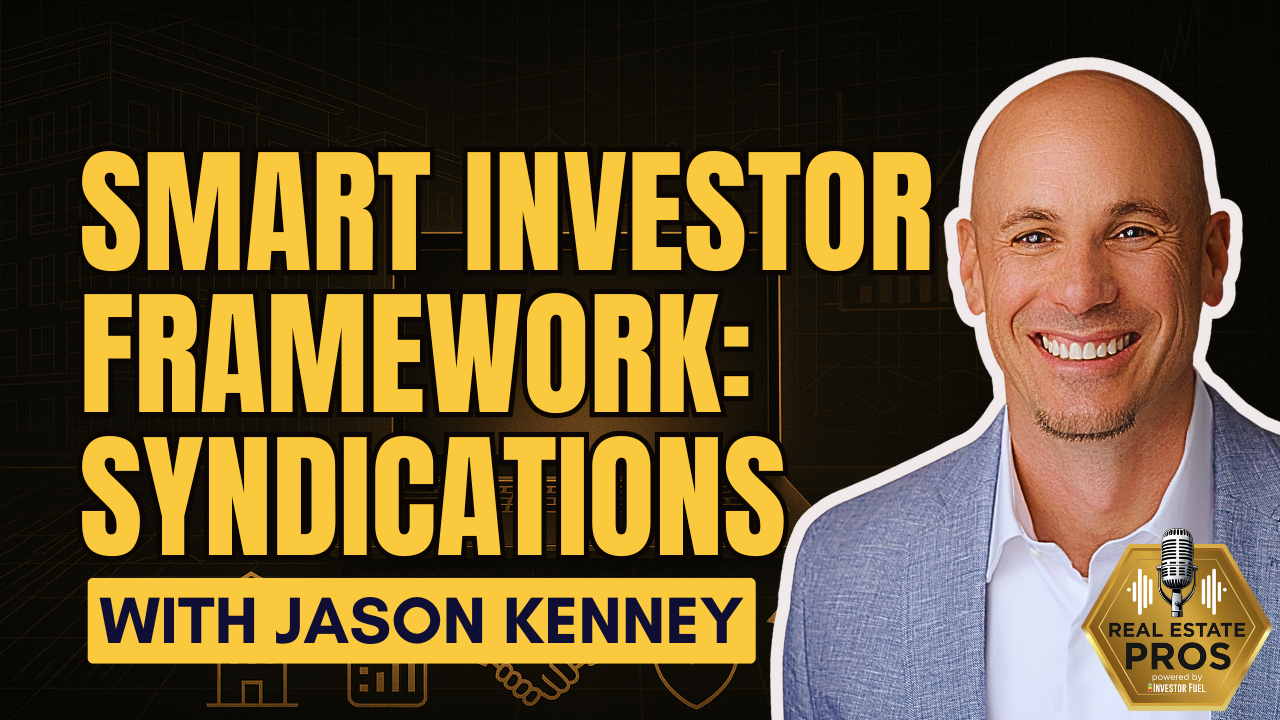
In this conversation, Jason Kenney discusses his journey in real estate investment, focusing on the multifamily housing market. He emphasizes the importance of turning challenges into opportunities, maintaining discipline in investment decisions, and the value of building meaningful relationships. Kenney introduces his ‘Smart Investor Framework’ to help investors make informed decisions and highlights the significance of having a clear vision and taking action to achieve goals.
Resources and Links from this show:
-
Listen to the Audio Version of this Episode
Investor Fuel Show Transcript:
Jason Kenney (00:00)
You know, I think I would just say this. would say have a clear vision, have a clear direction, know what your goals are. Don’t be afraid to ask for help. There are plenty of people out there who have done things already that you’re trying to do. So build a strong network, build a strong team, and then you have to take action. You can’t sit around, you can’t just talk about it, you can’t look at the data forever, you got to actually take action.And if you do those things, if you have a clear vision, if you build a strong team and then you take action, you will achieve your goals.
Quentin (02:04)
Hello everyone. Welcome to the Real Estate Pros podcast. I am your host Q Edmonds. And know what I’m gonna say? I’m excited to be here. We have another dynamic guest. I’m telling you. I just, really appreciate the people that I get to meet. And today this guy, he’s gonna talk to you about multifamily, multifamily syndication. But more importantly, I love the way this gentleman, his brain works, right? He is an analyst. Like he loves our…the art of the deal, researching, using data. You’re not going to get this guy too emotional. He’s going to go by the data with the data and show them. That’s how he’s going to structure the deal. But also, you know, he just has a story to tell, like most people that come on. And that’s what excites me is when I get a chance to peek through people’s lenses and they get to take me into their world. And so today is going to be no different. And I’m so excited to introduce you to Mr. Jason Kenney. Mr. Jason, how you doing today, sir?
Jason Kenney (02:58)
I’m doing really well, Quentin. Thanks for having me. I’m excited to be here.Quentin (03:01)
Absolutely excited for you to be here. Listen, Jason, I ain’t gonna waste no time. I want you to take us into your world. I want you to tell us what your main focus is these days. Maybe tell us where you are in the world, what market you’re operating in. And Jason, honestly, if you want to give us a little origin story, we love origin stories. So we want to tell us a little bit about how you got taller than real estate. We would love that too. But listen, Mr. Jason, you got the floor,Jason Kenney (03:23)
Yeah, sure. So I guess I’ll start with an origin story, give some people ⁓ some context around my story. So I’ve got a corporate background, spent about 20 years as an IT analyst, like you mentioned earlier during the intro. About 10 of those years were in financial services, another 10 were in the medical field. My wife also has a corporate background, spent about the same amount of time, but she does medical device sales.And we really spent quite a bit of that time just kind of moving around the country, climbing the corporate ladder, chasing promotions. And while it was just me and her, it was great. We were earning a great living and got to live in some really cool places. And we bought a beautiful home and all of that. But eventually, it kind of started to burn us out. And we got to a place where ⁓ it was just a tough pace to keep. And when you’re
Climbing the corporate ladder, every rung that you climb, you’re kind of giving a little bit more of yourself, right? You’re spending more time, more stress, more responsibility. And for my wife, was more time away from home. So traveling, for sales, she was on and off an airplane about every other week. And pretty much living out of a suitcase. And so over time, it really just started to take its toll. And things really, you we kind of had a turning point after our first son was born. You know, we were able to take… ⁓
leave and spend the first couple of months with him. And of course, the day came when my wife had to get back on a plane and start traveling again. And ⁓ I remember standing in the fore of our house and she was standing there, you know, holding our three month old and she was just crying, Quentin. I she was just crying her eyes out because it was the first time ⁓ since he was born that she was going to have to separate from him. So I remember just feeling really awful. I remember thinking like, you know, we’ve done all this stuff. We moved all over the country. You know, we
took on all this pressure and this responsibility. And we’re still in a situation where we have to pay somebody else to watch our kid. This is the situation we found ourselves in. So ⁓ it was kind of a realization for us at that point that we needed to make some changes.
And that’s really what got us into ⁓ real estate investing. So we made a conscious decision at that point ⁓ that we were going to be more intentional with the incomes that we had literally spent decades kind of building.
and we were going to start consuming less, investing more, and buying assets that not only generated wealth for the long term, but that gave us cash flow that we could use now. ⁓ Up until that point, every single dollar of income we had was tied to our W-2 income. We were completely tied to our paychecks. All the wealth we had was locked up in retirement accounts, ⁓ stuck in equity. So we really just didn’t have the freedom and flexibility that we thought we were going to have.
And so, you my wife and I got to talking and decided that real estate was going to be a good way for us to build wealth. And I signed up for some investment courses, ⁓ spent a couple of months doing that, started investing in single family residentials, ⁓ did that for a few months, built up a small portfolio, but realized shortly after that, that that wasn’t going to be the way to get there. You know, we
realized there was going to be a challenge scaling that. ⁓ And the other thing was what I had actually done for myself was create a second job. Being an analyst and having an analytical background, I enjoy the data, I enjoy the research, but I spent a lot of time on nights and weekends researching markets, underwriting deals, overseeing renovations, doing those sorts of things. And being a new dad, still working at W2 at that time, I just didn’t really have the time for that. ⁓
Quentin (07:28)
Yeah.Jason Kenney (07:48)
Real estate was working, but we started looking for other ways to invest in real estate that weren’t going to consume so much of our time. And that’s really when I stumbled across syndication. And at that time, I had no idea what syndication even was. ⁓ And for those in the audience who might not understand what a syndication is, it’s really just a way for a group of investors to pool their resources together to invest in large real estate that they couldn’t take down on their own.When you invest in this education, it’s really a partnership. There’s two groups of partners, a general partner and limited partners. General partner has all the active control. They have the management control over the asset. And then limited partners are completely passive. They just invest equity and they share it in the majority of the returns. And so for us, where we were at that particular time, that was a great option.
And so I remember at that time, I was actually listening to a real estate radio guys podcast. had advertised a syndication seminar in Dallas. I bought a ticket, flew out there, spent the weekend, signed up for their syndication mentoring club after that. And really for the next year, just immersed myself in all things syndication. ⁓ And then on the backside of that, we were ready to start investing. I did some research, found some sponsors I liked.
And then since then we’ve invested in, think, five syndications. I’m a partner on over 1200 units on the limited side. And it’s really been a game changer for us, Quentin. mean, the returns are better. We have consistent cash flow. We get great tax advantages from that now. So for people that were in our situation, it really helped significantly. And my wife has been able to step back from her corporate career. You she works from home full time. She’s around our boys every single day.
She travels like a fraction of the time that she used to travel and she’s under a lot less stress. And then for me, you know, I’ve also been able to step back. I’ve left my W2 job. I started Noble Capital Management, which is a multifamily real estate investment firm, really focused on helping other accredited investors like myself, you know, grow and preserve their wealth through stable but undervalued multifamily assets.
For me, it’s really about building partnerships, long-term relationships, and helping other folks get the same level of freedom and flexibility that we have.
Quentin (10:00)
Man, thank you, Jason, sir. Thank you for this origin story. Man, thank you for paying so much close attention to your wife. I’m a husband myself, and I mean, they say a lot of times that purpose comes from pain, right? So identifying where your wife was, her to be around her kids, your kids, not just her kids. I mean, to her, these are the kids that she’s birthed, But you just really tapping in and finding them lame.Jason Kenney (10:22)
Yes, yeah.Quentin (10:28)
to be able to help her with our overall goal of being around our children more and being around your kids more. so hats off to you, man. That’s something to celebrate in itself. And so thank you, man. Thank you again for the story. What do you identify as some of the, and I want this two ways. What do you identify as some of the key strategies to your business and also to life that kind of keep you running smoothly, keeps your eyes on the prize?Jason Kenney (11:28)
You know, I’ll touch on the life question first. I think for me, you know, being married, having a wife, having a family, it’s having a clear vision and a clear purpose and being aligned on that. You know, I hear stories about significant others, whether they’re, you know, husband, wife, whoever they may be, that they’re not necessarily in alignment on the direction they want to head in. And that makes things really difficult. It makes it really hard to accomplish your goals if you don’t have a shared vision.Fortunately, I have a great marriage. My wife and I see eye to eye on the really important things. And we have a clear vision, a clear direction, and a clear strategy for how we want to achieve that. And so that’s been a big part of that. And then on the business side, think strategy-wise, for what I do in multifamily, I like to focus on markets that I have immediate access to. So I’m just outside of Nashville, Tennessee.
There’s a lot of great markets here in Tennessee. There’s a lot of population growth. It’s a really business friendly environment. It’s just really a great place to be in real estate and even some of the peripheral markets. So I like to focus on my markets, become an expert in my markets, ⁓ know them inside and out, build those relationships and then get access to opportunities that other folks are not going to get access to.
Quentin (12:38)
Yeah, Jason, thank you so much. in Tennessee is just a beautiful market man. So yeah, I know there’s great things going on in Tennessee for sure. Now, listen, I love what you’re saying. I love how you have built this space in this pocket where you are finding success. And I also like to talk about in a point in the podcast where people show the success, but there is a journey of how you got to the success.Right. And I want to sometimes point out that journey on how you got to the success. And so I know, you know, you’ve been in it long enough. know, things get real deals go sideways. There are times that you have to pivot fast. And Jason, I was wondering if you ever hit some adversity on your trail to success.
Jason Kenney (13:06)
Yeah.You know, I think there’s been a lot of adversity. ⁓ Luckily, there haven’t been any really significant hurdles. ⁓ You know, for me, this is a really competitive market. Obviously, a lot of people want to invest here. And so just, you know, taking the time to develop those relationships. Now, I’ve been underwriting deals for quite a while, ⁓ making offers and not getting offers accepted. So I would say some of the challenges I’ve had has been around, you know, staying disciplined.
in my criteria and not straying outside of those criteria just for the sake of getting a deal done. I’m really particular about preserving capital. That’s my first and foremost goal. Can’t grow capital if you lose it. But it’s really easy to get distracted and to maybe step outside of your framework or your guidelines ⁓ and take some risks that you might not have made because you’re starting to feel the pressure maybe of not getting a deal done or…
wanting to get more deals done. that’s really been probably my biggest struggle is just making sure that I am being careful and being disciplined in how I’m looking at potential investment opportunities.
Quentin (14:30)
Absolutely. And again, that’s the analyst in you, right? Like I think that’s a lot of people can take ⁓ actually like a cue from that when you talk about like data determining the outcome, being disciplined. Because sometimes if you get too emotional and try to make a deal, if you’ve been led by your emotions and instead of your disciplines, things can just fall apart very, very quick.And so yeah, you I love when you talk about, you know, the analytical part of you, because I think all of us can take a little beat from that for sure.
Jason Kenney (15:41)
Yeah, yeah, thank you. ⁓ you know, from the, would say, I’ll throw this out there too. You know, for me, education is a big thing, Quentin. You know, anybody who knows me personally knows that like, when I get involved in something, like I completely immerse myself in it. So from the passive side, for people who are looking to invest, you know, one of the things I put together early on ⁓ when I was looking to do syndication and I knew it was the direction I wanted to head was what I call a smart investor framework.And it was really a framework that I put together for myself and my wife to make sure that we were picking investments that align with the goals and the strategy that we had and that we’re going to mitigate risk as much as possible. I mean, there’s risk in everything, right? And nothing is ⁓ without risk, but it’s about taking calculated risks. ⁓ And it’s something I call the smart investor framework. And it’s really just an acronym. S stands for structure. is for model and assumptions. A is for alignment of interest.
R is for risks and T is for team. And so as I look at investments, I go through each one of those things and it really helps me stay on track, both from an active side, but especially a passive side and to make sure that I’m looking at investments and asking the right questions. And it’s a repeatable process. It’s a repeatable framework that I can use every time I’m making an investment. And so that’s a resource I’d be happy to share with your audience if it’s something that we can provide in the show notes.
S is structure is really just about looking at an investment and making sure that it has the transparency necessary for the limited partners to make informed decisions. So those are things like, how is the investment structured? ⁓ How are the returns shared between the general partner and the limited partner? How often are communications made? What happens if there is an emergency and you need to get your investment out?
Is that even possible? What are all the rules around that? And then model and assumptions is all of the criteria that go into underwriting a deal. And it’s important for people to understand, I think, that when you see those pitch decks and you see those fancy numbers, the cash on cash returns and the IRRs and equity multiples, that’s just a story, Quinton. It’s really just a story. It’s something that was based on a model and those models were based on assumptions. So you need to know what those assumptions were.
to understand whether or not that that’s a realistic investment and whether or not those returns can even be achieved. ⁓ And then A is alignment of interest. So you’re looking for investments where the general partner or the sponsor is aligned with the limited partners, right? And one of the best ways, in my opinion, to do that is to make sure that the general partner is investing alongside the limited partners. And then there’s also things like preferred returns and a number of other things that you can be looking at.
⁓ Risk is pretty self-explanatory. You want to understand the risk involved with any investment, right? The market risks, what kind of debt is being used, what the capital stack is, all those questions around what are the risks you need to be aware of. And then T is the team, right? Who are the partners? Who’s going to be managing this partnership? Who’s making the investment? Who’s making the decisions on your behalf? And, you know, do they have the skill and the credibility and the what’s necessary to make that a successful investment? So.
Quentin (18:30)
Yeah.Jason Kenney (18:55)
That’s really helped us to stay on track in our investments and hopefully it’ll be something that helps other folks too.Quentin (19:00)
I love it. So smart, structure, model assumption, alignment, risk, and team. Did I get that right?man. Great nugget. Great nugget. Yeah, great nugget. Thank you for adding that. That’s that’s great, Listen to me, actually, what do you most focus on solving or scaling next? Like, what’s the next real goal for you and Novo Capital, sir?
Jason Kenney (19:10)
You got it.You know, I think for me, for my personal firm, it’s really looking for properties that can grow and preserve people’s wealth. ⁓ And so I’m focused, like I said, specifically on markets throughout Tennessee. ⁓ I’m vertically integrated in the sense that I do in-house asset management. And my goal long-term is to continue to build that out in a way that has properties in the geographic location that not only allow me to integrate with property management, continue to do asset management.
but maybe even do something on the construction side. So always looking for opportunities. I love secondary, tertiary markets that are still close enough to the main population centers to benefit from the economic growth that’s happening there, but areas that did not get the attention from developers and still have an under supply and are still experiencing stable ⁓ rent growth. so always looking for opportunities, always looking to grow the business, looking to connect with other people. ⁓
who are interested in those types of opportunities. And that’s where I’ll be focusing most of my time, especially through the end of the year. There’s gonna be some low maturities and some more opportunities coming around. And I think there’s gonna be some really good opportunities here in the next six to 12 months.
Quentin (20:32)
Absolutely. And I’m glad you said you’re looking for opportunities, looking to connect, because I want to talk briefly a little bit about relationships. I would love to get your view on relationships and growing them. So when growing your network, making building relationships, what’s made the biggest difference for you?Jason Kenney (20:48)
That’s a great question. You know, I read a book not too long ago, and I’m not sure if you’re familiar with it, it’s called Never Eat Alone. And ⁓ it’s a really good book. And it’s focused on how to build meaningful relationships, meaningful lasting relationships. And one of the ways you do that is by providing value, Quinn. And it’s been a real eye opener for me. know, the tendency when we need help is to always ask for things that help us.Quentin (20:55)
Ooh, no sir, thank you. Okay.Jason Kenney (21:14)
But the best way to get help is to offer help first, right? And so one of the things I try to focus on when I’m building relationships is adding value first. ⁓ And then, you know, when you need help, when something comes up, those people will be around to help you out. ⁓ So for me, it’s not a transactional thing. I look to build long term relationships, meaningful relationships. And I think by doing that, you build you build good camaraderie and you build relationships that last.Quentin (21:40)
Yeah, no, I totally agree. think relationships are everything in this space and just in life, period. I believe in community, common unity, people that’s doing things together, people who can hold you accountable. And like you said, people who you can add value to their life. So I definitely 100 % agree with you, sir. Absolutely.Jason Kenney (22:01)
Yeah, amen. I couldn’t agree more, Quinn.Quentin (22:03)
Absolutely. So listen, man, listen, before we get out of here, if someone wanted to reach out to you, connect with you, collaborate with you, learn more about what you’re doing, what’s the best way for them to reach out to you, sir?Jason Kenney (22:15)
Yeah, you know, I think the best way is to just go to the website. It’s novocapitalmgmt.com and click on contact us and just set up a call. it’s a great way for us to get to know each other, for me to understand people’s goals and objectives and their risk tolerance and for people to understand my investment philosophy, the type of properties I like to invest in. And then if we’re a good fit to get added to the list and be able to see these kinds of opportunities when they become available.Quentin (22:39)
Absolutely. Listen, before we get out of here, is there any message that we did not touch on that maybe you wanted to give to people as inspiration, education, as encouragement? there anything on your heart that you wanted to give to people before we get out of here?Jason Kenney (22:55)
You know, I think I would just say this. would say have a clear vision, have a clear direction, know what your goals are. Don’t be afraid to ask for help. There are plenty of people out there who have done things already that you’re trying to do. So build a strong network, build a strong team, and then you have to take action. You can’t sit around, you can’t just talk about it, you can’t look at the data forever, you got to actually take action.And if you do those things, if you have a clear vision, if you build a strong team and then you take action, you will achieve your goals.
Quentin (23:28)
Listen, heard him, Mr. Jason Kenney. Sir, thank you, man. Thank you so much for your time. Thank you for your story. Thank you for your perspective. We absolutely need more people like you in this space of real estate trucks. Man in the world, man. So just thank you so much for being here today.Jason Kenney (23:44)
I appreciate it, Quinn. Thanks for having me on.Quentin (23:45)
Absolutely. So listen, y’all heard Mr. Kenney, you got the value from this conversation. He’s given us amazing nuggets. Now listen, we’re going to continue to bring up amazing people just like Mr. Jason. So go ahead and subscribe. That way when the show pops up, you can just come on in and get the value. Again, thank you again, Mr. Jason and listen, everyone else, we will see you on the next time.