Subscribe via:



Show Summary
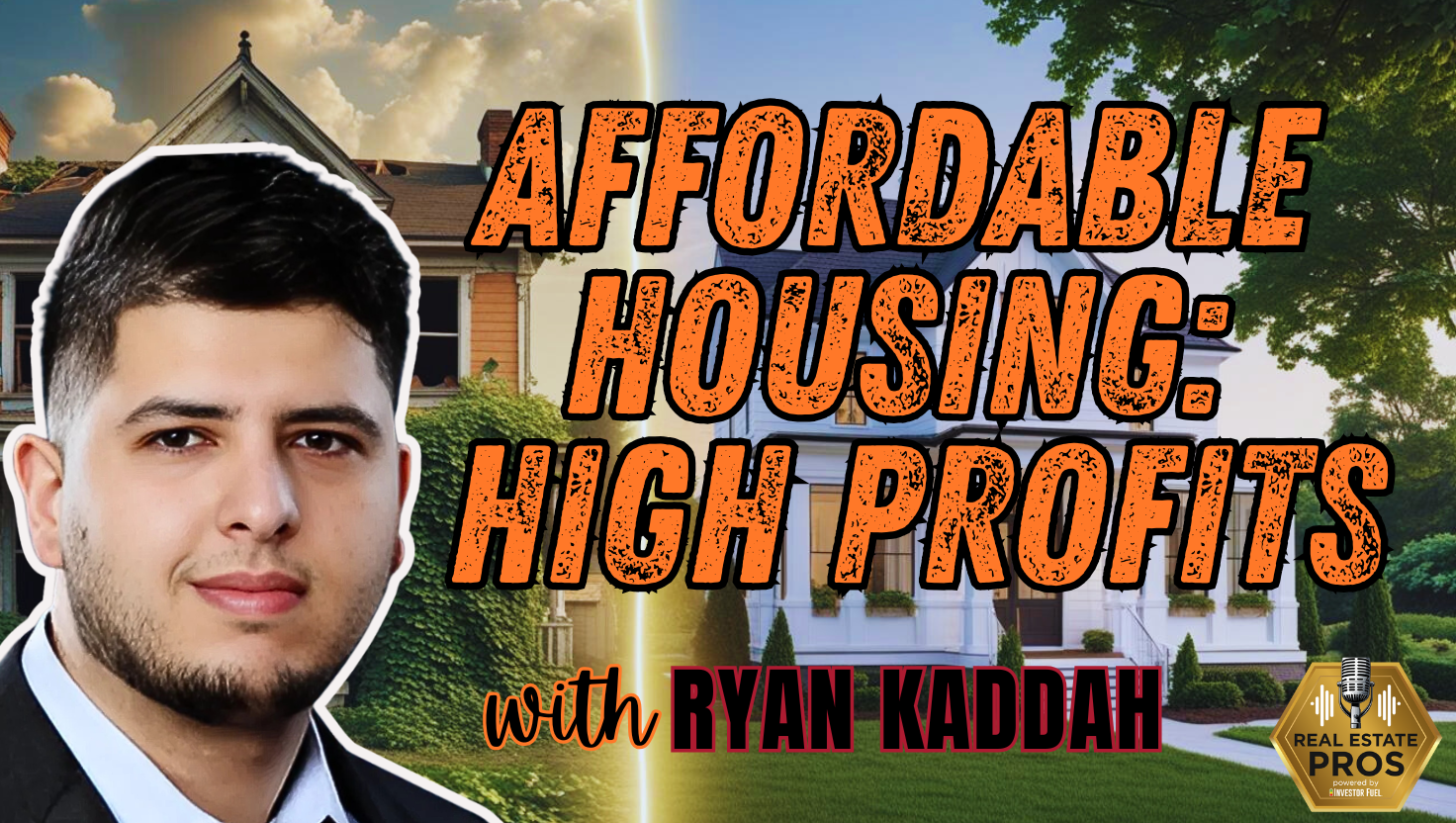
In this conversation, Ryan Kaddah shares his journey into the real estate industry, focusing on affordable housing and Section 8. He discusses the challenges of real estate development, the intricacies of navigating the Section 8 program, and his future plans for development projects. Ryan emphasizes the importance of doing good while making money and highlights the need for affordable housing in today’s market.
Resources and Links from this show:
-
-
- Investor Fuel Real Estate Mastermind
- Investor Machine Real Estate Lead Generation
- Mike on Facebook
- Mike on Instagram
- Mike on LinkedIn
- Ryan Kaddah’s Phone Number: (585) 397-9372
-
Listen to the Audio Version of this Episode
Investor Fuel Show Transcript:
Ryan Kaddah (00:00)
In my city, Rochester, we’re buying $120,000 houses, we’re renting them for $2,000, kind of thing. So I’m getting suburbs rent in the city while not having the tenants pay for it which is it’s a great formula, especially when when you get high rent, taxes and the risk of non-payment is almost zero.
Dylan Silver (01:56)
Hey folks, welcome back to the show. Today’s guest is based in Rochester, New York with a background in real estate development and currently focusing on affordable housing, including section eight. Please welcome Ryan Kaddah. Ryan, welcome to the show.
Ryan Kaddah (01:56)
Thank you.
Nice to have you.
Dylan Silver (02:14)
It’s great to have you on here. I’m a New Jersey guy at heart. I grew up in New Jersey and you’re in Rochester, New York, so not too far from my home state and where I grew up. What’s it like out there in the real estate space in Rochester, New York these days?
Ryan Kaddah (02:33)
⁓ Still a hard market, surprisingly. Especially the suburbs, you still have a lot of competition. You put in a couple of offers there and nothing bites. It’s the reality of all of us, I think, but some markets are slowing down, I think.
Dylan Silver (02:50)
I want to ask you about getting into the real estate space. often ask a lot of my guests, you know, how they got into the space. So what was your journey like getting into real estate?
Ryan Kaddah (03:01)
So was a lot of learning. was in undergrad learning about real estate. My sophomore year, I got my real estate license just reading books, bigger pockets, podcasts. So I used to drive between New York City and Buffalo. That’s where I used to study, University of Buffalo. And just, it’s a seven hours drive. So you just…
one podcast after the other, you just learn as much as you can and you do that a couple times a month, you’re suddenly you’re an expert without even touching any deals. ⁓
Dylan Silver (03:35)
Now you mentioned you got licensed while you
were in school. Did you come from a family of real estate investors? Did you have a lot of inspiration? What made you decide, hey, I want to pursue real estate?
Ryan Kaddah (03:44)
Mm.
Um, yeah, so I did not have enough money growing up. My family would say the same, you know, just doing okay, barely, you know, just getting by paycheck to paycheck kind of situation. That was my family situation. And I started looking, you know, I was always wanted to make it up there, you know, you know, the song Bruno Mars, I want to be a billionaire.
That was one of the songs that you really liked for a reason, because it portrayed that freedom of choices and doing whatever you want. ⁓ So just started learning about it and figure out real estate is one of the only ways that a normal person that does not have to be a super smart startup, you know, creating the next Amazon and be able to actually do something with it down the road.
Dylan Silver (04:30)
Yeah.
Ryan Kaddah (05:38)
⁓
Dylan Silver (05:39)
I think there’s a lot of people who can echo that
sentiment and I certainly can. When I got into the real estate space, had a W-2 job completely unrelated to real estate, didn’t know anybody in the space, wasn’t really familiar with what real estate entailed, but I basically did a cursory Google search and found that real estate might be the way to help me build some kind of foundation of wealth and ⁓ appreciating as well. And so with that little knowledge, I got into the real estate space as a wholesaler.
got my real estate license two years later actually earlier this year. And I’ve been super grateful and super passionate about being in the space. You got into the development track as a developer. How did you get in? Because I think so many people would love to be ⁓ in that vertical. Did you have a background in construction? Where did the development come from?
Ryan Kaddah (06:34)
Yeah, so there’s two ways to get into development. It’s either your family does it or you go get an education. And I took the second option because my family did not have the option. The first option was not an option to start with. ⁓ So I actually did the pharmaceutical sciences. So we used to work for L’Oreal, which is the big…
conglomerate of makeup companies, beauty products. I was a chemist testing, quality control stuff. And I looked at my life, I like, I don’t want to be here within the next five years. So I made a choice to go back to school for real estate development at University at Buffalo. And that was the reason I actually moved to Rochester is because they hooked me up with a job with a guy that they know, it’s all about connections.
Dylan Silver (07:01)
Yeah.
Ryan Kaddah (07:25)
So that connection led me to get my first job as a development associate, which is basically an assistant to a project manager at that time, which in the development world, if you do project management, you’re basically representing the ownership team. So you need to negotiate on their behalf, doing all of that kind of stuff. So basically you’re an owner, but somebody is paying you to do it, ⁓ which was great because I got to learn a lot.
Without having to risk my own money would and for people who think that development is easy. It’s really not easy It’s very risky. Yeah, if you want to it’s all about it’s all about the money You would probably make more money just doing small flips and rehabs and rentals to be honest ⁓
Dylan Silver (08:00)
There’s a lot of risk.
And then
developing out there in New York is not like some other markets. It’s costlier. There’s also probably in many ways difficult process due to permitting and so many other issues. Did you ever think, you know, this is a very competitive market that I’m jumping into or because you went to school out there, it kind of seemed like a natural progression.
Ryan Kaddah (08:36)
Well, it was not my money I was risking at that time. And yeah, it made it easier to spend somebody else’s money, right? You sure want to spend it. But the towns are really tough. Nobody wants to build something in their town, unfortunately. People think you’re to have these complexes that are going to have drug issues, all of that stuff.
Dylan Silver (08:49)
Yeah.
Ryan Kaddah (09:05)
town, neutral neighbors, they came out against it. So that’s one of the uncertainty of that is really great. Imagine having spent $300, $400,000 and then, you know, the people start frowning up and they say, we don’t want these apartments next to us. And all of sudden the town was like, oh, the people said we want to do this and you know, they’re gonna affect our re-elections kind of thing. So sorry, we have to shut you down. They’ll find a reason to shut you down.
⁓ As my old boss would say like if they don’t want us we don’t want to be there either Because you can you can sue your way into zoning and approvals But they’re gonna make your life a living hell
They can still give you yes so many issues just inspections They could find the the smallest things that they could shut off a project for a while
Dylan Silver (10:23)
meaning once you start the project, they could still have so many different hurdles along the way.
Ryan Kaddah (10:38)
And when you’re looking at the interest expense and all of that, sometimes, you know, that $50 million project, we’re spending, you know, a couple ⁓ hundred thousand dollars a month in interest. ⁓
Dylan Silver (10:48)
Yeah, mean, those payments can definitely
rack up. That’s a huge, holding costs, right, are tremendous. Even on a single family fix and flip. So when you’re talking about a commercial development, commercial residential, you know, it can be tremendous. I wanna pivot a bit here, Ryan, and ask you about going full time with your own endeavor ⁓ earlier this year and looking at the affordable housing space. I’m a big fan of this space. I don’t really…
Ryan Kaddah (11:00)
Mm-hmm.
Dylan Silver (11:17)
know much about it and so forgive my ignorance here but I’m glad to be talking with you because you’ve now really made this your niche. How did you pick affordable housing versus some of the other verticals?
Ryan Kaddah (11:30)
Just doing good part of it. ⁓ I always wanted to do good while at the same time making money and I think that’s how my my I don’t know there’s that Japanese concept of you know, do what you love and I’m sure you’ve heard of it before about what gives you meaning and what you love and what makes you money and what you enjoy to do and ⁓ That’s that’s kind of where it’s all combined ⁓ and made sense ⁓
Dylan Silver (11:58)
You know, I think the affordable housing
space is so needed. I’ve actually looked at it from a totally different angle. So you’re looking at section eight. I’ve lived in Texas and so we had ample land. I’ve said and seen there’s so many different land plays, whether it’s tiny homes or RV parks or, you know, modular homes, mobile home parks, so many different land plays, which are alternative housing that I’ve looked at and said, wow, this is really great. But
where I’m from in Northern New Jersey, definitely that tri-state area, it can be difficult, because it’s not like there’s a whole lot of vacant land all of the time. When it comes to Section 8, for myself and other folks who may not be familiar with how this works as an investor, give us the 101, give us a breakdown of how Section 8 works.
Ryan Kaddah (12:48)
Yeah, so it works on different levels based on the regions, but usually the rules are almost the same. So I started focusing on Section 8 because, you know, the due goods also the part of it that it has demand. So
in my city, Rochester, we’re buying $120,000 houses, we’re renting them for $2,000, kind of thing. So I’m getting suburbs rent in the city while not having the tenants pay for it.
which is it’s a great formula, especially when when you get high rent, taxes and the risk of non-payment is almost zero.
So the way it works, you find the property, you fix it up, you advertise it, and makes it you make it look nice. You still want it to be livable because you will not attract the best tenants. So you put it on
a website is called affordable housing mark, affordablehousing.com, which is a website that the local agency here uses to advertise their section eight units. It could be different in each town or city or municipality. ⁓ But in general, section eight is government funds on the federal level that’s being allocated to an administrator, basically an agency. ⁓
here in Rochester is called Rochester Housing Authority. So in Buffalo, there is a not-for-profit school, Belmont Housing, which administers the Section 8. ⁓ So each city, each town has their own way of doing it. So the funds get allocated from the federal level based on the population size and the vouchers. And then when you put the property for rent, you have to check with the housing agency, see how much they’re willing to pay based on the bedroom size and
⁓ the people’s voucher so each person they get their own voucher and Do you have to match the house size with the voucher size in order to be able to? Get the correct amount of friends ⁓ So you can’t for example have a three-bedroom voucher live in a five-bedroom house because no matter how much you want to increase the rent They’re not gonna give you more than that three bedroom voucher limit ⁓
Dylan Silver (15:04)
Ryan.
Ryan Kaddah (15:47)
So that’s kind of run down. You find the house, the person you adversize the house, they find it. They come in, they do the inspection, and then after they do inspection, they’re free to move in. ⁓ I think that’s kind of it in a nutshell. It sounds easy, but it takes a couple of months.
Dylan Silver (16:03)
I want to ask you about the process surrounding non-payment, because
I think a lot of people think, well, if it’s basically guaranteed, that’s a good thing. Is there ever an issue where you have to deal with evictions with Section 8? Is that more something that’s handled by the government backing it, or is it still very much an intensive process for the investors?
Ryan Kaddah (16:25)
It’s pretty much an intensive process. mean, you can get bad people that want to live on your house and same thing. They might be paying, but there’s other release violations that could happen like, you know, moving dogs or having other people that live there, they should not be living. But, you know, having the payment, it kind of reduces your risk in general because at least 70 % of rent usually is covered, which is great.
Dylan Silver (16:52)
It’s a huge deal. I think affordable housing specifically up in that tri-state area. I I’ve said this before on the show, the average income that you need to qualify for a home in the very middle class area that I grew up in in Northern New Jersey is like $220,000 a year. So most people are not making that money even seven years, 10 years out of graduating school. And so it can be challenging, right? So what do you do? You look at some of these alternative
Ryan Kaddah (16:54)
you feel it.
Mm-hmm.
Dylan Silver (17:22)
housing setups and you know, I wanna pivot here and ask you about where you think maybe your investment strategy may evolve to. Do you like the section eight space? Are you going to continue to acquire more section eight properties? Or are you looking at maybe some other asset classes as well?
Ryan Kaddah (17:44)
Yeah, so, you know doing the development as I said, it’s doing it as a day job is is nice You’re spending somebody else money But I would like to come back and do the development at some point again And actually we’re looking at the 15 unit building possibly we’re taking an old train station and converting it ⁓ into housing ⁓
which at the same time that the whole train station hall was a restaurant at some point that’s still operational. So you still get the old the patching pins and the cigarette dispenser like the vending machines from the 1920s. And I was walking up there looking up the records and you see the, there was a rail line between ⁓ Pittsburgh, Buffalo, Rochester and.
You still see the records of the people when they were moving back and forth ⁓ with these passenger rail lines. ⁓ It’s kind of cool to really look at all that stuff and see how it’s preserved.
Dylan Silver (18:50)
think the elements of real estate, are, I would say, ⁓ enticing and also ⁓ particularly ⁓ novel to me and so many other people, are the ability to really transform a space, to preserve history as well. I mean, you talk about a train station. And then also, you know, the ability to solve a need. And when you talk about affordable housing, that’s exactly the niche that ⁓ we’re talking about here.
Ryan Kaddah (18:53)
Thank
Dylan Silver (19:19)
We are actually coming up on time here though, Ryan. Where can folks go if maybe they have a deal in the Rochester area they’d like you to take a look at or if they’d just like to get in contact with you?
Ryan Kaddah (19:31)
Yeah, so I can give you my phone number if anybody wants it. It’s 585-397-9372. And yeah, I’m not just a builder and affordable housing guy. I do have a cabinet job. I do have my construction crew. So it’s like a virtually integrated situation where ⁓ I actually do work with investors out of state that want to do a Section 8 housing. ⁓
I’m a licensed real estate person. I can do these placements too for the tenants. So people come to me as a one-stop shop. All they have to do is buy the house and I’ll take care of the rest.
Dylan Silver (20:12)
and thank you so much for coming on the show here today.
Ryan Kaddah (20:13)
Thank
Thank you.