Subscribe via:



Show Summary
In this episode of the Real Estate Pros podcast, host Q Edmonds interviews Richard Rosen, a seasoned real estate investor with decades of experience. Richard shares his journey through the real estate industry, including the impact of the mortgage meltdown and his mission to create opportunities for young investors. He discusses the importance of education, the BRRRR method, and the challenges of property management. Richard emphasizes the significance of consistency and networking in achieving success in real estate, while also providing insights into the current market dynamics in the Midwest.

Resources and Links from this show:
Listen to the Audio Version of this Episode
Investor Fuel Show Transcript:
Richard Rosen (00:00)
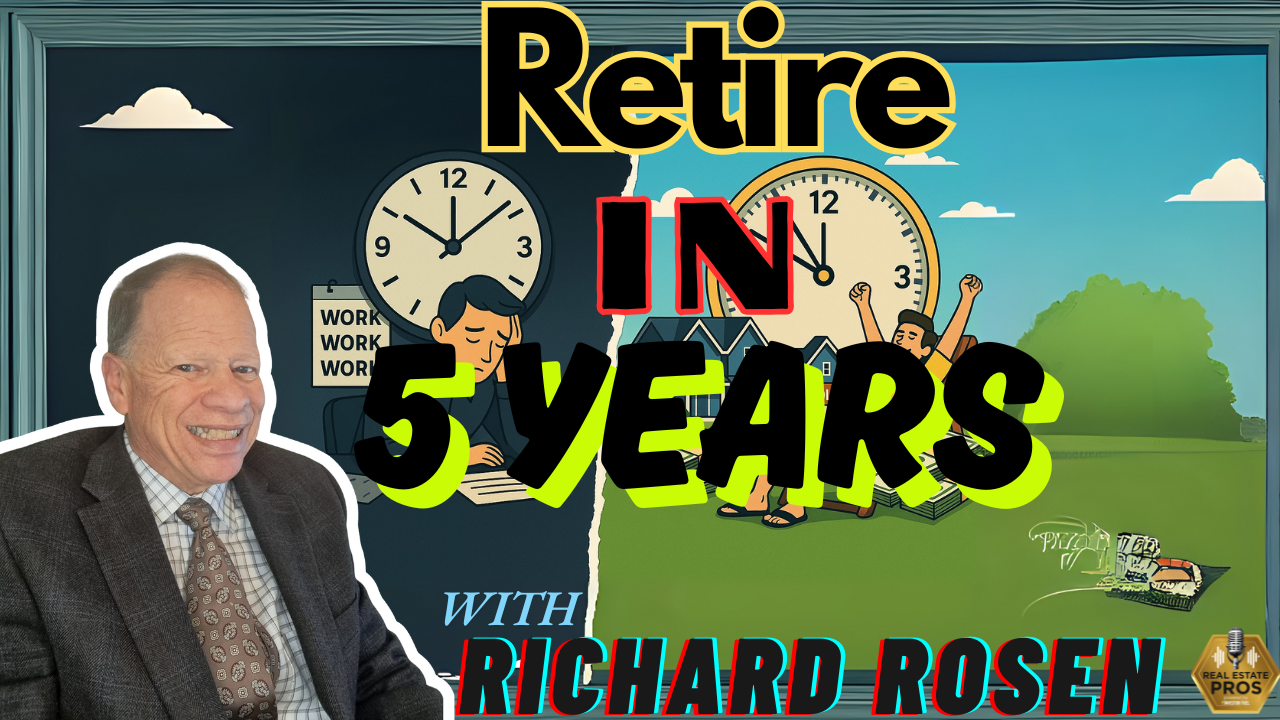
How would you like to own 20 doors in five years with the same money you first started with? And they go, what? I go 20 doors and duplexes, at least in Detroit area could give you a net walk away cash after you refinance it of a thousand dollars a month. So now he has 10 buildings, 20 doors. He has $10,000 a month coming in five years from now. Now let me ask you, what profession
Quentin (00:12)
Thank
Richard Rosen (00:26)
Can you go into that in five years time, in theory, you can retire?
Quentin (02:03)
Hello everyone. Welcome to the Real Estate Pros podcast. I am your host, Q Edmonds. Of course, I’m excited to be here today. I’m excited about guests. Listen, my guest has been, he’s been in the business about four to five decades. Listen, he learned from his dad. He’s not new to this. And one thing I love about my guest that he’s going to create legacy for young investors that’s coming into the game. so.
I asked you to sit at attention because we’re about to get some really, really good nuggets on today. And so help me introduce and bring to you Mr. Richard Rosen. Mr. Richard, how you doing today,
Richard Rosen (02:37)
Good, I appreciate you letting me come on. This is pretty good opportunity to help out people. It’s kind of like my mission is right now is to be able to touch other lives right now because I’ve done a very successful real estate career and I really, I’m really, I got out of it where I was really hoping to get. So now is the chance to give back a little bit.
Quentin (02:57)
Yeah.
Absolutely, man. And I know our listeners are really going to get a really good takeaway from how your approach of creating legacy, the different things that you’re putting in place for young investors to make it easy on them. so, Mr. Richard, if you don’t mind, I want to dive in. I want you to take people into your world. I want you to give us what’s your main focus these days. Tell us what you’re focusing on and also what markets you’re operating in, you know, if you want to tell us that as well.
Richard Rosen (03:25)
So about almost 15 years ago, we had the mortgage meltdown. And out of that came my, I keep reinventing myself all through the years I’ve been in real estate since the late seventies. I was a broker owner of Remax, one of the first ones in Michigan. And I was the youngest one for sure in the country. I was in my mid twenties. And what got me that opportunity, cause I didn’t come from a wealthy family was the fact that
I learned from my dad who was a builder how to renovate homes. And so I renovated a duplex that provided the capital for me to own and operate my own real estate company. And from that time on, I continuously purchased and renovated properties. And then we kind of, like I say, kind of warped into the mortgage meltdown. Everything came to a standstill. All my clients for my real estate company were all underwater.
Nobody had equity in their homes anymore. And same thing on the commercial side, nobody had equity in their homes. So what do you sell when there’s no equity? Well, you got to create equities, which you got to do, right? And so I formed the Fresh Start Homeowners program. You can actually go on EWTN, which is a Christian, and you can actually see an episode where I had one of our families actually came on with me and…
It was beautiful. They got themselves a house opportunity after they lost their house during the meltdown time. He lost his job. Then he got hired back again into automotive. And we knew that he would be eligible in a certain time period to be able to get a mortgage from FHA. So we offered them a house opportunity in a nice neighborhood where they were able to move in with 10 % down.
And two years later, they were able to refinance the property and something special happened. You know what happened? They found themselves $50,000 ahead in equity and appreciation over those two years. And they were like so thankful you would not believe that they went from having nothing till now they have a house with a lot of equity in it, you know? So that was definitely a great thing. And we did, I did over a hundred home renovations.
in the right like 2012 to 2016. So that was an important part. And I think I really touched a lot of lives during that timeframe. But ever since I’ve been active in those years in real estate investment, I bought a lot of properties, I turned them into rentals in our metro Detroit area, Oakland County, Macomb County and Wayne County.
Quentin (05:36)
Beautiful.
Richard Rosen (05:55)
When I got back to Detroit, I was out of Detroit. didn’t have anything investment wise to do in Detroit until about 2016. And we started buying properties in the high end communities in Detroit and renovated those. And that was really cool because you got to see historical houses that were built a hundred years ago, completely restored. were just beautiful homes. They all had personalities that you don’t see in the new homes today.
Quentin (06:21)
.
Richard Rosen (06:22)
So that’s inner city Detroit.
There just some gorgeous areas that are near parks and of course not too far from downtown, which has been totally revitalized. don’t know if you know, Detroit is like, it’s been completely rebuilt. The mayor said during the state of the state, we have currently $20 billion in renovation projects going right now at this time. And that was in December. So what a transformation.
You want me to continue on or do you have more questions?
Quentin (06:48)
No, no,
I definitely have more questions. I just did not want to cut you off. you had to shoot his hand. You was going, you was shooting. I didn’t want to cut you off,
Richard Rosen (06:53)
no no no.
I
didn’t want to go on so many rabbit trails here.
Quentin (07:00)
Absolutely. No, man, I loved it. Again, it shows me how you’re true to wanting to help our people. When you talked about creating legacy for young investors, you took me back and let me know that this is something that’s not new. You was doing helping people back then, think, you I think you said like in the 2000s with, I think you said EWM, I think you said we can go and look.
Richard Rosen (07:20)
Yeah,
it’s a Christian network.
Quentin (07:23)
Okay, got you, got you. But I love what you was doing for those people. And even now, you you’re buying property in Detroit and you’re revitalizing it. I love it, man. listen, I know it’s not easy, especially in this climate. So what’s been the key to keeping that machine running smoothly, Mr. Richard?
Richard Rosen (07:37)
Business planning. I always was a proponent of in the fall of the preview before you go into your year is to set up your business plan for the upcoming year. And so can I tell you about what I did for this year? Okay, so I don’t know how many more years I have left in this business. I’m thinking, you know, maybe like three more years, maybe four years. And
Quentin (07:49)
Yeah, absolutely.
Richard Rosen (08:00)
I wanted to really have a great business plan for 25. And so one of the things was I wanted to be able to create an opportunity for young real estate investors to really be able to master all the skills that you need to become a on fire real estate investor with ⁓ momentum year after year after year. All too many times.
a young real estate investor will see failure on their first investment. That’s probably, I would say 19 out of 20 times the investors will tell you that we failed, we weren’t in the black, we were in the red on our first one. But what if I had an educational site you could go to and if you really mastered the skills and followed the instructions from the professionals around my website, you’ll be able to absolutely
have a great opportunity to come in the black on your first one. And so I’m a strong proponent of the BRRRR method. Now there’s a lot of other real estate methods that out there, but the one thing was I was doing the BRRRR method back four decades ago before they even had a name for it. And I know the system has been around that long because I’ve talked to so many investors that were proponents of it, but there was just no label. There was no name for it.
So I formed a website called birdthrive.com that’s B with four R’s and the word thrive and then dot com. And it doesn’t matter if you’re a new investor or one maybe that has not done as well as they wanted to. You can go to this site and the professionals that are on there will show you exactly what you have to do in order to become the professional you want to be in real estate investment. And
There’s also going to be a sister site that you’ll have an opportunity to go to and that’s your investmentfunding.com and we’re going to be launching the new site this weekend for the holiday, the Liberty Holiday. And it’s going to have a three-part video that young people can go to that say that they never got a real estate loan before, maybe outside of their mortgage, okay, in the house that they bought.
These are how to get non-bank mortgages through hedge funds, private investors, and be able to buy your first piece of real estate and then also refinance that real estate after you got your renovation complete, you got your tenant in the house, and how to successfully get all of your starting capital back, that lump sum money that you work so hard to save, boom.
and you get that back and now you can go and repeat the process a second time. And so the investors I work with, our goal is to be able to, twice a year, be able to use that same money and use it over and over again. In theory, you should be able to go on year after year after year with that same pool of money. Now sometimes you may intentionally leave a little bit of money behind.
But you may know that you have a way to replace it. Maybe from your savings. You you need three or five thousand dollars more. No problem. Now you left behind a property that you refinanced and it’s going to give you a positive cash flow for the rest of your life. It’s amazing. And I told this one young investor, he really likes duplexes a lot. Okay. And I said, you know, you’re somebody I can really work with.
How would you like to own 20 doors in five years with the same money you first started with? And they go, what? I go 20 doors and duplexes, at least in Detroit area could give you a net walk away cash after you refinance it of a thousand dollars a month. So now he has 10 buildings, 20 doors. He has $10,000 a month coming in five years from now. Now let me ask you, what profession
Quentin (11:31)
Thank
Richard Rosen (11:45)
Can you go into that in five years time, in theory, you can retire?
Quentin (11:49)
Yeah, no. Yeah.
Richard Rosen (11:51)
Doctor? No. You’d be lucky to pay back your medical loan, You know, get, you know, a
good loan. Attorney, same thing. You’d be lucky to pay back your college tuition money back. There’s no profession I know of, then five years, that you could actually, in theory, retire. And I said, all you gotta do is every six months, a new duplex, the next six months, another duplex, and you do that for five years.
Quentin (12:02)
Yeah.
Richard Rosen (12:15)
And then when you wake up in the morning, you can say, okay, what am I doing today?
Quentin (12:19)
Yeah, yeah. No, I’ll, yeah, you got it right, man. I love it. I love, I’m excited about this Thrive, B-B-B-B-B
Richard Rosen (12:20)
It’s not the day,
Quentin (12:27)
So there’s times when maybe a deal goes sideways or a time when you had to fast. Do you mind sharing any, do you have a story like that that maybe you can share with us, Mr. Richard?
Richard Rosen (12:35)
⁓ okay. So, you know, throughout my career, I’ve had, like I said, I’ve had ups and downs. Okay. I’ve had my share of bad tenants, but I got to the point that my office said to me, Rick, you got to stop being your own landlord. And this is some, this is something that I have on my birth drive. You have to give the landlord ship to a professional company.
and I’m willing to wager that in the course of the years as it goes by, they’re going to put more money in your pocket than you could for yourself. They’re going to be able to get you closer to market rent than you could for yourself. And they’re going to have a better selection of tenants than you could for yourself. And then when tough things happen, they do stuff and they don’t allow the tenants any wiggle room. So like if I have a tenant that’s five days late, okay.
Do I send them a notice to quit? No. But what does the landlord do? Automatically, in the mail, off it goes, the notice to quit. And they do everything step by step, scientifically. They have a database that if you had gone to the courts in a landlord-tenant dispute, it shows up on their database.
So if you want a professional tenant, continue to be your own landlord. If you want to have good tenants, hire these companies. They’ll keep you out of hot water. And they charge anywhere from 8 to 10 % of your gross. But your gross will actually be larger because they get the higher market rent. And you’ll have more months that you actually collected the rent.
So you’ll see it on my website. We have an interview with a professional landlord company and they go through all that on the website.
Quentin (14:17)
I love it. That’s great. Thank you for sharing that nugget. Thank you for sharing that story. Let me ask you this, and I know you’re creating opportunities for young investors. You’re bringing them back to Burr Method, burrthrought.com. What are you most focused on solving or scaling next? What’s the next real goal for you?
Richard Rosen (14:19)
Yeah.
Okay, there is a new huge challenge that I didn’t expect that I would have in my lifetime. So I’ve been able to establish relationships with some highly successful investors that have really large real estate portfolios. Many of them are over 100 units. I have some that are in the 500 units or more range. That’s a lot of real estate.
But it’s their lifetime work. This is what they’ve done their whole life. So I’ve been asked to do disposition of these portfolios. I’m working a lot with my own state of Michigan, but I also am actively involved with other states outside of Michigan. And a lot of times what I find is in the Midwest, there’s a lot of similarities on the type of houses that are there.
and how the rents go and how the markets are. And a lot of the national investors, these large funds, they love the Midwest because the relationship between your rent that you’re going to collect and the price you pay for the real estate, I believe they call that the gross rent multiplier. It’s higher in the Midwest than it is on the East Coast or the West Coast.
I’ve heard like on some kind of like TV program, know, I like my wife likes watching those house slipper programs, you know, and so there was a, was a like a house slipper that was doing some business in California and they were keeping one as a rental because they felt that it was a high appreciating area and they were bragging that it was only costing them a thousand dollars a month to keep that house going. And I go, are you kidding me? That’s not an investment.
Quentin (15:57)
Yeah.
Yeah, not at all.
Richard Rosen (16:18)
Now they may argue
with me when it jumps up to a million dollars in the next two years, but the thing is you can’t always count on that supercharged appreciation. But in the Midwest, it has a history of really good gradual appreciation. And so you’ll probably see in Midwest type of properties that double digits do happen quite often year after year, know, 10, 12 % increase in values.
So you will get over a period of time, a lot of increase, but at the same time, the rental market has gone absolutely crazy. And you’ll find that like on a property that you have $100,000 all in, it’s collecting $14,000, $15,000 a month rent. Where else are you gonna find those kinds of ratios? It’s like 18 or so, or 16, $18,000 annual on a $100,000 investment. Are you kidding me?
Quentin (17:13)
Yeah, yeah. No.
Richard Rosen (17:14)
In the 60-40
rule, I don’t know if anybody knows about it, is on most multi-families and single families, 40 % of your gross goes towards your taxes, your insurance, all your operating expenses, and a 60 % on the average of your net operating income. So if you want to figure out something very quickly, know, $100,000 on that $16,000 property,
Well, if you’re getting 60 % of that, you’re clearing almost $10,000 a year clearer net operating income on their property. So if you happen to have a house payment going out, say about $7,000 worth of interest every year, that’s not going high. You’re still clearing $3,000 a year in profit after everything. And you don’t even have your money on there anymore. What’s wrong with that?
Quentin (18:03)
Yeah.
Yeah. Yeah. Absolutely. Now, I hear you, man. I hear you again. You are giving us some great, great, great, great information. You know, I particularly like when you talked about, you know, these large portfolios is competition, you know, and you’re trying to figure out what to do, how to move. And again, you know, you are creating legacy for other people.
And I think this leads me to my next question because you’re looking to make sure you make an investment to the younger generation. So, you know, you got people that’s listening, they’re early in their journey, they’re looking to level up. And I think they benefit hearing this from you when it comes to building relationships and growing your particular network, what’s made the biggest difference for you?
Richard Rosen (18:42)
Consistency. That’s what everybody says is consistency. So each day I have a, on my calendar, I break it up like, like back, like when I was in high school, I have, as I mentioning before, I start off my day early in the morning. I’m in gym class. Okay. Three hours every day I’m at the gym. And so I’m at work at nine o’clock.
Quentin (18:43)
Mmm!
Yeah.
Yep, yep, yeah.
Richard Rosen (19:05)
So 99.30 is planning and then throughout the day I have it broken up into the different tasks that I have to do. But I have to also prioritize what needs to be done. so make a beginning of the day during planning, I do a priority of that. So when I work my day, that consistency is what makes me successful. I’m always consistent throughout the week. I can get more done in a week.
then a lot of people can get done in a month because not only do I have an idea of what I do, but I also outsource a lot of what I do to virtual assistants. So I have people in different parts of the world that are working on my stuff right now as we speak. You could be on LinkedIn right now and you could be getting my stuff that was sent out by my virtual assistant, okay?
Quentin (19:46)
Yeah. Yeah.
Richard Rosen (19:53)
And it’s way that people get introduced to me on LinkedIn. You could be on Facebook. I belong to, like I said, I got 40 to 50 real estate groups I belong to. You could be getting some of my stuff on Facebook thanks to my virtual assistants. So throughout the day, I have this multiplying effect of virtual assistants that are doing things for me.
Now I have a planning session Monday, Wednesday and Friday, 15 minutes I spend with my staff on what I want to have done and I review what was completed. 15 minutes three times a week is not that bad. And then I have on Wednesdays, I have a staff meeting for two hours and that’s it.
Quentin (20:29)
Yeah, absolutely.
Yeah. I love it. I love it. Yeah. There you go. So I love it. So I heard consistency. I heard putting the right systems in place, connecting with the right people. And also I hear you, I heard you say you got 30 on Sunday. We got that rest time in there too. So I love it, man. You got it figured out. I, and it is no doubt in my mind. That’s why you’ve lasted four or five decades doing what you’re doing. So I love it. But listen, Mr. Richard, before we wrap, if someone wanted to reach out to you, connect with you.
Richard Rosen (20:36)
Yeah, I don’t work Saturday or Sunday.
Quentin (21:02)
or maybe collaborate with you or learn more about what you’re doing, what’s the best way for them to reach out to you?
Richard Rosen (21:07)
So I don’t know if you’re gonna provide it, but it’s okay for text or phone. They could send me a text that say they would wish to chat or by email that they wish to chat and then we could set up a time.
Quentin (21:21)
Absolutely. Did you want to give away those numbers now or did you want to say to the people?
Richard Rosen (21:25)
Either
or could give you my calendar date, you know, that thing, you know, and then they could pick a time. So ⁓ whatever you think might be easier, but I could do it either way.
Quentin (21:29)
⁓ Mm-hmm.
Okay, got it. Uh-huh, go ahead.
Whichever way you want them to reach out to you, I just want to be able to have it on recording so they can hear it. Yes, sir.
Richard Rosen (21:38)
Okay.
Okay. Yeah, I’ll offer it. Sure.
Quentin (21:43)
Absolutely, absolutely. But there he is everyone, Mr. Richard Rosen. Sir, thank you so much for your time, your perspective and your story. I really appreciate you being here. I know our listeners have taken away a great deal from your perspective and your lens. And so I thank you again, sir, for being here.
Richard Rosen (21:59)
It was pleasure, you know, finally getting to meet you.
Quentin (22:02)
Absolutely. And for everyone else, listen, I know you got value from this, so make sure you are subscribed. You do not want to miss these incredible conversations that we had, just like we had today that we’re going to have, just like we had today with Mr. Richard Rosen. So again, thank you, sir. For everyone else, thank you for tuning in and we will see you on the next time.
Richard Rosen (22:20)
Bye now.