Subscribe via:



Show Summary
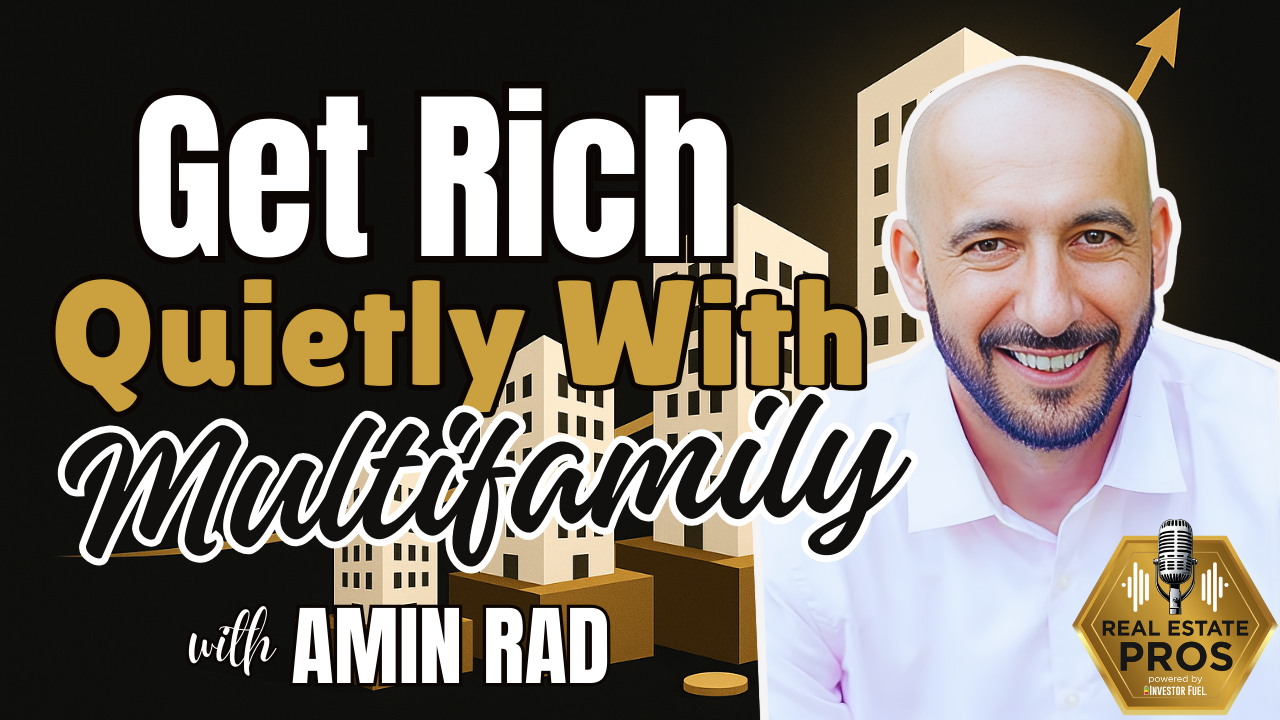
In this conversation, Amin Rad shares his extensive journey in the real estate industry, detailing his transition from various entrepreneurial ventures to becoming a successful broker and investor in the DFW Metro area. He discusses the importance of leveraging opportunities in real estate, the intricacies of loan modifications and foreclosure prevention, and his shift from single-family homes to commercial real estate. Additionally, Amin introduces his innovative tech-driven brokerage aimed at empowering agents and streamlining real estate operations.

Resources and Links from this show:
-
Listen to the Audio Version of this Episode
Investor Fuel Show Transcript:
Amin Rad (00:00)
So basically, what is the return on investment on something that you don’t have any money in?Is it 100 %? Is it 1,000 %? Is it a million? So that’s the main difference between a REIT and what we’re doing. A REIT will take investors in, go buy a property, refinance, give their money back, and then keep the asset. So with multifamily, what we’re doing is we’re getting investors in, buying the property, refinancing after we force equity and raise the values in the property. And then
given their investment back, they keep their ownership in the project and still get the monthly dividends.
Dylan Silver (02:12)
Hey folks, welcome back to the show. Today’s guest, Amin Rad is a 20 year veteran of the real estate space. He’s in the DFW Metro and he’s active as a broker and investor in the commercial space, the fix and flip space and now real estate tech. Amin, welcome to the show.Amin Rad (02:31)
Thank you, thank you for having me. It’s great to be on.Dylan Silver (02:32)
It’s great to have youon here. I I always like to start off at the top of the show by asking guests how they got into real estate.
Amin Rad (02:40)
Yeah, well, it’s long story, I guess, but ⁓ I had a Quiznos franchise and ⁓ ventured in some other businesses, had a hair salon, other things. ⁓kickboxing aerobic studio and I took all those savings and wanted to buy and sell properties and very quickly I saw I didn’t have enough money, know, so I had to start using leverage and that’s when kind of my passion for real estate started because when you get rewarded and you can leverage things then you’re getting paid exponentially. So that was very ⁓ rewarding to me because I’ve
same time I was helping people so was like knocking out two birds with one stone because in this business the last 20-25 years like I have you really have to have core values and build everything on helping people otherwise you’re you’re not going to last you know so ⁓ that’s that’s the main part
Dylan Silver (03:44)
When we talk about going from other forms of entrepreneurship into real estate, oftentimes it’s beneficial to have that background because you kind of understand the mentality. Eat what you kill. You’ve got to be networking ⁓ in many cases in order to get those first deals. Did you take any of that experience from some of those other businesses that you were involved in into real estate or was it totally new and you felt like you had to start from zero over again?Amin Rad (05:00)
That’s a good question. I think that it was just different businesses So it didn’t have much to do with real estate ⁓ with real estate is kind ofdifferent facets. Number one is if you go after brokerage and licensing, then it’s about fiduciary duties and learning fiduciary duties and putting other people’s interests ahead of yours. And then if you’re looking at it from an ⁓ investor standpoint, then it’s buy low and sell high, right? So ⁓ maybe like the sandwich business, but I didn’t have too much like real estate. ⁓ None of those businesses really ⁓ helped that, you know, I had
a little nest egg and I thought that was going to last but you know it didn’t really really last and I had to learn leverage. We’re talking earlier about foreclosures you know so that’s really how I got into the business knocking on doors and trying to buy foreclosures and people slammed the door in my face telling me that you know F off they didn’t want to sell so we actually became one of Texas’s leaders in loan modification and we helped thousands of people
⁓ save their houses with loan modifications and ⁓ partial claims, FHA partial claims. that’s really how I got into the business. And then we started flipping the short sells and ⁓ linked up with hedge funds and sold tons of properties to hedge funds and, ⁓ you know, ⁓ explored other brokers like EXP and kind of things that we talked about. And here we are today.
Dylan Silver (06:38)
I wanna get a little bit granular and ask you about some of those loan modifications. So I come from the distress base, never thought about the loan modification as a way to help these people stay in their homes. Break that down for myself and our audience. How would that work so folks could stay in their homes?Amin Rad (06:54)
Yeah, I’m happy to whatWhen it comes to foreclosure prevention, you’re looking at two main things. Number one is their equity. ⁓ If the home has equity, then the homeowner has lots of options. They could refinance, you could let them borrow some money, you could buy it and sell it back to them. They have more leverage when they have equity. Unfortunately, due to how loans amortize, most homeowners don’t have equity and everything is upside down. So ⁓ short sell is really the way to go. But when there is no equity and you want to keep the
Then it always comes down to your DTI your debt to income ratio your financial statement So if you have more income than debt, then you qualify to keep that property and on paper I can show the lender that you can afford it now if you have more debt than income How can you afford it? I show you that you have more debt than income and that’s why you can’t keep this house and you need to sell it So when I consult with homeowners that are behind on their mortgage payments
and facing foreclosure. It’s all about their ⁓ debt to income and their financial statement, whether they should keep it or sell it, whether they want to keep it or want to sell it.
Dylan Silver (08:10)
And so the difference is in that case, they would have some equity, whereas in the short sale case, they would not.Amin Rad (08:16)
Well, ⁓ when you’re doing a short sale, you’re helping someone sell the property. The only difference is the bank is taking a reduction in their payoff. It’s a normal sale. When they’re keeping the property in a modification, it’s a refinance in sort with the actual lender itself. So they’re keeping the house and it’s a refinance. They’re putting their debt at the end of the loan or restructuring the loan.That’s for conventional and ⁓ you may know, but FHA has their own foreclosure prevention program called partial claim where they actually put a second lien on the home and they pay ⁓ the past due amount in full so they don’t have to pay the whole loan off. That’s why it’s called a partial claim because they insured alone.
Dylan Silver (08:46)
Right.Now, when we’re talking about helping people stay in homes and loan modification, short sales, we’re talking single family. I know that today you’re involved in the commercial space. One of your brokerages is in the commercial space. How did you venture into the commercial space coming from the single family space?
Amin Rad (09:56)
Yeah, I think it was just ⁓ running into the right mentors and you know that could be a whole show on itself about how loans are amortized, how single family is designed for the banks to make money and the whole overall ⁓ ecosystem that we’re in and the fiat money and so those are really long conversations but ⁓What I love about ⁓ multifamily is the ability to bring on investors and then force equity in the property, refinance, give those investors their money back, but our program allows those investors to stay in.
So basically, what is the return on investment on something that you don’t have any money in?
Is it 100 %? Is it 1,000 %? Is it a million? So that’s the main difference between a REIT and what we’re doing. A REIT will take investors in, go buy a property, refinance, give their money back, and then keep the asset. So with multifamily, what we’re doing is we’re getting investors in, buying the property, refinancing after we force equity and raise the values in the property. And then
given their investment back, they keep their ownership in the project and still get the monthly dividends.
⁓ the transition was more building. I’ve done every single ⁓ get rich quick scheme. We talked about EXP. I was the first one in Excel back in the day to… ⁓
telephone service, you know, there was all kind of things that I’ve been in and ⁓ multi-family is get rich slow, which is what I wish I started 20 years ago, you know, so ⁓ building wealth is if you study, know, Warren Buffett and everyone that’s building wealth is building wealth slow and you can definitely do that with multi-family. I have single-family rentals all over DFW right now and they’re all the biggest mistakes I’ve made. So
You know, right now I’m trying to give these properties away because I gotta run and fix the toilet here or collect the rent here or they didn’t pay their, you know, section eight now wants this or that. So,
Dylan Silver (12:04)
Hmm.Amin Rad (12:16)
the overhead that I’ve had to put to manage this shit, I’m sorry, ⁓ things that we have going on, you know, it’s like if we have that in multifamily, the reward would be exponential. So that’s kind of what made me transition into multifamily.Dylan Silver (12:33)
When we talk about multifamily, it’s such a wide range. There are segments within multifamily. You’ve got smaller multifamily under 20 units, then you might have a small apartment complex up to 100 units. And of course, you’ve got multiple hundreds of units in larger complexes. What kind of deals are you looking at in the commercial space?Amin Rad (12:54)
Dylan that’s an excellent question and let me tell you why because most people when they think multi-family what they’ve been told is go buy a fourplex and rent out the other three units and live in one right so what you’re doing essentially anything under 30 50 60 doors you’re buying a job because you need to manage that property ⁓So in our system, we’re looking at 100 doors and above, and we’re looking at properties where the management’s been there in place. And a lot of times we’re going to use the existing management. ⁓
project right now the management’s been in there for 10 years and they’re at a 96 % occupancy. Now why would I come in and want to change that right? So my philosophy is that I need to pay at least $10,000 a month for property management because if I pay $10,000 a month that better be your whole life that for my $10,000 you’re getting the best out of that property and if not I
probably have nine people lined up for that job, right? Whether it’s a company or one or two individuals. So the key with multifamily is don’t go small, go big, right? And at least get into a hundred doors. Otherwise you’re buying a job and you might as well just buy single family is no different. So you gotta have a project big enough where you’re paying someone 10, 12, 15 K to manage it. And then you’re gonna see the ⁓ long
wealth that we’re talking about? Excellent question.
Dylan Silver (14:31)
I wanna pivot a bit here, I mean, and ask you about the real estate tech space. I know that one of your businesses is a ⁓ tech-driven brokerage. Walk me through this, because this is a different space. There’s a lot of competition here. How’d you get into the tech space?Amin Rad (15:29)
Yeah, there’s a ton of competition. ⁓And how we got there is basically all the struggles that I’ve had as a realtor and also an investor to be able to effectively be a good investor. You have to have so many different platforms. Your CRM doesn’t do this. You know, it doesn’t track this or your dialer doesn’t mass text or your voice mail drop doesn’t do this or your data source doesn’t do skip
Tracing you got to pull it here and put it there. So there’s so many different ⁓
meticulous things that have to happen for you to be able to run a big investment company. You know, we’re talking mom and pop shop. You don’t need this stuff, right? But ⁓ if you’re trying to do 50, a hundred deals, you know, you have to have all these tools. And ⁓ so we’re creating a centralized real estate ⁓ operations platform. So all these tools are all in one place and
We believe that is so revolutionary that when you try and have this software is going to be so influential and help you in your business that ⁓ we don’t even need to make money from the brokerage side. Are you with me? So if you can use our tech, you don’t need to join the brokerage. But if you want to join the brokerage, it’s free benefit of the tech.
So ⁓ no monthly dues, no transaction fees, no sign up fees, even the E &O is free, right? So the idea is when you go in there and you send a hundred texts or a hundred emails, we’re gonna make .001 cent on every text and every email and that’s where we’re gonna ultimately make our profit. And let me tell you one more thing because
Dylan Silver (17:07)
Wow.Amin Rad (17:36)
we believe that we’re going to have hundreds of ⁓ agents join us. So when I have a thousand agents, then how much easier is it going to be for me to feed my title company that I own or feed the mortgage company that I own or even buy and sell more properties, right? So this is a concept about two things. Number one, empowering the agent. So many people starting with NAR and then the brokers, everyone is taking from the agent, the customer.once commissioned from the agent right so as an agent I know what it feels like so I want to help the agent however I can and it’s like by the time you get your first deal done your broker’s charging you $150 a month then you give them 30 % of your check that’s why 80 % 90 % of realtors don’t renew their license and no one cares about them right starting with your let me tell you this because I have
new realtors go to their local association board to get their MLS and they can’t get it because their virtual class is full. How is a virtual class full? My realtors are paying the board seven, $800 for MLS access and then they can’t get it because they can’t get their orientation. Not in person, but a virtual class is full. So again, like every one of these segments I could go off on for a long
Dylan Silver (18:47)
full.Amin Rad (19:05)
time but it’s really about empowering the agents and giving them the tools they need and we’re happy making money when they use the tools so they don’t have to use the tools because the biggest challenge is me as an agent paying for something that I don’t need I don’t use or I don’t value right so we wanted we we this I bring so much value to my agents but they don’t see it rightDylan Silver (19:26)
Right.Amin Rad (19:34)
because I’m force charging them, right, for fees or dues of this. So hey, how about that everything’s a la carte, there’s no fees, right, and you just pay and use whatever you want.Otherwise, we’ve already closed eight nine million dollars with zero dues zero fees We’ve collected zero fees on ⁓ eight nine million and we haven’t really ⁓ Launched so this is kind of in the beta version But we’re very excited about it. The name of the company is solto really T solto is the tech and solto means break free. So We’re very excited about it
Dylan Silver (20:05)
Yeah.hey, anytime you can rob and hood the system and put the power in the hands of people who are working their way up, it’s a beautiful thing. We are coming up on time here though. I where can folks go to learn more about the new brokers that you’re starting or if maybe they’d like to reach out to you directly, maybe they have a deal they’d like you to look at, how can folks reach out to you and your team?
Amin Rad (20:34)
Yeah.My deal needs to go to Cash DFW so that email is my name is Amin, A-M-I-N. A lot of people say Amin business so that’s a good way to remember it. But it’s Amin, A-M-I-N at cashdfw.com so anything deal related would go there. And then our brokerage is Soto Realty so you could go to SotoRealty.com but for onboarding and finding out more information about joining.
would go to Gosolto.com and that’s g-o-s-o-l-t-o.com so thank you for asking.
Dylan Silver (21:12)
mean. Thank you so much for coming on the show here today. Thank you, man.Amin Rad (21:15)
Of course, I appreciate it and look forward chatting with you more.