Subscribe via:



Show Summary
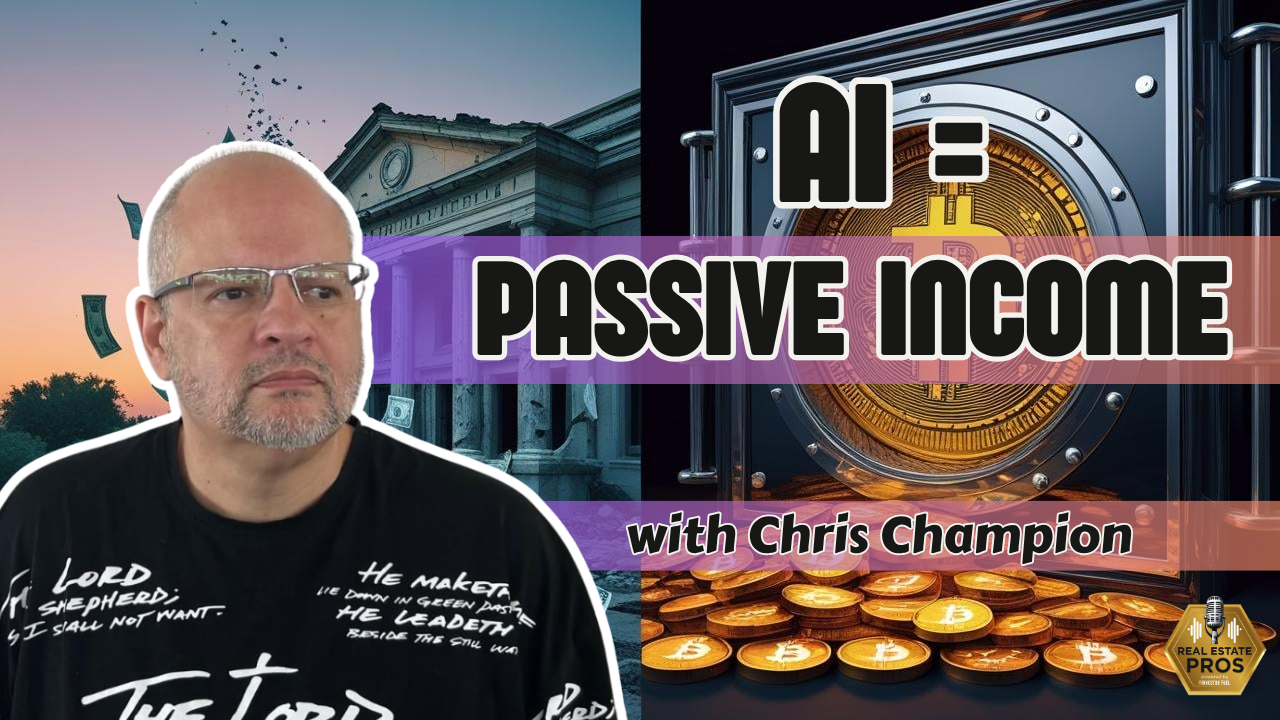
In this episode of the Investor Fuel podcast, host Michelle Kesil speaks with Chris, an innovator in the lending space, about the transformative power of AI and cryptocurrency. Chris shares his journey into AI, how he leverages it for business growth, and discusses the failures of the American banking system. He emphasizes the importance of Bitcoin as a store of value and its application in real estate investments. The conversation also touches on the role of AI in education, the significance of building relationships in business, and the necessity of continuous learning for personal and professional growth.
Resources and Links from this show:
Listen to the Audio Version of this Episode
Investor Fuel Show Transcript:
Michelle Kesil (01:31)
Hey everyone, welcome to the Investor Fuel podcast. I’m your host, Michelle Kesil. Today I’m joined by someone I’ve been looking forward to chatting with. We have Chris here with us, who’s been making serious moves in the lending space and really innovative in his work. Really glad to have you here with us today, Chris. I think our listeners are really going to take something away from how you’re approaching new innovations with Bitcoin and AI. So I’m excited to dive in with you.
Chris (02:00)
Appreciate it. It’s great to be here.
Michelle Kesil (02:01)
So first off, for people who may not be familiar with you and your world, can you give us the short version? What’s your main focus these days?
Chris (02:10)
So my main focus is AI. About a year and a half ago, I got very entrenched in AI.
the more I peel away the layers of AI, I start realizing that this is literally the end game for any business out there. don’t care. I’ll give you a great example. I have four dogs and less than a week ago, I had AI write me a series of children’s stories about my four dogs called The Adventures of the Champion Squad. And I literally now have a cartoon series that I’m getting generated by another AI tool of those stories. So not only are these stories that can be read to children, they’re actually cartoons
that they can be downloaded and bought for $4.95. And I literally have a cartoon series that I’ve created about my four dogs.
all written and created by AI that generates me $4.95 every download. Well, if you think about that, that’s incredibly, that was incredibly more difficult before AI came along years ago. It would take a lot longer and it would take a lot more dollars and resources to do that. I did that in less than a week. That’s just mind blowing.
Michelle Kesil (03:15)
Yeah, that is super mind blowing.
Chris (03:18)
And I tell people this all the time. That’s a form of getting AI to work for you.
So you have AI create this video series of your four dogs and you put it up for sale on YouTube or Apple or whatever stores you want to do. And now people, when they’re driving on a long trip, they give their small child the iPad and that cartoon series entertains them. And I also did some research. Most cartoons are like three to five minutes long. But if you give them a cartoon series that’s a half hour long, it’s enough time that the trip that they’re driving in cannot
occupy their mind. And that’s what parents want, is they want their child occupied so they’re not driving home cuckoo while they’re driving to the grocery store or wherever.
Michelle Kesil (03:59)
Absolutely. And yeah, we’d just love to hear a little bit more about your business and what you’re doing with that.
Chris (04:06)
I think my business is being an entrepreneur or visionary. I’ve been lucky to exit a few companies and have capital to invest and deploy. And when I see an opportunity, I vet it out and then I jump on it. And a lot of people, you know, in life, people are scared to take a leap forward or take a risk on themselves.
I actually look at betting on yourself as the best bet you could ever make. Like if you’re going to invest in something in life, some people invest in lottery tickets, some people invest in sports.
sports betting, but most people are afraid to invest in themselves. Most people are afraid to take a risk on themselves. And I think to myself, why would you risk your money on a horse running around a racetrack before you risk that same amount of money on yourself? Or why would you risk money on a blackjack table when you’re not willing to risk that money on yourself? Take that money and buy, you know, go for a business, know, spend money on saying, hey, I’ve got this idea. Let me see if it’s got potential to generate money for myself.
and my family.
Michelle Kesil (05:52)
Yeah, absolutely. That is such an important thing that people really want to, yeah, just understand deeper. Awesome.
Chris (05:59)
Yeah, you are your best bet. You are always your best
bet. And too many people forget that. And they’re like, well, I’m willing to bet on myself, but you know, I’d rather go play blackjack or I’d rather bet on football or I’d rather buy a lottery ticket. All three of those are worse bet than yourself because you control the outcome.
Michelle Kesil (06:19)
Absolutely. Yeah, what really caught my attention about you was the way that you’ve been able to leverage these newer technologies like cryptocurrency and AI. And yeah, I would just love to hear more about that.
Chris (06:32)
I think at the end of the day we have to understand that the American banking system is a failure. Since we’ve gone off the gold standard, you have to look at the US dollar. It’s lost 98 % of its buying power since 1972 and it continues to do that because we have idiot politicians that keep printing dollars. And as you keep printing more dollars, those dollars become worth less. Not worthless, but worth less.
And we have a system that is ultimately going to drive the bus off the cliff. So I tell people all the time, if you think your money in the bank is safe, go look at countries like Greece or Lebanon. You know, people that have $15,000 in the bank at Greece, they can only get $60 a week out of the bank. So is it really your money? No, it’s not. People that have money in Lebanon, the same situation. They can only get, I want to say $100 a week out of the bank. No matter how much money you got in, they’ll only let you take $100 a week out.
So the bank is really not solvent and that’s not a good place for your money. Cryptocurrency gives you control over your money. It is a store of value that you have access to at all times.
Michelle Kesil (07:37)
Absolutely, that is so wise and important.
Chris (07:41)
Well, you think about it too, Bitcoin’s
been the best performing asset for the last 12 years. More better performing asset than gold stocks, real estate, you name it.
Michelle Kesil (07:46)
Yeah.
Yeah, absolutely. And how are you using Bitcoin when it comes to real estate?
Chris (07:55)
So we recently announced at the Bitcoin conference in Las Vegas, the largest commercial note ever done staked by Bitcoin. So you go to a bank typically for a commercial note and you invest that money into a real estate venture like Golf Suites or a real estate venture like Real Estate. And then the bank gets the interest payments. Well here, Bitcoin holders can now stake their Bitcoin and they get the interest payments and they get the interest payments paid in Bitcoin. It was $105 million deal
we’ve got another one we’re working on that’s right behind that and it was the largest commercial note ever staked by Bitcoin.
Michelle Kesil (08:31)
Wow, that’s so powerful. Are you teaching other like investors how to leverage Bitcoin or how are you continuing to grow this?
Chris (08:32)
Yeah.
So our goal is to really educate people on how to literally take control of their money and literally use Bitcoin. When you sell Bitcoin, you have taxable liabilities. Therefore, if you can borrow against Bitcoin and get a yield, you don’t have to sell it. You don’t have to create a taxable liability. So people have to understand there’s ways to use Bitcoin. And if you need cash, you don’t have to liquidate it. You can borrow against it now. It’s a $2 trillion asset. might even be more. might be $3 trillion.
Michelle Kesil (09:11)
Wow, that is so powerful.
Chris (09:12)
Yeah. I think you own any Bitcoin.
Michelle Kesil (09:13)
And yeah,
like $200.
Chris (09:16)
Okay, so let me give you a little tip. If you buy Bitcoin today, let’s say you put $100 a week into Bitcoin today, I always tell people that $100 is like you’re buying $100,000 in the future. You’re taking $100 of US dollars and you’re buying Bitcoin, which is a better store of value. And it also has a limited supply, whereas the US dollar has an infinite supply.
Michelle Kesil (09:38)
go ahead.
Chris (09:38)
At the end of the day, if all you do is take $100 a week for the next year and put it in Bitcoin, it may not seem like a lot, but you’re buying future money at a multiple of probably 10x. So imagine if you could literally take $100 and say, I’m not going to touch that for five years,
and that $100 in five years is worth $1,000 down the road.
That’s what you’re doing when you buy Bitcoin today. And I tell people, you don’t have to buy a million dollars today. Buy $50 a week, buy $100 a week, buy $1,000 a week, whatever you want.
Michelle Kesil (10:41)
So you recommend dollar cost average versus waiting for the price to drop.
Chris (10:46)
Yeah, because everyone thinks that they can pinpoint when the price is going to drop, when it’s going to go up. Listen, you’re going to buy Bitcoin because it’s the best digital asset on the planet. So you’re literally putting your money into that. What you do with that digital asset, you could borrow against it, you can do all kinds of things, but you’re buying it because it’s the best store of value. There’s no better store of value. Not real estate, not stocks, not bonds, not treasuries, nothing.
Michelle Kesil (11:11)
Yeah, absolutely. And how are you connecting this with the real estate world? Are you just teaching people to use it as leverage?
Chris (11:20)
So we’re literally
turning commercial notes instead of just being available from private equity and banks. Now Bitcoiners, people that are storing and staking Bitcoin can stake their Bitcoin and get paid the interest payments on a commercial note. So they can literally own part of a commercial note for a real estate project that’s $105 million. Instead of the bank getting the interest, the people that are staking their Bitcoin get the interest.
Michelle Kesil (11:46)
And is your role mainly educating people or how do you work in this dynamic?
Chris (11:52)
you
So Champion Capital is my company that created this model and my goal is to ⁓ educate people but more importantly give people the opportunity to literally put their Bitcoin up and stake it against some of the commercial notes out there that are over collateralized pieces of real estate. It’s beautiful when you get a commercial note and the collateralization is 300 % because most commercial notes you’re getting 80 % loan to value. In the notes that we’re doing we’re getting
about 300 % collateralization. So literally we’re over collateralizing the note, therefore reducing the risk.
Michelle Kesil (12:29)
Yeah, that’s really big. Not a lot of people are talking about that.
Chris (12:33)
Nobody is we created the vehicle in May and we’ve got one project that’s 105 million and we’ve got another one behind it That’s 888 million
Michelle Kesil (12:34)
Yeah.
Amazing. So let me ask you this. What are you most focused on solving or scaling next?
Chris (12:47)
I think the greatest thing that I’m trying to do right now is help people understand that you have got to get AI to work for you right now because AI is like the little Pac-Man. It is eating every job it can get its hands on. This week we saw Tesla open up a diner and in that diner they have optimist robots that are literally giving you popcorn.
Well, think about this. If they open a diner and they get robots to do the popcorn work and all the work in a restaurant, there’s no job for kids anymore. No kid is gonna work in a fast food place anymore. You just have robots because what a robot does is they don’t make mistakes. They don’t complain. They don’t show up late for work. They work 24 hours a day.
Michelle Kesil (13:27)
Yeah, and how can people leverage AI, especially when it comes to real estate investing?
Chris (13:33)
You know, I think one of the best things that they can do with AI is create AI tools. I’ll give you a great example. I think you and I were just talking about this. I have four dogs. And literally two weeks ago, I wrote a short series of short stories about my four dogs, the adventures of the champion squad. And then I fed that information into a tool, an AI tool that creates cartoons. And now I’m selling those cartoons so that children can watch a half hour’s worth of cartoons while they’re
driving to the grocery store. That is a way that I could have never done that in two weeks in the past without having AI as a tool. That’s how you can use AI to work for you. I build a series of cartoons and I sell those cartoons in the future and I used AI to basically get to work for me.
Michelle Kesil (14:20)
Yeah, absolutely. And I know most of the listeners here are maybe getting started with real estate investing or looking to level up. So how can those people use AI for their business?
Chris (14:33)
So at the end of the day, there’s so many applications to AI you can’t even imagine. as long as you have cash being generated by an AI project that you’ve developed, I always tell people you have to get AI to work for you so you can spit out cash. So with that cash flow, you can invest that cash into real estate. One thing that real estate demands from you is cash flow and capital. And as long as you have cash flow and capital, you can invest in a series of real estate projects.
Michelle Kesil (15:01)
That’s important for sure.
Chris (15:02)
Yeah.
And it’s important for people to understand that you can get AI to work for you. And the beauty of AI is it works 24 hours a day, every single day. It doesn’t take any breaks. So once you build these AI models that work for you, it’s just a matter of scaling it.
Michelle Kesil (15:17)
did you learn about this all? Were you self taught? Or how did this come about for you?
Chris (15:22)
There’s a lot of tools online where you can learn about them. In fact, to be honest with you, you can go to GROCK right now, which is the AI tool built by Elon Musk’s team, and GROCK will teach you everything you need to know. You could literally spend hours asking questions to GROCK, and GROCK will give you the answers. It’s literally, there’s no limit to what you can learn right now. In fact, AI, I think, is going to ultimately dramatically change the educational system in this country, which has failed.
Michelle Kesil (15:47)
That’s really powerful.
Chris (15:49)
Yeah, I think a lot of kids are going to start getting homeschooled by AI teachers.
Michelle Kesil (15:53)
I’m not sure how good that is.
Chris (15:55)
Have you seen the school system lately? It’s got to be an improvement.
Michelle Kesil (15:58)
I mean, yeah, I have my own opinion I’ll keep to myself, but you know, I believe in like human connection.
Chris (16:03)
I mean, we’re watching.
We’re watching
America’s educational system collapse. I mean, we’ve got massive issues with our educational system. Kids don’t even read at a fifth grade level by the time they graduate high school in some major cities. Yeah. So you got to say to yourself.
Michelle Kesil (16:50)
Yeah.
I definitely didn’t
have that. had quite a high level, I feel.
Chris (17:03)
Yeah, and that’s a shame too because you know some of the cities like Chicago, Los Angeles, Philadelphia, San Francisco, they’re putting kids in a position to fail in life. If you don’t give kids an education during their years where they can learn, which is high school and grade school ages, if you don’t give them an education, you’re putting them on a path to failure. And that’s what we’re looking at right now is we’ve got to use AI to educate kids at an earlier age and improve the educational system.
Michelle Kesil (17:24)
Yeah.
Chris (17:32)
because it’s horribly broken.
Michelle Kesil (17:34)
Yeah, absolutely. Now, I know a lot of people listening to this show are, like I said earlier, in their investor journey or looking to level up. And I think they could benefit from hearing this. When it comes to building relationships and growing your network with your business, what has been the most beneficial thing for you?
Chris (17:53)
Breakfast, lunch and dinner.
Everyone’s got breakfast, lunch and dinner. If you want to get in the right room with the right people at the right time, offer them breakfast, lunch or dinner. I’ve thrown over 300 high value breakfast, lunches and dinners. And I can tell you right now, when you sit with a group of people at a dinner or at a lunch or breakfast, one thing is in common. Everyone puts their phone away. They have real conversations. You connect at a very high level. But when you’re at a convention or a conference, and let’s say for
Michelle Kesil (17:55)
Hahaha.
Chris (18:23)
you’re on stage speaking. I’ve spoken on many stages, but if you could look outside into the audience, you’ll see that 90 % of the people are tweeting and tick-tocking and texting and checking their stock prices and you know, watching a video on YouTube. They’re not paying attention to you. But if you get off that stage and you just literally sit down with less people over a lunch or a breakfast or a dinner, you have real conversations. You make real connections. So I tell people it’s not about the quantity
It’s about the quality of your connections.
Michelle Kesil (18:55)
Absolutely, relationships are everything in this space.
Chris (18:58)
Yep.
Michelle Kesil (18:58)
Yeah, so what would you say if you have an investor listening and maybe they don’t know much about crypto or AI, but they’re really curious and they want to see how it can support their business? Like, where can they start?
Chris (19:14)
You know, I think at the end of the day, I’ve got a YouTube channel, I’ve got an Instagram page. I share as much information as I can freely so that people can literally educate themselves. Nobody’s ever gonna hold you by the hand and carry you through life, but the more you can feed this brain. You know, people always worry about feeding their body. know, breakfast comes along, they go to Dunkin’ Donuts. Lunch comes along, they go to McDonald’s. Dinner comes along, they go to Chipotle. They’re always worried about feeding their face, but you gotta feed your brain.
And just like your body, if you don’t feed your brain good things, you won’t learn good things. You won’t create the knowledge that you necessarily need. People feed their body crap and they end up becoming unhealthy. People don’t feed their brain anything good and they end up becoming poor or economically poor or educatively poor.
Michelle Kesil (20:02)
is very valid. Definitely the more that we can teach ourselves new things and expand our knowledge and our awareness, the more that serves every area of our life.
Chris (20:10)
I agree. Like I said, you gotta feed the noodle. You gotta feed it every single day. The more you feed your brain, the more powerful you become. Knowledge is power.
Michelle Kesil (20:19)
How do you feed your brain?
Chris (20:21)
Audiobooks. I love audiobooks. Audiobooks and YouTube and X. I think Twitter is a great place. The former platform known as Twitter X. You can really connect with people and there’s a lot of great information there.
Michelle Kesil (20:33)
Awesome, I love that. All right, so yeah, go ahead.
Chris (20:35)
Yeah.
And the other thing too is I tell people this, the greatest free resource in the world.
is podcasts. You can listen to somebody be interviewed for 30 minutes and in that 30 minutes of all you do is learn one thing you didn’t know. That is like you just put that nugget of information in your brain by what listening to a podcast. You’re maybe driving in your car or maybe you’re at the gym working out. Podcasts are the best way to learn and then you can also learn from who you want to connect with who you want to follow follow. There’s some great people out there that are leaders that are sharing knowledge. Those are the people that if you get a chance to meet them one day
Those are the people you want to put in your circle in life.
Michelle Kesil (21:13)
Absolutely. Yeah, who you surround yourself with, what you watch is so crucial.
All right, so before we wrap up, if someone wants to reach out to you, connect with you, maybe collaborate or just learn more about what you’re doing, what’s the best way for them to reach you?
Chris (21:28)
Call me, my number 702-389-5866 or just send me a text.
Michelle Kesil (21:34)
Perfect. Well, listen, I really appreciate your time, your story and your perspective. We really need more people out here who are thinking outside of the box and doing innovative things. So thank you for being here.
Chris (21:46)
You’re awesome. Thank you very much, Michelle.
Michelle Kesil (21:48)
Yeah, and for those of you tuning in, if you got value from this, make sure you’re subscribed. We’ve got more conversations coming with operators. Yes, more conversations are coming with operators just like Chris who are out here building real businesses and we’ll see you all in the next episode.
Chris (21:55)
Yeah, pound the subscribe button.