Subscribe via:



Show Summary
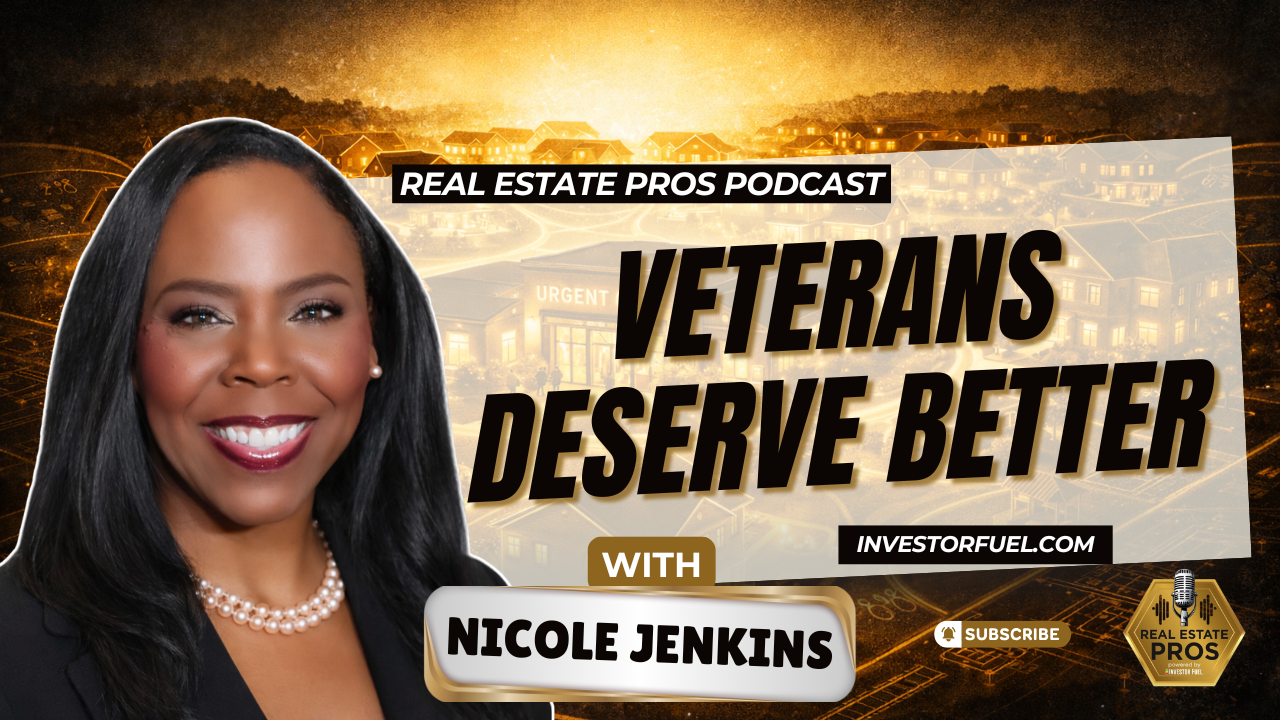
In this episode, Nicole Jenkins shares her inspiring journey in veteran healthcare, her innovative approach to urgent care, and her vision to create a supportive community for veterans through healthcare and real estate development.

Resources and Links from this show:
Listen to the Audio Version of this Episode
Investor Fuel Show Transcript:
Nicole Jenkins (00:00)
I recently last year got into the housing portion. And that housing portion is because of those financial constraints that veterans have, but they do like to live together. They are each other’s support system. That is where my real estate role plays, or that comes into play.
My ultimate goal is to create a safe place and community for veterans where it will house 200 plus veterans starting off with a VAUC clinic within that land and that development and ⁓ some sort of store for them to go and get their daily necessities where they don’t have to just go off of campus. It’s kind of their own thing. It’s like their own university.
Scott Bursey (02:22)
Hi everyone. Welcome to the Real Estate Pros podcast. I’m your host, Scott Bursey. And today in the studio, we’re joined by a person I’ve really been eager to chat with, Nicole Jenkins, who is a big player in the real estate space. She has dedicated her career to providing high quality, affordable healthcare, specifically tailored for those who served. Nicole, welcome to the show.
Nicole Jenkins (02:44)
Thank you for having me, Scott.
Scott Bursey (02:46)
⁓
it is our sincere pleasure. And Nicole, please give us ⁓ the backstory. How did your career begin and what are you focused on today?
Nicole Jenkins (02:56)
my healthcare career began, this is my 29th year in healthcare. My career with veterans, veteran healthcare began 12 years ago. And I am, I couldn’t love it more. You know, I’ve worked on the civilian side for so many years, but I feel as if
veterans, they just do not get the compassionate from officials. I think, you know, the VA, can say that they, VA employees do have compassionate fatigue. I was once a VA employee and we love our veterans. But I feel as
they just don’t get what they deserve. They were hope and a dream and they gave their lives away to fulfill that. And when they’ve come home, it hasn’t been what they feel they deserve. And me myself as a healthcare worker, business owner, ⁓ I don’t feel they get what they were promised.
You know, they exit young. They come home with conditions that they can never ever, you know, really heal from, from back pain to neck pain to head injuries, traumatic brain injuries. How can you, how can you heal from that? They can’t stand longer than an hour or two and yet they fight for their benefits. They fight to get help.
the shell shock, the war, just, you know, all of that. It plays a part in serving the veterans. And, you know, when I open up my doors, my day-to-day operation, it reminds me of what America, you know, we fight for so many things, but I always say, I never see a huge line of people everywhere.
flooding the streets, flooding in front of the White House. I never see them fighting for the benefits of veterans. So I’m on a mission to start a veteran benefit bill. That’s my next life. That’s what I’m trying to transition into. Right now I am looking for a director of operations for me to take over my role. And I will see, you know, the backstory, the operations in the back end.
But I am looking for a director because I want to get more into the role of helping veterans obtain their benefits so they can have a somewhat quality way of life to live. My clinic does not turn a veteran away. It is 100 % whether you are eligible or noneligible. Any veteran can walk through my door. ⁓ And I have started a nonprofit side. So
Scott Bursey (05:39)
your
Nicole Jenkins (06:44)
I do peer groups, I feed veterans on Thursdays, and this is my mission.
I recently last year got into the housing portion. And that housing portion is because of those financial constraints that veterans have, but they do like to live together. They are each other’s support system. That is where my real estate role plays, or that comes into play.
My ultimate goal is to create a safe place and community for veterans where it will house 200 plus veterans starting off with a VAUC clinic within that land and that development and ⁓ some sort of store for them to go and get their daily necessities where they don’t have to just go off of campus. It’s kind of their own thing. It’s like their own university.
Scott Bursey (07:40)
What a great worthwhile cause. That is outstanding. Nicole, what caught my attention about you was the way you’ve been able to take the complex world of urgent care and simplify it into a service that truly honors and understands the specific needs of our veterans. Curious, was there a specific patient that made you realize veterans’ advantage absolutely had to exist?
Nicole Jenkins (08:01)
Yes.
Yes. So while working at the Atlanta VA Medical Center, I used to call and get authorizations. I remember one time I called a lady for her community care authorization and she told me that she had cancer. And that was a game changer for me. She said, you know, I’ve been trying to get in touch with the VA. I have an expensive bill and I have cancer, but I had to get it done because I knew something was wrong.
And I knew, because I really, I worked my butt off. I took pride in my job as well as the other veteran employees that worked with me, my team. I knew that something had to be done and the VA needed help. And that really is the spark ⁓ that made me want to push and open up these clinics. So what I did is I took the specialties that I knew.
that they were just specialties where veterans could not get into the doctor to see them, whether it be a ⁓ outpatient clinic for the VA, the big VA hospitals, it was just a backlog. So I took those specialties and I also took those specialties. I also took the mental health component and I added more love into it versus more pharma. So my clinic is very unique.
And when you say, is there a threat? I really don’t feel threatened from the aspect of community and operations because I know that I have that compassion. And whether someone tries to open up another clinic like mine or not, I’m saying go for it. But what I do know that they don’t have, they’re not me, they’re not Nicole. They don’t have that every patient that walks through my door, I know them by name.
⁓ My patients feel a sense of compassion and urgency with both me and my team. I have a great front office, you know, manager, Shay. I mean, when she’s not there, our veterans, as well as we
them, they love us. So if she’s not there, even if I’m at the front, they will say, where is she at? How is she? Tell her we miss her.
You know, so that says a lot. This is a lot about the team that I’m building to take care of our heroes. So now I don’t feel threatened and that is my spark.
Scott Bursey (11:14)
those human connections that you described, that is, it must feel rewarding for you as well. Could you expand on that a little bit?
Nicole Jenkins (11:24)
It’s the most gratifying thing.
all my years in healthcare that I done. It is very gratifying and it’s rewarding. It’s full of purpose. I have stepped back from the day-to-day operations of what’s going on in America and I always tell my staff,
I cannot fight a war for other people if we cannot fight for our veterans.
Scott Bursey (11:56)
you for your your efforts and your passion. Nicole, if you could change one thing about how the broader medical community treats our heroes, what would it be?
Nicole Jenkins (12:08)
It would be to listen, to research, to stop pushing pharma.
I have the patients that come to me, have, I’ve literally had patients say, because of you, I am stopping this trend of what I’m doing. I’m stopping the alcohol. I’m stopping the drugs. They need love. They need speaking to, they need compassion. And I think they get such a bad stigma that if you live next to them, the word see,
begins with the C and ends with the Y, I don’t use because that’s not a word that exists in my book when it comes to veterans. I use love with them. For the first time ever, most of my community, the veterans that I serve, I have a broad ⁓ background of veterans. Some are high end, ⁓ the financials are there and most of them are very low end. However,
They’re learning, I’m teaching, on Thursdays we do art. ⁓ We won a contest. We do chess now, we play chess. And I’m teaching them a different way of life where you don’t have to really depend on that combat cocktail.
How do I approach you from a more holistic approach, which is why I offer acupuncture in my clinic?
Scott Bursey (13:35)
Excellent breakdown. And if you would walk us through how you would describe the culture you built at your clinics.
Nicole Jenkins (13:43)
I have built a culture of a, as I said, holistic approach culture. I have built a culture of when you first walk through the door, a day to day, a day for me and a day for the team is we have, we always have fresh fruits. We usually have bananas and little tangerines. There are flowers everywhere. We have plants.
And there’s always some really good jazz music playing on our big screen. don’t watch the news. We have a back workout room, which is we have two waiting rooms. So if you just want quiet and you just want to listen to the music, we have patients that do that when they first walk in. You can just go to the back.
Scott Bursey (14:14)
That’s awesome.
Nicole Jenkins (14:31)
and you can go work out. Some of them get on the treadmill, just whatever. And my culture is a very clear and clean atmosphere. My exam rooms, they don’t look like exam rooms. They look like suites. So we have very comfy chairs. It looks like you just, we have great providers. We’re great with good bedside manner. So Dr. Q might be back there 40 minutes with a patient. However, I only,
My providers are only allocated to see 15 to 20 patients versus in a normal chiral clinic is 40. Everything is slashed in half. It is not a clinic where you come to and you’re sitting in the waiting room forever. It’s a gathering place and that’s what Veterans Advantage Urgent Care is.
Scott Bursey (15:16)
Nicole, in your eyes, what is the biggest gap in veteran health care that most people aren’t talking about?
Nicole Jenkins (16:05)
I think the biggest gap is the non-willingness to listen to the patient itself and understanding that the patients, I feel in healthcare, when you speak to veterans, the topics that you hear is they have pain, they have headaches, they have addiction, they’re unhoused, they talk about their benefits.
Those are the five that I hear the most since I’ve been in the veteran world. But as providers and as civil servants of veterans and those that work with veterans, we don’t listen to them enough because these problems can be fixed. They can’t be eradicated within a year or two. It’s going to take years, 10 plus. However, they can be fixed. These are things that we can fix if we begin to listen to them.
Because if you listen to them, we can change the entire veteran as a whole, such as when veterans walk through the door as a community care provider, they have foot pain. A lot of them that we know that they’ve been in the army and they say, my feet hurt so bad because they were carrying the barrels and they were carrying the bags. And my medical director, Dr. Walker says immediately when that chiropractor says, Hey, Dr. Walker, they have foot pain.
and they’re triaged, we ask, were they in the army? We get their mineral labs. We want to make sure that everything is okay with them. Because magnesium, could be something as simple as low magnesium because of foot pain.
Scott Bursey (17:44)
Your proactive approach, I must say, is inspiring, but please continue. But I did have to interject. That is just uplifting. The way that you approach things in a productive manner, Nicole.
Nicole Jenkins (17:45)
So it’s yes, and we are not.
Thank you.
Yes, and you have to. so as a veteran healthcare worker, because just because I am the owner of the clinic, that does not mean that I am still not a healthcare worker. Most of the time I’m in my scrubs. I am a healthcare worker. will give an injection just like I was working for the big hospital, just as if someone was paying me a check. So when they come in, the proactive approach, another example, we’re on a whole
Scott Bursey (18:01)
Thank you.
Nicole Jenkins (18:28)
veteran health initiative. So when veterans come in and they have this high blood pressure, they have these dizziness, these fainting spells and just whatever’s going on with them, high cholesterol. I asked them, when was the last time you went to your primary care doctor at the VA or a primary care period? And when was the last time you got your labs ran? Most of them said, I haven’t been in three years. Well, that’s a problem. So VAUC is a friend.
to the VA and we take the proactive approach where we will be their friend and we run all of the labs and we can give that to the patient and they can take it back to their primary care to get their medicine adjusted. Or if they need medication, our doctor will start them on the first 90 days and they go to their VA doctor. But those strengths that we build with the VA,
that matters and it helps the veteran as a whole and more primary care providers and more VA community care providers, I think that we should strengthen our relationship with Department of Veteran Affairs to help the veteran as a whole.
Scott Bursey (19:40)
Yes, and I’m with you. couldn’t agree more. Nicole, what’s the one piece of advice that you wish you had known when you were first starting out, perhaps?
Nicole Jenkins (19:51)
The one piece of advise that I wish I have known was a.
Don’t get a partner unless the contract is 100 % correct on paper.
Do not put everything in your name. Make sure the legalities are, I mean, it’s gonna cover you. Because when I first started out, I had to close my brand new facilitated clinic within two and a half years. And I was left with everything. Every bill, I just was left. It was detrimental to me because this was my dream.
And this was not only my dream that I own in a business, it was something that I deeply cared about. It was PTSD in my household as a young girl, alcoholism in my very own household as a young girl. So this is something that I wanted to eradicate and fix. So as a business owner, whether it be healthcare, whatever it may be, make sure that those four corners of that paper, that it covers you.
Most of your money the first five years should be spent on attorney. should always have an attorney. You’re not going to be able to spend the way that you want to spend the new cars and the new houses. ⁓ Everything financially has to match and you might struggle for a minute. You might not even get paid. This is my first year paying myself, believe it or not, because I had to recoup everything and my vision
from home ownership and real estate was much more higher and seemed much better to me with the return on investment along with helping the population that I serve and me getting a paycheck. So you have to weigh out the pros and cons and what makes sense as a business owner.
Scott Bursey (21:44)
Very good advice. Very good. All right, before we wrap, if someone wanted to reach out, connect with you, maybe collaborate or learn more about what you’re doing. What’s the best way for them to reach you, Nicole?
Nicole Jenkins (21:48)
Thank you.
They can send a message in as a Nancy dot Jenkins J E N K I N S at the as in veteran as an apple. Here’s an umpire season cat dot org. They can go on our website www.vauc.org. I am looking to open up clinics around the US. I’m looking to develop
So if anyone is interested, I just got an offer ⁓ to help me scale and open up clinics, but I would love to take a chiropractor’s office, a podiatry office, a medicine office. Maybe you’re not doing as well as you thought you were. I can help you take that office and turn it into a Veterans Advantage Urgent Care. But my goal is to help veterans all over the US. ⁓ If you have real estate and you want to learn how to do something with that.
With the HUD program, HUD VASH and veteran program, build your own. I am into development. That is my next stage of life.
Scott Bursey (23:01)
Awesome. Huge thanks to Nicole for being so transparent on such an important subject. It was just outstanding having you on the show, Nicole.
Nicole Jenkins (23:09)
Thank you.
Thank you.
Scott Bursey (23:11)
And for everyone tuning in, if you found value in today’s episode, please make sure you’re subscribed until next time. Keep your standards high and your vision clear. We’ll see you in the next episode, everyone.