Subscribe via:



Show Summary
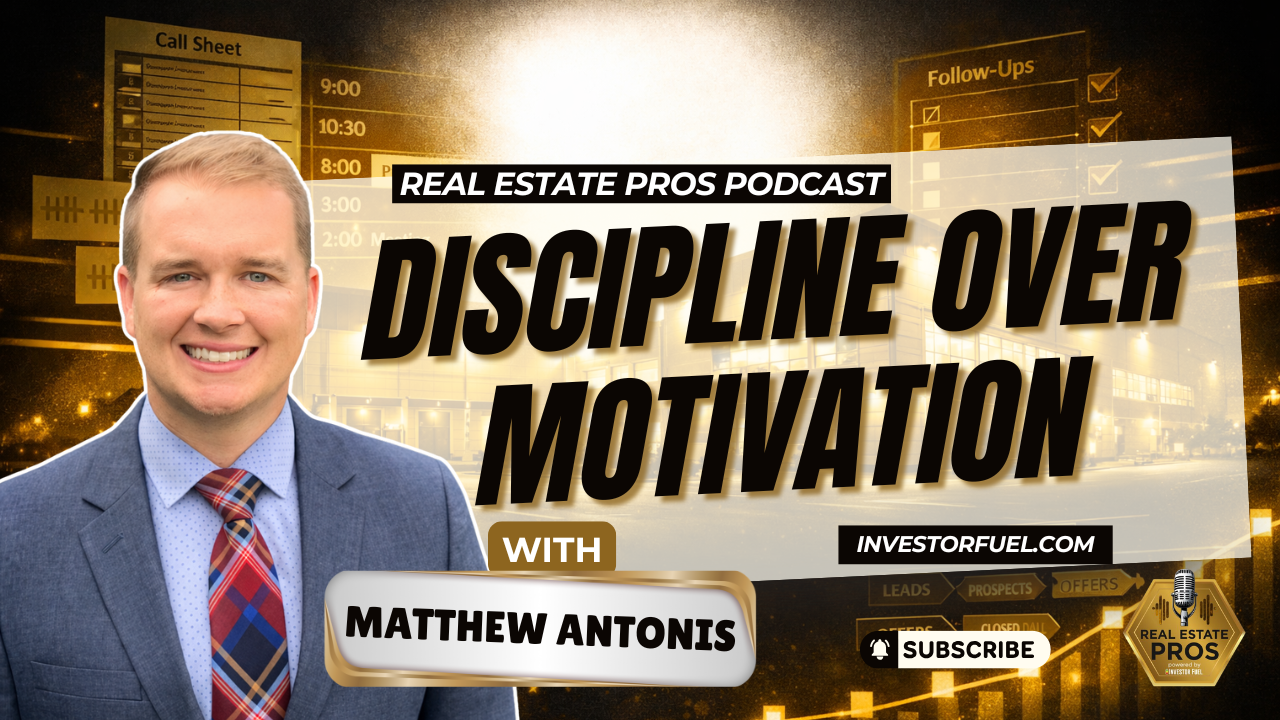
In this engaging interview, real estate expert Matthew Antonis shares his inspiring journey from radiology to commercial real estate, emphasizing the importance of mindset, resilience, and relationship-building in business. Discover practical insights on how personal experiences shape professional success and the value of serving others in real estate.

Resources and Links from this show:
Listen to the Audio Version of this Episode
Investor Fuel Show Transcript:
Matthew Antonis (00:00)
You know, I’m a firm believer that discipline each and every day, you you show up.
You don’t want to be at the gym. You work out anyway, halfway through the workout. Most of the time you’re like, man, I’m glad I came. And then you get a great workout in or you do something, but you show up and every day, if you show up and you make the calls, I don’t know what to say. I’m new. Why would someone want to learn from me or hear what I have to say? They know more than I do. All very true, but you still can add value. You still can get to know them and build a relationship.
Quentin (00:08)
Yeah.
Yes, sir.
Yeah. Yeah.
Ha
Hello everyone. Welcome to the Real Estate Pros podcast. I am your host Q Edmonds and I am excited to be here today. Super excited because this gentleman right here, man, he has been very gracious to me. And I appreciate that. Been very gracious to me. And he’s locally in my neck of the woods. And so I always brighten up when I got people that’s kind of close to me that’s doing this. Cause you know, I talk to people all around, but.
This gentleman is close to my heart because he’s close to my neck of the woods. And so if he get preferential treatment, y’all just deal with it, you know? So I’m so excited now. I’m excited for us just to get to know his journey, what he’s all about. You know what I love? I love peeking through other people’s and getting to know them. And so I’m so excited to introduce you all to Mr. Matthew Antonis. Mr. Matthew, how you doing today, sir?
Matthew Antonis (03:04)
Hey, I’m doing great, Q. Thanks for having me on. Appreciate it.
Quentin (03:06)
Absolutely,
absolutely. Listen, man, I’m so glad you’re here, brother. I want to just dive in, man. I want you to tell the people what your main focus is these days. I would love, if you give us a little bit of an origin story, kind of how you got started.
And let us know where you are in the world, man, where you’re doing your business at. And so what you’re doing, Little Origin Story, and where you are. Matt, you got the floor, sir, Matthew. Yes, sir.
Matthew Antonis (03:32)
Excellent. Thank you so much. So
where I am is located in Maryland. I’m in between Baltimore and Annapolis. We’re close to DC as well. I have a license in Maryland, DC and Virginia. And our company pretty much works at tri-state area. ⁓ We’re pretty heavy on the industrial side, both in investments, owner user, and leasing as well as part of what we do. But we also have ⁓
experience and other asset classes like retail, multifamily, and office. And we have about 18 agents here. We’re a boutique brokerage, but very, very enthusiastic about commercial real estate. And we try to work very tenaciously in our markets here. Before I got into real estate, commercial real estate, I was in the medical field. I worked from about 17 years old.
in the field of radiology as an X-ray tech. And then I learned CAT scan MRI and worked in the MRI field and radiology for, you know, about 15 years. hit a point where I just felt like I needed a change and I wanted to start investing in commercial real estate. So I figured the best way to learn about it is the jump right in and, get some hands-on training and really try to understand, how investments work.
and how commercial properties work and operate.
Quentin (05:48)
I love it man, 17 years in the medical field, radiology, and now we’re in real estate, right? And I love it man, because Matthew, I say probably once every episode, that destiny has no wasted moments, right? Meaning no matter what we go through in life, these moments build the person that we are now. And we borrow from different parts of our life, different parts of other fields that we may been in.
we borrow and it kind of makes us who we are today. And I love how you said you wanted to learn about commercial real estate. So you like, listen, I’m going to jump right in. So I would love to know, man, just personally peeking into you a little bit into your life. What has these moments taught you about yourself? What has this journey taught you about you? Has it taught you resilience? Has it taught you discipline? Has it gave you a certain type of structure? Like what has these moments taught you, Matthew?
Matthew Antonis (06:40)
That’s an excellent question. it’s funny, you mentioned, you know, having resilience and the whole reason I actually got into the medical field was I was diagnosed at age 14 with a pretty sizable major brain tumor. And it took about two years off of my teenage years, just being in the hospital, lengthy surgeries.
One of them wasn’t successful, so they had to go back in and reschedule a surgery a year after that. You know, all kinds of different things, but I tried to have a very positive mindset about it and try to learn from the experience, which I did. And, you know, my parents were very helpful with helping me have the right mindset because it felt very defeating a lot of times. But when I think back,
at that experience, it really taught me a lot about myself. It helped me learn early on just to take care of myself and to be my own health advocate. So as I was in the medical field all those years, I’ve seen so many different, whether it’s like cardiovascular issues or if it’s your orthopedic, know, your back pain or knee problems, all that stuff, no matter what age you are, it’s just so interesting to see how much choice, even though
like myself, you may get hit with something you never saw coming. I had no choice whether I was going to have that brain tumor or not, just something that happened. You know, we’re born with stuff, but a lot of things we can control just by how we take care of ourselves. So that really was something that stuck with me early on. But then I, for so many years, it’s almost a form of customer service, but on a more compassionate and empathetic level. So I was able to,
take care of patients both in a hospital setting. I even did more emergency shock trauma cycles, rotations. And when you’re in these different environments, you see really how concerned and desperate people can be in such a poor state with their health. And it helped me develop that hands-on kind of empathy.
that I try to translate to real estate. Now it’s completely different. We’re talking about finances, money, but it’s life decisions. It’s business decisions. It affects your, you know, how you’re able to care for your family, how you can, you know, make sure you’re taking care of your employees if you’re running a big operation and corporation. And also if you’re trying to wealth or build a portfolio and have cashflow for yourself, your family, and maybe even pass it on to generations to your kids.
Quentin (08:58)
Yeah, yeah, yeah, yeah, yeah. Yes.
Matthew Antonis (09:23)
that becomes pretty emotional at times. So I try to use some of that, what I learned over the years and kind of bring that a little bit into how I deal with my clients and help them and add value to what they’re trying to accomplish in real estate.
Quentin (10:13)
Matthew, thank you, sir. Thank you for what I call the gift of your vulnerability, man, the gift of your transparency. And I asked that question because you brought up the exact word mindset, no matter the continual thing in real estate. If you are a real estate investor, agent, you know, whatever, the constant thing in that is you. Right. I mean, like, you know, like the the commission checks may go up and down, the sales may go up and down, but it’s always you.
And it’s always having a healthy mindset that’s going to help you thrive in this space. And so I’m glad you brought it up and thank you for answering the question the way you did. Because another thing within real estate is being empathetic to the people that you are serving. And what you just said, at your background, you was in a place of serving people at different capacities in their life.
Like you said, some may been dealing with the hearts and may been dealing with back pains and know, did some stuff and shock trauma, I believe I heard you say, you know, I don’t know if everybody, I don’t know if shock trauma, you did say shock trauma, correct? Did I hear you say that?
Matthew Antonis (11:22)
Yeah, no,
no, I’ll be just to be transparent further. did a short rotation and shock trauma, but it was like three months. And I was like maybe 18 or 19. I was young and man.
Quentin (11:25)
Okay.
Okay. Yeah.
Got you. But I don’t
know if Chalk Trauma, I don’t know if that’s universal, if that’s just to Baltimore, that’s to the Maryland. Yeah, because when I hear that, because we in Chalk Trauma, I mean, when we hear that, I know that’s specific to Baltimore. I don’t know if that’s universal. Yeah, yeah. ⁓ Yeah. Yeah.
Matthew Antonis (11:40)
It was, I don’t know, it was-
Right.
University of Maryland, So we were wearing the powder paint scrubs and we were on the x-ray side, you know, so we’d go
into the, to the little room. This was years ago. So I’m going to hold memory, but we’d go into the room and people were, you’d see so many things and it’s like chaos and man, it like opened my eyes like, man, what is going on out here? Like, this is crazy. But, ⁓ yeah.
Quentin (11:59)
Yeah, yeah, yeah, yeah.
Chaos.
Yeah, yeah. So they’ve trained,
they have trained soldiers in shock trauma that’s gonna deal with like bullet wounds, like, you know, the medical people that’s gonna be in the military, they’ve come to shock trauma to train. My dad is a pastor, so he’s been a pastor for like 40 plus years. So when family members have been taking a shock trauma, he’s got calls in the middle of the night, I’ve gone with him.
My own sister unfortunately lost her life to the violence in Baltimore. know, Merla can be treacherous. So we had to go to shock trauma because of her. just, I’m just saying, just hearing that those skills are translatable, transferable to real estate because it does bring the empathy side in it. And when you’re dealing with somebody that’s buying a home, selling a home, we don’t know the backstory that they’re going through. As you know, they may have family members that’s…
that’s in dire need and may have medical emergencies. And so I definitely see where that skill is transferable in real estate. Because I tell people all the time, I believe that the foundation of any sustainable business is servitude. It’s serving people. And if you continue to serve people and have a serving heart, you will always be successful because you’ll always find the opportunity to serve.
And so I love it, man. And I just wanted to say all that because what you said make total sense. And I appreciate you sharing a little bit about your journey, So I would love to know me. Yeah, please go ahead. I’m so sorry.
Matthew Antonis (13:44)
Absolutely. It was nice to hear your thoughts.
No, I was going to say I really appreciate what you were saying there and it is so true. And, you know, it takes special kind of people to now. Here’s the other thing. I didn’t end up going back to shock trauma because it really does take a special type of person to sit in that role, you know, day after day, week after week. And I mean.
I truly appreciate everybody that does decide to stay in that role because someone has to be there and do that work and it’s incredible, incredible how they operate there.
Quentin (14:18)
Absolutely.
Absolutely. I know. So I’m going to pick on you just a little bit because I feel like you my brother. Like I said, you’re from my part of town, but I know one thing that I heard you say, you kind of said when I was asking some questions earlier, I don’t know if I got any kind of special skill set or whatever, but I challenge you on that because I think we all have our special skill set. You know, and just like you said, the people in shock trauma.
Matthew Antonis (14:24)
Let’s go.
Quentin (14:46)
They got a certain, they got a, they’re wired a certain way. And I believe what you do and the fact that you can take that skillset and trans make it transferable shows the type of person you are, shows the type of tools that you use when you are helping clients. And so I really try to make sure I create a space that everybody that come on and let them know that they are absolutely unique. They absolutely have a skillset that
Matthew Antonis (14:55)
Mm-hmm.
Quentin (15:12)
everybody may not have. And I want people to know that because we need to pull it out every now and then. And I think sometimes just reflecting that on our life, how we got to the point where we are, will help us see some of the skills that we developed over the time. man, you know, I can’t talk to people and sympathize and empathize with people. And you look around and you see everybody in your office may not have that. you know, everybody in the office may not be being patient with people and stuff like that. So.
Matthew Antonis (15:30)
Yeah.
Quentin (15:39)
I think your being here is refreshing. I think hearing your story is refreshing. And I know that this is part of the reason why you are successful at what you do is because of the way you think your perspective and gaining that perspective over the years. Does that make sense, Matthew? Yeah. Yeah. Yeah. No, absolutely. And I mean, it’s not me just blowing smoke. I really, really, really.
Matthew Antonis (15:55)
It does and that’s very kind of you. I do appreciate that. Thank you
Quentin (16:05)
really believe that. And I would say that to you and anybody else. I’m encouraged to another person the same way. Cause I believe we all have something that’s unique about us. And I think that for me, that’s why I light up. That’s why I love doing this podcast because I get to talk about the uniqueness of the person in front of me. You know what I mean? And so I really, appreciate you, man. I appreciate you being here. So let me ask you this, man. What, what’s the next real goal for you in, business, in real estate? What are you looking to solve and scale next?
Matthew Antonis (17:15)
Yeah, so me personally, I want to build my real estate portfolio. You know, just no pressure, kind of just looking for opportunities. I try to invest in things that aren’t really in the same line as, you know, clients that I have what they’re looking to get into. I never want to compete with, you know, clients that I’m working with or nor would I get involved in a deal if it’s something that.
a client of mine was looking at. just keeping my eye open for good opportunities to slowly grow and just increase some extra cash flow. Also, we get young agents and summer interns every year all the time. And it’s very challenging. It always reminds me of when I first started. Of course, I was at a certain age. I came from a medical background. And then I’d
jumped and learned a new trade, a new skill, a new industry. But some of these kids are, some of these guys are younger, ladies are younger. Some, some are, some are middle-aged, but you know, they’re still starting out and they’re new. So you start to see some very similar things, the struggles, the challenges that they face. So I really want to, ⁓ I’ve started working on an application that really just helps provide a resource or a guide of some of the things you could do.
or systems you could put in place to stay focused on what your goal is as a new agent. A lot of times they haven’t even set a goal. So that’s number one, getting clarity. Where do you want to go? What do you want to do? And then putting a couple of metrics to those and then putting a plan together and then executing the plan. And I call it the realest discipline.
Quentin (18:47)
Yeah.
Matthew Antonis (18:56)
You know, I’m a firm believer that discipline each and every day, you you show up.
You don’t want to be at the gym. You work out anyway, halfway through the workout. Most of the time you’re like, man, I’m glad I came. And then you get a great workout in or you do something, but you show up and every day, if you show up and you make the calls, I don’t know what to say. I’m new. Why would someone want to learn from me or hear what I have to say? They know more than I do. All very true, but you still can add value. You still can get to know them and build a relationship.
Quentin (19:05)
Yeah.
Yes, sir.
Yeah. Yeah.
Ha
Matthew Antonis (19:31)
And if you lean on that experience and you put some of these things into practice, ⁓ you can not only survive and stick around in real estate, but you can thrive and accomplish all the goals you want to accomplish.
Quentin (19:44)
Yeah, I love it, man. You’re absolutely correct. I turned 44 in December and the gift I said to myself was like, I’m gonna get back in the gym. I’m gonna get back, you know, being real, you know, serious about my health. I’ve lost over a hundred pounds twice in my life. So yeah, I’ve lost a hundred, gained a bet, lost a hundred, gained a bet, and now I’m in the next stride of losing it again. And so I’ve been consistently, proudly can say since December consistently,
Matthew Antonis (20:02)
Wow.
I don’t know.
Yeah
Quentin (20:14)
been working out four to five times a week, And so, and you’re absolutely right. You get there, you wake up and you get there you’re like, ⁓ man, like, but once you get going, and I’ve been journaling while I work out and I’m just learning like how exercise, like cardio does, gives, improves your oxygen. and it just, it gives you oxygen flow, which gives you energy. And this is why like, you you’re putting in the work.
Matthew Antonis (20:16)
That’s awesome, Way to go. ⁓
Quentin (20:43)
and you’re feeling better later because literally your insides is like, yes, you’ve given me oxygen. So I’m I’m learning different things of why we should take care of this temple, this body that we have, you know what I mean? So yeah, man. Yeah, I appreciate it, brother. I appreciate it. So man, I want to ask you this question, especially you, And I ask this every episode, but the word relationships, I specifically want to ask you because of your background and empathy, because of the way you think.
Matthew Antonis (20:51)
Yeah, man.
That’s awesome, man. Keep it up. That’s great.
Quentin (21:12)
When you hear the word relationship, what do you think about? Are relationships within this business space important to you? If it is, how do you go about building relationships? So Matthew, talk to a little bit about the word relationship.
Matthew Antonis (21:24)
Yeah, no, that’s a great question. So relationship makes me think of, ⁓ you know, two parties that are connected in some way. And, know, I think of relationship, I think of something positive. And, you know, even if I were to take it to a more personal level, like a relationship with a spouse, ⁓ you know, two different people come together and now you’re living in one house, you’re kind of one person, right?
But you have similar objectives and goals, hopefully in line with each other. we’re all still individuals, right? We have different thoughts, different opinions and ⁓ things we want to do, all that good stuff, preferences. So the way I feel about it, my own philosophy is, what am I bringing to that relationship? And it shouldn’t be affected or influenced by what another person brings.
Quentin (21:56)
Yeah, yeah, hopefully, right? Yeah. Yeah, yeah.
Yeah. Yeah.
Matthew Antonis (22:22)
You know, there’s times where I have a relationship and I’m all in and I’m working hard and doing all these things. And then I get blindsided by the other person and they do something that I, it’s not great. And it, and I’m like, you know, what’s that about? But if I let it affect how I show up to that relationship and I’m not saying if it’s, over the top, sometimes you have to cut, cut bait and get out of there and just say, you know what? I’m going to go in a different direction, but yeah. So.
Quentin (22:51)
Yeah.
Matthew Antonis (22:52)
But if you bring your energy, your positivity, ⁓ your value to that relationship, and you show up each day, each week, each month, I think that’s going to foster a really positive interaction and positive, hopefully ongoing relationship with the other person. And most likely it’s reciprocal. You’re going to get a lot of that back by what you bring to it. But the
struggle for me over the years, I’ve learned is showing up regardless of how the other person, you know, don’t always take it personally, man. I, when I was younger, I used to be so defensive and it was my one of my least favorite qualities that I had. And I’m just like, you know what? I just going to own everything. Like I can only control. I think it’s Greg Hardy. I can only control the controllables or the things that are within my ability to control everything outside of that.
Quentin (23:44)
Yeah.
Matthew Antonis (23:45)
Like if somebody’s having a bad day, I feel bad for them. I’m sorry, feeling that way. But I’m good. Like I feel good. I’m going. So just not being influenced by that and just showing up to each relationship. If I’m committed to a client, if I’m committed to a deal, I’m showing up and that’s what I can control. And that’s what I try to do.
Quentin (23:52)
Absolutely, yeah.
Man, I swear you my brother from another mother, bro. Because I, that’s literally, I told you I just turned 44. I’m literally, I am literally learning that I can decide how I show up. Like I have been a person that’s been super offended very quickly, person that gets angry very fast. And I am learning like, I really don’t have to be that way. Like I-
Matthew Antonis (24:07)
You
Yeah.
Quentin (24:29)
didn’t know I could control that. And so, right, I love how you said, because relationship, think one of the most important relationships is the relationship you have with yourself. know, of my mentors told me when you know who you are, you know what to do. And so when I can know me, I can know how to show up because I don’t have to let somebody else affect me.
the way I show up. How I show up is defined by how I’m going to show up. Like it’s not defined by what somebody else done to me. And so I love that. And I’m learning how to show up in business relationships. I’m learning how to show up in personal relationships as my authentic self. And that’s part of me just getting to know me and not letting other people dictate how I’m going to react and how I’m going to show up. So I love that you brought that up because I promise you, bro, that’s kind of where I’m at. This is, it’s all unfolding like for the last year. Just like, man.
Matthew Antonis (25:01)
Absolutely.
Yeah.
Quentin (25:19)
Like I can get through this. so, yeah, I to tell one client, had to be real honest with one client. We was talking, it didn’t go my way. And I kind of got off the phone with him very quickly. And I had to call him back and say, bro, I was offended. And that’s not your problem. That’s my problem. And I apologize for the way that I treated you. I had to be very honest. he was like, man, I wasn’t trying to offend you. said, I know. I said, but listen, I believe in just organic relationship. We have a very good relationship.
And I feel like I owed you like, hey, I was offended. So if I acted a certain way, that’s why, but that’s not your fault. That was my fault. You know? And so, yeah, man. So I’ll hear you.
Matthew Antonis (25:54)
That’s awesome.
That’s such a great way to handle that too. mean, that shows a lot about your character and I think of the word emotional intelligence, being able to kind of harness those like feelings and we’re guys too. I feel like we get really like worked up sometimes. We won’t always admit it, but sometimes we get to in our feelings and it’s like, man, just take a second. Think about it. Don’t send the email. Don’t press send.
Quentin (26:11)
for more.
Matthew Antonis (26:21)
Don’t make the call just yet, just take a minute. usually time, if you delay it, you won’t respond like you would have if you just go at it ⁓ right away.
Quentin (26:32)
I listen, everyone is listening. I hope y’all understand this has a lot to do with real estate. Cause we all here, y’all doing a lot of deals out here. And some of y’all y’all blowing a lot of deals because you lead with your emotions in a not emotional healthy way. So please know this all ties in. Cause like I said, the one constant thing in real estate, yes, it’s real estate is land, is buildings, is properties. But the other constant thing is you.
Matthew Antonis (26:37)
Yeah.
you
Quentin (27:00)
You are the other kinds of thing in real estate. And so how you show what matters. Matt, man, bro, I could do this with you easily another 20, 30 minutes, But I don’t have that type of time. We both got things to do. But listen, man, if someone wanted to reach out to you, connect with you, collaborate with you, learn more about what you’re doing, how can they reach out to you, Matthew?
Matthew Antonis (27:13)
Thanks
Yeah, so you can visit my website matthewantonis.com or mantonis.com Have Matthew Antonis on LinkedIn as well. That’s more for commercial real estate You know just connecting on a professional business level if you are interested in the realest discipline You can check out the realestdiscipline.com There’s social links in there for that
I don’t know what they are off the top of my head, but something pretty new. It’s a little rough around the edges right now, but just taking a kind of a chill approach to building that. And hopefully it’ll be helpful to especially new agents zero to three years. That’s when it matters the most. Get your systems in place, get your footing. And if you keep at it, you can not only make it, you can thrive and do really well in real estate, both on the residential.
and or commercial side.
Quentin (28:16)
I love it, man. So let me say three things to you, brother, sincerely. First, thank you for your time. You could have been anywhere in the world, but you’re here with us. And you know we’ve been working on this. So thank you for your time, I greatly appreciate that. Secondly, thank you for your story, the gift of your vulnerability, the gift of your transparency. I believe stories, I put a premium on stories because they have a way of kind of cutting through them and kind of getting to the soul of people. And it starts to plant seeds in them.
Matthew Antonis (28:43)
Mm.
Quentin (28:44)
and it starts to make them think like, wow, you I’m not the only one, or man, I can overcome this, or like, I’ve never thought about that idea, let me try it. Like, I believe our story is plant seeds that really help people. So thank you for coming and planting some seeds. And lastly, thank you for your mindset, man, the way you think and bringing that perspective to this platform. I greatly appreciate you coming through, Matthew.
Matthew Antonis (29:06)
Thank you, Q. Thanks for having me on and I appreciate your kind words. Thank you so much. It’s been a great time.
Quentin (29:11)
Absolutely. Yes,
sir. Absolutely, man. Well, listen, y’all heard Mr. Matthew. You heard the stories. You heard the resources. His stuff is in the show notes, information is in the show notes. Get in contact with him. Yeah, I showed some prefrontal treatment today. Yeah, and I make no qualms about it. He’s in my area. He’s my guy. He’s from my area. So yes, absolutely. Oh, man, you ain’t said nothing but a word, man. You ain’t said nothing but a word.
Matthew Antonis (29:32)
I owe you a coffee or lunch for that,
Quentin (29:38)
So listen, y’all definitely check out my man. Definitely if you’re in the Maryland area, check with him, get in contact with him. But definitely make sure you are subscribed here, because we’re going to continue to bring up amazing people, just like Mr. Matthew. So sir, thank you again. And everyone else, listen, y’all have a fantastic day.
Matthew Antonis (29:53)
Appreciate it.