Subscribe via:



Show Summary
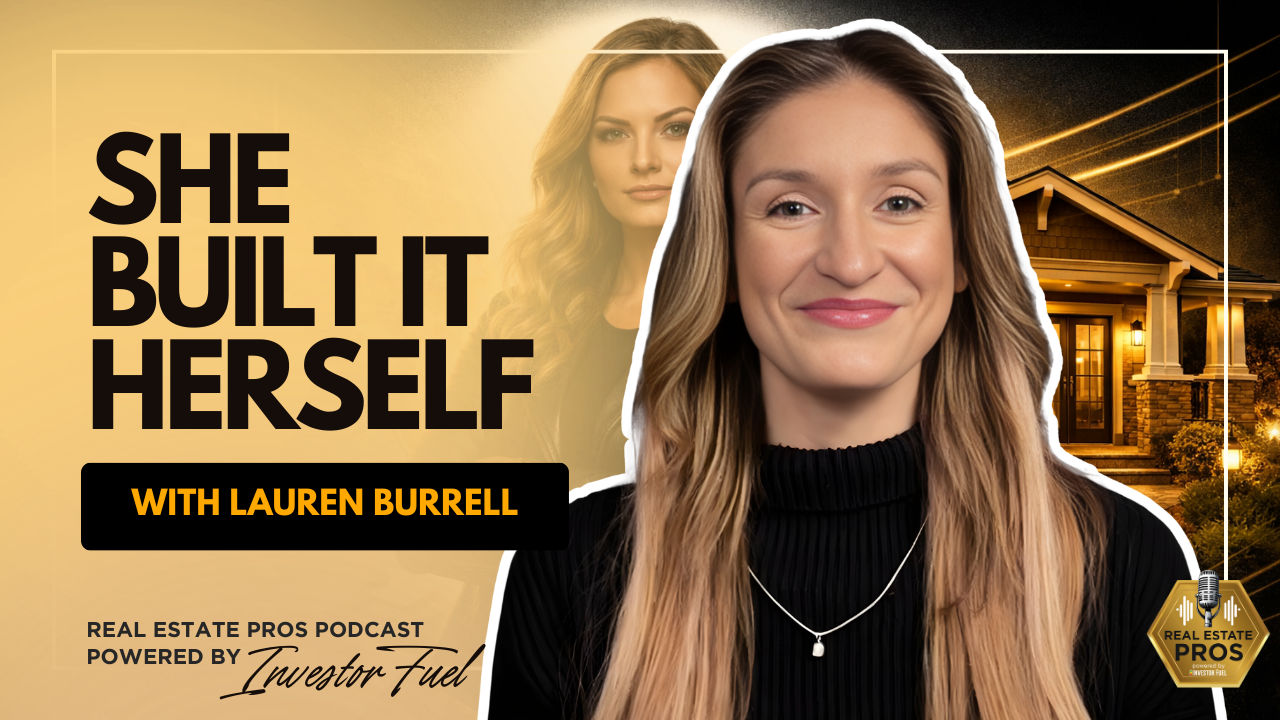
In this episode of the Real Estate Pros Podcast, host Cody Crabb sits down with Lauren Burrell, founder of Burrell Investments in the Seattle metro area, to discuss her journey into real estate investing and the challenges of building a business in the fix-and-flip space. Lauren shares how her path into real estate began after she dropped out of college to avoid student loan debt. While researching how wealthy individuals build financial independence, she discovered real estate investing and quickly immersed herself in books, deal analysis, and market research. That curiosity eventually led to her first investment deal—a distressed hoarder property that required extensive cleanup and renovation.

Resources and Links from this show:
Listen to the Audio Version of this Episode
Investor Fuel Show Transcript:
Lauren Burrell (00:00)
I would say that the biggest lesson that I have learned, I don’t know if it’s necessarily a lesson, but ⁓ is that life is so short and it’s so valuable. I have a daughter with my late husband and ⁓ real estate has given me the opportunity to be able to stay home with her. After losing my husband, ⁓ it’s just…
I’m really so thankful I have already said this up previous before he passed away that I can be with her and spending more time with her.
Cody Crabb (02:07)
Hello and welcome to the real estate pros podcast. I’m Cody Crabb with investor fuel and I’m joined by Lauren Burrell of Burrell investments out of the Seattle metro area. Lauren is a real estate operator focused on fix and flips. And today we’re talking about her whole journey, like where she came from, why, why she’s doing this and how to
what it takes to keep growing when you know you’re capable of more. So Lauren, thanks so much for joining us today.
Lauren Burrell (02:32)
Hey Cody, good morning. Thank you so much for having me.
Cody Crabb (02:35)
Yeah, it’s a pleasure. ⁓ So how did you very first get into real estate? Because I find it’s one, it is one of those things where, you it’s not at the career fair. Like you don’t, typically see the kids like, I want to be an astronaut. I want to be a real estate. I want
go into real estate. Like no one says that. So I’m curious, what did that look like for you in the early times when you, when you first wanted to do that?
Lauren Burrell (02:56)
Yeah,
absolutely. It was definitely not a clear cut, straight, narrow path for me. ⁓
Cody Crabb (03:02)
Yeah, it never is. ⁓
Lauren Burrell (03:03)
Yeah, no. I actually dropped out of college ⁓ because I did not want to have student loans. I was going into psychology initially and I did not really want to, like I said, have student loans. And so I was researching all these different things of like, how can I make money? How can I be successful? And I was Googling. was like, how are the richest people?
Like how did they get that rich? I was like, that doesn’t make sense. Cause I was like the jobs that doesn’t get you there. So I was like very confused. And then I came across real estate and I was like, oh my gosh, I fell in love with it. And, but it wasn’t just selling real estate as like a real estate agent. And so I dropped out of college. I got a real estate license cause I was like, that’s my first path to go into real estate. And then I started reading real estate investment books, like crazy, like bigger pocket.
Cody Crabb (03:34)
Yeah.
Lauren Burrell (03:58)
Robert Kiyosaki, Brandon Turner, like all of those. I was just like immersed myself into that and analyzing deals. And so that’s kind of how the conception of me going into real estate was. You know, I did not want to be in the rat race per se. I didn’t want to work in basic nine to five job. ⁓ So yeah, that’s pretty much the conception of it.
Cody Crabb (04:22)
Yeah, we do hear that a lot on this podcast. People kind of go, well, how is everyone else, people have that much money, how are they doing that? And oftentimes they stumble across real estate as one of the ways they do that. So at this point, you’ve started out, ⁓ what was your first deal like? I love hearing about the first one that made you like, okay, I’m actually doing this for real now.
Lauren Burrell (04:30)
Thank
Yeah,
yeah, so my first deal was actually super interesting. my, my husband and I at the time, he still technically is my husband, but my late husband at the time. ⁓ my god, we’re gonna need to cut that out. Anyway.
Cody Crabb (04:58)
Okay, gotcha. Gotcha. Gotcha.
If you are, Editors, just
take note of that if you could. Thank you so much.
Lauren Burrell (05:07)
Okay,
⁓ anyways, so my husband and I, ⁓ I was…
I got an email from, I made a Facebook post telling everyone that I was going to be start, I’m going to look for off market properties. If anyone had something, well, one of my friends from childhood, he was telling me his mom had inherited a property. was three years back on behind on taxes and here in Washington, after three years, it goes to a foreclosure auction. ⁓ And this was in Puyallup, Washington and in a really good neighborhood, gated community. And so.
So
I went ahead and was like, okay, let me come see it. Send me some pictures. It was like a hoarder situation. It was really, really bad. had thousands of pounds of garbage that we had to. We were wearing hazmat suits. It was horrible. was
Cody Crabb (05:52)
Jeez.
Wow.
Lauren Burrell (06:47)
Yeah, it was really, really bad. Like maggots, rats, animal feces all inside of the house. But it was a really good, yeah, gross, I know. It was a really good, yeah.
Cody Crabb (06:47)
That’s like straight out of the show Hoarders. Like that’s wild.
Ugh.
Well honestly that’s a great way to start because it’s going to be
a lot easier going forward. Get the bad stuff out of the way.
Lauren Burrell (07:02)
Yeah, no, I think that
was a good desensitization for me, realizing that it’s not all gonna be just old houses, because I think there was a lot of misconception in the beginning, and for real estate investors, it’s like, it’s just you’re gonna go into an old, outdated house. No, a lot of them are just nasty, disgusting situations, unfortunately. But however, I do look at it also from a holistic standpoint, is like…
Cody Crabb (07:06)
Yeah.
Lauren Burrell (07:25)
I really helped this lady too, and that’s the most beautiful thing out of all of it, you know, because she was going to lose everything by going to this foreclosure auction. And we literally closed a day before it went to auction. was the auction was November 17th, and we closed on the 16th of November of 2020. And so that was pretty exciting. ⁓ Anyways, so yeah, I purchased the house. Would you like to go over the numbers or?
Cody Crabb (07:52)
If you want to, yeah, I think it’s good
for people that are starting out to kind of hear actual numbers, because no one wants to, usually people aren’t willing to like say the actual numbers and it’s hard to know, know, so we’d love to hear that.
Lauren Burrell (08:01)
Yeah, no,
think I like the transparency and knowing that because I think that helped me too in the beginning. Yeah, so I purchased the property for $220,000. I put 10 % down. I did a hard money loan. And then we had a rehab budget of $50,000.
And we turned that in about a total of two months. After we did have the first initial month, we let the previous owner stay there while I helped her find a new home. And so that was really cool. My husband at the time, now my late husband, he did a lot of the demo. We did the demo in-house. He was an electrician. And so that was amazing that he was able to do all the electrical work.
Cody Crabb (08:44)
I was gonna say that, that probably came in handy, yeah.
Lauren Burrell (08:46)
Yeah, ⁓ and so yeah, it was definitely a hard process, but it was so rewarding. ⁓ And that this was at the time of when real estate was crazy, like wild, wild west. And so once we finished… ⁓
I listed it at 399 and we closed at 440. And so that was, because we had multiple offers, it was insane. And so that was where like I got hooked after that. And I was like, oh my gosh, this is addicting and this is so fun. And yeah, so the rest is kind of just me being addicted to it after and like.
I love the part of running the numbers and the potential of seeing what the house can turn into. So that’s pretty exciting for me.
Cody Crabb (09:37)
⁓ Yeah,
so we were chatting beforehand and I just want to emphasize, you told me that you’re a one-woman team, is that right? So I was gonna say what parts of the business do you handle, but that means all of it, everything. ⁓
Lauren Burrell (09:47)
Yep.
Yeah,
so I would like to clarify. So I do sub out a lot of work. Obviously, I can’t do electrical or plugging. Yeah, no, no, that would be a little crazy. So I do sub out and I do have… ⁓
Cody Crabb (09:58)
Oh, that’s good. I was gonna say that’s pretty impressive, but yeah, there you go.
Lauren Burrell (10:08)
Yeah, I do have one person I mainly sub out to ⁓ for demo and then I also have, you know, obviously electrical contractors, plumbing contractors, framing, all of that. So I sub all of that out. But for my tile work and stuff like that, I do all my tile work in house. Yeah, so for acquisition and underwriting and all of that stuff, that’s all me. ⁓ But for purchasing, that’s literally all me and obviously my hard money lender team.
Cody Crabb (10:23)
cool.
see, there you go.
Okay, see, there you go. So, I mean, you made it sound like, I don’t do everything, but you do a lot of work. mean, so that’s a big deal. ⁓ What do ⁓ you find is one of the hardest things about working by yourself on things like this? Like, you have to kind of be the end point. So what do you find being difficult about that?
Lauren Burrell (10:57)
Yeah, yeah, so I would say definitely so there’s probably a two-prong thing I would say to this
one is being a female a small female I’m only five one and I’m young too So I think the female in the industry is really really hard try get taken advantage of by you know It’s a male dominated industry, especially in construction. And so a lot of times I feel like I need to be a lot more Tough I guess in lack of better words, maybe a
Cody Crabb (11:44)
huh.
Sure, yeah.
Lauren Burrell (11:59)
BTCIH essentially, you know what I mean? And that’s the hardest part is like kind of balancing that. ⁓ But then it’s like, okay, I can prove my knowledge and prove that I have a track record, a successful track record in this industry. And so it’s like, okay, with that, and I built this like subcontractor. ⁓
Cody Crabb (12:00)
Yeah, yeah, yeah, I know what you mean. Yeah
Yeah.
Lauren Burrell (12:21)
relationships over time now. Now they like it’s kind of like dust settled and they’re like, okay, know what she’s about and that’s probably the biggest. Yeah, that’s probably the biggest part was is like having to get my footing in that ⁓ and ⁓ get respect, I guess, from male dominated industry. Secondly, I would say is probably having to deal with all the stress and everything by myself and say, for example, one of my
Cody Crabb (12:26)
Yeah, they know you know what you’re talking about, yeah.
Lauren Burrell (12:49)
one of my films we had, it was an emergency, ⁓ I was in Graham and the septic overflowed and this was like a night at night and I had to like, I was had to go over there like when the septic is overflowing back in the tub and like I had to call, ⁓ you know, an emergency septic system or company to come out and take care of that and just so I would say like pretty much being.
Cody Crabb (12:57)
Ugh.
⁓ man.
Lauren Burrell (13:15)
the main person that has to deal with that 100 % stress and when contractors do you wrong and all of that type of thing, I think is definitely a pretty tough being the only person who has to deal with it.
Cody Crabb (13:27)
Yeah, yeah, that’s a really good point, because sometimes you are just the one that ends up going to, I mean, have you had to deal with any of the, you haven’t had to deal with any of the property management type stuff, because you’re just mostly in flips right now, so that’s good.
Lauren Burrell (13:41)
Yeah,
well initially when I first got started my husband and I we did have one rental and so it wasn’t really property management it was just literally one and it was super simple so but yeah I haven’t really had much to do.
Cody Crabb (13:54)
Yeah,
yeah, well that’s, mean, there you go. That might be the tipping point of you going, let’s just get some more people on this team, because that’s just, I don’t know if I can do that. So, all right, you know, you’ve got, I’m curious, where do you see like the biggest opportunity? Like Lauren, like five years, like what are you doing, what would you ideally like to be doing? Yeah.
Lauren Burrell (14:18)
Yeah, that’s a good question. So ideally, I think the biggest opportunity is what is the underserved and under appreciated communities that have their I don’t know if you look into other markets, but I look I love like that’s one of my past times to look into other markets and see what’s going on there. There’s so many different communities that have like multifamily properties that are just
kind of dilapidated and I would say getting into redeveloping those communities and multifamily. So multifamily is definitely my ultimate goal. Kind of switching more into just, you know, fix and flip into more buy and hold like and renovate that way to have cash flow. So I think that is definitely where I want to be because that’s always been my bigger goal is to get into holding. And so that’s where I see myself as like flipping multifamily or not,
necessarily flipping it but more by rehab and then rent so the burr method I said it a little bit wrong but
Cody Crabb (15:19)
No, no, I’m following you here. ⁓ So if someone’s trying to replicate what you’re doing, what would be the hardest thing that they are not even aware of that they’re gonna have to deal with?
Lauren Burrell (15:35)
Yeah, that’s a really good question. I would probably say the lack of knowledge, not enough knowledge and patience and time, because it’s definitely not a quick, get quick rich scheme. You know, there’s a lot of, a lot of things that will pop up that issues that I don’t even expect with like repairs, contractor issues, even mental health. I would say that it can take a big toll on you too, if you’re not 100
there in terms of like,
Trusting yourself and believing in yourself. ⁓ So I would say definitely, you know not lack of knowledge and lack of trusting in yourself and Believing in yourself that you are capable and that you are worthy of doing this ⁓ and so yeah, I would just say you know to have those top of mind education and The willpower I guess essentially to be able to do it
Cody Crabb (17:12)
Yeah, I love that. let’s do a little bit more specifically around ⁓ flipping and around being a woman in the industry. I would love to know what are some tips around those things specifically that the early people would want to know.
Lauren Burrell (17:19)
Yeah.
Yeah, I would say probably being able to run numbers effectively. think that is something like, you know,
your after repair costs, your max allowable offer on how to be able to do that. And then typically ⁓ your rehab costs, I think that would be really, really important to be able to actually effectively calculate those because if you don’t effectively have your numbers down to a science, you will have issues and you will, you know, it won’t work. Secondly, I would say ⁓
to be a woman in this industry, I think you shouldn’t get afraid of being in a male-dominated industry. It’s okay. You can have, you just have to have the knowledge behind you to be able to put those people in their place, essentially. And so I would say the biggest thing is to have that knowledge and to have the, ⁓ to have the wherewithal to be able to put people in that place because unfortunately, that’s just kind of human nature. I feel like we’d…
you know, other people do try to step on other people’s toes and like, ⁓ I have a little bit more knowledge than you and you shouldn’t be in this industry. ⁓ And so, yeah, would say that’s, knowledge is the biggest thing.
Cody Crabb (18:46)
Yeah,
that’s a really good point because I feel like everyone brings something different to the industry. I talked to a contractor who worked in construction in low-paid environments for a long time and he learned a lot from there. And then he ended up using it to become a contractor. I think you’re right. Education also varies. You’re going to know less or more than some of the people around you. ⁓
they’re also gonna beat you at some other things. So it’s important to know that it’s also not a big stack of one single thing. You can learn a lot about one little ⁓ piece of it. So as a, hang on, let me just think about how I wanna phrase this here. ⁓
Okay. ⁓
Yeah, all right. Have you ever had a deal where you started running numbers and you suddenly were like, ew, this is probably not gonna pan out? I’d love to hear about that, because I feel like someone that’s getting into real estate investing, that’s a very important thing for them to be able to flag for fix and flips, so I’d love to hear your thoughts on that.
Lauren Burrell (20:05)
Yeah, absolutely. Before I, I probably look at, I don’t know, 10 to 20 different homes before I actually put an offer in, analyze and underwrite those deals and run the numbers to make sure it works because yeah. ⁓
I’m very conservative with my numbers. very scared of like I know in this industry like you to take risk and but it’s like the risk scares me so it’s like I am very careful in running my numbers and so I think it’s very important because
you could literally lose everything if you do not run your numbers effectively. And I think you’re gonna have to look at so many deals. You’re not just gonna find one deal and think that deal is it and that’s golden. No, there’s so many different parameters, the market parameters, the where it’s at, the community, all of those different things you have to look at. And so yeah, I think that it definitely comes.
Cody Crabb (20:38)
Yeah.
Lauren Burrell (21:02)
about and unfortunately I’ve had something kind of similar where I bought a house in Tacoma it was on an acre and I ran the numbers on it but it was a bidding war this was crazy when
when people were bidding up like real estate investment properties, it’s like, what the heck? Anyway, so had to waive the inspection on this. And so unfortunately that deal went a little bit sideways and it was a teardown, but I had a backup plan. I knew I would not have purchased this property unless that I knew there was a backup plan. And so that ended up being a short plat and I ended up tearing down the house and developing the lot into four new lots. So yeah.
Cody Crabb (21:30)
Wow.
Hmm So that’s a good
ending see I think I think that’s a when people hear risk They think they feel like risking it all like they that’s all in that’s like that’s the that’s way to do it But I like what you said ⁓ That it’s like careful risk like do you do it may have a bet have a plan B Have some stuff saved up and get get ready for what if something goes wrong? So I think you you nailed it. Yeah, I don’t think you’re scared of risk I think you’re careful about risk because that’s that’s what I think ⁓
Lauren Burrell (22:11)
Yeah.
Cody Crabb (22:13)
That’s how I think people really get successful is having that, having a risk, but like planning for if it doesn’t.
Lauren Burrell (22:18)
Yeah, exactly. Having that backup plan and plan B and the contingency budget for like rehabs, all of that is really important.
Cody Crabb (22:25)
⁓ So what kind of margin do you like to see before you kind of go forward? Like what’s your kind of rule of thumb there?
Lauren Burrell (22:33)
Yeah, I definitely ⁓ will not purchase anything other than like 70 % under 70 % ARV. ⁓ so, yeah, essentially, so I look at it as like, if I don’t, I don’t necessarily look at it from a percentage standpoint, but if I like to net.
my profit net proceeds is I’m gonna be looking at a minimum of 100k. That’s, because the work and the effort that I have to put into it, it’s not worth it if I’m making only 30k at the end of the day. To me, that doesn’t make sense. yeah, I’m good. There’s a lot involved into it, so.
Cody Crabb (23:06)
You can work at Jimmy John’s and make 30, yeah, so it’s really, yeah. Yeah. Yeah, for sure. Well,
that makes a lot of sense. And I think having a percentage, it’s kind of wise of you to not think of it as a percentage because at the end of the day, you’re still doing all that work and the percentage kind of doesn’t matter. It’s like, much am I actually making? So that’s a…
Lauren Burrell (23:22)
Yeah. Yeah. Yeah, for purchasing
actually the property and stuff, yeah, I do use that as a rule of thumb to be clear, but yeah, I do. If I’m not going to be making, if the spread’s not there, then the spread’s not there and I don’t, to me, it’s not worth my time.
Cody Crabb (23:38)
Gotcha. ⁓ All right, well, we’re about to wrap up here, but just a couple more questions. ⁓ I would love to hear one lesson that real estate has kind of taught you about life in general. It sounds like you’ve had all kinds of different experiences in real estate, and it sounds like people learn a lot from those lessons, ⁓ and it’s not just in their career. I feel like they kind of translate to other areas too.
Lauren Burrell (24:04)
Yeah,
would say that the biggest lesson that I have learned, I don’t know if it’s necessarily a lesson, but ⁓ is that life is so short and it’s so valuable. I have a daughter with my late husband and ⁓ real estate has given me the opportunity to be able to stay home with her. After losing my husband, ⁓ it’s just…
I’m really so thankful I have already said this up previous before he passed away that I can be with her and spending more time with her.
And I would say is just life is too short to be able to just be away from your family and your kids for that long. And I would say despite.
whatever you have gone through in your life. Like I wasn’t handed anything. Like I had to grit with my teeth to be where I am today. And I would say the most important thing is that wherever you are in your life, in your path, like despite making bad choices, ⁓ you can still achieve this and you’re still worthy of it. And I think anybody can do this and you don’t need to waste your life to a nine to five job because family is the most important thing and being there for them.
Cody Crabb (25:18)
That is a heck of a way to end this episode. So if someone is thinking, want to do this someday, you’re saying don’t wait, just get started. Actually try to make this work.
Lauren Burrell (25:26)
Yeah, ⁓
Cody Crabb (25:30)
Love that. All right, well, if someone wants to work with you or get in contact with you, what is going to be the best way to do that?
Lauren Burrell (25:38)
Yeah, probably just my Facebook or my Instagram, but my Facebook is just Lauren Burrell. And then my Instagram is realestateinvestment_queen (realestate_investment_queen).
Cody Crabb (25:50)
Awesome. That’s an awesome handle. All right.
Well, thank you so much for joining us. I feel uplifted. feel good inside after that episode. Thanks for sharing your story with us. And thank you all that are listening. We appreciate you. If you haven’t yet, subscribe to the Real Estate Pros podcast and we will see you on the next episode. Take care.
Lauren Burrell (25:59)
Awesome!