Subscribe via:



Show Summary
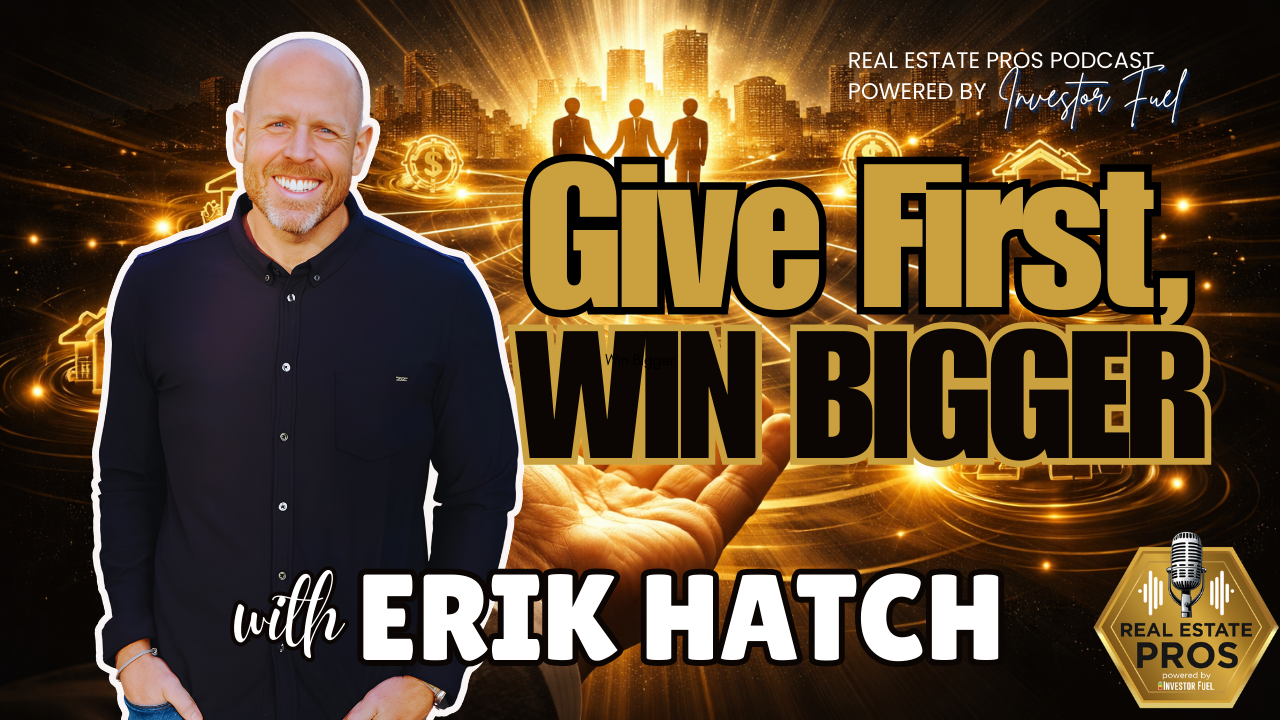
In this episode, host Scott Bursey chats with Erik Hatch, founder of Hatch Realty and a leading figure in the Fargo, North Dakota real estate market. Erik shares his journey from youth ministry to real estate dominance, explaining how his “first pitch people” approach and leadership philosophy built a top 50 national team. He discusses strategies for scaling a team without burnout, investing in single-family homes, leveraging relationship capital, and making a lasting impact both in business and the community.

Resources and Links from this show:
-
Listen to the Audio Version of this Episode
Investor Fuel Show Transcript:
Erik Hatch (00:00)
if you walk into any relationship and your intent is to give, you’re always going to have more than enough. But if you’re going to take, you’re going to be really limited on who you connect with. And so.Of course, that idea continues to reverberate in my soul is that this is a time to give. If you want great relationships, if you want great opportunity, you have to figure out how can you help somebody else reach their goals instead of them coming to work for you.
Scott Bursey (02:02)
Hi everybody and welcome to the Real Estate Pros Podcast. I’m your host, Scott Bursey. And today I’m joined by someone I’ve really been looking forward to chatting with, Erik Hatch. Erik is the force behind Hatch Realty and a legend in the 701 Fargo, North Dakota market. We’re talking to a man who successfully transitioned from youth ministry to real estate dominance. He is famously first pitch people approach.and his leadership skills and philosophy is the backbone of his massive success. Erik, welcome to the show.
Erik Hatch (02:41)
Scott, my brother from my neighboring states where I vacation to at my lake home all the time in Minnesota. ⁓ Bro, good to be here. Thanks for having me.Scott Bursey (02:51)
absolutely, it’s our sincere pleasure. I think our audience is really going to take something away from your ministry to market approach. You’ve built a top 50 national team, not by focusing on commissions, but by focusing on being a chapter in other people’s books. It’s a complete flip on the traditional eco-driven real estate model. Let’s dive in, shall we?So first off, for people who may not be familiar with your world, give us the short version. What’s your main goal these days?
Erik Hatch (03:32)
so it’s been a 20 plus year journey in real estate. was a part-time agent. Then I was a full-time agent. Then I started a real estate team at that same time. About 15 years ago, I started investing, recognizing like, this is like insider trading. I get a chance to have first dibs at a bunch of properties and opportunities. And, it was such a grand thing. And so, the investing that I’ve been doing in to real estate now has allowed me the opportunity to retire.46 years old. have no desire to retire whatsoever, but real estate has changed my life for forever. Got on to build a large real estate team in brokerage. have now I have a president that runs my day to day operations and so she is such a gift to me. But my real estate team is still cooking in Fargo, North Dakota and Bismarck, North Dakota and the Detroit Lakes area of Minnesota. So those are the three communities that we serve. And then I have been spending about the last decade as a real estate ⁓ consultant business coach.
and helping to accelerate people to really get out of the messy middle, right? Like, they gotta find out how do I transition myself from production into leadership without losing my money and losing my time and of course losing my peace. And so that is a gift set that I spend and I get to talk to people every day about money and about leadership and about real estate. It’s a pretty sweet gig.
Scott Bursey (04:54)
It doesn’t get much better than that or sweeter than that, as you put it. It’s just to know, Erik, what was the specific leading indicator that made you plant your flag in the markets that you just ⁓ indicated? Was it job growth, landlord friendly laws, just where the best margins were?Erik Hatch (06:02)
So I’ve grown up, born and raised in Fargo, North Dakota. It’s where the majority of my ⁓ investments are now. And so I think that you got to stick to the devil, let you know. And you understand the backyard. live ⁓ Fargo is a border city sharing a border with Moorhead, Minnesota. And so there’s ample opportunities on the Minnesota side as well. But there’s a lot more friendly ecosystems for investors in North Dakota than in Minnesota. And so outside of my lake home, ⁓all of my real estate properties that I invest in.
All the real estate properties I invest in are in the North Dakota area. And then I have a large Rolodex of opportunities now in Arizona and California because self storage has taken a lot of my dollars in time and attention as of late. But locally, I stick to what I know ⁓ and I understand the residential market for opportunities. It’s much easier to evict. It’s much easier to get support. And there’s not a whole lot of ⁓ extra red tape that’s going to slow down the process.
us.
Scott Bursey (07:07)
Certainly, love it. What caught my attention about you was the way you’ve been able to scale a team that functions like a family, but produces like a machine. You’ve cracked the code on retention and culture, Ensuring your agents can earn six figures without burning out or losing their souls in the process. That’s not easy, especially in today’s climate. What’s been the key to keeping that machine running smoothly for you?Erik Hatch (07:39)
You know, when it comes to, you said that we treat them like a family. I actually, try to stay away from treating people like a family because I can’t fire my sister.You know, ⁓ it’s hard to hold hard to hold blood accountable, but we do treat ourselves like a team, right? Teams have starting rosters. Teams have consequences. Teams have coaches. Teams have standards that everybody has to adhere to in order to be on that team. And that actually, Scott is the accelerator for so many things in my life. My team, my investing, my everything is that I have to follow standards. Most people treat standards like suggestions, their hopes, their wants, their
Scott Bursey (07:50)
I can’t argue with that.Erik Hatch (08:19)
wishes but a standard as a hard line in the sand saying listen I won’t allow anything underneath this standard if we can buckle up and if we can protect our infrastructure with standards and standards have to have consequences if you don’t have consequences you just have suggestions and I’m not interested in suggestionsScott Bursey (08:40)
And that’s the reason you were able to rise to the level that you have in the markets that you’re operating in. I tip my hat to you, Erik. It’s impressive that you’ve reached that level of autonomy. there a specific moment or a particular deal where you realized, okay, hey, this is working?Erik Hatch (09:01)
When it came to real estate sales, there are certainly moments when I was like.Oh, I can do this. People see this and believe in me. I remember the very first house I ever invested in. was 2012. It was a foreclosed property, $90,000. And I was afraid to go in and put even 20 or 30 % of my own cash down. Even though I had the cash, it seemed like such a giant leap. So I found some people to invest with. And all of a sudden, this $90,000 property, we put in probably $15,000 to get it up to where it needed to. And that $105,000 property,
That was renting out for 1300 bucks. I was like, oh, oh, OK, so there’s something here. And you start to develop a little bit of swagger and a little bit of confidence. And we just stuck to that same model. Scott, our model was this, is single family homes near our local university. And we knew that when kids would sign on the dotted line, the parents would co-sign with. And so we felt we had that extra level of protection that was there. And so we just did that. The houses didn’t have to be in great shape.
because the standard for a 19-year-old is far different than the standard of a family of four. And we weren’t trying to be slumlords. In fact, looking back in retrospect,
we should have done a better job at keeping the properties up because when it hits you then it’s like well I got $30,000 worth of work to do to this property and there goes all my profit for the last number of years. But the moral of the story is this, is we found one simple equation that made sense and that started to create consistency for us and I just repeated that. Every time I’ve deviated from that equation I’ve stumbled and fumbled but I found the equation that worked for us. It was never about taking cash out, it was always about
leaving cash in. So all of our notes are on a 15-year term and ⁓ we’re running with the same kind of single-family wash, rinse, repeat system.
Scott Bursey (11:31)
And it’s been a winning recipe. Now Josh, every operator I know has a moment where things got real. Maybe a deal that went sideways or a time that they had to pivot fast. You mind sharing one of those moments with us?Erik Hatch (11:34)
it has.Yeah, there’s always the old crafts, isn’t there? As I moved away from what I thought was the wash, rinse, and repeat, I was like, well, if this works on this $150,000 house, this will work on the $300,000 house. So I bought a house just outside of town on 6 and 1 acres, and it probably needed $100,000 worth of work. Well, the $100,000 turned into $200,000.
And the sales price I thought I could sell it for ⁓ ended up being $50,000 less. And so that’s $150,000 in unplanned money. ⁓ It then, the day it was supposed to close, two different times fell apart. So this thing was $150,000 in the whole for me. I had margin of about $50,000 on it. So really, overall, I was $100,000 in the whole on it. And then I made the decision, after not selling it twice, I was still
Emotionally exhausted with it that I accepted a bunk Contract for deed offer on it ⁓ and that took me six years to finally get out of that thing I got my cash out finally after six years this just happened this last fall I got my cash out begrudgingly with litigation with like all these other things because I I deviated from the plan and I went to something that looked opportunistic and instead it was so painful
you
Scott Bursey (13:15)
Erik, looking at your business today, what tripwire or system have you built specifically so that exact same misfortune can never happen to you again?Erik Hatch (13:27)
I have a great mentor in my life. His name is Brian Gubernick. Brian’s out of Scottsdale, Arizona, owns hundreds and hundreds of properties, understands wealth at such an exceedingly high level. And I asked him at an event that I was hosting, I or somebody else, I’ll give somebody else the credit, I’m sure they asked, but they’re like, hey, how do you know if something’s a good investment? And he said, if you show me one investment, it’s gonna appear pretty good, but I need you to show me five.I need you to give me consideration of the five things that you are most likely to invest in, and one of them will stand out. ⁓ If it’s the end of the bar, if I’m single, and it’s bar close at 2 AM, and there’s one girl in the bar, she looks pretty good.
But if it’s bar clothes and there’s five girls, well, now I’m going to figure out which, and don’t get me wrong, I was never that guy. I used to be in the ministry. I’m just using a very egregious example ⁓ of ⁓ how to make selections. But if you have choice, Scott,
If you have choice and options, that’s the tripwire that we’re gonna avoid. If it’s just one that we’re going after, and if we feel desperation in our business, desperation leads to terrible choices most of the time.
Scott Bursey (14:44)
It certainly can, and by the way, that was a great analogy. That’s the kind of stuff people don’t talk about enough to be quite frank with you.Erik Hatch (14:52)
takinggirls home from the bar. I’m sure lots of people talk about it, just not in our circles.
Scott Bursey (14:57)
But to pivot quickly on that one, Erik, and honestly, I must say it’s what separates the folks who just dabble from the ones who stay in the game long term. Let me ask you this. What are you most focused on solving or perhaps scaling next?Erik Hatch (15:18)
⁓ It’s a great question. Right now, I haven’t treated my investment business like a business. I’ve treated it like a hobby. giving part-time effort usually produces less than part-time results. I’ll use an example. Let’s say I want to hire an administrator for my team. And I’m trying to be cost-conscious. And so instead of hiring somebody full-time, I hire somebody to be 20 hours a week.commonplace, right? I think that if I invest 20 hours a week into an employee, I get 12 hours of return. Not 12 hours back into my life, but their 20 hours is actually only worth 12. Because there’s a dilution of momentum that is lost.
This game belongs to those that have momentum, Scott. No matter what game you’re playing, sales or investing or anything else, the more you focus on it, the more energy you give it, the more full-time push that comes to it, on the other side of that push should be compounded results. But if you give it a half-hearted effort, you get even less than a half-hearted result.
Scott Bursey (16:28)
Point well taken. Thank you for sharing that. What’s the next real goal for you, Erik?Erik Hatch (17:15)
So I’ve transformed much of my life ⁓ and the transformation has come from ⁓ investing in the relationship capital that I had never cashed in on. Now…I think I have a fair understanding of the dollars and cents and the brick and mortar that goes into real estate, having done this 21 years. I think I have a decent understanding. But I’ve been a student of people and human behavior for my entire life. I’m not ever declaring myself as an expert, but I am a passionate student. And I joined a company four and a half years ago called Real. Real is the brokerage that now is where my team operates. And I’ve been serving the real estate industry for the last 20 years.
And so a lot of people have followed my leadership and followed ⁓ my taking that first step. And now I’m at a part of this, I’m a part of this company called Real. And Real affords me the chance to ⁓ cash in on Relationship Capital. When I invite them to come and join, I get a piece of what they do. I’m like an angel investor in a sense. But I’m investing my time and I’m investing my energy into their success. But I don’t have any financial responsibility on the forefront. But I do have a whole lot of financial reward.
on the back end. And so I recognized Scott that I was sitting on a lottery ticket that I wasn’t cashing in because of relationship capital. And the same is going to be said about investing. The same is going to be said about whatever it may be. The next thing I’m building is on the other side of relationship capital. For me, again, I understand bricks and mortar. I understand dollars and cents. But I study people. And if I can find some key relationships with some right people, that’s going to change my forever.
Scott Bursey (18:58)
And that is the key. We see people chase doors of revenue all the time, Erik. For you, is that goal the destination or is it just the fuel that allows you to do something even bigger?Erik Hatch (19:13)
⁓ It’s undoubtedly the fuel that allows me to do something bigger. My goal, and you said it in the intro, is my goal is to be a chapter in as many books as possible. I wanna leave a lasting mark on this world. I’ll give you an example, Scott. My wife and I had our hearts broken 16 years ago ⁓ when we were staring human trafficking in the face. And human trafficking is the number two… ⁓money earner in the trillions of dollars almost. ⁓ Drugs are number one. Human trafficking is number two. Guns are number three, right? So pretty gross stuff that’s out there. And I was doing some mission work down in Haiti and at this orphanage these kids ended up being sold into the sex trade industry or murdered for organ harvesting. These were kids that I had held and spent time with and like I took it really personally because we should. Well now my wife and I are trying to grow the biggest business possible with the biggest impact possible with the biggest reach
possible with the most money possible ⁓ to not sit on the potential that God has given us but instead to step into the calling that we have.
for human trafficking and to fight it and to make sure that it doesn’t happen. And so we’re committing hundreds of thousands of dollars out of our own pocket every year, as well as using our voice to introduce other people to it so that this problem doesn’t continue to exasperate itself. Today there’s over 50 million people trafficked across the world and 12 million of those are kids. And I’m just taking that personally because I should.
Scott Bursey (20:43)
you should and I think our audience can really appreciate you taking your gifts and bringing them to the world. Especially when you already got the resource in place, Erik, ⁓ you know what you just described is pretty big. The next move can either compound things or create chaos depending on how you play it.Now, I know a lot of our audiences either earlier in their journey or is looking to level up. And I think they benefit from hearing this. When it comes to building relationships and growing your network, what’s made the difference for you?
Erik Hatch (21:24)
I have a business partner and a mentor. name is Ben Kinney.Ben is on the Mount Rushmore of like impressive real estate people. He is the CEO and co-founder of a company called Place. Place is a real estate team for teams. It’s an entire operating system. And in fact, Place and Ben own half of my real estate team. And Ben is absolutely brilliant and wise in all the things that he says. And so he came to me or I came to him with this idea of like, all right, based on everything you said, Scott, like how are we going to
scale, how are we going to grow? Actually, I need to apologize. I just lost your question. Can you ask the question one more time?
Scott Bursey (22:04)
Yeah, no problem, no problem.Erik Hatch (22:06)
I had the bandreference, I lost the reason why I was referencing it.
Scott Bursey (22:10)
Sure, let’s just discuss relationships for instance. Everyone says provide value, but when we’re starting out and you know a person doesn’t have a huge bank account, Erik, or a massive portfolio, let’s just put it that way. What was your currency? How did you actually get the attention of the bigger players in your industry?Erik Hatch (22:34)
Yeah, that’s really great. I have a relationship in my life. His name is Ben Kinney. ⁓ Ben’s on the Mount Rushmore of people in real estate. This really powerful, brilliant man who is worth billions of dollars. And Ben came and spoke at an event that I was hosting. And somebody had asked him a similar question. And he pulls out his wallet, and he starts walking around the room, and he’s handing out $100 bills to people. Guy hands out probably $3,000 worth of cash, unprompted, and nobody knew what he was doing.And so he finishes and he walks back up to the front and grabs the microphone. And then he simply says this. says,
if you walk into any relationship and your intent is to give, you’re always going to have more than enough. But if you’re going to take, you’re going to be really limited on who you connect with. And so.
Of course, that idea continues to reverberate in my soul is that this is a time to give. If you want great relationships, if you want great opportunity, you have to figure out how can you help somebody else reach their goals instead of them coming to work for you.
Scott Bursey (23:41)
totally agree and thank you for bringing those comments to our discussion. You just can’t fake that. And Erik, relationships are everything in this space. All right, before we wrap, if someone wanted to reach out, connect with you, maybe collaborate or learn more about what you’re doing. What’s the best way for them to contact you?Erik Hatch (24:04)
always hit me up on Instagram or Facebook. I’m at at real Erik Hatch. That’s Erik with a K at real Erik Hatch. Easiest way to find me and connect.Scott Bursey (24:13)
Perfect, well listen, I appreciate your time, your story, and Erik, definitely your perspective. We need more people in this space who are doing it the right way. Thanks again for being here. And for those of you tuning in, if you got value from this, make sure you’re subscribed. We’ve got more conversations coming up with operators just like Erik, who are out there building real businesses. We’ll see you on the next episode, everybody.