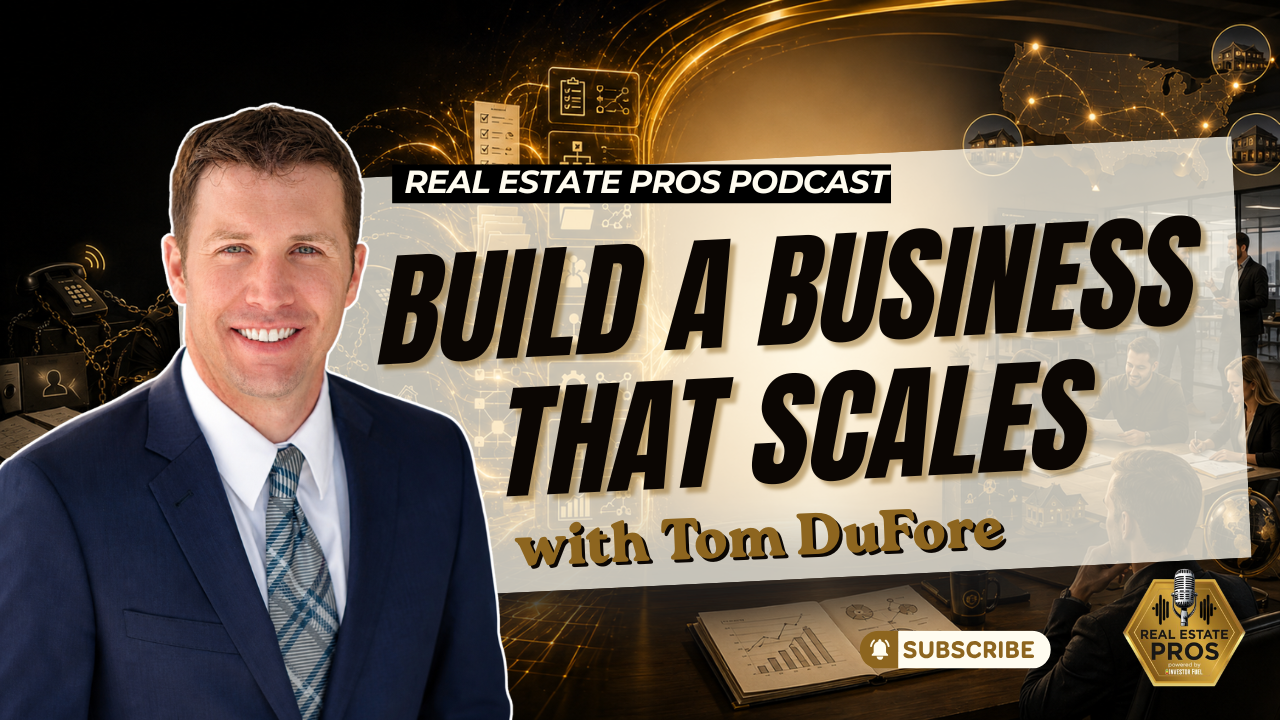
How Entrepreneurs Build Wealth Like Banks | Stack, Shield, Scale Explained
Show summary
In this episode, Christopher Hemmert shares his journey from traditional financial planning to founding the War Chest Principle, emphasizing the importance of principles, leverage, and serving others in wealth creation. Discover how he integrates biblical principles with business strategies to serve entrepreneurs and build sustainable wealth.
Key takeaways
- Hemmert left a full traditional financial planning book of business at New York Life to officially launch The War Chest Principle in November, choosing to work exclusively with entrepreneurs who have been in business five or more years.
- His core framework is Stack, Shield, Scale: fund a stable, compounding, liquid, leverageable asset (Stack); borrow against it only to acquire income-producing assets, never for lifestyle spending (Shield); then reinvest tax savings and cash flow back into the system to build velocity of money (Scale).
- He specializes in properly structured dividend-paying cash value life insurance, modeled on how institutions keep large portions of their portfolios in 3-6% 'boring' holdings because they prioritize return on liquidity over rate of return.
- The framework also incorporates HELOCs and securities-backed lines of credit as tools that mirror institutional capital architecture.
- He is shifting from one-on-one consultations to a one-to-many model via online sales funnels, launching an online challenge he expects to draw upwards of 100 participants.
- His governing business principle: if failure is not an option, you must structure like wealthy people and institutions who engineer certainty into their capital, rather than like consumers who merely hope for it.
- He credits daily study (nightly between 10pm and 1am for roughly six to seven years), staying close to coaches, and drawing on biblical principles as what has kept his business and decision-making on track.
In this episode
- 00:00Opening thought: structuring capital like a durable institution
- 01:56Introduction to Christopher Hemmert and The War Chest Principle
- 02:58What the business is and who it serves: entrepreneurs
- 03:45From New York Life captive agent to leaving traditional financial planning
- 06:52Walking away from his old book of business to start fresh
- 09:59Current volume and plans for an online challenge
- 13:13Principles first, then tools, then product: HELOCs, securities-backed lines of credit, cash value life insurance
- 16:25Teaching entrepreneurs to steward capital as a system
- 18:51The Stack, Shield, Scale framework explained
- 21:47Wisdom, coaching, and defining wealth as the ability to create value
- 24:10Relationships, service, and closing story about planting a 150-year tree
About the guest
Christopher Hemmert is the founder of The War Chest Principle, a business serving entrepreneurs with capital structuring strategies. He spent years in traditional financial planning as a captive agent at New York Life before officially leaving to start his own business in November of last year, now specializing in helping entrepreneurs structure capital the way financial institutions and wealthy families do, including properly structured dividend-paying cash value life insurance.
Listen to the audio
“Durable institutions aren’t paid to be optimistic. They’re paid to survive.”
Christopher Hemmert
“Wealthy people don’t avoid taxes. They avoid income. And leverage allows them to avoid income.”
Christopher Hemmert
“Wealth is one’s willingness and ability to create value for someone other than themselves.”
Christopher Hemmert
“I had to say goodbye to my entire book of business if I wanted to work with the individuals that I truly, really desired to work with.”
Christopher Hemmert
Questions answered in this episode
What is the Stack, Shield, Scale framework?
Stack is funding a stable, compounding, liquid, leverageable asset. Shield is applying leverage against that stacked asset solely to acquire income-producing assets (not for lifestyle spending), which protects against unnecessary taxable events. Scale is reinvesting the tax savings and cash flow back into the system to create velocity of money. Hemmert says this mirrors how financial institutions and wealthy families structure capital to grow through any economic environment.
Why does Christopher Hemmert focus on cash value life insurance?
He specializes in properly structuring dividend-paying cash value life insurance, not for the death benefit but because it helps mirror how financial institutions structure their own capital. He notes institutions keep an overwhelming majority of their portfolio in what consumers would call low-yield, boring holdings (3-6% returns) because they prioritize return on liquidity over rate of return.
What's the difference between how consumers and wealthy people/institutions use leverage?
Most individuals leverage for consumption or lifestyle purchases. Wealthy people and institutions borrow only to acquire income-producing assets, following the principle 'you borrow for income or you don't borrow at all.' Hemmert says wealthy people don't avoid taxes, they avoid income, and leverage is the tool that lets them do that.
When did Christopher Hemmert start The War Chest Principle and what's his background?
He has been an entrepreneur since 2017 and spent years at New York Life in traditional financial planning. He began unofficially sharing contrarian, non-traditional advice while still a captive agent, then officially severed ties and launched The War Chest Principle in November of last year, after which he gave up his entire prior book of business to work exclusively with entrepreneurs.
How does Hemmert define wealth?
He says wealth is not money, it is one's willingness and ability to create value for someone other than themselves, and the more people someone can create value for, the greater their wealth becomes. He illustrates this with a deserted island example where a trillion dollars is worthless against someone who has water or the ability to hunt.
What is Hemmert doing to scale his business now?
He describes his client book as still small since officially launching in November, but he is building leverage through online sales funnels instead of one-on-one consultations. He is hosting an online challenge the following month and anticipates upwards of 100 people joining.
Resources and links
Full transcript
Christopher Hemmert (00:00)
Durable institutions aren’t paid to be optimistic. They’re paid to survive. If you could not be wrong, if you couldn’t afford to be wrong for the next 30 years, if you have people depending on you, employees, family, and if you cannot afford to be wrong for the next 30 years, how would you structure your capital? So let that hit people on the way home.
Joseph Crooms (01:56)
Hey everyone. Welcome to Investor Fuel Real Estate Pros Podcast. And today I have Christopher Hemmert. And Chris, did I pronounce your last name correctly?
Christopher Hemmert (02:09)
No one does, but you got real close. Well done.
Joseph Crooms (02:11)
Real, him. Hemmert. There you go. Hemmert. Yes. Thank you so much. I’m your host, Joseph Crooms. Today I’m joined by someone I’ve been looking forward to chatting with. Christopher, who’s making some serious moves in the business. I’m trying to really grasp my head around it. So the best person to answer is to go to the horse’s mouth. So he’s gonna answer that for us. So Chris, glad to have you here. Say hello to everyone.
Christopher Hemmert (02:35)
Hello everyone. My hope is that you get a ton of value out of our conversation. I’m thrilled. I really am thrilled to be here. So thanks for having me.
Joseph Crooms (02:46)
Sounds good. Chris, I think our listeners are really going to take something away from how you’re approaching business. So tell me exactly the name of your business and what’s your niche.
Christopher Hemmert (02:58)
Sure. So the name of my business is The War Chest Principle. And I serve entrepreneurs. I’ve got a deep soft spot in my heart for entrepreneurs, obviously, because primarily I am one. And so I already know so much about entrepreneurs. If they can tell me that they’ve been in business for five years or more, then I already know so much about the pain that they have endured. I already know so much about the difficult conversations that they’ve had to have with their spouses. Like I’m drawn to these people because I feel like they’re my brethren.
Joseph Crooms (03:34)
Let me ask you this. When did your business kick off? How long have you been kicked off the ground? You’re off the ground, off and running. How long has that been?
Christopher Hemmert (03:45)
That’s a good question. You know what? I had my inauguration this year. So I’ve been an entrepreneur since 2017. I haven’t taken a paycheck since 2017. I decided to bet on myself and to seek wisdom everywhere that I could, and I went out on my own in 2017, beginning in the financial services industry. And after having been in that industry for quite some time, I just had an awakening. I had an awakening that told me that what we were taught in traditional financial planning was never gonna set anyone free, man. And so I had this awakening and it became important to me to not become rich for becoming rich’s sake, but I began to obsess over understanding how wealth actually works. Because I really wanted to create wealth so that I could become valuable and show other people how to do it. And so that journey began around 2020. And my wife will tell you—and this is the last thing I’ll say, and then I’ll hand it back off to you—is that my wife will tell you that if you wanted to know what I was doing on any given night of the year for 365 days out of the year between 10 p.m. and 1 a.m., she’ll tell you I was studying. And that was all that I was doing because I really wanted to become useful and valuable and to be able to serve folks. So there you are.
Joseph Crooms (05:26)
So you’re a guru per se, for all—and if you don’t like the word, you can correct me, so I’m wide open. But you study to show yourself approved for entrepreneurs and you have a heart for them. I’m trying to gather this question. When did you actually launch your business?
Christopher Hemmert (05:52)
Well, I began to offer contrarian advice that wasn’t traditional financial planning while I was a captive agent within a particular firm. I worked at New York Life. And I don’t have a single disparaging thing to say about New York Life. They gave me some great training. They taught me systems. But I unofficially began servicing and sharing advice and guidance on the things that I teach now when I was at New York Life. But it wasn’t until I officially severed ties last year that I officially then began my business right after that. So my official business began in November of last year. So if earlier I said this year, I accidentally misspoke. It was in November of twenty twenty-five.
Joseph Crooms (06:52)
And when you left the financial engine, where’s your book of business at? And now that you’ve been a year, where’s your book of business now?
Christopher Hemmert (06:59)
Well, my book of business was all traditional financial planning. I mean, just because traditional financial planning is no longer where my heart is doesn’t mean that you can’t get really good at it. And so I would like to think that I was well-rounded and that I was, you know, pretty slick at being able to show individuals how to do some pretty creative planning.
Joseph Crooms (07:25)
Yeah, so when you left the financial industry you say, “You know what, I’m gonna start my business.” Where did you—are you still handling a book of business from that also, or what was your financial like and or volume revenue that you had?
Christopher Hemmert (07:40)
That makes sense. Okay, so I’ll bet you a lot of your listeners will be able to completely understand this. I had to say goodbye to my entire book of business if I wanted to work with the individuals that I truly, really desired to work with. Now, for any of the clients that I used to have who might hear this, I hope that they hear that with the right mindset and they receive that with the right heart. I desired to work with people who were creative and who had done things that would be frightening and terrifying to most people, you know, risking it and going out on their own and doing their part and serving the world and innovating and, you know, bringing light. Entrepreneurs are amazing. They have to deliver so much more value than they receive in the form of compensation. This is like—this is God’s mechanism for creating wealth. You have to serve so hard in order to enrich yourself. So my current book of business is entrepreneurs. And I would be misstating the truth if I said I had an enormous book of business because I have embarked exclusively on working with entrepreneurs. And so I’m in my business’s infancy. The strategies, the principles are timeless and they’ve always been around. But my business has only recently, or as of November of last year, begun serving people with those principles.
Joseph Crooms (09:59)
Okay. And this is the last volume question I’m asking. What is your volume that you’re doing on a monthly basis now? How many—
Christopher Hemmert (10:08)
When you say—okay. All right. So I’m having to be mindful of how everyone might hear this, but I’m gonna be extremely honest with you. I have said goodbye and I closed the door on the type of business that I was writing. I let go of something of a lower nature so that I could grab ahold of something of a higher nature. And so I’m sharing that with you, and I’m hoping that your audience will give me some grace in that I have begun acquiring clients officially only as of November. So my book of business is small. I mean it’s technically small, but it’s going to—it is going to blow up this year because I have not only been leaning on the truth about everything that I’m sharing, but I have been studying how to incorporate leverage into my business and to serve more people than I ever would have been able to by studying online sales funnels. And so the volume is not where I would want it to be, but I’m telling you, Joseph, I mean, this next month is the month. So I’m hosting an online challenge and that begins next month. And so I anticipate having upwards of a hundred people joining my online challenge. And we can elaborate on that later if you’d like.
Joseph Crooms (11:45)
Why the online funnel education?
Christopher Hemmert (11:49)
Well, it is my deep-seated belief that we were made by a creator who is separate from time. You know, God didn’t appear on the scene on, whenever the first page of Genesis was written. He had already been around forever before that. And so we are called to be more and more like our creator every single day. If that’s the case, then I have to believe that I am supposed to become more and more like God every day. And if that is the case, I have to separate myself from time as much as possible. So, with that being said, I look for leverage in every single area of my life. And this is no exception. In the Bible, in Ephesians chapter 5, verses 15 through 16, it says: “See then that ye walk circumspectly, not as fools, but as wise, redeeming the time, because the days are evil.” Long story short, that just means wake up, be aware, buy your time back, rescue it from loss because life is hard. And so online sales funnels offer me the opportunity to serve far more people than I ever would have, and that I ever did selling one-on-one with my consultations the way that I used to. This is essentially a one-to-many model. So I seek to serve at a higher and higher level. I hope that answers your question.
Joseph Crooms (13:13)
Christopher, what does your table of contents look like that would cause people to take interest in your—
Christopher Hemmert (13:21)
In my product.
Joseph Crooms (13:22)
Yeah, what is the table—you got the online following, but what is the—if I had an open book, what would that table of contents look like that would capture my interest?
Christopher Hemmert (13:34)
Well, we teach principles first, then tools, then product. So in my business, there is a governing belief. There is one single governing belief. And the governing belief is: if failure is not an option, then one must structure like wealthy people and financial institutions, not like consumers. Because wealthy people and institutions structure and engineer certainty into their structure, whereas consumers hope for it. So what we do is we engineer certainty into people’s capital architecture. We engineer certainty so that when pressure shows up or when great opportunities show up, they can move. So you asked about product. I’m not trying to dodge. In fact, I’m extremely excited to talk about it, but we address principles first. And so how do we implement that into our business? Well, we use various products. And so we can advise individuals on how to incorporate all sorts of things into their life, but we show individuals how to essentially incorporate a framework that models precisely how financial institutions operate. HELOCs fit into that, securities-backed lines of credit fit into that, dividend-paying cash value life insurance fits into that. I specialize in properly structuring dividend-paying cash value life insurance policies, not because of the death benefit—and this is something you’ve heard a million times, but because—I’m sure you’ve interviewed individuals who do this—our approach is so unique because what it does is it helps, it serves, and it lends to mirror and almost identically reflect the way that financial institutions structure their capital. If you study financial institutions, you’ll find that an overwhelming majority of their portfolio is in holdings that most consumers would say is really low yield and really boring. Three to six percent rates of return. Now, why would they do that? Most people would say that that is lazy, but they do that because they don’t care as much about rate of return. They care about return on liquidity, what that money can afford them to do. So we show people how to mirror and reflect the capital architecture of really wealthy people, family offices, and institutions. So cash value life insurance is the area that I specialize in.
Joseph Crooms (16:25)
Thank you for sharing that. So how do you reshape a consumer’s mind with the principles? What are some of the principles that you teach?
Christopher Hemmert (16:34)
Well, entrepreneurs are far easier to educate on this because they already know how to create value. They wouldn’t be in business if they didn’t. But what they may not know is how to manage and steward the capital that is created. They may not know how to steward and capture the capital and make it into a system once it’s been produced. So traditional financial instruments involve things like bank accounts and brokerage accounts. But we just don’t teach that because that’s not a system. If an entrepreneur looked at any area of their business that had a system in place, and if they removed those systems, everything would devolve into chaos. Because they’re looking for systems, because systems scale, man. That’s the whole idea here. We’re trying to scale. Now, they may have a system around how to create wealth, but they may not have a system around how that wealth is governed. So we show people how to scale a wealth system.
Joseph Crooms (18:15)
So Christopher, what you say makes a lot of sense. And so you say the consumer is looking to scale, but the financial institution—tell me if I’m wrong—they’re looking that if I scale, how is that gonna give me money to reinvest? Is that correct?
Christopher Hemmert (18:33)
A hundred percent. You’re a great listener.
Joseph Crooms (18:35)
So how do you shape the entrepreneur that’s so busy scaling? What are the first lessons that you take them to? Can you sort of take us to that to show them, “No, you’re looking at it wrong”?
Christopher Hemmert (18:51)
Well, I understand the question, but I have to respond with a bit of a nuance because as you very well know, and you’re likely an expert on this because you talk to so many dynamic, really great people who’ve bet on themselves and, you know, the bet has worked out for them. So like, you deal with a lot of entrepreneurs and I’m kind of jealous of your situation. I wish I was talking to entrepreneurs all day long like you. At any rate, there is a simple framework inside of our business. And it’s called Stack Shield Scale. Now, what this shows is it shows the framework that institutions use to make sure that they grow through any economic environment. And if you asked any of the entrepreneurs inside of your audience, if you asked them to raise their hand to show that they have had growth years, year after year, since they’ve been in business, most individuals would not be able to raise their hands. But there is a model that financial institutions use that can support that reality. There are companies that grow like clockwork despite the world being on fire. And so the framework is Stack Shield Scale. Stack is where you fund a stable, compounding, liquid, leverageable asset. Shield is where you apply leverage and you leverage the stacked asset that you have funded. So you leverage it for only one reason. Most individuals leverage for consumption, for lifestyle. They want to buy stuff they like. I’m not mad at them, but that’s just not the way wealth is created. Wealthy people understand you borrow for income or you don’t borrow at all. So leverage is where one creates—you know, they essentially apply leverage for one purpose, and it would be to acquire income. And so the shield element, it protects from unnecessary taxable events. Wealthy people don’t avoid taxes. They avoid income. And leverage allows them to avoid income. And so that’s the only purpose for leverage, then, is to acquire income-producing assets. So we’ve got Stack, then we’ve got Shield. Scale is where one reinvests the tax savings and the cash flow back into the system so that velocity of money is thereby created. Stack Shield Scale. And it won’t take long for somebody to just do a quick ChatGPT search to find out and corroborate that this is in fact how institutions and wealthy people have created wealth for generations, eons.
Joseph Crooms (21:47)
Chris, I was listening more and didn’t want to be disturbed from what you were saying. What’s the key to keeping your machine running smoothly through the next 12 months?
Christopher Hemmert (21:57)
Staying close to my coaches, seeking wisdom daily. You know, the Bible says that the principal thing is wisdom. And so and it also says, though it may cost you all that you have, get understanding. So what’s going to not only keep things afloat but help things thrive is just the daily adhering to coaches who can help me see things that I just can’t quite see yet. And staying close to my creator. And so, wealth—I promise this is answering your question, but wealth is not money. A lot of people—this may sound contrarian and I don’t mean to ruffle any feathers, but wealth is just not money, you know. Wealth is one’s willingness and ability to create value for someone other than themselves. This is made super evident if you use the deserted island reference. You can have two people on an island. If someone’s got water and you’ve got a trillion dollars, you’re not going to be able to get that water with that trillion dollars because it’s no longer worth anything. It has no intrinsic value. But if you can hunt, well, you see, that’s how you get the water. You can create value for that gentleman. So everyone’s wealth is in their ability to create value for other people other than themselves. And to the degree that somebody can create value for a greater number of people, one’s wealth becomes greater and greater. So what is going to make everything work seamlessly, Joseph? Wisdom. Wisdom is the application of truth, wisdom is skills. I’m just gonna be looking to knock down skills every single night like I have been for the past six or seven years. That is the best answer that I can give you, man.
Joseph Crooms (23:45)
Great. No, this is for our listeners. So the next move can either compound or create chaos depending on how you play it. Now I know a lot of our listeners are early in their journey, looking to level up. I think they’re going to benefit from hearing this. When it comes to building relationships—you sort of alluded to it—and growing your network, what’s made the biggest difference for you, Christopher?
Christopher Hemmert (24:10)
Man, I really need to take this opportunity to give you a serious compliment that I just can’t move on before I say it. Man, you’re so good. You’re so good. I can feel that your answers are genuine and you’ve gotten really good at listening and fielding questions. So I’m proud of you, man. I’m proud of everything that you’ve accomplished over there. My wife used to roll her eyes whenever I used to say that billionaires have the best thoughts. She used to think that that sounded disgusting. “What are you talking about?” Well, you know, billionaires have found more elegant solutions to people’s pain and problems than millionaires have. And they’ve done it at scale on a larger scale than millionaires have. So if I have the opportunity to get advice from either a millionaire or a billionaire, well, it would make obvious sense to me to seek the advice of a billionaire. Now, the reason I’m sharing that with you is because what nobody told me and what I had to learn the hard way when God brought me to my knees about four years ago was that He has all the best ideas. Nobody told me how detail-oriented the Bible was about everything that we needed to know to have the best life possible. I always thought, I always teased Christians by saying, “You have to give up so much. How do you deal with it, man?” But that was so naive, man. And what I discovered was that if billionaires have the best thoughts, God’s got zillionaire thoughts. And so when it comes to relationships, what I found is that God is right. King Solomon, the richest and wisest man who ever lived, prayed a prayer that pleased God. And God gave him not only what he asked for, but He also gave him what he didn’t ask for. And the prayer that he prayed was basically saying, “Lord, thank you for the mission that You’ve given me and all the people that You’ve trusted me to serve. I pray for the wisdom and the heart to be able to rule righteously over this mission that You’ve given.” And so what has helped with my relationships is changing the focus that’s in my mind, which causes a different feeling in my heart, which translates into different behaviors with the members in my body. So my focus is serving folks. And I know that sounds so cheesy to so many folks, but that’s the only answer I got to that, is that God showed me that if I focus on other individuals, if I focus on Joseph and I give him all I got, then what will likely happen is that riches will likely follow. But that’s not a guarantee. But the model in the Bible shows that that is what someone can likely expect. Now, again, that’s not supposed to be the motivator, but my focus is on serving people at the highest levels possible. I’ve never run a national business, or at least not yet, but God knows exactly how to do it. So I pray every day, “Lord, I pray for the wisdom to serve all of these clients and all the future clients in a way that’s honorable and pleasing to You.” And so that has made the biggest difference in the way I serve my clients. And I serve my wife, my kiddos, and hopefully how I might serve you in some form or fashion in the future. So that is the thing that has made the biggest difference in terms of how I see the world and interpret reality. Does that make sense?
Joseph Crooms (28:18)
Yeah, makes a lot of sense, Chris. So Chris, unfortunately, we’re down to the wire. This has been really great. You can’t fake that. Relationships are everything in this space. Thank you for sharing that. All right, before we wrap up, if someone wanted to reach out, connect with you, maybe collaborate or learn more about what you’re doing, what’s the best way to reach you? And also, Chris, once you say it, I’m telling you, someone’s gonna be looking for a pen once you complete it. So say it twice, okay?
Christopher Hemmert (28:47)
All right. So let me just say: Durable institutions aren’t paid to be optimistic. They’re paid to survive. If you could not be wrong, if you couldn’t afford to be wrong for the next 30 years, if you have people depending on you, employees, family, and if you cannot afford to be wrong for the next 30 years, how would you structure your capital? So let that hit people on the way home. But what I would say, though, is that they can reach me by going to my landing page, which is at warchestprinciple.com. And there they can learn a lot about my business and they can feel me out. They can size me up. But I would say, yeah, so warchestprinciple.com. I also have a YouTube channel where people can get to know me a little bit better and figure out for themselves if I know what I’m talking about. And the name of that channel is The War Chest Principle. My handle for YouTube is @ChristopherHemmert. Now may I say one more thing, sir?
Joseph Crooms (31:20)
Sure.
Christopher Hemmert (31:21)
All right. So life is short. Even if you have a long, long life, life is short. With that being said, I’m reminded of this story. And it’s in this James E. Hughes book. It’s called Family Wealth. And in this book, the author talks about this gentleman who was a marshal for Napoleon. And the name of the gentleman, his name is Lyautey. He’s looking out over his amazing garden. And I believe it’s his gardener standing right next to him. And Lyautey says something about birch or there’s a particular tree or a plant that he wishes that he had in his garden. And the gardener tells him that if he decides to plant it, it’s gonna take 150 years before it matures. Now, see, Lyautey knew that he wanted that tree. Most people would say there’s no point in doing that because I’m not even going to be around to see it. But see, his response was, “Let’s begin immediately.” So he took violent, immediate action. Because whereas most people would say it’s not worth it, entrepreneurs know that they understand things like the future value of money, time value of money. Like, the best time is now. Speed is capital. And so if one wants to really put themselves in a position where they won’t—if they can’t be wrong for 30 years, man, then they have to be aggressive and they have to violently address their structure because the tree needs to get planted now. So with that being said, yeah, warchestprinciple.com, and my YouTube channel is @ChristopherHemmert. I had a blast. I would love to have asked you questions. I think you’re the man.
Joseph Crooms (31:43)
Thank you, Chris. Thank you for this. I really feel you’re sincere. Chris, thank you for being here. This has been great. You did a wonderful job explaining because you don’t know the value that people got to one, strike interest in your business in this way, and also just thank you for being here. And for those of you tuning in, I know you got some value listening to Christopher Hemmert. We got more conversations coming with operators just like Chris, who’s out there building real business, but helping real people and communities. We’ll see you at the next episode of Investor Fuel Real Estate Pros Podcast.