Subscribe via:



Show Summary
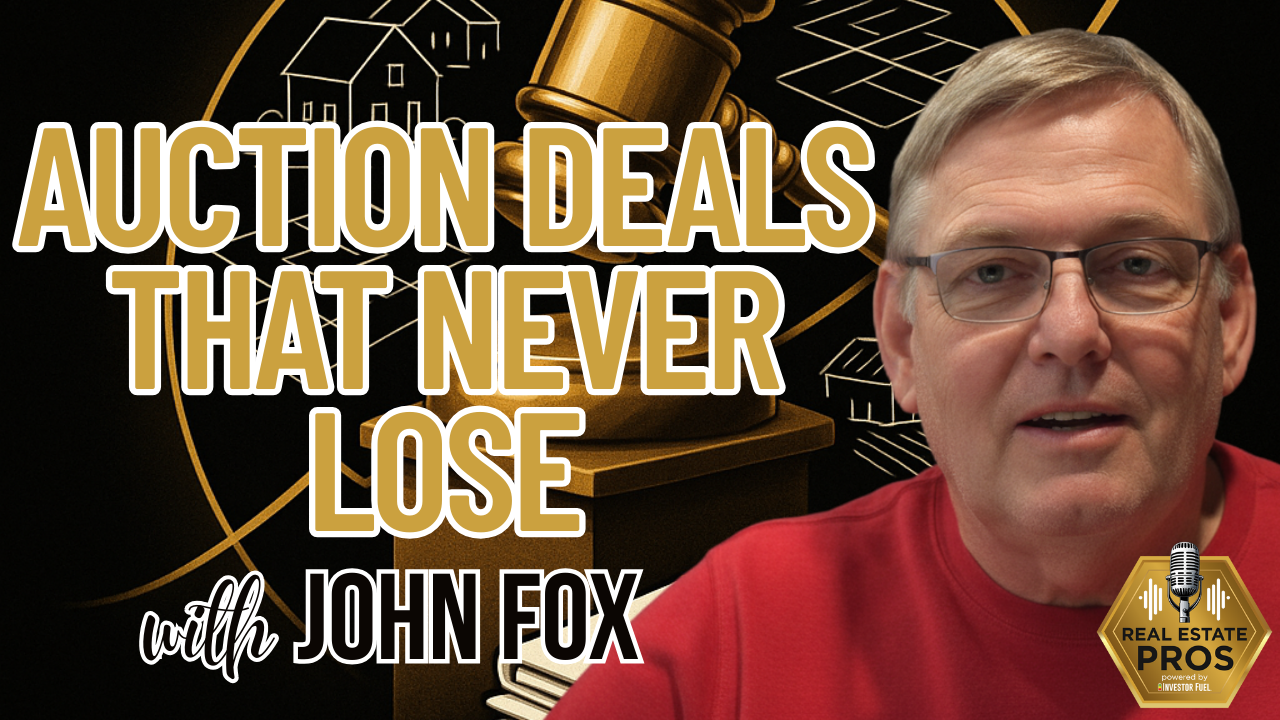
In this episode of the Real Estate Pros podcast, host Michelle Kesil interviews John Fox, a seasoned real estate investor with over 33 years of experience in buying properties at auctions and flipping them for profit. John shares his journey from being a broker at Merrill Lynch to becoming a full-time real estate investor. He discusses his auction strategies, the importance of flexibility in investing, and how to identify market opportunities. John also provides valuable advice for aspiring real estate investors, emphasizing the need for due diligence and understanding market dynamics.

Resources and Links from this show:
-
Listen to the Audio Version of this Episode
Investor Fuel Show Transcript:
John Fox (00:00)
And three days after the auction, he came back and said, tell you what, I’ll give you a low ball offer of 140. And so I ended up selling that property at $140,000 that I had bought at $42,500 three days earlier at auction. That is when I decided to quit Merrill Lynch and go to work just buying and selling real estate. Since that time, I’ve had2049 transactions. My best year was 2009 where we bought 209 houses. But overall, say 2049 transactions. I’ve lost money on four transactions. 2045 I’ve been profitable deals. And it’s because when they go to auction, they go cheap.
Michelle Kesil (02:15)
Hey everybody, welcome to the Real Estate Pros podcast. I’m your host, Michelle Kesil Today I’m joined by someone I’m looking forward to chatting with, John Fox, who has 33 years of experience buying real estate at auctions and flipping them. So excited to have you on the show today, John.John Fox (02:34)
Thank you.Michelle Kesil (02:34)
Yeah, I think our listeners are really going to take something away from your auction strategies and yeah, how you have made profit and understood the real estate game from this lens. So let’s dive in.Yeah, first off, for those not familiar with you and your world, can you share a little bit about yourself?
John Fox (02:57)
Sure. I used to be a broker at Merrill Lynch and back in 1991 I had a little bit of money to invest. I bought some real estate, made some nice profit and decided that I found a niche that was worth exploring. So I started buying real estate in…my portfolio, I added a few of my friends. In 1991, my first big auction was, I remember it still, July 1st, 1991. I bought a few different properties and…
just did extremely well, well enough that I decided to retire from Merrill Lynch and just do the real estate full time. Just to give you an idea, in that very first auction, we bought 11 properties. One property was for sale at $170,000. It originally was for sale at $270,000, but Ronald Reagan came out with the Savings and Loan Act of 1988 and destroyed savings and loans. So lot of them went bankrupt.
And land especially was very, very hard to get rid of and prices were dropping rapidly.
So a man had purchased a piece of property for 270,000. It went down to approximately 170,000. He lost the property. It went to the FSLIC, which I know a lot of your younger viewers have not heard of the FSLIC. They know FDIC. But FSLIC was savings and loans. FSLIC was closing banks so quickly that they set up a department called the Resolution Trust Corporation.
that was selling all these properties. Resolution Trust put this property for sale at $170,000 because that’s what it was worth back then. They couldn’t sell it.
They put it in an auction, absolute. That was the auction I went to on July 1st of 1991. It was one of the 11 properties I bought. The property, they wanted to get 200,000, then 150, then 100, and you know the way auctioneers work. They just keep going down until they get an opening bid. Finally, a guy opened the bidding at 30,000. Someone else did 35,000. The first bidder said, I don’t want to bid more. Now, I knew it was worth about 170.
So trying to get the best deal possible, I gave the sign that says I’m only gonna give you half instead of going to 40, I’ll go to 37.5. The other bid went to 40, I went to 42.5 and I won the property.
The very next day I called the realtor that had it listed, and this is part of my due diligence that I know what I’m bidding and what values are. I called her and said, hey, I bought the property. Let’s try to list it and see if can get it sold. She called the man that had it at 270 and said, look, it’s only worth 170. Do you want to buy it back? He couldn’t buy it at auction. He was disallowed, but he could buy it from me.
He then said, well, I don’t want to pay 170 for it.
And three days after the auction, he came back and said, tell you what, I’ll give you a low ball offer of 140. And so I ended up selling that property at $140,000 that I had bought at $42,500 three days earlier at auction. That is when I decided to quit Merrill Lynch and go to work just buying and selling real estate.
Since that time, I’ve had
2049 transactions. My best year was 2009 where we bought 209 houses. But overall, say 2049 transactions. I’ve lost money on four transactions. 2045 I’ve been profitable deals. And it’s because when they go to auction, they go cheap.
And now if it’s a single auction, a lot of times they won’t go. If you go to a trustee sale nowadays, you know, they’ve got opening bids and there’s a lot of competition. But the bigger auctions, they always gave me great profits and.
I’d go into an auction of 400 properties sometimes back in the good old days, and I’d bid on 250 of the 400 and I’d come out winning 30 properties. So I didn’t win a lot of what I went in for, but everything I won I made good profit.
Michelle Kesil (07:46)
Amazing! What an incredible story that is quite a unique experience that you’ve had.So what does the next step look like after you buy these properties?
John Fox (07:55)
After I the properties,In the old days when it was mostly land, I would just put it right back up. I would do my research before the auction. The auction had, and I’m going to round it down to 100 properties. If it had 100 properties and I was bidding on 60 of them, would take me a month and a half to get my true values on all those properties. And I would know what, I have a local realtor. I always use either realtor.com or just some other source to get a local realtor who knows the market better than I do so I could do this.
nationwide. I’ve owned in 28 states and they would tell me what a property was worth at that time. I don’t care what it was worth when it went in the foreclosure. I don’t care what it’s gonna be worth in three years. What’s it worth today? I’d find that price. I’d do my formula, extrapolate backwards to what I was bidding. I would buy it. Very next day I would call that realtor back up and say let’s put it back on the market at a little bit less than that realtor told me it was worth and we just flip it.
Now once I went into houses, which I really started to buy houses in about 2008 because there was another crisis and the crisis happened to be houses. I would do it a little bit different in that I had to repair some of the houses. Some of the houses had 5,000. Some of the houses had 30 or 40,000 repairs that needed done. And of course that was put into my bid. But I hired a handyman in 2009. I still have that handyman working for me.
time ⁓ just because I treat my people well, I treat him well, and he does a good job. So I fix the houses up and then we turn around we flip those houses.
In 2009, I decided there were some houses I wanted to keep because I knew the market was starting to go back up. So I started to keep some rentals and I had five rentals, then 10, then 20, then I bought 30 at one auction and I kept growing. I got up to 121 rentals at one time and I had four different property managers that I was using at about 30 houses a piece. And then I started to sell those off. Today, I only have 11 houses left in rentals.
and I just kept them. I sold most of them in 2020 to 2022 because housing prices really screamed up. So I’m still buying houses, I’m still buying land, I’m still buying widgets as I call them, whatever works. And I flip them is what you asked what I do after I flip them and I sell them off.
Michelle Kesil (10:24)
Awesome. What do you feel has made like the biggest difference in being able to run this business successfully?John Fox (11:08)
Biggest thing I think I’ve done and I find it to be rarity is I’ve been flexible. I mentioned to you, I bought land in 1991 all the way to about 2000. I bought land. In 2000 to 2006, I bought land in the mountains of Arizona. I moved from Colorado to Arizona for…the land deals and I would buy 10 and 20 acre pieces of property and split them five ways because in Arizona you could do a five way split without a subdivision. And I sold them at a much higher price per acre because there was less acres. And so I did that. Then I started to do houses as I say in about 2008 is when I really started to do houses. There’s been other things that I’ve done and I find that people come up to me and say, John, I want to buy single family houses. How do I do it?
And I give them the same advice every time. Don’t buy your desired asset. Single-family houses, commercial real estate, whatever. Find what is working and buy that.
Back in 2001, I went to an auction in Florida and at the end of the auction, they auctioned off 40 timeshares. Now timeshares today you can buy them on eBay literally for $25, but back then you could buy them for about $2,000. But this was an auction of 40 of them all in the Florida Keys, all on 10 units that were over the water in little bungalows.
The first round you could buy one, you could buy two, you could buy ten, you could buy whatever you want. The first round everybody was afraid to buy. I didn’t even research the timeshares, but I knew they would sell for $2,000 approximately back then. I ended up winning the first round at $800. By winning the first round at $800 he asked how many I want and I said I’ll take them all. I took all 40 of them.
That day I sold seven of the 40 to other people that were in the audience that were afraid to bid and wanted to buy and knew that they could get them at less than $2,000. So I just said $1,500. Who wants one who was too afraid to lift their hand? And I sold that day properties at $1,500 that I bought at $800 before I left the tent where they were selling.
So you’ve got to buy what is making money. Not what you want, but where the money is being made. Right now, I can’t make a lot of money on land. There’s just not a lot of good deals. What little bit of land is out there is selling close to retail. So I don’t buy it. You know, I still do trustee sales in certain counties because I’m able to buy there. Other counties I can’t. But you need to buy what makes sense no matter what it is. ⁓
Michelle Kesil (13:52)
Wow, that’s fascinating. Definitely some good advice. What are you most focused on now? Like is there something that you are focusing on buying or scaling to?John Fox (14:01)
Right now, I’m actually sitting on significantly too much cash and significantly too little real estate. So I’ve been putting money out in hard money lending to people that are buying at these trustee sales and they’re buying it at prices that I don’t think they can make enough money. They’re buying, I know people that are buying at the trustee sales because they think they can make a $10,000 profit and if they can flip six of them a year, they can make 60,000 a year.But making $10,000 on 200,000 invested or 300,000 invested is not enough for me. So when they buy it, I turn around and lend them the money to do the purchase. And I charge 12 % a year. I normally have six-month balloons. If they go into default, it goes up to a higher rate. And I’ve been putting money out on the street, hard money. In the meantime, I’m always looking for deals. A few years ago,
I bought a bus because a city whose name I won’t mention here bought and expand the bus, first one in their city, and then they decided their city streets were too narrow for that bus to make some of the corners. So they decided to auction the bus back off, and they auctioned a bus off that had 42 miles on it, and it sold for pennies on the dollar because nobody wants to go buy a bus. I did my due diligence.
Again, key words, due diligence, know what you’re buying and what your price is going to be. Put it in ink, not in pencil. I went to the auction, said, what the heck? If I can make money out of it, I’ll do it. I bought the bus. I hired a girl from the youth group at my church to do some cold calling to other cities that had expandable buses. Took us three weeks to sell that bus. And we little bit more than quadrupled our money in three weeks.
because the city that bought it paid less than they would have for theirs. They had to get an approval to do so, which took a little bit of time, but they got it done. And we made money. I have no desire to own a bus, especially an expandable bus. Make money where you can find it, not where you have your plan and you try to make your plan work. Be flexible. Buy what makes a profit.
Michelle Kesil (16:11)
Yeah, well, that’s awesome. How can somebody know what would make them money?John Fox (16:58)
The best way to know what makes you money is to look around and see what is having a problem. Right now, housing prices aren’t really having a problem. But I hear in Florida, condos are having a problem right now.Why? Because of the law that they put into effect after that condo collapsed that says that condos have to shore up their foundations if they’re older than a certain time period and they have to fund their HOAs fully or their COAs as they call them and therefore there are condos that are worth 350,000. They’re getting $150,000 fees against them. One-time assessments and those people just don’t know what to do. So the condo market all of a sudden
and has just grown like crazy in Florida. Nowhere else but in Florida. So you look in the news, I’m constantly looking to see what’s going on and when I see things like that, I go into that market and I start buying. And so I’m semi-active right now and trying to buy some condos in Florida, buying them cheap enough that the cash flows are running me to 20%.
which is a great cash on cash. And I bought them cheap enough that they’ll never go cheaper than that. I had to pay some expenses and some of the large assessments, but I’m still in them for less than they are worth. Plus I’m getting 15 to 20 % cash flow. The key is look around, find something that’s having a problem, watch it. And when the timing is right,
You buy. started buying in 2008 in houses. They didn’t hit a bottom till 2010, but I went into a market in West Phoenix that.
Houses that were brand new in 2005, a subdivision of 400 houses, over 300 of them ended up in foreclosure. Because as the value went down and down and down, other people said, I’m not going to continue to pay my mortgage on a $300,000 house. It’s only worth $100,000. So it forced them, even if they didn’t need to, to also let them go into foreclosure. So I bought houses that had sold brand new in 2005 at
250 to 275 depending on the amenities and I was buying in between 50 and 75 Five years old in 2010 six years old in 2011 and I continued to buy there till about 2015 when the values were up to a hundred today. They’re back to about 360 to 390 So every one of those and that’s by the way where I own 10 of my 11 rentals. I said I kept 10 of those houses
You find something that’s going wrong, you wait for it to be low enough, and you buy it, and you make your money.
Michelle Kesil (19:44)
Yeah, that is great advice. Thank you for sharing that.John Fox (19:48)
I’m full of advice and examples. Let me give you one more example of an opportunity. Farm Service Agency. A few years back, farms had a problem. I bring it up because farms are starting to have a problem again. I’m not buying farms right now, but they did have a problem later than the other stuff. In about 2005, farms really had an issue.Michelle Kesil (19:48)
Are you still part? Sure, go ahead. Go ahead.John Fox (20:10)
I went to a farm service agency auction that only had 13 properties. I ended up buying six of those 13 properties because I’m a pretty active buyer. One of those six, perfect example, and the rest I made great money on. Actually, I’ll give you two of them, two of the six I’ll give you example. But one of them, I was in the auction waiting for the auction to start. A guy came in the back. He got into an argument at the desk while registering and he left. And I didn’t think anything of it.We went to the auction. I was buying a piece of property that was 820 acres. I ended up buying it at $900 an acre plus a 5 % buyer’s premium. So I spent $775,000 on that one property.
But I knew it was worth about $1,700 to $1,800 an acre because 620 of those acres were what they call wet. They had water rights. And 200 of it did not have water rights. But between the combination of the higher and the lower, it was worth about $1,800. And I bought it at $900, which was $0.50 on the dollar. Well, after the auction, my realtor said, John, you got a few minutes before you head back home? I said, sure. said, I want to take a ride. And we rode to the property.
immediately adjacent to this 820 acres. And he knocked on the door and lo and behold, the guy that was in the back that had the argument and left the auction answered the door. My realtor knew him, a small little community farmers, they all know each other. And he said, what happened?
They said, well, I wanted to buy this land. I’m not going to pay $1,800 or $2,000 an acre, but I was willing to pay $1,500 an acre. But I told them, I’ve got to sell my cattle, and my cattle are going to market in approximately 45 days, and I’ll pay cash. And they said, closing is in 30 days. If you can’t close in 30 days, you lose your deposit. So they wouldn’t let me register and pay in 45 days. So I left.
My realtor said, well, you wanted to buy it. What do you want to pay? said, I want you to pay more than $1,500 an acre. I know it’s worth more, but that’s all I was going to pay.
And the realtor said, well, you’re still willing to pay $1,500 an acre? He said, yeah, I would, but they won’t sell it to me. says, I can get it sold to you for $1,500 an acre today. We sold the 820 acres to him that day, literally 90 minutes after I bought it, for $1,500 an acre, which was $1,230,000. It was a $445,000 profit to me. Gross. Net, I netted $381,000 in 90 minutes.
because I went to an auction, I did my due diligence, I knew what it was worth, and then I got lucky because the neighbor next door wasn’t able to outbid
That’s the type of examples that happen when you go to auctions. And sometimes you’ll go to an auction and the property’s worth $300,000 and it sells for $280 or $260. Someone got to discount more power to them. But sometimes it sells at $145, and that’s when I step in and buy. Another property I bought at that same auction, I bought 160-acre pecan orchard.
Michelle Kesil (22:38)
Mmm.John Fox (23:01)
And since it was farms, I bought apple orchards, I bought pecan orchards. I never had a farm in my life till then. Never had one since. But I bought that day and I ended up selling that pecan orchard to the University of Arizona because the pecans were in bad shape and they wanted to use it for their ⁓ herbology or whatever, the biology department to nurse that back to health and use that as a project for the university. I ended up selling it to them approximately two weeks after.I bought it and we made just shy of a hundred percent on that property. So go into the auctions, same thing I just said, do your due diligence, know what you’re gonna do, and have a number you’re gonna buy it at. If it goes above that number, someone else got a deal, not you. If it goes below,
Don’t hesitate. The people at the timeshares hesitated. They were willing to pay $1,500, but they didn’t pay $800. Because they thought, well, gee, if the first round goes at $800, the next round may go at $600, then $400. I can get it even cheaper. I bought them all. It disappears. And once the auction is gone, that property is no longer worth what it was sold at auction. It’s now worth what I’m willing to pay it or sell it for.
Michelle Kesil (24:02)
Yeah.Yeah, amazing. Thank you for sharing all of these stories and examples. Super fascinating.
John Fox (24:16)
That’s what I’m full of examples and stories. ⁓ You know, I’ve been doing this a long long time and ⁓ you know now I’m doing a lot less just because I don’t see the deals out there right now. But when the deals come back I’ll get really really active and I’ll pick up more money from my investors again and I’ll get active again.Michelle Kesil (24:16)
Awesome.Yeah.
Right?
Awesome, John. Thanks so much. So before we wrap up here, if someone wants to reach out, learn more, connect, where can people find you?
John Fox (24:46)
⁓ They can email me if they’d like to and they can ask me questions and whatever. I will say I’m not open to new money, not looking for investors. I haven’t been looking for investors since 1999, eight years into my deal. ⁓ My first investors… ⁓Michelle Kesil (24:59)
Okay. Sure.John Fox (25:04)
We each invested, I only had 10 first investors. We each put 50,000 in. I gave the money back six years later because the taxes were getting high and I said, you can give me it back, but I need to give it to you. We each put 50,000 in, we each got 841,000 out. So I turned 500,000 into 8.4 million in six years.Michelle Kesil (25:07)
Yeah.Yep.
Awesome.
John Fox (25:23)
Andsince that time, I’ve had a lot of people want to invest a lot of money. So in 1999, I closed down the new money, but I love to answer questions. I love to help people along the way. I love to mentor for free. I don’t charge anybody anything. And my email, you want me to give my email here on the podcast? Sure. Email is gomeljohn9, which is spelled G as in George, O-M-E-L-J-O-H-N. ⁓
Michelle Kesil (25:38)
short.if you would like to.
John Fox (25:52)
than the number nine at Yahoo.com.Michelle Kesil (25:56)
Awesome, John. Thank you so much.John Fox (25:58)
I appreciate the opportunity.Michelle Kesil (26:00)
Of course. And for the listeners tuning in, if you got value, make sure you’ve subscribed. We have more conversations with operators like John who are building real businesses. See you on the next episode.